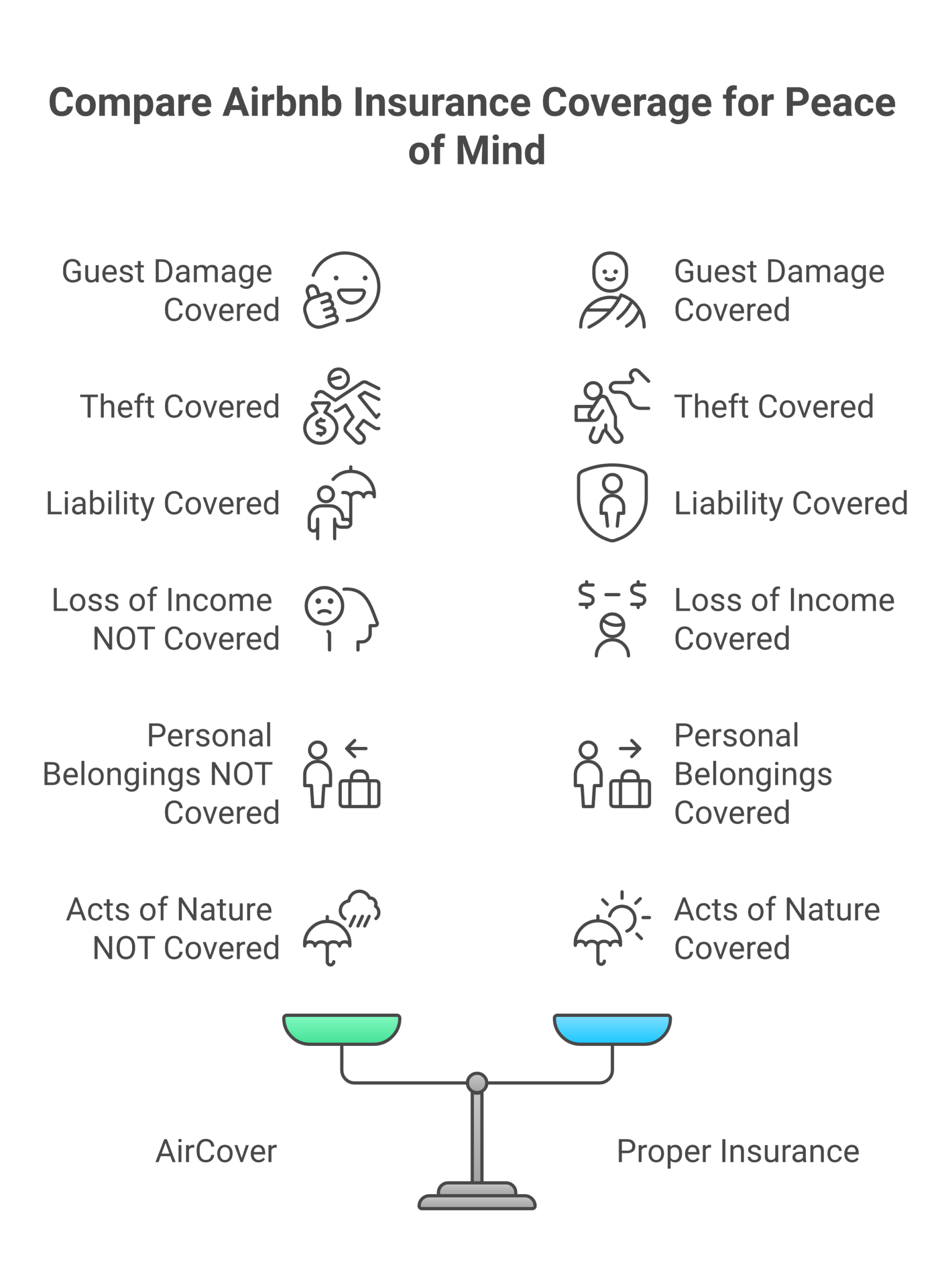
For hosts operating in 2026, navigating Airbnb and insurance requires a dual-layered strategy: relying on Airbnb’s built-in AirCover for stay-specific incidents while maintaining a robust private short-term rental (STR) insurance policy. AirCover provides $3 million in damage protection and $1 million in liability coverage, but it is not a substitute for comprehensive homeowners or commercial insurance, which covers broader property risks and business-related liabilities.
The Foundation of Airbnb Protection: Understanding AirCover
In 2026, AirCover remains the standard, no-cost protection plan included with every Airbnb booking. It is designed to give hosts a baseline level of security, but understanding its specific components is essential for risk management. AirCover is not a traditional insurance policy; rather, it is a host guarantee and a liability insurance contract that Airbnb maintains with third-party insurers.
Host Damage Protection
Host damage protection provides up to $3 million in coverage for instances where a guest causes damage to your home or belongings during an Airbnb stay. Over the years, this protection has expanded to include several specific categories that were previously difficult to claim:
- Pet Damage: Coverage extends to damage caused by guests' service animals or pets.
- Deep Cleaning: If a guest leaves a mess that requires professional intervention beyond standard cleaning, hosts can claim reimbursement for specialized services.
- Income Loss: If damage caused by a guest results in the cancellation of future confirmed bookings, Airbnb may compensate the host for that lost revenue.
- High-Value Items: Coverage includes protection for art, jewelry, and other collectibles, though these often require specific documentation and appraisals provided at the time of the claim.
Host Liability Insurance
While damage protection covers your physical assets, host liability insurance protects you legally. In 2026, the standard limit remains $1 million per occurrence. This coverage applies if a guest is injured during their stay or if their property is damaged or stolen while at your listing.
For example, if a guest slips on a wet tile or trips over an unsecured rug and decides to sue you for medical expenses, the liability portion of AirCover is designed to step in. It also covers claims brought against you by third parties, such as a neighbor whose property was damaged by one of your guests.
The Gap: Why AirCover Is Not Enough
The most common mistake new hosts make is assuming AirCover replaces the need for a private insurance policy. AirCover is specifically "excess" insurance, meaning it often applies only after other insurance options have been exhausted. Furthermore, it only protects you during the active dates of a booking.
The Business Activity Exclusion
Most standard homeowners insurance policies (HO-3) contain a "business activity" exclusion. Because renting out your home on Airbnb is considered a commercial endeavor, a standard insurer can legally deny a claim—even if the incident is unrelated to a guest. If a pipe bursts while the house is empty, but the insurance company discovers the home is used for STR, they may void the entire policy for "misrepresentation of risk."
Limitations in Coverage Scope
AirCover has specific exclusions that can leave a host vulnerable:
- Wear and Tear: Gradual deterioration of furniture or flooring is not covered.
- Natural Disasters: AirCover does not protect against earthquakes, floods, or hurricanes.
- Theft by Non-Guests: If your home is burgled while no guest is present, AirCover provides zero protection.
- Personal Liability Outside Stays: If you are performing maintenance on the property and injure a neighbor, AirCover does not apply.
Selecting the Right Private Insurance in 2026
To ensure full protection, hosts must choose a policy that acknowledges the commercial use of the property. There are three primary ways to structure this in 2026.
Short-Term Rental Endorsements (Riders)
Many major carriers, such as State Farm and Allstate, now offer STR endorsements that can be added to an existing homeowners policy. This is typically the most cost-effective option for occasional hosts who live in the home they rent out. It bridges the gap by removing the "business activity" exclusion for a set number of days per year.
Specialized STR Commercial Insurance
For full-time hosts or those with multiple properties, a dedicated commercial policy is the gold standard. Companies like Proper Insurance provide policies specifically drafted for the short-term rental industry. These policies replace the homeowners policy entirely and cover:
- Commercial General Liability: Much broader than AirCover’s liability.
- Replacement Cost Valuation: Ensuring you get the full value to replace items, rather than the depreciated value.
- Squatter Protection: Legal fees associated with removing a guest who refuses to leave.
Landlord Insurance (DP-3)
If you do not live on the property and rent it out long-term or short-term, a Landlord Policy (DP-3) is often required. While better than a standard homeowners policy, you must ensure it includes a "short-term rental" clause, as many landlord policies are written for 12-month leases and may exclude "transient" guests.
Comparing Host Protection Options
The following table compares the three most common protection layers available to hosts in 2026.
| Feature | Airbnb AirCover | STR Endorsement (Rider) | Full Commercial STR Policy |
|---|---|---|---|
| Cost | Included in Fees | $200–$500 / year | $1,500–$3,500 / year |
| Primary/Excess | Excess | Primary | Primary |
| Liability Limit | $1 Million | Typically $300k–$500k | $1 Million - $2 Million |
| Theft Coverage | Guests only | Limited | Full (Theft & Entrustment) |
| Loss of Income | Confirmed bookings only | Optional | Actual Loss Sustained |
| Building Coverage | Up to $3 Million | Homeowners Limit | Full Commercial Replacement |
| Off-Stay Coverage | No | Yes | Yes |
The Claims Process: A Technical Walkthrough
Filing a claim through Airbnb requires meticulous documentation. In 2026, the process is largely digitized, but the burden of proof remains with the host.
Step 1: Immediate Documentation
As soon as you discover damage, take high-resolution photos and video. Do not touch or clean the area until the documentation is complete. If the damage is criminal (e.g., significant theft or vandalism), you must file a police report to satisfy AirCover's requirements.
Step 2: The 14-Day Rule
Under current Airbnb terms, you must notify the guest of the damage and request payment through the Resolution Center within 14 days of the guest’s checkout, or before the next guest checks in—whichever is earlier. Failure to meet this window is the primary reason AirCover claims are denied.
Step 3: Escalation to Airbnb
If the guest refuses to pay or does not respond within 24 hours, you can involve Airbnb. You will need to provide:
- Proof of ownership or original purchase price.
- Estimates for repair or invoices for replacement.
- Before-and-after photos (using "before" photos from your most recent turnover is highly recommended).
Step 4: Co-filing with Private Insurance
For major claims (e.g., fire or structural damage), you should notify your private insurance carrier simultaneously. Because AirCover is often excess, your private insurer may need to issue a formal denial before Airbnb’s insurers will finalize the payout.
Risk Mitigation Beyond Insurance
Insurance is a safety net, but risk mitigation reduces the likelihood of ever needing to file a claim. In 2026, smart home technology has become an integral part of "insurance-adjacent" hosting.
- Noise Monitoring: Devices like Minut or Roomonitor alert hosts to decibel levels that suggest a party, allowing for intervention before property damage occurs.
- Exterior Cameras: Verifying guest counts via Ring or Nest cameras helps ensure that "no-party" rules are enforced, which is a common requirement for insurance validity.
- Water Leak Sensors: Since water damage is one of the most frequent and expensive insurance claims, installing smart sensors under sinks and near water heaters can save thousands in deductibles.
Frequently Asked Questions
Does Airbnb insurance cover me if a guest gets hurt in the building's common areas?
Airbnb’s Host Liability Insurance generally covers you for incidents that occur within your "accommodation." If a guest trips in a lobby or an elevator of an apartment building that you do not own, the building's own commercial insurance usually takes precedence. However, if the guest sues you personally for failing to warn them of a known hazard in the building, AirCover may provide a defense.
What is "Host Intentional Act" and is it covered?
No. Insurance, including AirCover, almost never covers intentional acts. If a host intentionally damages a guest's property or commits an assault, insurance will not provide coverage. Similarly, if a guest intentionally damages your home, it is covered under "Damage Protection," but if the host was negligent (e.g., leaving the front door wide open), the claim may be complicated.
Do I need extra insurance if I have a swimming pool or hot tub?
Absolutely. Pools and hot tubs are considered "attractive nuisances" by insurance companies. Many standard STR endorsements exclude pool-related injuries unless specifically disclosed. You should ensure your private liability limit is at least $1 million and consider an "Umbrella Policy" for an additional $1–$2 million in coverage.
Will my insurance premium go up if I tell my agent I'm hosting on Airbnb?
Yes, in most cases, your premium will increase because the risk profile of a short-term rental is higher than that of a primary residence. However, failing to disclose this to your agent can lead to a total denial of claims and policy cancellation, which is far more expensive in the long run than a slightly higher premium.
Does AirCover protect against "Mysterious Disappearance"?
Generally, no. AirCover and most insurance policies require evidence of a specific incident. If you notice a small item is missing three weeks after a guest leaves, but you cannot prove which guest took it or exactly when it disappeared, the claim will likely be denied. This is why thorough inspections between every guest are critical.
Practical Recommendation for 2026 Hosts
To ensure you are fully protected in 2026, start by calling your current homeowners insurance provider and asking for their specific policy on "short-term rentals." If they do not offer an STR endorsement, do not hide your hosting activity. Instead, seek out a specialized provider like Proper Insurance or Foremost. Use AirCover as your first line of defense for minor guest-related damages, but rely on your private commercial policy for major liabilities, structural losses, and any incidents that occur outside of a guest’s stay. Document every turnover with photos to ensure that if you do need to use AirCover, you have the "before" evidence required to secure a payout.