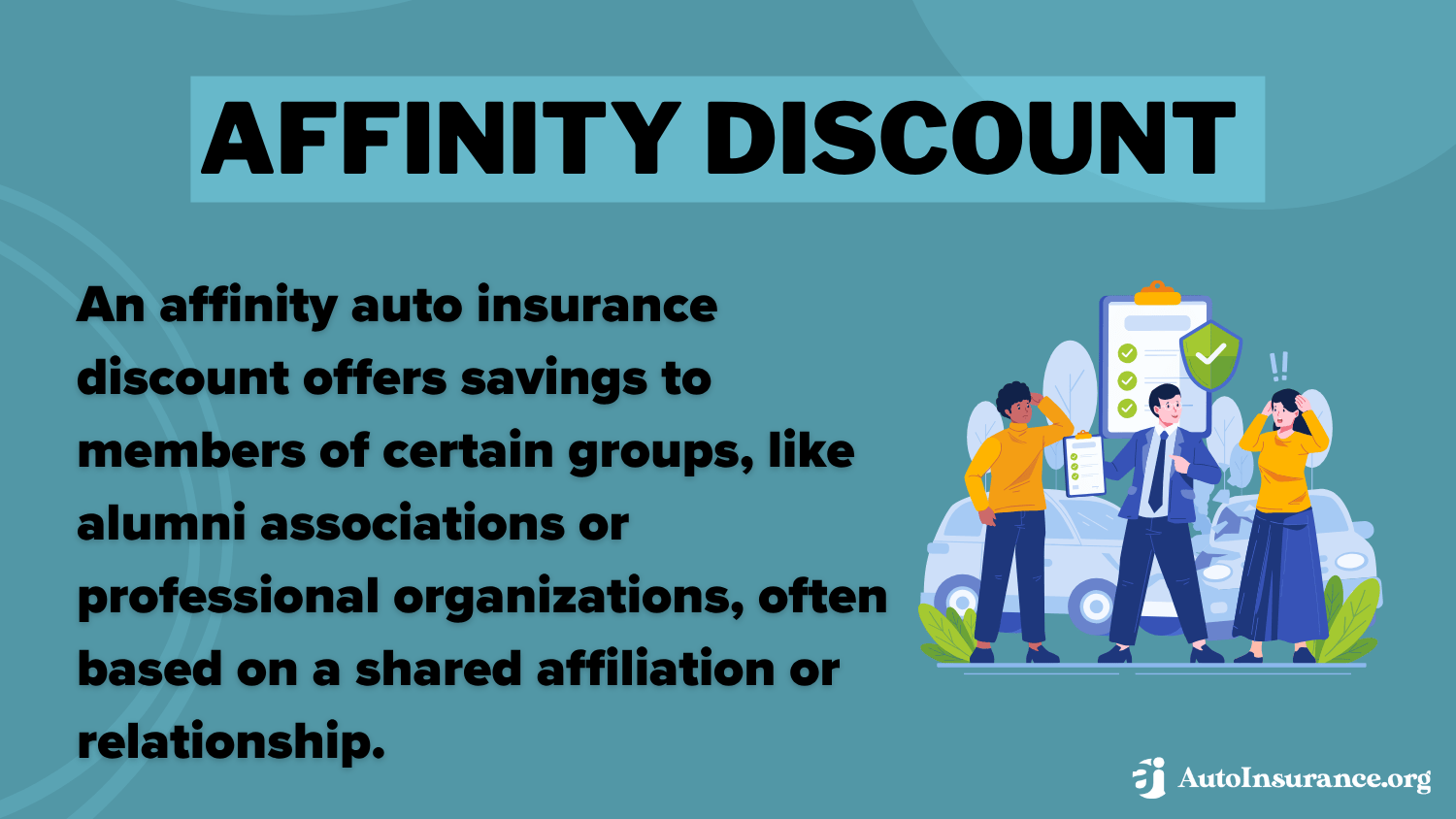
Affinity auto insurance is a specialized auto insurance distribution model where insurance carriers partner with organizations—such as employers, university alumni associations, professional groups, trade unions, and credit unions—to offer tailored policies and discounted premium rates to the organization’s members or employees.
By leveraging the collective purchasing power and lower risk profile of a defined group, insurers can reduce marketing expenses and administrative costs, passing those savings on to eligible policyholders through discounted rates, extra coverage benefits, or flexible payment methods.
Disclaimer: Auto insurance regulations, discount structures, and filing rules vary by state and jurisdiction. The information provided in this guide is for educational purposes. Consumers should consult licensed insurance agents or financial advisors regarding their individual coverage needs.
What Is Affinity Auto Insurance?
Affinity auto insurance—often referred to as group auto insurance or voluntary group benefit insurance—is auto insurance coverage sold to individuals based on their membership in a specific entity or group. Unlike traditional individual auto policies, which are marketed to the general public through direct advertising or independent agencies, affinity programs rely on an established relationship between an insurer and a host organization.
The fundamental economic mechanism driving affinity insurance is group risk pooling and reduced customer acquisition costs. Insurance carriers spend significant capital advertising to the general public. When a carrier secures an exclusive or preferred partnership with a corporate employer, a professional trade association, or an alumni network, the carrier gains direct, low-cost access to a captive audience. In exchange for this distribution pathway, the insurer offers group-specific rate reductions, specialized policy endorsements, or streamlined administrative processes.
It is important to clarify that affinity auto insurance policies remain individual insurance contracts. Unlike group health insurance—where an employer typically pays a portion of the premium and provides a master policy covering all employees—an affinity auto insurance policy is held directly by the individual driver. The policyholder remains responsible for paying the premium, maintaining coverage standards, and managing claims, even though the rate structure reflects their group membership.
How Affinity Insurance Programs Work
Affinity programs operate through contractual agreements between an insurance provider (or an insurance brokerage acting as an administrator) and a sponsor group. The mechanics of these programs involve three main components: program setup, eligibility verification, and ongoing administration.
- Partnership Agreement:
- Insurance Carrier (e.g., Underwriter)
- Issues Individual Policy to Individual Driver
- Sponsor Organization (Employer/Association)
- Promotes Program to Members/Employees
- Insurance Carrier (e.g., Underwriter)
- Individual Driver:
- Receives Group Discount & Tailored Benefits
1. Partnership Agreements and Group Underwriting
When an insurance carrier partners with a host organization, the carrier analyzes the demographic and risk profile of the organization's membership base. For instance, members of a professional engineering society or employees of a tech company may statistically exhibit lower claim frequencies, higher average credit scores, or safer driving patterns than the general population.
Based on actuarial data and reduced acquisition costs, the carrier files group discount schedules with state insurance commissioners. State regulatory bodies oversight ensures that group discounts comply with non-discrimination laws and actuarial justification requirements under state codes.
2. Enrollment and Verification
To obtain an affinity discount, an applicant must demonstrate proof of affiliation with the participating group. Depending on the sponsor organization, verification may require:
- A valid corporate email address or employee identification number.
- An active membership number in an alumni association or professional union.
- Proof of account ownership at a partner credit union or financial institution.
During the underwriting process, the insurer verifies membership and applies the approved discount code to the rate calculation. If an individual leaves the organization, the discount may expire at the end of the current policy term, requiring the policyholder to transition to a standard rate structure or supply proof of a new qualifying affiliation.
3. Administrative Integration and Billing Options
Affinity auto insurance programs often integrate with the sponsor organization's administrative infrastructure. For corporate employers, this frequently includes option for payroll deduction, allowing employees to pay their premium through automatic deductions from their regular paychecks. Payroll deduction eliminates monthly processing fees, reduces billing installment charges, and lowers policy cancellation rates due to missed payments.
Organizations That Offer Affinity Auto Insurance
Affinity insurance programs span across public, private, non-profit, and civic sectors. Understanding which organizations partner with insurance carriers can help drivers discover discounts they may already qualify for.
Employers and Corporations
Many medium-to-large corporations offer affinity auto insurance as part of their voluntary employee benefits package alongside supplemental life, dental, or pet insurance. Employers provide these programs at no direct cost to themselves as a recruitment and retention tool. Employees benefit from convenient payroll deductions and baseline group discounts that typically range from 5% to 15%.
Alumni Associations
Colleges and universities frequently partner with national insurance carriers to offer alumni group auto insurance. In these arrangements, the insurer often pays a royalty or sponsorship fee to the university's alumni association in exchange for access to member mailing lists and official branding. Alumni benefit from group-specific rates, while the institution generates non-dues revenue.
Professional and Trade Associations
Professional organizations—such as legal bar associations, medical societies, educators' unions, and engineering institutes—regularly negotiate group insurance rates for their active members. Because many professional groups require specialized education or licensure, carriers view these demographics as favorable underwriting risks, resulting in competitive affinity pricing.
Credit Unions and Financial Institutions
Credit unions frequently partner with insurance providers to deliver affinity auto policies to their credit union members. Because credit unions operate as member-owned cooperatives, these insurance partnerships align with their mandate to offer financial value to account holders. Policies may include additional incentives, such as loan-gap insurance discounts when financing a vehicle through the credit union.
Fraternal, Military, and Special Interest Groups
Active-duty military members, veterans, retired civil servants, and members of fraternal organizations (such as auto clubs or civic groups) often qualify for specialized affinity programs. Certain insurance companies cater exclusively to military service members and their families, operating as large-scale affinity organizations that structure their product offerings around the specific lifestyle needs of military personnel.
Key Benefits of Affinity Auto Insurance
Affinity auto insurance offers distinct advantages over standard, off-the-shelf consumer auto policies. While discount sizes vary, the overarching benefits extend beyond initial cost savings.
- Group Rate Discounts: The primary draw of an affinity policy is a premium discount, generally ranging between 5% and 15% off standard rates. This discount is frequently stackable with other standard carrier discounts, such as anti-theft device credits, multi-car discounts, or bundled homeowners/renters coverage.
- Enhanced Policy Endorsements: Some affinity programs feature expanded coverage perks at no additional cost. Examples include waived deductibles for windshield repair, identity theft protection add-ons, enhanced roadside assistance, or broad coverage for rental car loss of use.
- Favorable Underwriting Terms: While individual driving history (such as tickets and accidents) still impacts pricing, group underwriting can result in more forgiving tier assignments or lower baseline rates for drivers within the affinity pool.
- Payroll Deduction and Flexible Billing: For employer-sponsored programs, paying via payroll deduction usually waives installment fees and automatic payment charges, saving policyholders an extra $20 to $60 per year in administrative fees.
- Portable Individual Policies: Even though the policy is purchased through a group discount program, it remains an individual insurance policy. If the policyholder leaves their employer or organization, coverage does not automatically terminate mid-term; the policy remains active through the end of the policy period.
Limitations and Potential Drawbacks
While affinity auto insurance provides substantial benefits, it is not universally the cheapest or best option for every driver. Policyholders should evaluate potential trade-offs before signing up.
1. It May Not Outperform Market-Wide Shopping
A 10% affinity discount off a carrier's high baseline rate may still cost more than a standard policy from a competitor with lower overall pricing. Driver risk profiles, geography, vehicle type, and claim histories heavily influence base pricing. An affinity discount does not guarantee that the sponsoring carrier provides the absolute lowest rate in the open market.
2. Loss of Discount Upon Status Change
If you change employers, cancel your professional membership, or graduate/disaffiliate from a sponsor organization, you lose your eligibility for the affinity discount. Insurers audit affinity rosters periodically or require status confirmation upon policy renewal. Losing the discount will increase your renewal premium unless you qualify for another affinity group.
3. Limited Carrier Choice Within Sponsor Programs
Host organizations usually partner with only one or two insurance carriers to streamline program administration. If the carrier partnered with your employer or alumni group has poor customer service ratings, strict claims settlement practices, or limited online portal capabilities, the group discount may not compensate for the administrative drawbacks.
4. Membership Fees Can Offset Savings
If acquiring eligibility requires paying annual membership dues—such as joining a professional organization or trade association strictly for insurance purposes—the cost of membership may negate the annual premium savings.
Comparing Affinity Auto Insurance vs. Standard Auto Insurance
Understanding how affinity policies compare to standard auto coverage across critical categories helps consumers evaluate their options effectively.
| Comparison Category | Affinity Auto Insurance | Standard Individual Auto Insurance |
|---|---|---|
| Eligibility Requirement | Must be an employee, alumnus, or active member of a affiliated partner organization. | Open to the general public meeting minimum driver and credit guidelines. |
| Discount Structure | Group-level rate reductions (typically 5%–15%) added to base rates. | Standard consumer discounts (e.g., safe driver, multi-policy, paperless). |
| Billing Methods | Standard options plus payroll deduction (for corporate employer programs). | Automatic bank draft, credit card, or manual check payments. |
| Carrier Selection | Restricted to the insurance carrier(s) contracted with your host group. | Full access to all regional and national insurance providers. |
| Policy Ownership | Individual contract (belongs to the driver, not the employer or group). | Individual contract. |
| Extra Perks | May include complimentary policy add-ons, reduced deductibles, or waived fee schedules. | Optional add-ons available for purchase individually. |
| Effect of Status Change | Discount is removed at renewal if organization membership terminates. | Unaffected by employment or association membership changes. |
Step-by-Step Guide: How to Find and Claim Affinity Discounts
Securing an affinity auto insurance discount involves systematically auditing your personal and professional affiliations and comparing those rates against open market quotes.
- Step 1: Audit Affiliations
- Step 2: Request Quotes
- Step 3: Compare Market Rates
- Step 4: Verify & Activate
Step 1: Inventory Your Eligible Affiliations
Make a complete list of every group, organization, or employer you or household family members belong to. Key categories include:
- Current employers (check HR benefits portals for voluntary benefit offerings).
- College and university alumni associations.
- Professional unions, licensing boards, or trade associations.
- Credit unions, banks, or member-owned financial cooperatives.
- Military service branches, veteran groups, or defense organizations.
- Fraternal societies, national honor societies, or civic clubs.
Step 2: Request Quotes Through Affinity Portals
Access quotes directly through the dedicated link or phone number provided by your sponsor group. Avoid using generic public landing pages, as standard web forms may omit the specific affinity tracking code required to apply group discounts. Have your organization member ID or employee badge number ready.
Step 3: Gather Baseline Quotes from Standard Carriers
To verify that the affinity price is truly competitive, obtain 2 to 3 baseline quotes from reputable direct-to-consumer insurers and independent agents outside the affinity network. Ensure all quotes utilize identical coverage limits, deductibles, and endorsement choices for an accurate comparison:
- Bodily Injury Liability: e.g., $100,000 per person / $300,000 per accident.
- Property Damage Liability: e.g., $100,000.
- Comprehensive & Collision Deductibles: e.g., $500 or $1,000.
- Uninsured/Underinsured Motorist Coverage: Matching liability limits where applicable.
Step 4: Calculate Net Annual Costs
Calculate the true net cost of each policy by accounting for policy fees, payment installment charges, and annual membership dues. If a professional association charges $150 per year in membership dues and saves you $100 on car insurance, purchasing the membership solely for insurance is not cost-effective. However, if you already pay those dues for professional reasons, the insurance savings represent a clear benefit.
Step 5: Activate Coverage and Monitor Annually
Once verified, select your start date, submit proof of prior coverage to prevent gaps, and set up your payment schedule (such as payroll deduction or automatic clearing house payments). Re-evaluate your affinity rates annually or whenever you experience major life events, such as moving, changing jobs, or adding a new driver to your policy.
Frequently Asked Questions
Does my employer or alumni association have access to my driving record?
No. While your employer or association facilitates access to the affinity program, the insurance agreement is strictly between you and the insurance carrier. Privacy laws prohibit the insurance company from sharing your personal driving record, claims history, credit information, or policy details with your employer or organization.
What happens to my auto insurance policy if I leave my job?
Your auto insurance policy remains active through the end of your current policy term because the policy is an individual contract in your name. However, upon renewal, the insurance carrier may remove the affinity discount if you are no longer an active employee or member of the sponsor group, causing your rate to adjust to standard pricing.
Can I stack an affinity discount with safe driver or multi-policy discounts?
In most cases, yes. Affinity discounts are typically added on top of standard discounts like safe driver credits, multi-car discounts, and bundled home/auto policy savings. However, state regulations set maximum limits on cumulative discounts, so check with the carrier to understand how discounts combine under your state’s insurance guidelines.
Are members of my family covered under my affinity auto insurance policy?
Yes. Immediate family members residing in the same household and driving covered vehicles listed on your policy generally benefit from the same policy rates and group discount structure.
Is affinity auto insurance always cheaper than standard auto insurance?
Not always. While affinity programs offer group discounts, an insurer's base rates are calculated using individual risk factors such as your location, driving history, vehicle model, and age. If the carrier’s baseline rate for your demographic is high, a 10% affinity discount may still result in a higher premium than a standard policy from a competitor with lower baseline pricing. Always compare multiple quotes.
Practical Recommendations for Consumers
To make the most of affinity auto insurance opportunities, approach your auto insurance search systematically:
- Conduct an Annual Benefits Review: Check your employer’s HR portal and professional membership benefits pages once a year to identify new insurance partnerships or updated group discount codes.
- Lock in Staked Savings: If your affinity carrier offers competitive rates, maximize savings by bundling home, renters, or condo insurance with your auto policy and enrolling in automatic payments or payroll deduction.
- Shop the Open Market Periodically: Re-evaluate your coverage every 12 to 24 months. Market dynamics change, and independent carriers may introduce competitive pricing models that beat your group affinity discount.
- Verify Official Portals: Always sign up for affinity quotes through your organization's official member benefits link or dedicated phone line to ensure group discount codes apply directly to your policy file.