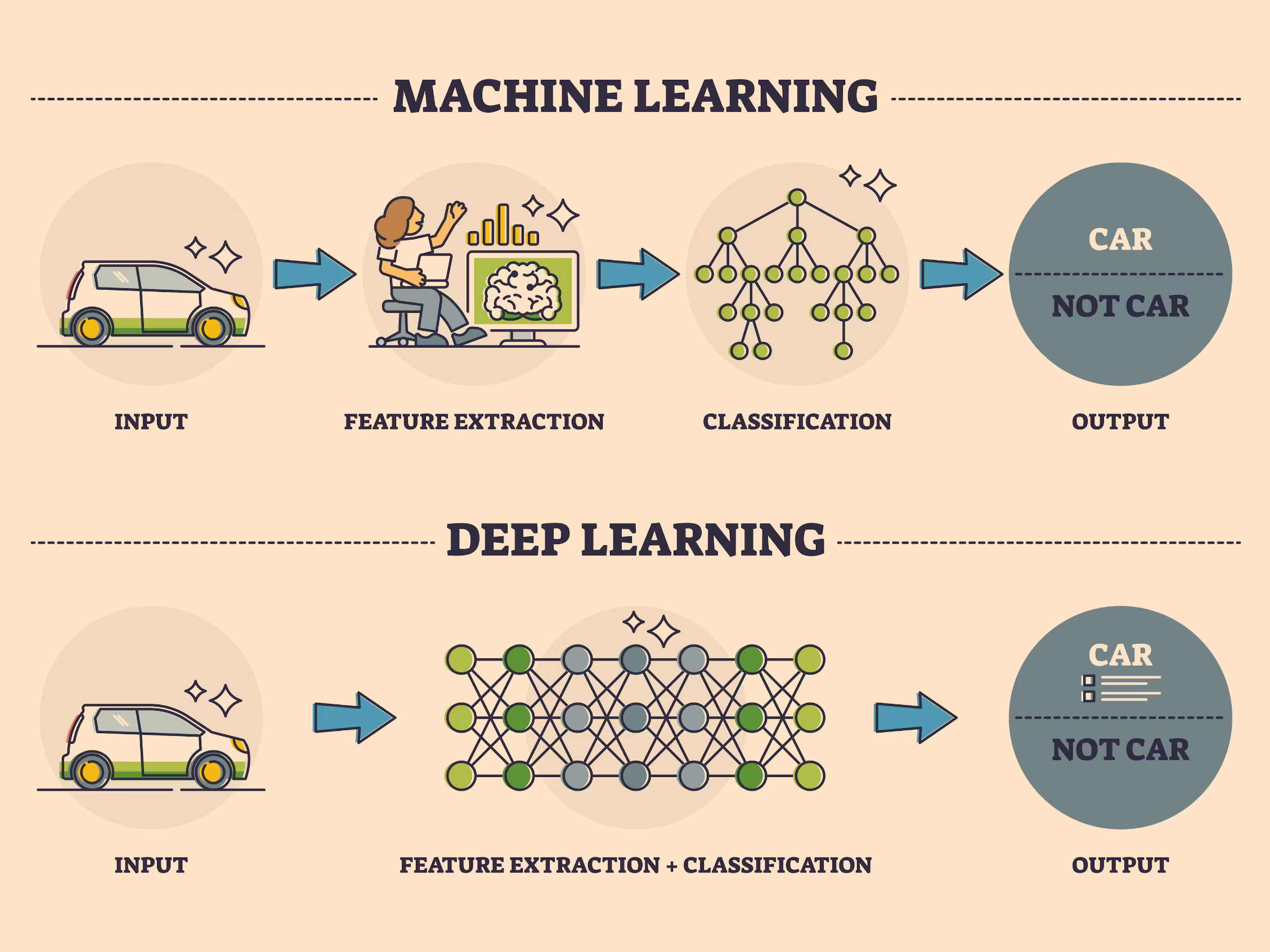
Deep learning is a subset of machine learning based on artificial neural networks with multiple layers. It enables computers to process complex data—such as images, text, and sound—by automatically extracting hierarchical features. Unlike traditional algorithms, deep learning scales with data and compute, forming the foundation of modern generative artificial intelligence.
Understanding the Foundation of Deep Learning
To understand deep learning, one must first position it within the broader landscape of artificial intelligence (AI). AI is the overarching field dedicated to creating systems capable of performing tasks that typically require human intelligence. Machine learning (ML) is a branch of AI that uses statistical techniques to enable computers to "learn" from data without being explicitly programmed for every scenario.
Deep learning represents a specialized evolution of machine learning. The "deep" in deep learning refers to the number of layers through which data is transformed. While traditional machine learning models might have one or two layers of processing, deep learning models often involve dozens or even hundreds of layers. This depth allows the model to learn increasingly abstract representations of data. For example, in image recognition, the first layer might detect simple edges, the second layer identifies shapes, the third identifies complex features like eyes or wheels, and the final layers recognize entire objects or faces.
As of 2026, deep learning has moved beyond mere academic interest to become the primary engine driving global technological shifts, from real-time language translation to autonomous logistics.
The Biological Inspiration: From Neurons to Networks
Deep learning is inspired by the structure and function of the human brain, specifically the network of neurons that process information. In a biological system, a neuron receives chemical signals through dendrites, processes them in the cell body, and passes the signal along via an axon to other neurons if a certain threshold is met.
In deep learning, we use Artificial Neural Networks (ANNs). These consist of:
- Neurons (Nodes): The basic unit of computation that receives inputs, applies a mathematical operation, and produces an output.
- Weights and Biases: Numerical values that determine the importance of a particular input. Learning in a neural network is essentially the process of fine-tuning these weights.
- Activation Functions: Mathematical formulas (like ReLU, Sigmoid, or Tanh) that determine whether a neuron should "fire" or pass its signal to the next layer. This introduces non-linearity, allowing the network to model complex, real-world data that doesn't follow a straight line.
While the brain analogy is useful for visualization, it is important to note that modern deep learning relies more on high-dimensional calculus and linear algebra than on exact biological replication.
How Deep Learning Models Learn: The Mechanics
The process of training a deep learning model involves two primary phases: the forward pass and the backward pass. This iterative cycle is what allows a model to improve its accuracy over time.
The Forward Pass
During the forward pass, input data (like a digital image represented as a grid of pixels) is fed into the input layer. Each neuron in the layer performs a weighted sum of its inputs, adds a bias, and applies an activation function. The result is passed to the next layer. This continues until the data reaches the output layer, which provides a prediction—for instance, "This image is a 95% match for a Golden Retriever."
Loss Functions and Error Measurement
Once the prediction is made, the model compares its result to the "ground truth" (the actual label provided in the training data). The difference between the prediction and the reality is calculated using a Loss Function (also known as a Cost Function). Common loss functions include Mean Squared Error (MSE) for regression tasks and Cross-Entropy Loss for classification tasks. The goal of training is to minimize this loss value.
Backpropagation and Gradient Descent
The magic of deep learning lies in Backpropagation. Using the chain rule from calculus, the model calculates how much each weight and bias contributed to the error. It then uses an optimization algorithm, most commonly Gradient Descent, to update the weights in the direction that reduces the error.
Imagine standing on a foggy mountain and trying to find the lowest point (the valley). You can’t see the whole landscape, but you can feel the slope beneath your feet. You take small steps in the direction where the ground slopes downward most steeply. In deep learning, the "slope" is the gradient, and the "steps" are the adjustments made to the neural network’s parameters.
Key Architectures in Deep Learning
Different types of problems require different neural network structures. By 2026, three primary architectures have come to dominate the field.
Convolutional Neural Networks (CNNs)
CNNs are the gold standard for spatial data, particularly images and video. Instead of treating every pixel as an independent variable, CNNs use "filters" or "kernels" that slide across the image to identify patterns.
- Convolution Layers: Identify local features like edges and textures.
- Pooling Layers: Reduce the dimensions of the data (downsampling) to make the computation more efficient and the model more robust to small shifts in the image.
- Applications: Facial recognition, medical imaging analysis, and autonomous vehicle vision systems.
Recurrent Neural Networks (RNNs) and LSTMs
Traditional neural networks assume all inputs are independent of each other. However, for sequential data like speech or time-series stock prices, the order of data matters. RNNs have "memory" as they pass information from one step of the sequence to the next. Long Short-Term Memory (LSTM) networks are a specific type of RNN designed to remember information over long periods, preventing the "vanishing gradient" problem where old information is forgotten.
Transformers: The Engine of Modern NLP
Introduced in the seminal paper Attention Is All You Need, Transformers have largely superseded RNNs for natural language processing. They utilize a "Self-Attention" mechanism that allows the model to weigh the importance of different words in a sentence simultaneously, regardless of their distance from each other. This architecture powers the Large Language Models (LLMs) that define the current era of Generative AI.
Deep Learning vs. Traditional Machine Learning
Choosing between deep learning and traditional machine learning depends on the available data, hardware, and the complexity of the task.
| Feature | Traditional Machine Learning | Deep Learning |
|---|---|---|
| Data Requirements | Performs well with small to medium datasets. | Requires massive amounts of data to be effective. |
| Feature Engineering | Requires experts to manually identify and extract features. | Automatically learns features directly from raw data. |
| Hardware | Can run on standard CPUs (Central Processing Units). | Requires high-performance GPUs (Graphics Processing Units) or TPUs. |
| Training Time | Seconds to hours. | Days to weeks for complex, large-scale models. |
| Interpretability | Easier to understand "why" a decision was made. | Often seen as a "Black Box" due to millions of parameters. |
| Accuracy | Plateaus as more data is added. | Continues to improve as data and model size increase. |
Prerequisites for Getting Started
If you intend to move from theory to practice, several foundational skills are necessary. Deep learning is a multidisciplinary field that sits at the intersection of mathematics and computer science.
- Mathematics: A firm grasp of Linear Algebra (vectors and matrices) is essential because neural network operations are essentially matrix multiplications. Calculus (specifically derivatives) is needed to understand how models optimize via gradient descent. Probability and Statistics help in understanding model uncertainty and data distribution.
- Programming: Python is the undisputed language of deep learning. Its extensive ecosystem of libraries makes it the most efficient tool for development.
- Frameworks: You don't need to write the math for backpropagation from scratch. Standard libraries like PyTorch and TensorFlow provide the building blocks for designing, training, and deploying models.
- Hardware: While learning can happen on a standard laptop, training serious models requires a GPU with high VRAM (Video RAM). In 2026, cloud-based providers offer easy access to high-end hardware like NVIDIA’s Blackwell architecture for those who do not own local workstations.
Challenges and Ethical Considerations
Despite its power, deep learning is not a silver bullet. It faces several significant hurdles that researchers are actively working to solve.
- The "Black Box" Problem: It is often difficult to explain why a deep learning model arrived at a specific conclusion. In high-stakes fields like healthcare or criminal justice, this lack of transparency can be a major liability.
- Data Bias: A model is only as good as the data it is trained on. If the training data contains human biases (racial, gender, or socioeconomic), the model will likely amplify those biases in its outputs.
- Environmental Impact: Training massive models like GPT-4 or its 2026 successors requires an enormous amount of electricity, leading to concerns about the carbon footprint of AI research centers.
- Data Privacy: Deep learning models require vast amounts of information, often raising questions about where that data comes from and whether individuals' privacy rights are being respected during the "scraping" or collection process.
Frequently Asked Questions
What is the difference between a neural network and deep learning?
A neural network is the underlying architecture, while deep learning refers specifically to neural networks with many layers (typically more than three, including input and output). All deep learning involves neural networks, but not all neural networks are "deep."
Do I need a Ph.D. to work in deep learning?
No. While many researchers in the field hold advanced degrees, the democratization of tools and education has made it possible for software engineers and data analysts to enter the field through specialized courses and hands-on projects. However, a strong grasp of the underlying math is necessary for high-level roles.
Why did deep learning only become popular recently?
The theories behind deep learning have existed since the 1950s. However, the field only exploded after 2012 due to three factors: the availability of "Big Data," the development of powerful GPUs capable of parallel processing, and algorithmic improvements like the ReLU activation function and dropout regularization.
Can deep learning models learn from any type of data?
Yes, provided the data can be represented numerically. Images are grids of numbers; text can be converted into vectors (word embeddings); and audio can be processed as waveforms. The primary requirement is that the data has patterns that the model can mathematically identify.
What is "Transfer Learning"?
Transfer learning is a technique where a model developed for one task is reused as the starting point for a model on a second task. This is highly efficient because it allows users to take a "pre-trained" model (which has already learned basic features from millions of images or words) and "fine-tune" it on a smaller, specific dataset.
Next Steps for Beginners
If you are ready to begin your journey into deep learning, start by mastering the Python programming language and its data science libraries (NumPy, Pandas, and Matplotlib). Once comfortable, explore introductory courses such as those offered by deeplearning.ai or the fast.ai curriculum, which emphasizes a "top-down" approach—coding first and theory second.
Focus your initial projects on classic datasets like MNIST (handwritten digits) or CIFAR-10 (object classification). These allow you to experiment with different architectures without the need for massive computing power, providing a solid foundation for more advanced explorations into generative models and autonomous systems.