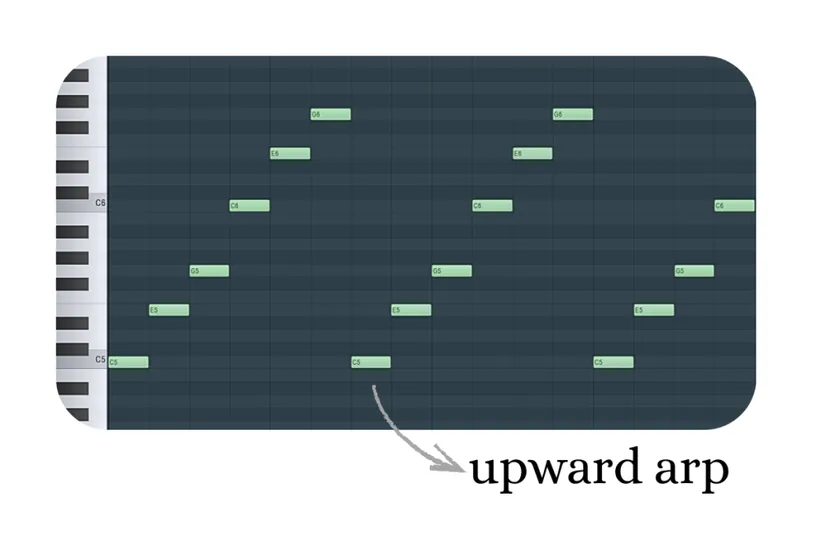
An arpeggio is a musical technique where the notes of a chord are played individually in a sequence rather than simultaneously. Often referred to as a "broken chord," arpeggios allow musicians to outline harmonic structures while creating melodic movement, serving as a fundamental building block for improvisation, composition, and technical proficiency across nearly all instruments.
What is an Arpeggio?
The term "arpeggio" derives from the Italian word arpeggiare, which literally means "to play on a harp." This etymology is instructive: on a harp, it is natural and common to pluck individual strings in succession to create a lush, flowing sound. When a pianist, guitarist, or violinist performs an arpeggio, they are essentially mimicking this harp-like quality.
At its core, an arpeggio consists of the notes that make up a specific chord. For example, a C Major chord consists of the notes C, E, and G. If you play these three notes at the exact same time, you are playing a chord. If you play them one after another—C, then E, then G—you are playing a C Major arpeggio. These sequences can move upward (ascending), downward (descending), or in complex patterns that span multiple octaves.
In the musical landscape of 2026, arpeggios remain the primary bridge between rhythm and lead playing. Whether used in the sophisticated jazz fusion of modern ensembles or the algorithmic patterns of electronic music production, understanding the arpeggio is essential for any musician seeking to move beyond basic scales and block chords.
The Structural Difference: Arpeggios vs. Chords and Scales
To fully grasp the "apreggio explained" concept, one must distinguish it from its two closest relatives: the block chord and the scale.
Arpeggios vs. Chords
A chord is a vertical structure. It represents a single moment in time where multiple frequencies harmonize. Arpeggios are horizontal structures. They take that same harmonic information and spread it across a linear timeline. This allows for greater clarity, as each note has its own space to ring out without being muddied by the others. This is particularly useful for instruments like the bass guitar, where playing multiple notes at once can often sound dissonant or "boomy."
Arpeggios vs. Scales
While both scales and arpeggios involve playing notes in a sequence, they serve different purposes. A scale (such as the Major scale) typically moves in stepwise motion, containing seven different notes. An arpeggio is "intervallic," meaning it skips over the notes between the chord tones. This gives arpeggios a more "open" and "angular" sound compared to the fluid, "linear" sound of a scale. In improvisation, scales provide the "glue," while arpeggios provide the "framework."
Core Types of Arpeggios and Their Characteristics
Every chord has a corresponding arpeggio. The quality of the arpeggio—whether it sounds happy, sad, tense, or resolved—depends entirely on the intervals between the notes.
Major Arpeggios
Constructed using the 1st, 3rd, and 5th degrees of the Major scale. For a G Major arpeggio, these are G, B, and D. Major arpeggios are characterized by a bright, stable, and "heroic" sound. They are the foundation of classical music, folk, and most pop melodies.
Minor Arpeggios
Constructed using the 1st, flat 3rd (b3), and 5th degrees. In the key of A Minor, this results in A, C, and E. These arpeggios possess a darker, more somber or melancholic quality. They are essential for creating emotional depth in songwriting.
Diminished Arpeggios
Built using the 1st, b3, and b5. These are characterized by high tension and instability. In a musical context, diminished arpeggios often sound "spooky" or "dramatic" and are frequently used in jazz and heavy metal to create a sense of impending resolution or "dark" energy.
Dominant 7th Arpeggios
These add a fourth note to the triad: the flat 7th (b7). A C7 arpeggio consists of C, E, G, and Bb. This is perhaps the most important arpeggio in blues and jazz music, as it creates a strong "pull" toward a new key or chord, driving the music forward.
| Arpeggio Type | Formula (Intervals) | Example (Root: C) | Emotional Character |
|---|---|---|---|
| Major | 1, 3, 5 | C, E, G | Bright, Triumphant, Stable |
| Minor | 1, b3, 5 | C, Eb, G | Sad, Serious, Introspective |
| Dominant 7th | 1, 3, 5, b7 | C, E, G, Bb | Bluesy, Tense, Driving |
| Major 7th | 1, 3, 5, 7 | C, E, G, B | Sophisticated, Dreamy, Airy |
| Minor 7th | 1, b3, 5, b7 | C, Eb, G, Bb | Mellow, Jazzy, Cool |
| Diminished | 1, b3, b5 | C, Eb, Gb | Dark, Tense, Suspenseful |
| Augmented | 1, 3, #5 | C, E, G# | Ethereal, Floating, Unsettled |
Technical Execution Across Instruments
The physical demands of playing an arpeggio vary significantly depending on the instrument. Mastering these techniques is a requirement for advanced performance.
Guitar: Sweep Picking and Fingerstyle
On the guitar, arpeggios can be played using "string skipping" or "sweep picking." Sweep picking is a specialized technique where the pick moves across the strings in a single, continuous motion—much like a broom sweeping—while the fretting hand synchronizes with each string. This allows for incredibly fast, fluid arpeggios common in neo-classical metal and jazz. In fingerstyle guitar, arpeggios are often used to create a rhythmic "bed" for a vocalist, with the thumb playing the bass note and the fingers plucking the higher chord tones.
Piano: Crossovers and Thumb Tucks
Pianists face the challenge of spanning multiple octaves. To play a long C Major arpeggio, a pianist might play C-E-G with fingers 1-2-3, then tuck their thumb (1) under their middle finger to reach the next C. This "thumb-under" technique is essential for maintaining a smooth, legato sound without interruptions.
Bass: The Harmonic Anchor
For bassists, arpeggios are often the most important tool in their kit. Because playing full chords can sound muddy on low frequencies, bassists use arpeggios to outline the harmony. A common "walking bass" line in jazz is essentially a series of arpeggios connecting one chord to the next.
Practical Applications in 2026 Music
As of 2026, the use of arpeggios has evolved with technology, but the core musical principles remain unchanged.
- Electronic Arpeggiators: Modern synthesizers and DAWs (Digital Audio Workstations) feature "arpeggiators"—tools that automatically turn a held chord into a rhythmic arpeggio pattern. Musicians use these to create complex, syncopated textures in techno, trance, and modern film scores.
- Vocal Melodies: Many of the most memorable vocal hooks are simply arpeggios. For example, the opening notes of "The Star-Spangled Banner" are a major arpeggio. Songwriters use them to create melodies that feel "natural" and "right" because they mirror the underlying harmony.
- Lead Improvisation: Jazz and rock soloists use arpeggios to "hit the chord changes." Instead of playing random notes from a scale, they target the specific notes of the chord being played at that moment. This makes the solo sound more connected to the song.
Common Mistakes When Learning Arpeggios
Many students struggle with arpeggios because they treat them like "fixed" patterns rather than movable concepts.
- Neglecting the Root: Beginners often forget which note is the "Root" (the 1). Without knowing the root, you cannot move the arpeggio to different keys.
- Mechanical Playing: Because arpeggios are often practiced as technical exercises, players can sound "robotic." It is important to practice varying the dynamics (loud and soft) and the rhythm to make them sound musical.
- Over-Reliance on Shapes: Particularly on guitar, it is easy to memorize a shape without knowing what the notes are. If the chord changes to a minor chord, you must know how to lower the 3rd by one half-step to adjust the arpeggio quality.
- Ignoring the Harmonic Context: Playing a C Major arpeggio over a D Minor chord will create a "clash." You must always ensure the arpeggio matches the underlying chord of the song.
How to Practice Arpeggios Effectively
To master arpeggios, you must move beyond simple repetition. Start by choosing one chord quality (e.g., Major) and learn it in every key.
- The Circle of Fifths: Practice your C Major arpeggio, then G Major, then D Major, following the circle of fifths. This ensures you aren't just getting good at "easy" keys like C or G.
- Metronome Integration: Always practice with a metronome. Arpeggios require precise timing. Start slow (60 BPM) and increase the speed only when you can play the sequence perfectly ten times in a row.
- Application Over Theory: Once you learn a new arpeggio, try to find a song that uses that chord and play the arpeggio over it. This bridges the gap between a "finger exercise" and actual music.
- Interval Recognition: Try to sing the notes as you play them. This develops your "ear," allowing you to hear the difference between a Major 3rd and a Minor 3rd without looking at your instrument.
Frequently Asked Questions
Are arpeggios and broken chords the same thing?
In most practical contexts, yes. The terms are used interchangeably. However, "broken chord" is a broader term that can describe any chord where the notes aren't played simultaneously, whereas "arpeggio" specifically implies a sequence (usually ascending or descending) of the notes.
Why do arpeggios sound better than scales in some solos?
Arpeggios sound "stronger" because they only contain the notes of the chord. Scales contain "passing tones" that may not always harmonize perfectly with the backing track. By using arpeggios, you are reinforcing the harmony of the song, which often sounds more intentional and sophisticated.
Do I need to learn music theory to use arpeggios?
While you can memorize shapes and patterns, a basic understanding of intervals (Major 3rd, Perfect 5th, etc.) makes arpeggios much easier to understand. Knowing why a certain note belongs in an arpeggio allows you to adapt to any musical situation.
Can arpeggios be used in any genre?
Absolutely. From the classical compositions of Bach and Mozart to the heavy metal "shred" of the 1980s and the synth-pop of 2026, arpeggios are a universal musical language used across all cultures and styles.
What is the best arpeggio for a beginner to start with?
The C Major arpeggio (C, E, G) is the standard starting point. It uses no sharps or flats, making it the easiest to visualize on a piano keyboard or to map out on a guitar fretboard.
Final Recommendations
To master the arpeggio, consistency is more important than intensity. Spend 15 minutes of every practice session focusing on a specific arpeggio type. Start by identifying the chord tones of your favorite song and try to play them as individual notes. By integrating these "broken chords" into your daily playing, you will develop a stronger melodic sense, improved technical dexterity, and a deeper understanding of the music you create and enjoy.