Aon serves as a primary architect of global risk management, leveraging data-driven insights and specialized advisory services to help organizations identify, quantify, and mitigate complex threats. By integrating insurance brokerage with advanced analytics and human capital consulting, Aon enables businesses to navigate volatility in cyber, climate, and supply chain sectors while optimizing capital allocation.
The landscape of global risk has undergone a fundamental shift. In 2026, the traditional boundaries between financial, operational, and reputational risks have blurred, requiring a more sophisticated approach than simple insurance procurement. Aon (Aon plc) stands at the center of this evolution, transitioning from a traditional insurance broker to a professional services firm that prioritizes "risk consulting" over "risk transfer." To understand Aon’s role, one must look at how they utilize the "Aon United" strategy to synchronize disparate data sets into actionable intelligence for the world’s largest multinational corporations.
The Foundations of Aon’s Risk Architecture
Aon’s influence in the global market is built upon its ability to handle "tail risks"—those low-probability, high-impact events that can destabilize a global enterprise. Their role is structured around four primary pillars: Commercial Risk Solutions, Reinsurance Solutions, Health Solutions, and Wealth Solutions. While these may seem like separate business units, in practice, they function as an integrated ecosystem designed to protect a client’s balance sheet.
Commercial Risk Solutions and Advisory
The core of Aon’s global risk management role is Commercial Risk Solutions. This segment focuses on more than just selling policies; it involves a deep-dive analysis of an organization's specific vulnerabilities. Aon’s consultants use proprietary diagnostic tools to map out a company’s risk profile across different jurisdictions.
In 2026, this involves a heavy emphasis on Resilience Modeling. Aon helps firms move beyond reactive management—responding after a loss—to proactive resilience. This includes stress-testing supply chains against geopolitical instability or analyzing how shifting trade laws in the Asia-Pacific region might impact a manufacturer’s bottom line. By quantifying these risks in monetary terms, Aon allows CFOs to decide whether to retain the risk (self-insure), mitigate it through operational changes, or transfer it to the insurance market.
Reinsurance Solutions: Managing Market Volatility
Aon also plays a critical role as a reinsurance broker. Reinsurance is essentially insurance for insurance companies. By helping primary insurers manage their own capital and volatility, Aon ensures that the global insurance market remains liquid and capable of paying out large-scale claims.
Aon’s Reinsurance Solutions team utilizes sophisticated catastrophe modeling to predict the impact of natural disasters and large-scale cyber events. This role is vital for global stability, as it helps distribute the financial burden of massive losses across the global capital markets, preventing any single insurer from failing due to a localized or systemic catastrophe.
The Data-Driven Evolution: Aon Inpoint and Analytics
One of Aon’s most significant contributions to global risk management is its investment in data and analytics. Through Aon Inpoint, the firm provides data-led strategy and operations consulting to insurers and reinsurers. However, for the end-client (the global corporation), the value lies in Aon’s ability to benchmark risk.
Benchmarking and The Global Risk Management Survey
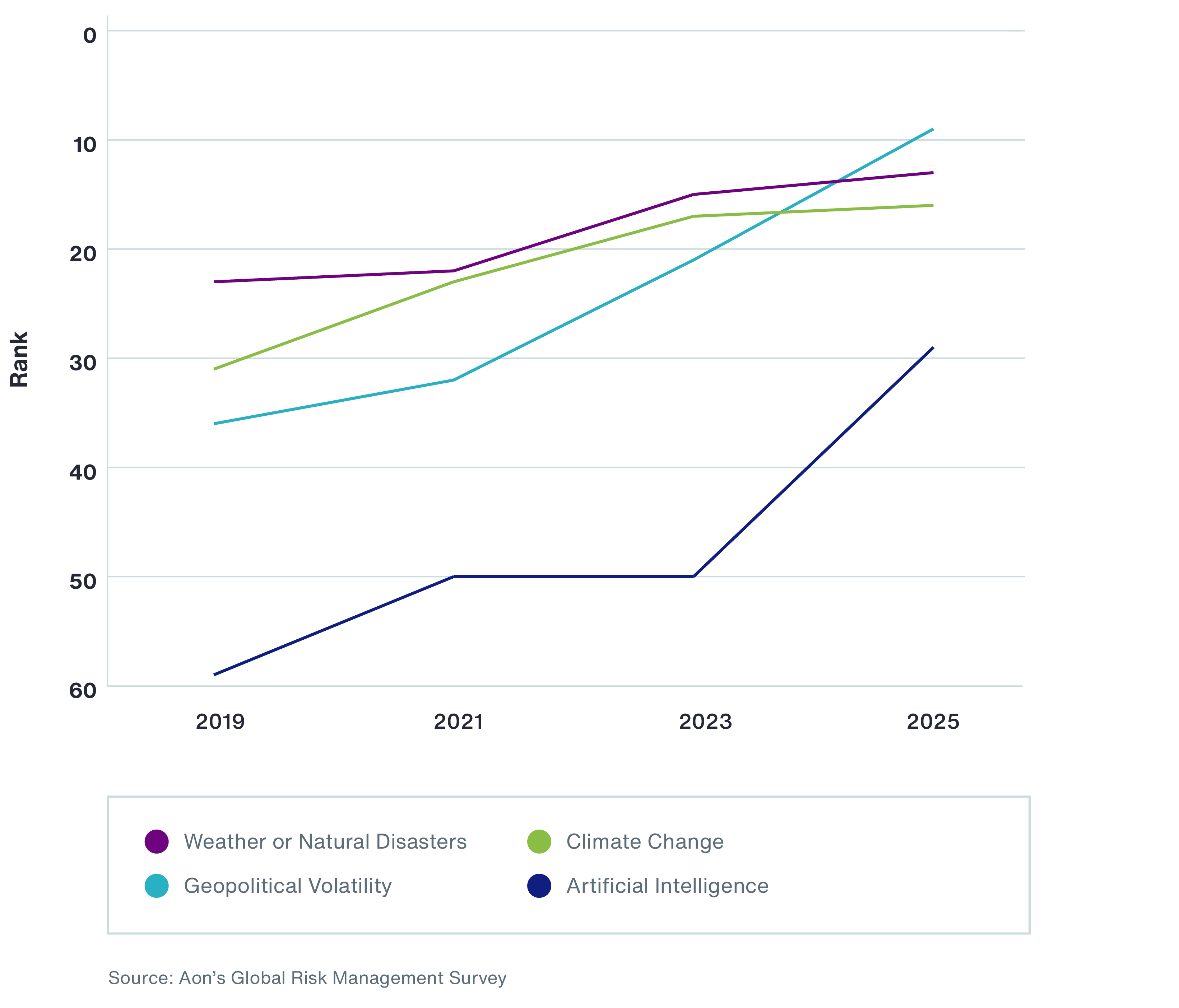
Every two years, Aon conducts its Global Risk Management Survey (GRMS), which has become a benchmark for C-suite executives worldwide. This survey identifies the top threats facing businesses—ranging from economic slowdowns and regulatory changes to cyber-attacks and brand damage.
By 2026, Aon has integrated AI-driven predictive analytics into this process. Instead of just looking at historical data, Aon’s models now incorporate real-time global sentiment analysis, satellite imagery for climate monitoring, and dark-web scanning for cyber threat intelligence. This allows Aon to provide "Forward-Looking Risk Assessments," which are essential for long-term strategic planning.
Addressing Emerging Risks in 2026
As the global economy evolves, so do the risks. Aon has positioned itself as a leader in three specific areas that dominate the 2026 risk landscape: Cyber Resilience, Climate Change/ESG, and Human Capital.
Cyber Resilience: Beyond the Policy
Cyber risk is no longer just an IT issue; it is a fundamental business risk. Aon’s role involves helping organizations understand their "Cyber Value at Risk." This is a calculation of the potential financial loss from a breach, including business interruption, legal fees, and reputational damage.
Aon’s approach in 2026 focuses on Cyber Quant. This tool allows companies to simulate various cyber scenarios—such as a ransomware attack on a key supplier—and see exactly how it would impact their cash flow. This data-driven approach helps firms justify the investment in better cybersecurity infrastructure, rather than just buying more insurance.
Climate Change and ESG Disclosure
With the maturation of climate-related financial disclosure requirements (such as those from the SEC and European regulators), Aon has taken on a significant role in helping firms manage "Transition Risk." This is the risk associated with moving toward a lower-carbon economy.
Aon provides climate modeling that helps property owners understand how rising sea levels or increased storm frequency will affect their assets over the next 10 to 30 years. Simultaneously, they advise on the "Social" and "Governance" aspects of ESG, helping firms manage the reputational risks associated with labor practices and executive oversight.
Human Capital as a Risk Factor
In a globalized economy, talent is a critical asset and a major risk. Aon’s Health and Wealth solutions focus on the "Risk of People." This includes managing the rising costs of healthcare benefits, the volatility of pension fund obligations, and the risks associated with "Key Person" loss. By 2026, Aon has pioneered the use of "Human Capital Analytics" to help firms predict turnover rates and the impact of workforce mental health on overall productivity.
Practical Engagement: How Organizations Utilize Aon
Working with Aon is typically a multi-stage process that moves from high-level consulting to the placement of insurance products. The following table illustrates the typical engagement model for a multinational corporation seeking global risk management services.
| Phase | Activity | Aon’s Role | Output/Deliverable |
|---|---|---|---|
| Discovery | Risk Identification | Mapping global operations and identifying physical/digital vulnerabilities. | Comprehensive Risk Register |
| Analysis | Risk Quantification | Using stochastic modeling to put a dollar value on potential losses. | Risk Appetite Statement |
| Strategy | Mitigation & Retention | Advising on internal controls and the feasibility of Captive Insurance. | Risk Management Framework |
| Execution | Risk Transfer | Negotiating with global insurers to place specialized coverage. | Insurance Portfolio |
| Optimization | Claims & Analytics | Managing large losses and updating models based on real-world data. | Annual Performance Review |
The Role of Captive Insurance Management
Aon is the world’s leading manager of "Captive" insurance companies. A captive is a wholly-owned subsidiary insurer formed by a parent company to provide risk mitigation for its owners. For a global organization, a captive offers a way to insure risks that the traditional market finds too expensive or too complex to cover (such as specific environmental liabilities or specialized product warranties).
Aon’s role in this niche is comprehensive. They handle the feasibility studies, the legal formation in jurisdictions like Vermont or Bermuda, and the day-to-day management of the captive’s operations. This allows large corporations to retain the profits that would otherwise go to a third-party insurer, provided they manage their risks effectively. This "self-insurance" model is a cornerstone of sophisticated global risk management in 2026.
Strategic Mergers and Acquisitions (M&A) Risk
In the realm of global finance, Aon’s M&A and Transaction Solutions team plays a vital role. When companies merge or acquire another entity, they inherit a massive amount of hidden risk. Aon provides "Transactional Liability Insurance," which includes:
- Representations and Warranties Insurance: Protecting the buyer or seller from financial loss if the facts presented during the deal are later found to be incorrect.
- Tax Liability Insurance: Protecting against challenges from tax authorities regarding the structure of the deal.
- Intellectual Property (IP) Solutions: Assessing the value and the risk of the target company’s patents and trademarks.
By 2026, Aon has expanded this to include "ESG Due Diligence," ensuring that an acquisition doesn't bring hidden environmental or social liabilities that could damage the parent company’s reputation.
Frequently Asked Questions
What is Aon’s primary function in global risk management?
Aon functions as a strategic advisor and intermediary. While many know them as an insurance broker, their primary function is to provide the data and expert analysis needed for organizations to make informed decisions about their risks. They help companies decide which risks to take, which to avoid, and which to transfer to the insurance market.
How does Aon help companies manage cyber risk in 2026?
Aon uses a "Resilience" framework rather than just a "Transfer" framework. This involves identifying digital assets, quantifying the potential financial impact of a breach using Cyber Quant tools, and then designing an insurance program that includes incident response services. This ensures that if a breach occurs, the company has both the financial protection and the technical support to recover quickly.
What is the "Aon United" strategy?
Aon United is the firm’s internal operating philosophy designed to break down silos between its various business segments (Risk, Health, Wealth, Reinsurance). The goal is to provide a unified experience for clients, ensuring that a global corporation receives a cohesive strategy that addresses both their physical property risks and their employee benefit risks simultaneously.
Does Aon only work with large multinational corporations?
No. While Aon is a leader in the "Global 500" space, they also provide specialized risk management services for mid-market companies and small businesses through their regional offices. Their role for smaller firms often focuses more on traditional insurance placement and compliance with local regulations.
How does Aon influence global insurance pricing?
As one of the world's largest brokers, Aon has a significant influence on market trends. Through the data they collect, they can identify which sectors are becoming "riskier" and provide that data to insurers. This helps set the "market sentiment," which in turn influences the premiums that companies around the world pay for their coverage.
Practical Recommendations for Risk Managers
To maximize the value of Aon's global risk management capabilities, organizations should move beyond a transactional relationship. In 2026, the most successful firms are those that integrate Aon’s data into their quarterly board meetings.
Next Steps:
- Conduct a Gap Analysis: Use Aon’s benchmarking data to see how your current insurance limits compare to your industry peers.
- Quantify "Uninsurable" Risks: Engage with Aon’s advisory teams to put a monetary value on risks that aren't easily covered by a standard policy, such as brand reputation or talent shortages.
- Explore Alternative Capital: If traditional insurance premiums are too high, work with Aon’s Reinsurance or Captive teams to explore self-insurance or insurance-linked securities (ILS).
- Audit ESG Compliance: Leverage Aon’s climate modeling to ensure your organization is prepared for the 2026-2030 regulatory reporting cycle regarding carbon footprints and physical asset vulnerabilities.
By treating Aon as a strategic partner in capital allocation rather than just a vendor of insurance policies, global organizations can transform risk from a threat into a competitive advantage.