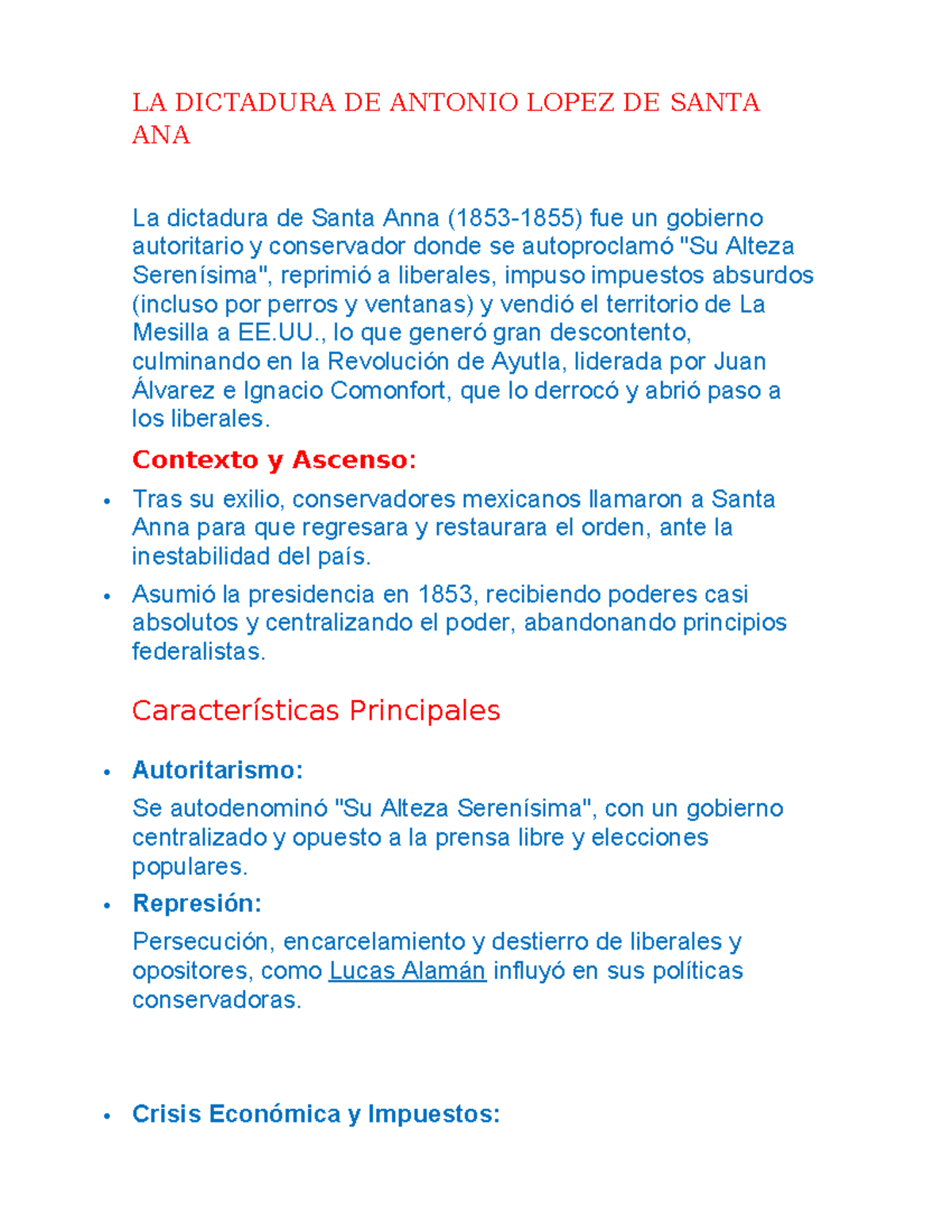
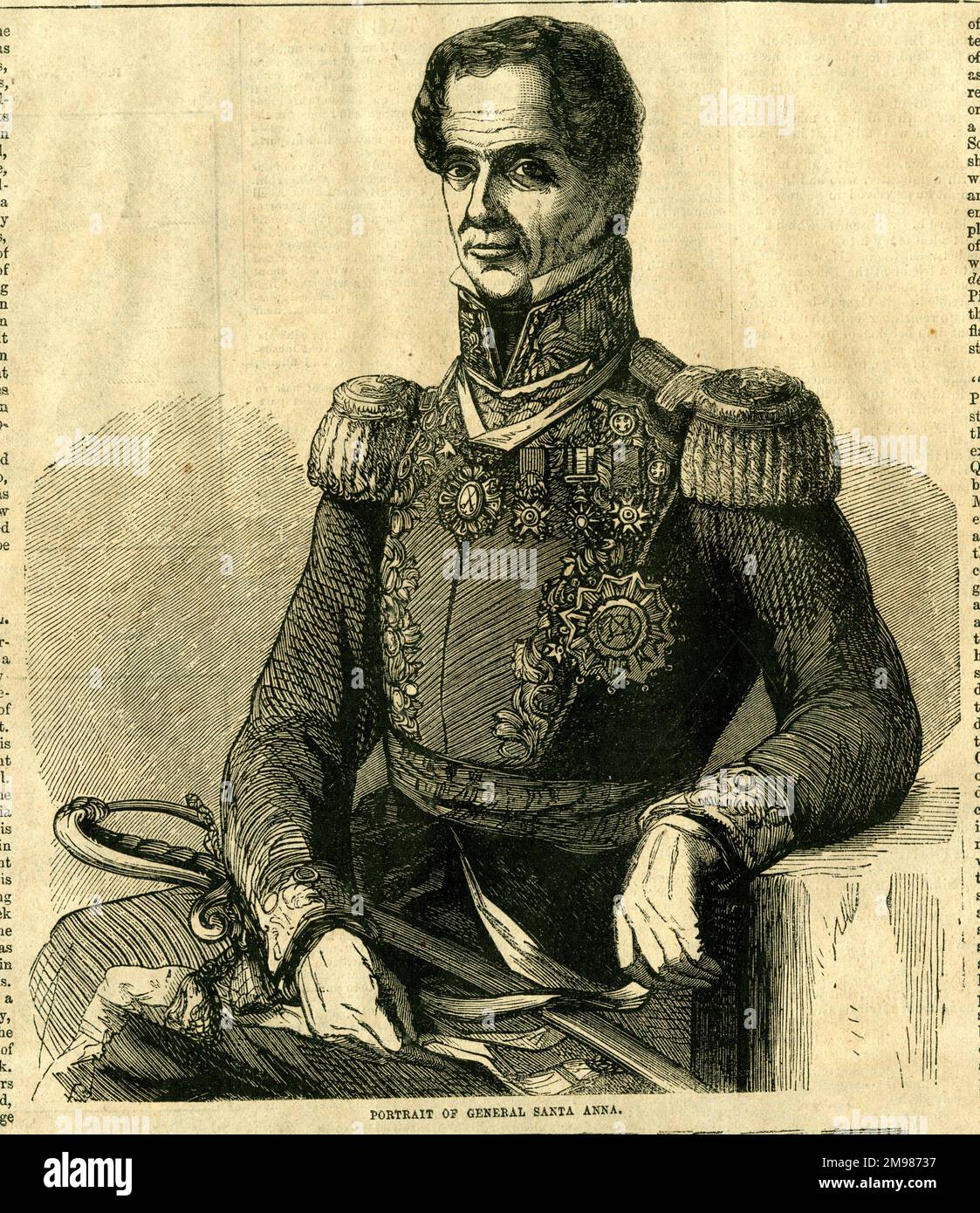
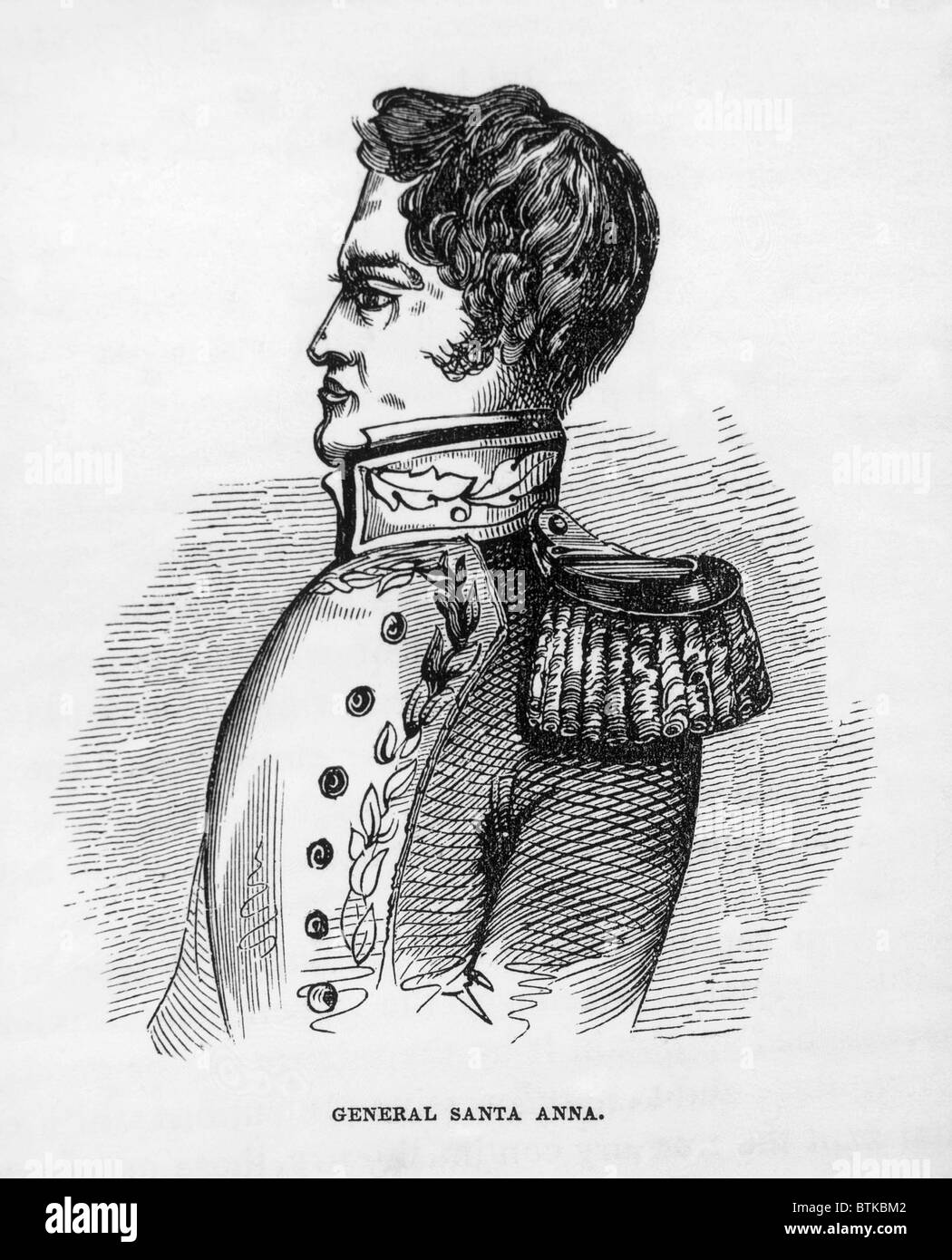
Antonio López de Santa Anna was a Mexican general, political opportunist, and multi-term president whose centralist policies and military actions directly triggered the Texas Revolution (1835–1836) and shaped the Mexican-American War (1846–1848). For AP U.S. History (APUSH), Santa Anna serves as a crucial catalyst for American territorial expansion under Manifest Destiny, leading directly to the Mexican Cession and the intensification of national debates over the expansion of slavery.
APUSH Short Definition and Quick Reference
On the AP U.S. History exam, Antonio López de Santa Anna is defined as the centralist ruler and military dictator of Mexico whose actions dramatically altered North American geopolitics during the mid-19th century. His suspension of Mexico's federalist Constitution of 1824 ignited rebellion among Anglo-American settlers and Tejanos in the Mexican province of Coahuila y Tejas. Santa Anna’s military victories at the Alamo and Goliad transformed Texas resistance into an ideological crusade, while his defeat at San Jacinto established the independent Republic of Texas.
Later, during the Mexican-American War (1846–1848), Santa Anna returned from exile to lead Mexican resistance against U.S. forces commanded by Generals Zachary Taylor and Winfield Scott. From an APUSH thematic perspective, Santa Anna acts as the primary foreign political and military foil to U.S. expansionist policies. His actions accelerated U.S. territorial growth and unintentionally exposed the fatal domestic political fractures surrounding the expansion of slavery into newly acquired territories.
APUSH Exam Context at a Glance
- Primary APUSH Period: Period 4 (1800–1848) and Period 5 (1844–1877).
- Key APUSH Themes: Geography and the Environment (GEO), America in the World (WOR), Politics and Power (PCE).
- Core Associated Terminology: Manifest Destiny, Texas Revolution, Battle of the Alamo, Battle of San Jacinto, Republic of Texas, Mexican-American War, Treaty of Guadalupe Hidalgo, Wilmot Proviso.
Historical Context: Santa Anna's Rise and the Mexican Republic
To understand Santa Anna’s role in American history, students must examine the unstable political landscape of post-independence Mexico. Mexico achieved independence from Spain in 1821 after more than a decade of conflict. However, the young republic suffered from severe economic devastation, ideological division, and repeated military coups.
- Mexican Independence (1821)
- Anglo Colonization of Texas (Empresario System / Austin)
- Santa Anna Seizes Central Power & Suspends 1824 Constitution (1835)
- Texas Revolution (1835–1836)
- Alamo & San Jacinto
- Republic of Texas & U.S. Annexation (1845)
- Mexican-American War (1846–1848)
- Treaty of Guadalupe Hidalgo
- Mexican Cession & Wilmot Proviso (Slavery Expansion Debates)
Santa Anna emerged as a dominant figure during this turbulent era. A master of political maneuver, he shifted alliances between liberal federalists—who favored strong state governments—and conservative centralists—who advocated for a powerful national executive aligned with the Catholic Church and the military elite. By 1834, Santa Anna abandoned his federalist allies, revoked the liberal Constitution of 1824, dissolved state legislatures, and centralized authority under the Siete Leyes (Seven Laws).
The Situation in Mexican Texas
During the 1820s, the Mexican government encouraged Anglo-American immigration into Texas through the empresario system, famously managed by Stephen F. Austin. Mexico sought to populate its northern frontier to buffer against Native American raids, particularly by the Comanche and Apache, and to develop the region economically.
To settle in Texas, Anglo immigrants agreed to three primary condition:
- Swear allegiance to Mexico.
- Convert to Roman Catholicism.
- Abide by Mexican law, including the abolition of slavery enacted nationally in 1829.
By the early 1830s, Anglo-American settlers—often referred to as Texians—far outnumbered native Mexican Tejanos. Most settlers retained their American customs, kept enslaved African Americans under legal loopholes, and disregarded Mexican authority. When Santa Anna centralized power in Mexico City and attempted to enforce Mexican law, disarm local militias, and collect import tariffs, Texian leaders viewed his centralization as tyrannical oppression.
The Texas Revolution (1835–1836) and Santa Anna's Role
The conflict began in late 1835 with the Battle of Gonzales, where Texians refused to hand over a cannon to Mexican troops under the banner "Come and Take It." Santa Anna responded by personally leading the Mexican Army of Operations north to crush the rebellion and restore centralist rule.
The Siege of the Alamo and Goliad
In February 1836, Santa Anna arrived in San Antonio de Béxar and besieged approximately 185 Texian and Tejano defenders inside the Alamo mission. After a 13-day siege, Mexican forces stormed the compound on March 6, 1836, executing all surviving combatants, including prominent figures Davy Crockett, James Bowie, and William B. Travis.
Weeks later, at the Battle of Coleto Creek, Mexican troops captured roughly 400 Texian combatants commanded by James Fannin near Goliad. Under Santa Anna’s strict orders regarding foreign insurgents, the prisoners were executed in the Goliad Massacre.
From Santa Anna’s perspective, these harsh actions followed Mexican law regarding unlawful armed insurgencies. However, in the United States, the incidents were reported as ruthless atrocities. "Remember the Alamo!" and "Remember Goliad!" became powerful rallying cries that attracted American volunteers, supplies, and public support for the Texian cause.
| TEXIAN STRATEGY | SANTA ANNA'S STRATEGY |
|---|---|
| Delay Mexican advance | Swift central suppression |
| Secure U.S. volunteers | Execute insurgents |
| Rally public support | Assert central control |
The Battle of San Jacinto and the Treaties of Velasco
Santa Anna pursued the fleeing Texian forces led by General Sam Houston toward eastern Texas. Dividing his army to catch the rebel government, Santa Anna overextended his lines and camped near the San Jacinto River.
On April 21, 1836, Houston’s force launched a surprise afternoon assault on the resting Mexican encampment. The Battle of San Jacinto lasted only 18 minutes, but resulted in a complete rout of the Mexican army. Santa Anna fled the field in disguise, was captured the following day, and brought before Sam Houston.
To save his life, Santa Anna signed the Treaties of Velasco (one public, one secret), agreeing to:
- Cease hostilities and withdraw Mexican forces south of the Rio Grande.
- Recognize the independence of Texas.
- Promote Mexican government recognition of Texas diplomatic borders.
Upon returning to Mexico City, Santa Anna was stripped of his presidency. The Mexican Congress repudiated the Treaties of Velasco, arguing that agreements signed by a captured commander under duress were legally invalid. Consequently, Mexico continued to view Texas as a rebellious breakaway province rather than a sovereign nation.
The Mexican-American War (1846–1848) and Santa Anna's Return
The unresolved political status of Texas created a decade-long diplomatic stalemate. The Republic of Texas sought annexation by the United States, but U.S. political leaders deferred the issue due to fierce sectional disputes over adding another slave state.
In 1845, President James K. Polk pushed through the joint resolution annexing Texas. Polk embraced the ideology of Manifest Destiny—the belief that the U.S. was divinely ordained to expand across the North American continent to the Pacific Ocean.
- U.S. Annexation of Texas (1845)
- Border Dispute (Nueces vs. Rio Grande)
- Polk Sends Taylor to Rio Grande
- Skirmish & War Declaration (1846)
- Santa Anna Returns from Exile
- U.S. Defeats Santa Anna / Captures Mexico City
- Treaty of Guadalupe Hidalgo (1848)
The Border Dispute and War Outbreak
A crucial element of the conflict was the disputed southern border of Texas:
- Mexico’s Position: The border was historically the Nueces River, placing Texas within modest boundaries.
- U.S. & Texas Position: The border extended further south to the Rio Grande, claiming vast additional territory.
After failing to purchase California and New Mexico through the Slidell Mission in 1845, Polk ordered General Zachary Taylor to march troops into the disputed territory between the Nueces and Rio Grande. In April 1846, Mexican forces crossed the Rio Grande and engaged Taylor's troops, prompting Polk to declare to Congress that Mexico had "shed American blood upon American soil."
Santa Anna’s Second Act
At the war's outbreak, Santa Anna was living in exile in Cuba. He struck a deal with President Polk: if the U.S. Navy permitted him to slip through their blockade into Mexico, he would use his influence to negotiate a peaceful border settlement favorable to Washington.
Upon returning to Mexico City in August 1846, Santa Anna betrayed his arrangement with Polk. He assumed presidency, organized Mexican military resistance, and marched north to confront U.S. forces.
Despite his charismatic leadership, Santa Anna suffered repeated tactical and strategic defeats against U.S. armies:
- Battle of Buena Vista (Feb 1847): Santa Anna fought General Zachary Taylor to a tactical stalemate, but was forced to retreat due to heavy casualties and political instability in Mexico City.
- Siege of Veracruz & March to Mexico City (1847): General Winfield Scott executed a major amphibious landing at Veracruz and advanced inland along the route used by Hernán Cortés centuries earlier.
- Battles of Cerro Gordo, Contreras, Churubusco, and Chapultepec: Scott's army defeated Santa Anna’s troops, resulting in the capture of Mexico City in September 1847.
Recognizing that military defeat was absolute, Santa Anna resigned the presidency and fled into exile once again.
Impact on American Sectional Politics and Manifest Destiny
Santa Anna’s defeats led directly to the Treaty of Guadalupe Hidalgo (1848), which reshaped the borders of North America and fundamentally altered U.S. domestic politics. Under the treaty negotiated by Nicholas Trist:
Mexico recognized the Rio Grande as the southern border of Texas.
Mexico ceded over 500,000 square miles of territory to the United States (the Mexican Cession), including modern-day California, Nevada, Utah, and parts of Arizona, New Mexico, Colorado, and Wyoming.
The United States paid Mexico $15 million and assumed $3.25 million in claims by U.S. citizens against the Mexican government.
MEXICAN CESSION (1848)
Wilmot Proviso (1846/1847) (Attempt to ban slavery in Cession)
Heightened Sectional Tension (Northern Free Soil vs. Southern Slavery)
Compromise of 1850 (Fugitive Slave Act, CA Free State)
The Wilmot Proviso and Sectional Polarization
The acquisition of this territory disrupted the delicate political balance between free and slave states established by the Missouri Compromise of 1820. In 1846, Pennsylvania Representative David Wilmot introduced the Wilmot Proviso, which proposed that slavery be banned in any territory acquired from Mexico.
Although the Wilmot Proviso passed the House of Representatives multiple times, it was repeatedly defeated in the Southern-dominated Senate. The legislative struggle over the proviso signaled a shift in U.S. politics: party lines (Democrats vs. Whigs) broke down, replaced by rigid sectional alignments (North vs. South).
The crisis triggered by the Mexican Cession required the Compromise of 1850, which admitted California as a free state, established popular sovereignty in Utah and New Mexico territories, abolished the slave trade in Washington D.C., and enacted a stringent federal Fugitive Slave Law. Rather than permanently settling the issue, these developments accelerated the nation toward the Civil War.
Summary Table: Santa Anna’s Impact on U.S. History & APUSH Themes
| Historical Event | Year | Santa Anna's Specific Role | U.S. Historical Significance | Primary APUSH Curriculum Connection |
|---|---|---|---|---|
| Abolition of 1824 Constitution | 1835 | Centralized power; abolished state legislatures. | Triggered rebellion among Texian settlers and Tejanos. | Period 4: State sovereignty vs. federal control in North America. |
| Siege of the Alamo | 1836 | Commanded Mexican forces; executed all defenders. | Galvanized U.S. public opinion and encouraged enlistments. | Period 4: Creation of iconic American political and military myths. |
| Battle of San Jacinto | 1836 | Defeated and captured by Sam Houston's forces. | Forced to sign Treaties of Velasco, creating Republic of Texas. | Period 4: Border expansion and non-annexation debates (1836–1845). |
| Mexican-American War | 1846–1847 | Outmaneuvered Polk, took presidency, led Mexican forces. | Unified Mexican defense; lost key battles (Buena Vista, Chapultepec). | Period 5: Ideology of Manifest Destiny and U.S. imperial impulse. |
| Treaty of Guadalupe Hidalgo | 1848 | Military collapse forced Mexican leadership to capitulate. | U.S. gained Mexican Cession (CA, NV, UT, AZ, NM, CO). | Period 5: Territorial expansion and the reopening of slavery debates. |
| Wilmot Proviso Controversy | 1846–1850 | Direct consequence of U.S. victory over Santa Anna. | Sparked national controversy over expanding slavery into the West. | Period 5: Sectionalism leading directly to the American Civil War. |
How Santa Anna Appears on the AP US History Exam
Understanding Santa Anna for APUSH requires moving beyond military biography to analyze cause-and-effect relationships within U.S. territorial and political history.
1. Multiple-Choice Questions (MCQs)
MCQs involving Santa Anna often feature primary source stimuli, such as letters from Stephen F. Austin, political cartoons criticizing Polk’s war, or speeches by anti-war Whigs like Abraham Lincoln (e.g., his "Spot Resolutions").
- Focus Area: Recognize how Santa Anna's centralist policies created the diplomatic pretext for American expansion, and how Polk leveraged these events to achieve continental expansion.
2. Short-Answer Questions (SAQs)
SAQs may ask students to compare different historical perspectives on the Mexican-American War or analyze the consequences of territorial acquisition between 1836 and 1850.
- Sample Prompt Element: "Briefly explain ONE historical effect of the conflict between Santa Anna's government and Texas settlers on U.S. domestic politics between 1836 and 1850."
- Effective Response Strategy: Connect Santa Anna’s actions at the Alamo/San Jacinto to Texas independence, followed by delayed annexation due to slavery debates, culminating in the Mexican Cession and the Compromise of 1850.
3. Document-Based Questions (DBQs) and Long-Essay Questions (LEQs)
On essay sections, Santa Anna is rarely the direct prompt focus. Instead, he serves as crucial outside evidence or contextualization for prompts regarding:
- The motivations behind U.S. westward expansion (Manifest Destiny).
- The domestic political impacts of territorial gains in the 1840s.
- The continuity and change in U.S. debates over slavery from 1820 to 1860.
Common Pitfalls to Avoid on the AP Exam
- Confusing the Texas Revolution (1835–1836) with the Mexican-American War (1846–1848): Santa Anna led Mexican forces in both conflicts, but they were distinct events. The first resulted in an independent Texas Republic; the second resulted in the U.S. acquiring the Mexican Cession.
- Overlooking Tejanos: Do not assume all Mexican residents of Texas supported Santa Anna. Many Tejanos fought alongside Anglo-Texians against Santa Anna’s centralist government to defend the federalist Constitution of 1824.
- Ignoring the Slavery Context: The primary APUSH focus when evaluating Santa Anna’s downfall is not tactical military history, but how the resulting territorial transfers forced the issue of slavery to the center of American politics.
Frequently Asked Questions (FAQs)
What is the APUSH definition of Antonio López de Santa Anna?
In AP U.S. History, Antonio López de Santa Anna is defined as the Mexican dictator and general whose centralist policies triggered the Texas Revolution in 1835 and who later led Mexican forces against the United States during the Mexican-American War. His military actions and ultimate defeat directly enabled U.S. territorial expansion under Manifest Destiny and reopened intense national debates over the expansion of slavery into the West.
Why did Santa Anna attack the Alamo in 1836?
Santa Anna attacked the Alamo to reassert central authority over rebellious forces in Texas and send a clear message to insurgents. He viewed the Texians as illegal occupiers who had violated Mexican sovereignty, ignored federal laws regarding immigration and slavery, and taken up arms against the legitimate Mexican state.
How did Santa Anna’s actions influence the ideological concept of Manifest Destiny?
Santa Anna’s suppression of local autonomy in Texas and his severe tactics at the Alamo and Goliad were used by U.S. politicians and press outlets to portray Mexico as an unstable autocracy. This narrative allowed American expansionists to frame U.S. territorial acquisition as a democratic, civilizing mission, fueling the popular belief in Manifest Destiny.
What was Santa Anna’s role in the Mexican-American War?
After returning from exile through an arrangement with U.S. President James K. Polk, Santa Anna assumed command of Mexico's defense and presidency. He led troops at key battles including Buena Vista and Cerro Gordo, but his defeats against Generals Zachary Taylor and Winfield Scott led to the fall of Mexico City and forced Mexico to sign the Treaty of Guadalupe Hidalgo in 1848.
How did Santa Anna's defeat lead to the American Civil War?
Santa Anna’s military defeat forced Mexico to cede vast southwestern territories to the United States in the Treaty of Guadalupe Hidalgo. The debate over whether to permit or prohibit slavery in these new lands—highlighted by the Wilmot Proviso and settled temporarily by the Compromise of 1850—fractured national political parties along regional lines, escalating the sectional conflict that led to the Civil War.
Essential Study Strategy for APUSH Students
When reviewing Antonio López de Santa Anna for the AP U.S. History exam, structure your review around causation and consequence:
- Master the Sequence of Events: Link Santa Anna’s centralism (1835) $\rightarrow$ Texas Revolution (1836) $\rightarrow$ Republic of Texas (1836–1845) $\rightarrow$ U.S. Annexation & Border Dispute (1845) $\rightarrow$ Mexican-American War (1846–1848) $\rightarrow$ Treaty of Guadalupe Hidalgo (1848) $\rightarrow$ Wilmot Proviso & Compromise of 1850.
- Practice Comparative Contextualization: Practice writing intro paragraphs that use Santa Anna’s actions in Texas and Mexico as historical context for prompts on mid-19th-century sectionalism or westward migration.
- Analyze Primary Sources: Review documents from the era, including Santa Anna’s manifestos, Sam Houston's calls to arms, James K. Polk's war message, and anti-war arguments by Whig politicians, to prepare for primary-source MCQ and DBQ prompts.
By framing Santa Anna as a major external cause of American expansion and subsequent domestic political crises, you will successfully capture the full analytical depth required by the APUSH curriculum.
EDITORIAL CATEGORY METADATA: