Airplane lights blink primarily to ensure conspicuity, allowing other pilots, air traffic controllers, and ground crews to identify an aircraft’s position, direction, and operational status. These flashing lights—specifically the red beacon and white strobes—function as an anti-collision system to prevent mid-air and runway accidents by making the aircraft visible against dark skies or cluttered ground environments.
The Science of Visibility: Why Constant Light Isn't Enough
In the vastness of the sky or the busy environment of a major international airport, a steady light can easily blend into the background of stars, city lights, or terminal signals. The human eye is biologically tuned to detect motion and changes in intensity. By blinking, aviation lighting systems "break" the visual field, forcing the observer's brain to register the presence of a moving object.
As of 2026, aviation safety standards remain heavily reliant on these visual cues. Despite advancements in ADS-B (Automatic Dependent Surveillance-Broadcast) and sophisticated radar systems, "see and avoid" remains a foundational principle of flight. Blinking lights provide the immediate, high-contrast signal necessary for pilots to make split-second decisions during close-proximity maneuvers or in crowded terminal corridors.
The Red Anti-Collision Beacon: The "Engine Running" Signal
The most recognizable blinking light on an aircraft is the red beacon. Located typically on the top and bottom of the fuselage, this light begins flashing before the engines are even started.
Purpose and Operation
The primary purpose of the red beacon is to warn ground personnel that the aircraft’s engines are operating or are about to be started. Ground crews see the rhythmic red flash and know to maintain a safe distance from jet intakes or propeller arcs. It remains active throughout the entire duration of the flight and is only turned off once the engines are safely shut down at the arrival gate.
Technical Evolution
Traditionally, these beacons utilized a rotating halogen bulb behind a red lens, creating a "sweep" effect. However, by 2026, the transition to high-intensity Light Emitting Diodes (LEDs) is nearly universal across commercial and general aviation fleets. LED beacons are more reliable, consume less power, and can produce a sharper, more instantaneous "on-off" flash pattern that is more noticeable than the older mechanical rotations.
High-Intensity White Strobes: The "In-Flight" Signature
If you look at an airplane in flight at night, the brightest flashes you see are the white strobe lights. These are located on the wingtips and sometimes on the tail (empennage).
Operational Use
Unlike the red beacon, white strobes are generally only turned on when the aircraft is on an active runway or in the air. Pilots typically flick the strobe switch as they receive their takeoff clearance. This serves as a "don't hit me" signal to other aircraft in the vicinity. The intensity of these strobes is significantly higher than any other light on the plane, often exceeding thousands of candelas, ensuring they can be seen from many miles away even in hazy conditions.
Reducing Pilot Fatigue
While strobes are vital for safety, they can be distracting or even disorienting for the pilots of the aircraft itself, especially when flying through thick clouds or fog. In such "Instrument Meteorological Conditions" (IMC), the high-intensity white light reflects off the water droplets in the air, creating a blinding flash inside the cockpit. In these specific scenarios, pilots may temporarily turn off the strobes to maintain their night vision and focus on their instruments, relying instead on the red beacon and navigation lights.
Navigation Lights: Determining Direction
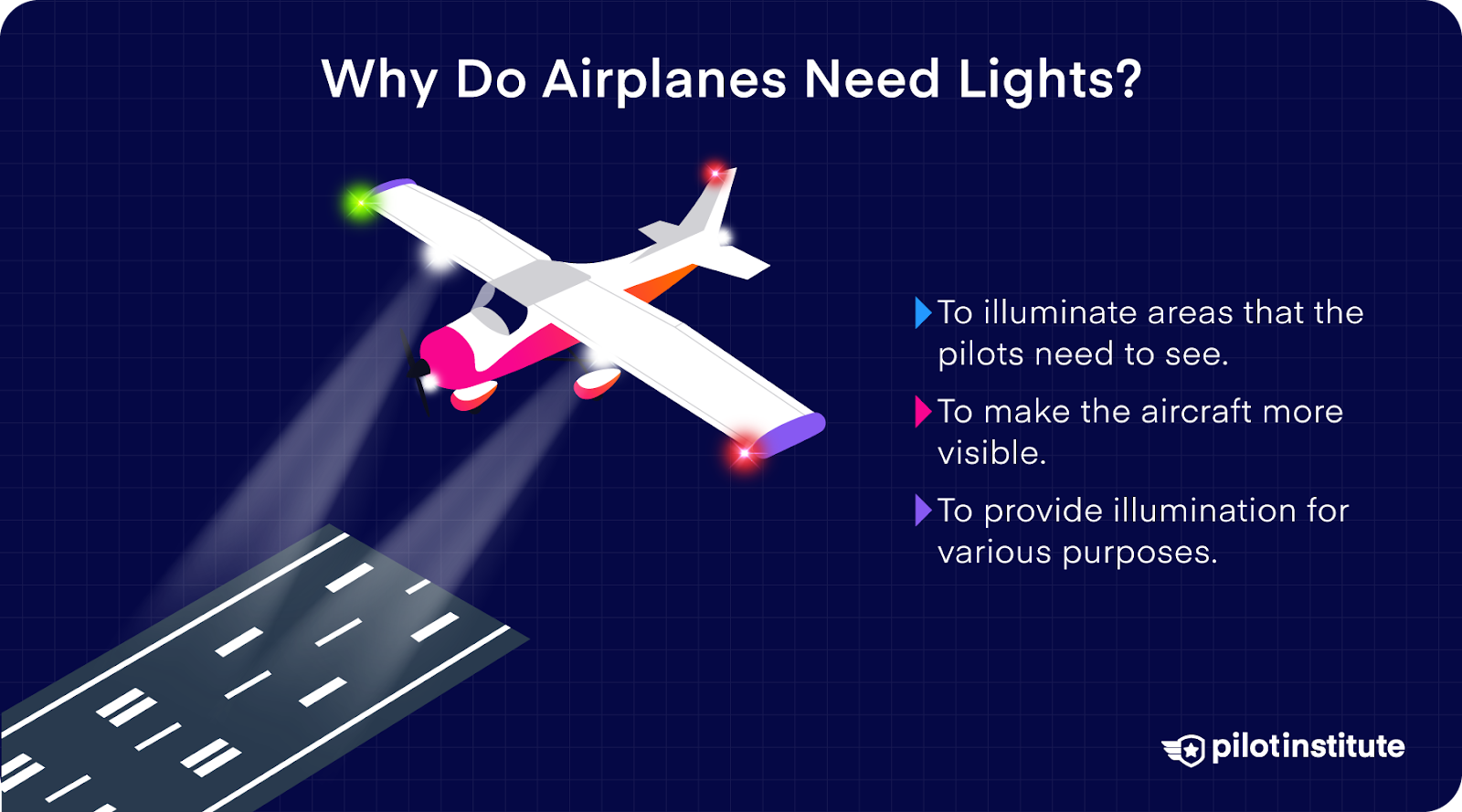
While they do not blink, the steady navigation (or "position") lights are critical for interpreting the meaning of the blinking lights. Following maritime tradition, aircraft use a standardized color scheme:
- Red Light: Located on the left (port) wingtip.
- Green Light: Located on the right (starboard) wingtip.
- White Light: Located on the rear-most point of the aircraft (the tail).
By observing the orientation of the red and green lights in relation to the flashing white strobes, a pilot can instantly determine which direction another aircraft is traveling. For example, if a pilot sees a red navigation light and a blinking white strobe, they know the other aircraft is crossing their path from right to left. If they see both red and green simultaneously, the aircraft is likely heading directly toward them.
Landing and Taxi Lights: The "Headlights" of the Sky
During the takeoff and landing phases, aircraft deploy massive amounts of forward-facing light. Landing lights are often located on the wing roots, the nose gear, or integrated into the leading edge of the wings.
Pulse Lights and Recognition
In 2026, many modern aircraft utilize "pulse light" systems. This is a feature where the landing lights or dedicated recognition lights oscillate or "wiggle" in intensity. While they don't blink completely off, the pulsing effect makes the aircraft much easier to spot for birds and other pilots during the day. Research has shown that pulsing lights significantly reduce bird strikes, as the shifting light patterns are perceived as a threat by avian species, encouraging them to clear the flight path.
The Hierarchy of Aviation Lighting
To understand the full spectrum of why and how these lights operate, it is helpful to view them as a functional hierarchy based on the phase of flight.
| Light Type | Color | Pattern | Primary Purpose |
|---|---|---|---|
| Beacon | Red | Flashing/Rotating | Safety warning: Engines running or about to start. |
| Strobe | White | High-Intensity Flash | Anti-collision: Identification in flight and on runways. |
| Navigation | Red/Green/White | Steady | Directionality: Determining the orientation of the aircraft. |
| Landing | White | Steady/Pulse | Illumination: Seeing the runway and being seen at low altitudes. |
| Taxi | White | Steady | Ground Navigation: Illuminating the path for ground movement. |
| Logo | White | Steady | Branding/Visibility: Illuminating the tail for identification. |
| Wing/Ice | White | Steady | Inspection: Allowing pilots to check for ice buildup on wings. |
Regulatory Requirements and Standards
Aviation lighting isn't just a matter of manufacturer preference; it is strictly regulated by international bodies like the International Civil Aviation Organization (ICAO) and national regulators like the Federal Aviation Administration (FAA) in the United States and EASA in Europe.
The "Anti-Collision Light" Rule
Under FAA Federal Aviation Regulations (FAR) Part 91, aircraft manufactured after 1996 must be equipped with an approved anti-collision light system (either the red beacon or the white strobes) that must be operated during all types of flight, day or night, unless the pilot determines it is safer to turn them off (e.g., in heavy clouds).
These lights must meet specific flash rates, generally between 40 and 100 cycles per minute. This standardization ensures that no matter what type of aircraft is in the air—from a small Cessna to a massive Boeing 777—the visual signals remain consistent and predictable for everyone sharing the airspace.
Technical Maintenance and Reliability
Given that these lights are critical for safety, they are subject to rigorous maintenance schedules. In the current era of 2026, the transition to solid-state LED technology has drastically reduced the frequency of "burnt out" bulbs. Older xenon strobe tubes required high-voltage power supplies and were prone to failure after a certain number of flashes. Modern LEDs are rated for tens of thousands of hours, ensuring that the blinking signal remains consistent across years of service.
If a light does fail, it is often listed on the aircraft’s Minimum Equipment List (MEL). Depending on the specific light and the type of flight (day vs. night), an aircraft may be permitted to fly for a limited time with a broken light, provided other redundant systems are operational and the repair is scheduled within a specific timeframe.
Common Misconceptions About Flashing Aircraft Lights
One common mistake observers make is confusing airplane lights with other celestial or man-made objects.
- Drones vs. Airplanes: Drones (UAS) also use blinking lights, but their patterns are often much faster or use different color combinations (like blue or purple) that are not standard in commercial aviation.
- Satellites: Satellites do not blink. They appear as a steady point of light moving consistently across the sky. If you see a "star" that is flashing red and white, it is almost certainly an aircraft.
- Emergency Signals: A common myth is that blinking lights are a sign of distress. While pilots can use lights to signal in extreme emergencies (such as toggling landing lights to get attention), the standard blinking of beacons and strobes is a sign of a perfectly normal, functioning flight.
Future Trends: Smart Lighting and Urban Air Mobility
As we progress through 2026, the sky is becoming more crowded with the rise of Urban Air Mobility (UAM)—electric vertical takeoff and landing (eVTOL) vehicles. These craft use advanced lighting arrays that can communicate more than just "here I am."
Some experimental systems use color-coded blinking sequences to indicate "intent," such as whether the vehicle is about to descend or hover. While these haven't yet replaced the global standards for commercial jets, they represent the next step in the evolution of how blinking lights help maintain safety in an increasingly complex three-dimensional transport network.
FAQ
Why do some planes have two white flashes and others only one?
The flash pattern is often determined by the manufacturer's strobe power supply. Boeing aircraft frequently utilize a single-flash pattern, while many Airbus models are known for a "double-flash" strobe. This difference allows experienced observers and pilots to identify the make of an aircraft even at a distance in the dark.
Can you see airplane lights during the day?
Yes. The white strobes and the red beacon are designed to be high-intensity enough to be visible even in direct sunlight. While they are obviously more prominent at night, they are required during the day to help pilots spot other aircraft against the glare of the sun or hazy horizons.
What happens if an airplane's blinking lights fail during a flight?
Airplanes have multiple redundant lighting systems. If the strobes fail, the red beacon still provides anti-collision protection. Pilots will also inform Air Traffic Control (ATC) of the failure. ATC can then provide greater separation between that aircraft and others to compensate for the reduced visibility.
Do blinking lights attract birds?
On the contrary, blinking or pulsing lights are often used as a deterrent. The "Pulse Light" systems used on many modern jets are specifically designed to create a visual "shimmer" that birds find startling, encouraging them to fly away from the aircraft's path.
Why is there a white light on the back of the airplane?
The white light on the tail is a navigation light. It tells other pilots that they are looking at the rear of the aircraft. If a pilot sees only a steady white light, they know they are following the aircraft and are not on a collision course.
Practical Recommendation for Observers and Pilots
For those on the ground, understanding these lights can turn a simple glance at the sky into an informed observation of aviation procedures. If you see a red light blinking on a plane at the gate, expect engine start-up soon and stay clear. For student pilots, mastering the "Lights-Camera-Action" checklist—where "Lights" refers to ensuring all strobes and landing lights are on before entering the runway—is a vital habit for career-long safety. Always verify the status of your anti-collision lights during pre-flight inspections, as they are your primary "voice" in the visual language of the sky.