American Funds, managed by Capital Group, is one of the world’s largest and oldest active investment managers. Known for its unique multi-manager approach called the Capital System, the firm offers a wide array of mutual funds and ETFs designed for long-term growth, capital preservation, and consistent income across diverse market cycles.
The Foundation of American Funds: The Capital System
To understand an American Funds investment overview, one must first grasp the proprietary investment process known as the Capital System. Established decades ago and refined through 2026, this system differentiates Capital Group from many other asset managers who rely on a single "star" portfolio manager.
Under the Capital System, each fund is divided into segments managed independently by different portfolio managers. These managers have diverse backgrounds, investment styles, and geographic focuses. Additionally, a portion of every fund is managed by the firm’s investment research analysts, allowing their highest-conviction ideas to be represented directly in the portfolio.
The primary benefit of this approach is the reduction of volatility. Because different managers may favor different sectors or styles—such as value versus growth—their individual investment decisions often offset one another during periods of market turbulence. This structural diversification aims to provide smoother returns over the long term, which is a hallmark of the American Funds brand. By 2026, this approach has remained a core pillar for investors seeking active management that prioritizes downside protection alongside upside participation.
Asset Class Categorization and Key Fund Families
American Funds organizes its offerings into several distinct categories to help investors and advisors build well-rounded portfolios. Each category serves a specific role within a broader financial plan.
Equity and Growth Funds
These funds focus primarily on stocks and are designed for investors with a long-term horizon who are seeking capital appreciation.
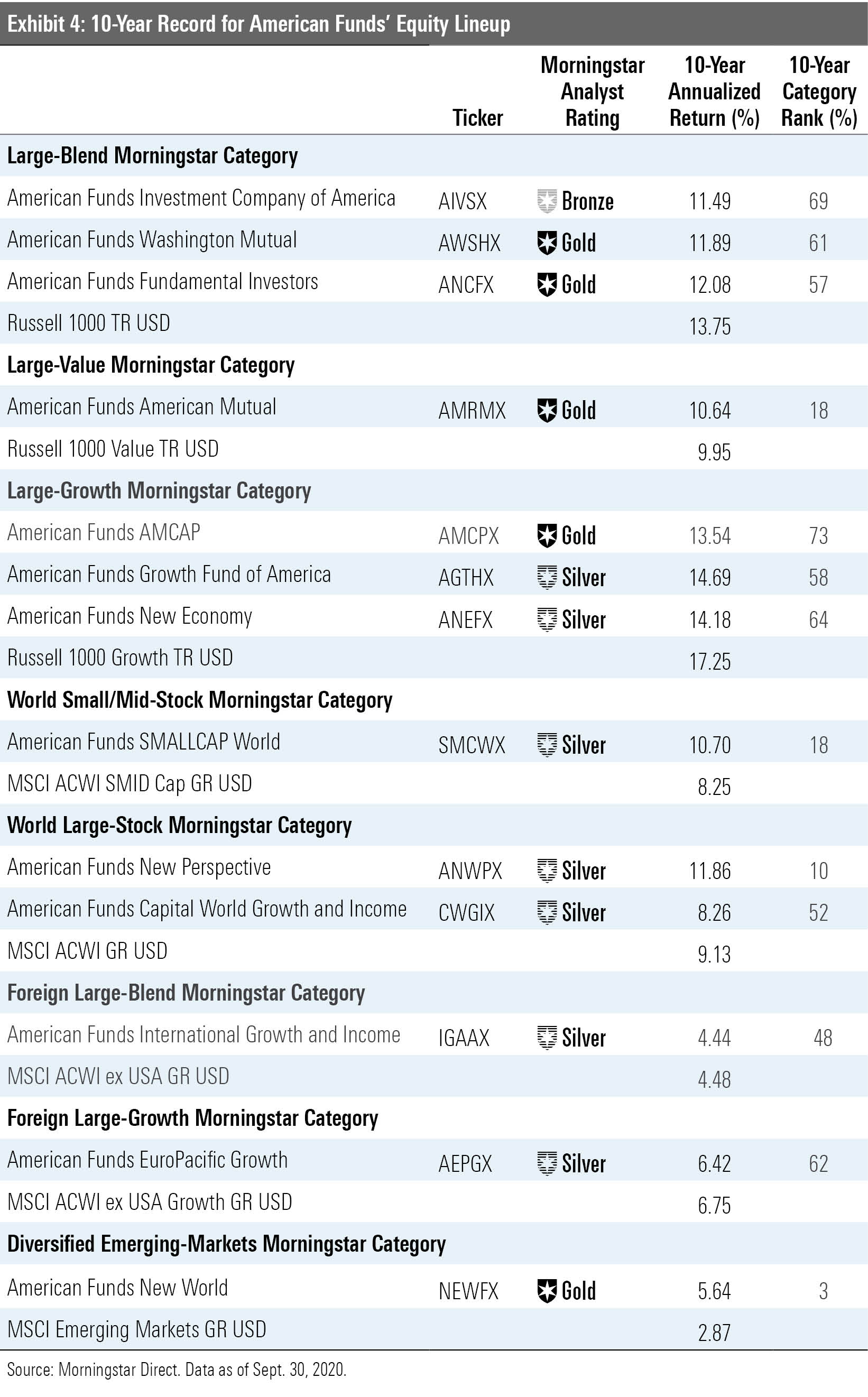
- The Growth Fund of America (AGTHX): One of the largest actively managed equity funds in existence, focusing on companies with strong growth potential.
- Investment Company of America (AIVSX): A foundational fund that seeks long-term growth of capital and income by investing in established blue-chip companies.
- EuroPacific Growth Fund (AEPGX): A premier choice for international equity exposure, focusing on growth opportunities outside of the United States.
Balanced and Income Funds
For investors who require a mix of growth and stability, balanced funds provide exposure to both equities and fixed-income securities.
- American Balanced Fund (ABALX): This fund maintains a relatively steady ratio of stocks to bonds, aiming for conservation of capital, current income, and long-term growth.
- Fundamental Investors (ANCFX): This fund focuses on undervalued stocks that offer the potential for dividend growth, making it a staple for "growth and income" strategies.
Fixed-Income and Bond Funds
Capital Group has significantly expanded its bond offerings leading into 2026. These funds are designed to provide diversification from the stock market and steady streams of interest income.
- The Bond Fund of America (ABNDX): A core bond holding that seeks to provide a high level of current income consistent with the preservation of capital.
- American High-Income Trust (AHITX): Targets higher yields by investing in lower-rated corporate bonds, suitable for investors with a higher risk tolerance.
Navigating Share Classes and Fee Structures
One of the most complex aspects of an American Funds investment overview is the variety of share classes available. Because American Funds are primarily sold through financial intermediaries, the fee structure is often tied to how an advisor is compensated.
| Share Class | Primary Use Case | Fee Structure | Key Characteristic |
|---|---|---|---|
| Class A | Long-term individual investors | Front-end sales charge (load) | Lower ongoing expenses (12b-1 fees) |
| Class C | Short-term holdings (1-3 years) | No front-end load; level load | Higher annual expenses; no initial cost |
| Class F-1/F-2 | Fee-based advisory accounts | No sales charges | Designed for fiduciary/wrap accounts |
| Class R (R-1 to R-6) | 401(k) and retirement plans | Varies by plan size | R-6 usually has the lowest expense ratio |
| ETFs | Independent traders/Tax efficiency | No loads; market-priced | Transparent, intraday trading available |
Understanding Sales Charges (Loads)
Class A shares typically carry a front-end sales charge, which is a percentage of the initial investment. However, American Funds offers "breakpoints"—discounts on the sales charge for larger investments. For example, an investment over $250,000 or $500,000 significantly reduces the percentage paid upfront. By 2026, many investors favor Class F-2 or ETF shares to avoid these commissions, provided they are working within a fee-based advisory model.
Performance and Risk Management in 2026
As of 2026, the performance of American Funds continues to be evaluated against both its peer groups and passive benchmarks like the S&P 500. A critical component of the American Funds value proposition is the focus on "Capture Ratios."
Active managers at Capital Group aim to capture a high percentage of market gains during "up" markets while capturing a significantly lower percentage of losses during "down" markets. This defensive posture is intended to help investors stay invested during volatile periods, avoiding the common mistake of selling at market bottoms.
Investors should note that while active management offers the potential to outperform the market, it also carries the risk of underperformance. In periods where a few massive "mega-cap" stocks drive the entire market's gains, the diversified Capital System may lag behind a concentrated index.
Comparing American Funds to Passive Indexing
The debate between active and passive investing remains central to any investment overview in 2026. Passive funds, such as those tracking the Vanguard 500, offer very low expense ratios and attempt to match the market. American Funds argues that their active research and flexible mandates allow them to avoid overvalued sectors and find "hidden gems" that an index might miss.
Furthermore, American Funds has integrated Environmental, Social, and Governance (ESG) considerations into its research process. Unlike a passive ESG index that might automatically exclude entire sectors, Capital Group analysts engage with company management to drive improvements from within, potentially uncovering value that a simple screen would overlook.
How to Invest: Portals and Advisor Requirements
Most individual investors access American Funds through a financial professional. This is because the firm believes that personalized advice is crucial for long-term financial success.
- Financial Advisors: Brokers at firms like LPL Financial, Edward Jones, or Merrill Lynch can facilitate the purchase of American Funds.
- Employer-Sponsored Plans: Many 401(k) and 403(b) plans include American Funds (particularly the R-6 share class) as core investment options.
- Direct Accounts: While less common than in previous decades, individuals can sometimes open accounts directly with Capital Group, though certain restrictions on share classes may apply.
- Brokerage Platforms: Investors using self-directed platforms (like Schwab or Fidelity) can purchase American Funds ETFs or certain mutual fund share classes, often subject to transaction fees.
Common Challenges and Troubleshooting
When managing an American Funds portfolio, investors often encounter specific technical or administrative hurdles.
- Cost Basis Tracking: For those who have held shares for decades, determining the cost basis for tax purposes can be difficult. Capital Group provides online tools to help calculate this, but historical records from before the mid-2010s may require manual entry.
- Signature Guarantees: For large withdrawals or changes in ownership, American Funds often requires a Medallion Signature Guarantee. This is a security measure more stringent than a standard notary, usually obtainable only at a physical bank branch.
- Fund Mergers: Occasionally, Capital Group may merge a smaller, underperforming fund into a larger one. Investors should monitor their prospectuses for "Proxy Votes," which allow shareholders to vote on these structural changes.
Financial Advice Limitation: This overview is for informational purposes only and does not constitute professional financial, legal, or tax advice. Investment involves risk, including the loss of principal. Consult with a qualified financial advisor or tax professional before making any investment decisions. For official regulatory filings and prospectuses, visit the Securities and Exchange Commission (SEC) or the Capital Group official site. Information regarding advisor conduct and firm registrations can be verified through FINRA’s BrokerCheck.
Frequently Asked Questions
What is the minimum investment for American Funds?
For most individual accounts (Class A shares), the initial minimum investment is typically $250. However, this minimum is often waived or reduced if you set up an automatic investment plan (AIP) of at least $50 per month. Retirement accounts or institutional share classes may have different requirements depending on the platform used.
Why do American Funds have sales charges?
Sales charges, or "loads," are primarily used to compensate the financial advisors who provide guidance, portfolio construction, and ongoing service to the investor. If you prefer to manage your own investments and avoid these costs, you may look for American Funds ETFs or F-class shares available through fee-only advisory platforms.
Are American Funds good for a Roth IRA?
Yes, many American Funds are well-suited for a Roth IRA because they focus on long-term growth. Since Roth IRAs grow tax-free, high-growth equity funds like Growth Fund of America or New Perspective Fund can be particularly effective within these accounts, as the capital appreciation will not be taxed upon withdrawal in retirement.
How do I sell my American Funds shares?
You can sell shares through your financial advisor or by logging into your account on the Capital Group website. If you hold shares directly, you can also request a redemption by mail. Note that if you hold Class C shares, you may be subject to a Contingent Deferred Sales Charge (CDSC) if you sell within one year of purchase.
Can I buy American Funds without an advisor?
Yes, you can purchase American Funds ETFs through most online brokerage accounts without an advisor. Additionally, some discount brokers offer certain share classes of American Funds mutual funds, though they may charge a transaction fee. Direct investing through Capital Group’s website is also an option for some investors, though the guidance of a professional is generally encouraged by the firm.
What is the difference between Capital Group and American Funds?
Capital Group is the parent company and the investment management organization. "American Funds" is the brand name for the family of mutual funds and ETFs that Capital Group manages and distributes. All American Funds are managed by Capital Group professionals using the Capital System.
Practical Recommendation for Investors
When considering an investment in American Funds in 2026, the first step is to identify your primary financial objective: growth, income, or preservation. If you are working with an advisor, ask for a "Breakpoint Analysis" to ensure you are receiving the lowest possible sales charge on Class A shares. For those managing their own portfolios, the newer American Funds ETF lineup offers the benefits of the Capital System’s active management with the tax efficiency and transparency of an exchange-traded vehicle. Always review the fund’s prospectus for its expense ratio and specific risk factors before committing capital.