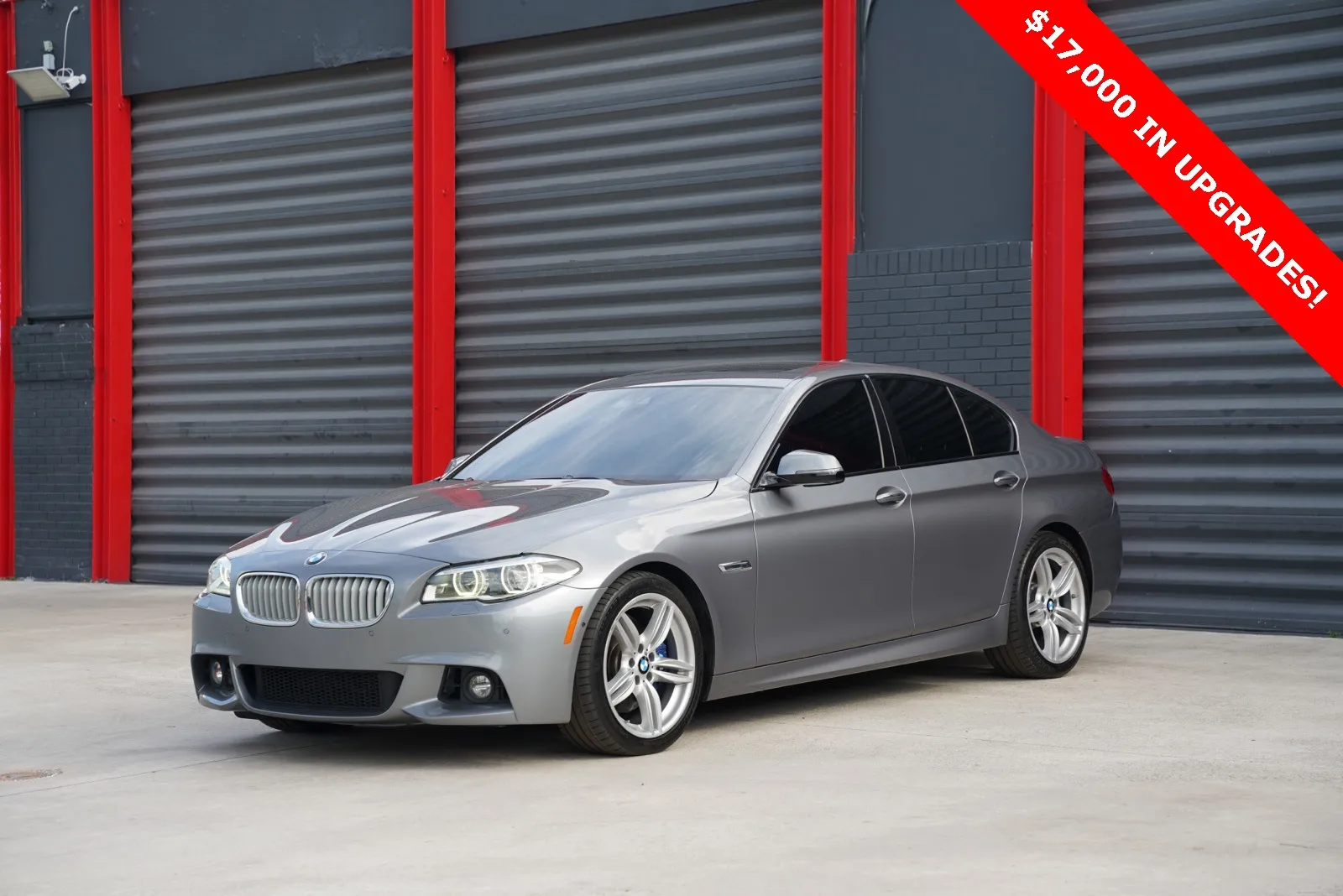
The 2014 BMW 550i represents the pivotal mid-cycle refresh of the sixth-generation (F10) 5 Series, marking the debut of the heavily redesigned N63TU twin-turbocharged V8 engine. Delivering 445 horsepower alongside comprehensive styling and technology updates, the 2014 model solved critical mechanical shortcomings of its predecessors while delivering an executive sedan with near-supercar acceleration.
The F10 Era and the 2014 Life Cycle Impulse
When BMW introduced the F10 generation of the 5 Series for the 2011 model year, the chassis shifted away from the razor-sharp, lightweight sporting ethos of the preceding E60 generation. Built on a modular platform shared with the F01 7 Series, the F10 prioritized high-speed stability, whisper-quiet cabin acoustics, and long-distance grand touring comfort. However, early iterations of the top-tier non-M model—the 550i—were plagued by mechanical growing pains under the hood and handling dynamics that critics found isolated from road feedback.
By the time the 2014 model year arrived, BMW initiated its mid-cycle refresh, known internally as the Life Cycle Impulse (LCI). The 2014 550i received subtle yet deliberate aesthetic upgrades:
- Re-profiled front kidney grilles with deeper vertical slats
- Redesigned front lower air intakes with revised chrome or sport accents
- Turn signals integrated into the exterior side mirror housings rather than the front fenders
- Standard xenon headlamps with newly optional adaptive full-LED units
- Revised rear apron styling and slimmer, more contoured LED light bars within the taillights
Inside the cabin, the 2014 LCI brought the updated iDrive 4.2 system featuring a ceramic or chrome rotary controller with an integrated touchpad surface, allowing drivers to trace letters and numbers for navigation inputs. BMW also tweaked the suspension hardware, revising front strut mounts, bushing durometers, and the calibration of the electric power steering rack to restore steering precision and reduce the disconnected feel that characterized the 2011–2013 cars.
Engineering the Heart: The Leap from N63 to N63TU
The most consequential transformation of the 2014 550i occurred under the hood. The original N63B44O0 engine—introduced across BMW's lineup starting in 2008—was an engineering milestone as the world’s first production automotive engine to utilize a "hot vee" layout. In this configuration, the intake manifolds sit on the outside of the cylinder heads, while the exhaust manifolds and twin turbochargers are mounted in the central valley between the 90-degree cylinder banks.
While the hot vee architecture yielded immediate throttle response and compact packaging, the original N63 suffered from extreme thermal retention. The intense heat cooked rubber vacuum hoses, hardened valve stem seals, degraded oil lines, and prompted premature timing chain elongation.
| Original N63 (2011–2013) | Updated N63TU (2014–2016) |
|---|---|
| 400 hp / 450 lb-ft torque | 445 hp / 480 lb-ft torque |
| No Valvetronic (throttle-body air) | Valvetronic III variable valve lift |
| Piezoelectric fuel injectors | Bosch solenoid fuel injectors |
| MAP / Speed-density intake metering | Dual Mass Air Flow (MAF) sensors |
| Single-circuit oil/coolant routing | Optimized thermal routing & chains |
For the 2014 model year, BMW replaced the N63 with the N63B44O1, widely referred to as the N63TU (Technical Update). This was not a minor calibration flash; it was an extensive mechanical overhaul.
1. Integration of Valvetronic III
The original N63 relied on conventional throttle bodies to regulate engine load. The N63TU integrated BMW’s Valvetronic III variable intake valve lift system alongside double-VANOS variable camshaft timing. By controlling engine breathing directly through the intake valves, throttle losses were eliminated, resulting in snappier transient throttle response, superior low-rpm torque production, and lower fuel consumption.
2. Revised Fuel Injection Architecture
Pre-LCI N63 engines utilized costly, delicate piezoelectric direct fuel injectors running on high-pressure circuits that were notorious for leaking down, washing cylinder walls of lubricating oil, and causing misfires. The N63TU abandoned piezo injectors in favor of more robust, conventional Bosch solenoid-type fuel injectors (HDEV5), dramatically reducing fuel injector failure rates.
3. Airflow and Engine Management Updates
The N63TU swapped the speed-density (manifold absolute pressure) air metering system for dual mass air flow (MAF) sensors situated directly post-airbox. Engine control duties moved to a more sophisticated Bosch engine control unit (MEVD17.2.8), orchestrating higher peak boost levels of roughly 11.6 psi from upgraded Honeywell Garrett turbochargers with revised compressor wheels.
4. Structural and Cooling Revisions
To address oil burning and premature mechanical wear, BMW re-engineered the piston ring lands, redesigned the crankcase ventilation (CCV) system, installed an improved timing chain with enhanced dampening guides, and reworked the cooling lines servicing the turbocharger bearing housings.
Powertrain Specifications and Performance Benchmark
The mechanical revisions of the N63TU transformed the 2014 550i into a true powerhouse, narrowing the real-world performance deficit between the standard executive cruiser and the high-strung, track-oriented F10 M5.
Power jumped from the pre-LCI’s 400 horsepower and 450 lb-ft of torque to 445 horsepower at 5,500 rpm and 480 lb-ft of torque, available across a wide flat curve starting at just 2,000 rpm. Every 2014 550i came paired with ZF’s second-generation 8HP70 eight-speed automatic transmission, capable of executing gear changes in 200 milliseconds while seamlessly handling the engine's massive torque envelope.
| Metric | 2011–2013 BMW 550i | 2014 BMW 550i (LCI) | 2014 BMW M5 (F10) |
|---|---|---|---|
| Engine Code | N63B44O0 | N63B44O1 (N63TU) | S63B44T0 |
| Configuration | 4.4L Twin-Turbo V8 | 4.4L Twin-Turbo V8 | 4.4L Twin-Turbo V8 |
| Horsepower | 400 hp @ 5,500 rpm | 445 hp @ 5,500 rpm | 560 hp @ 6,000 rpm |
| Torque | 450 lb-ft @ 1,750 rpm | 480 lb-ft @ 2,000 rpm | 500 lb-ft @ 1,500 rpm |
| Transmission | 6-Spd Manual / 8-Spd Auto | 8-Spd Sport Automatic | 6-Spd Manual / 7-Spd DCT |
| Drivetrain | RWD or xDrive AWD | RWD or xDrive AWD | Rear-Wheel Drive only |
| 0–60 mph (RWD) | 4.8 seconds | 4.5 seconds | 4.1 seconds |
| 0–60 mph (xDrive) | 4.6 seconds | 4.3 seconds | N/A |
| Quarter-Mile | 13.1 sec @ 108 mph | 12.6 sec @ 112 mph | 12.0 sec @ 122 mph |
| Curb Weight (lbs) | ~4,374 (RWD) | ~4,431 (RWD) | ~4,387 |
Equipped with BMW's xDrive intelligent all-wheel-drive system, the 2014 550i routinely logged real-world 0–60 mph sprints in 4.3 seconds under instrumented testing, making it faster off the line than the rear-wheel-drive M5 on unprepared road surfaces. Power delivery was linear, lacking the sudden spike or turbo lag associated with smaller-displacement forced-induction motors, providing sustained pull well into triple-digit speeds.
Dynamics: Luxury Cruiser Versus Sport Sedan
The driving experience of the 2014 BMW 550i depends heavily on how the car was configured from the factory. Base models leaned heavily toward a plush, floating ride quality reminiscent of full-size flagship sedans. However, when ordered with the M Sport Package and Adaptive Drive (which bundled Dynamic Damper Control with Active Roll Stabilization), the F10’s dual personality came forward.
- Driving Experience Control: Drivers could cycle between Eco Pro, Comfort, Comfort+, Sport, and Sport+ modes. These settings systematically altered throttle mapping, transmission shift points, damper stiffness, and steering weight.
- Active Roll Stabilization (ARS): This system utilized hydraulically split anti-roll bars that actively twisted against cornering forces. Under hard cornering, the 4,400-pound sedan remained unnervingly flat, masking its mass through switchbacks and sweepers.
- Integral Active Steering: An optional rear-wheel steering setup turned the rear wheels up to 2.5 degrees opposite the front wheels at low speeds to shrink the turning radius, or in the same direction at highway speeds to execute lane changes with monorail stability.
Despite these advanced chassis dynamics, the 2014 550i was never a pure canyon carver. Its braking system—consisting of 374 mm front ventilated discs gripped by aluminum sliding calipers—provided decisive stopping power for street use, but rapid heat buildup made it unsuitable for sustained track duty without fluid and pad upgrades.
Critical Reliability, Maintenance, and Known Vulnerabilities
While the N63TU resolved the structural disasters of early N63 iterations—such as the infamous timing chain stretch that prompted BMW’s nationwide "Customer Care Package" recall campaign—it remains a complex, high-stress German performance powertrain. The intense thermal conditions of the hot vee architecture still necessitate meticulous preventative maintenance.
Critical Maintenance Areas for the N63TU Engine:
- Hot Vee Thermal Zone:
- Turbo Coolant Lines (O-rings bake every 60k-80k mi)
- Crankcase Vent Hoses (Plastic gets brittle)
- Aux Electric Water Pumps (Internal shorting risk)
- Mechanical Wear Items:
- Valve Stem Seals (Noticeable smoke after idling)
- Oil Pan Gasket & Alternator Bracket Seals
- Front Thrust Arm Bushings (Hydro-bearing leaks)
1. Turbocharger Coolant and Oil Lines
The steel braided and rubber hoses routing engine coolant and synthetic oil to the center-mounted turbos sit directly within the engine’s highest heat zone. Over 60,000 to 80,000 miles, the internal Viton O-rings dry out, resulting in persistent coolant leaks that drip down onto the engine block, emitting a distinct sweet aroma under the hood. Upgraded silicone or revised OE thermal-shielded line kits are standard remedies.
2. Valve Stem Seals
Although far less prone to failure than the 2011–2013 versions, the N63TU valve stem seals can still harden past 100,000 miles due to accumulated heat cycles. The primary symptom is a cloud of bluish smoke exiting the exhaust tailpipes after idling for 5 to 10 minutes followed by a firm throttle application. Replacement requires specialized valvetrain tools to compress the springs without removing the cylinder heads from the vehicle.
3. Oil Consumption and Intervals
Factory BMW recommendations originally suggested 10,000-mile or 15,000-mile oil change intervals. For the N63TU, following that schedule is catastrophic. High-performance twin-turbo V8 engines shear synthetic oil rapidly; oil change intervals must be capped at 5,000 miles using high-quality BMW Longlife-01 (LL-01) certified 5W-30 or 5W-40 oils. Owners should anticipate consuming roughly 1 quart of oil every 1,500 to 3,000 miles under normal operating conditions.
4. Crankcase Ventilation (CCV) Lines
The corrugated plastic hoses that route blow-by gases from the valve covers back into the turbocharger intake pipes become brittle over time. Light contact during routine spark plug or air filter replacements can snap these lines, causing unmetered air leaks, lean running codes, and erratic idling.
Buying and Ownership Guide for a Used 2014 550i
Acquiring a 2014 550i delivers tremendous performance per dollar, offering executive comfort and effortless V8 power for a fraction of its original $64,000 to $85,000 window sticker. However, buying an unvetted or neglected example can quickly turn into a financial pitfall.
Essential Pre-Purchase Inspection (PPI) Checklist
Before purchasing a 2014 550i, prioritize a thorough inspection by a specialized independent BMW technician:
- Borescope Inspection & Smoke Test: Inspect the combustion chambers for oil pooling and smoke-test the intake and vacuum routing to locate cracked plastic fittings.
- Scan for Shadow Fault Codes: Standard OBD-II scanners only read generic emission faults. Connect via BMW-specific diagnostics (such as ISTA, INPA, or specialized scan tools) to check for shadow codes related to fuel rail pressure drops, auxiliary water pump faults, and VANOS actuator position errors.
- Inspect the "Valley" of the Engine: Use an inspection camera to view underneath the turbocharger heat shield. Any crusty white, blue, or green deposits point to leaking turbo coolant supply lines.
- Suspension Bushings: Check the front control arm thrust rod bushings (hydro-bushings). Because of the heavy V8 engine up front, these fluid-filled rubber mounts frequently crack and leak between 50,000 and 70,000 miles, causing steering shimmy during moderate braking.
Cost Expectations
Prospective buyers must budget for maintenance appropriately. An annual emergency fund of $2,000 to $3,000 is realistic for unexpected mechanical work, sensors, battery replacements (the dual-battery or large AGM charging system works hard on these cars), and suspension wear.
Frequently Asked Questions
What is the difference between the 2013 and 2014 BMW 550i?
The 2014 550i received the refreshed N63TU engine producing 445 hp and 480 lb-ft of torque, a notable jump over the 2013 model's 400 hp and 450 lb-ft N63 engine. The 2014 model also introduced the LCI cosmetic updates, revised steering geometry, updated iDrive 4.2 with a touch controller, and replaced the problematic piezoelectric fuel injectors with durable solenoid injectors.
Is the 2014 BMW 550i reliable?
The 2014 550i is significantly more reliable than earlier 2011–2013 F10 550i models because the N63TU addressed major design flaws in the timing assembly and fuel system. However, it is still a complex, high-maintenance twin-turbo V8. It requires strict 5,000-mile oil change intervals, proactive replacement of plastic cooling lines, and periodic attention to valve stem seals and auxiliary pumps.
Can the 2014 550i be tuned for more power?
Yes, the N63TU responds well to aftermarket software tuning. A basic Stage 1 flash tune on an otherwise stock engine typically elevates output to approximately 500–520 horsepower and over 550 lb-ft of torque on 93-octane pump gas. However, tuning significantly increases thermal stress on the hot vee components and places extra strain on the cooling system, requiring accelerated maintenance schedules.
Did the 2014 BMW 550i come with a manual transmission?
No, the 6-speed manual transmission was discontinued for the 550i in the North American market after the 2013 model year. All 2014 550i models feature the ZF 8HP70 8-speed sport automatic transmission with paddle shifters. Drivers wanting an F10 with three pedals in 2014 had to choose the F10 M5 or the six-cylinder 535i.
How does the 2014 550i compare to the 535i of the same year?
The 535i utilizes the 3.0-liter N55 single-turbo inline-six engine producing 300 horsepower. While the 535i is slower (0–60 mph in roughly 5.5 seconds), it is lighter over the front axle, easier to work on, and notably cheaper to maintain over its lifespan. The 550i sacrifices lower maintenance costs and fuel efficiency in exchange for effortless V8 acceleration, deep torque reserves, and higher standard luxury equipment.
Recommended Next Steps
If you are evaluating a 2014 BMW 550i for purchase, follow this sequence to protect your investment:
- Pull the Full Maintenance History: Verify that previous owners completed oil changes at reasonable intervals (ideally under 7,500 miles, rather than the extended factory schedule) and confirm whether the turbo coolant lines, spark plugs, and ignition coils have been serviced recently.
- Commission an Independent PPI: Never purchase an N63TU-powered BMW without an inspection by a shop equipped with dedicated BMW diagnostic software. Ensure they perform cold-start and extended-idle exhaust smoke checks.
- Execute Preventative Upgrades Post-Purchase: Upon acquiring the vehicle, replace all plastic turbo coolant lines with revised components, flush the drivetrain fluids (including the ZF transmission and differential fluids), and program your maintenance tracker for 5,000-mile engine oil intervals.