Achieving 10 000 pound towing power requires a properly equipped full-size truck or large SUV, a verified weight distribution system, and strict adherence to payload limits and trailer tongue weight ratings. This capacity comfortably handles large travel trailers, multi-car haulers, and heavy utility equipment.
Towing a 10 000-pound load is a significant operational threshold in the automotive and trailer industry. For everyday drivers, recreational enthusiasts, and commercial operators alike, managing this weight requires moving past light-duty setups into heavy-duty or properly configured half-ton and three-quarter-ton territory. Understanding what 10 000 pounds of towing capacity actually means involves analyzing gross combined weight ratings, hitch classes, braking systems, and the underlying mechanics of modern powertrain engineering.
Defining 10 000 Pound Towing Power in Context
To understand a 10 000-pound capacity, it is essential to distinguish between Gross Vehicle Weight Rating (GVWR), Gross Combined Weight Rating (GCWR), and maximum trailer weight. The maximum towing capacity specifies the absolute heaviest trailer a vehicle can pull under ideal testing conditions. However, reaching this number safely in the real world is rarely just a matter of hooking up a heavy trailer to a standard bumper hitch.
When a vehicle is rated for 10 000 pounds of towing power, the chassis, transmission, cooling system, and axle ratios are engineered to handle the thermal and mechanical stress of moving five tons of rolling resistance. Yet, achieving this capability relies heavily on balancing the weight distribution inside the tow vehicle itself. Passengers, cargo, fuel, and aftermarket accessories all subtract from the available payload, which directly impacts how much trailer weight the vehicle can safely carry on its rear axle.
Vehicle Categories Capable of 10 000 Pounds
Not all vehicles can handle a 10 000-pound load. Selecting the correct vehicle category is the first step in establishing a safe and legal towing configuration.
Modern Half-Ton Pickup Trucks
Many modern half-ton pickup trucks—such as the Ford F-150, Chevrolet Silverado 1500, Ram 1500, and Toyota Tundra—advertise maximum towing capacities that meet or exceed 10 000 pounds. However, achieving this rating usually requires specific engine configurations, such as high-output turbo-gas engines or heavy-duty hybrid powertrains, paired with an optional max-trailer-tow package and a specific axle ratio. Base-model half-tons with standard utility cabs often max out far lower.
Three-Quarter-Ton and One-Ton Heavy-Duty Trucks
Heavy-duty trucks (Class 2 and Class 3 vehicles like the Ford F-250/F-350, Ram 2500/3500, and Chevrolet Silverado 2500HD/3500HD) handle 10 000-pound loads with ease. Because these trucks are built with heavy-duty frames, larger brakes, multi-leaf rear suspension systems, and robust diesel or large-displacement gasoline engines, a 10 000-pound trailer represents a moderate load rather than a maximum-limit test.
Large SUVs
Select large, body-on-frame SUVs—including the Chevrolet Suburban, GMC Yukon XL, Ford Expedition, and Jeep Wagoneer—can reach or approach a 10 000-pound towing capacity when equipped with heavy-duty towing packages. These vehicles bridge the gap for drivers who need passenger seating alongside serious hauling capability, though their lighter relative weight compared to pickup trucks makes proper weight distribution even more critical.
Essential Hardware and Equipment Requirements
Pulling a 10 000-pound trailer requires robust physical connections between the tow vehicle and the load. Relying on standard factory components without verifying their ratings can lead to catastrophic equipment failure.
| Equipment Component | Minimum Requirement for 10 000 lb Towing | Function and Importance |
|---|---|---|
| Receiver Hitch | Class IV Hitch (rated up to 10,000–12,000 lbs weight-carrying) | Secures the physical connection point to the vehicle frame. |
| Hitch Ball and Mount | 2-5/16 inch forged steel ball and heavy-duty shank | Connects the trailer coupler to the receiver; must match tongue weight. |
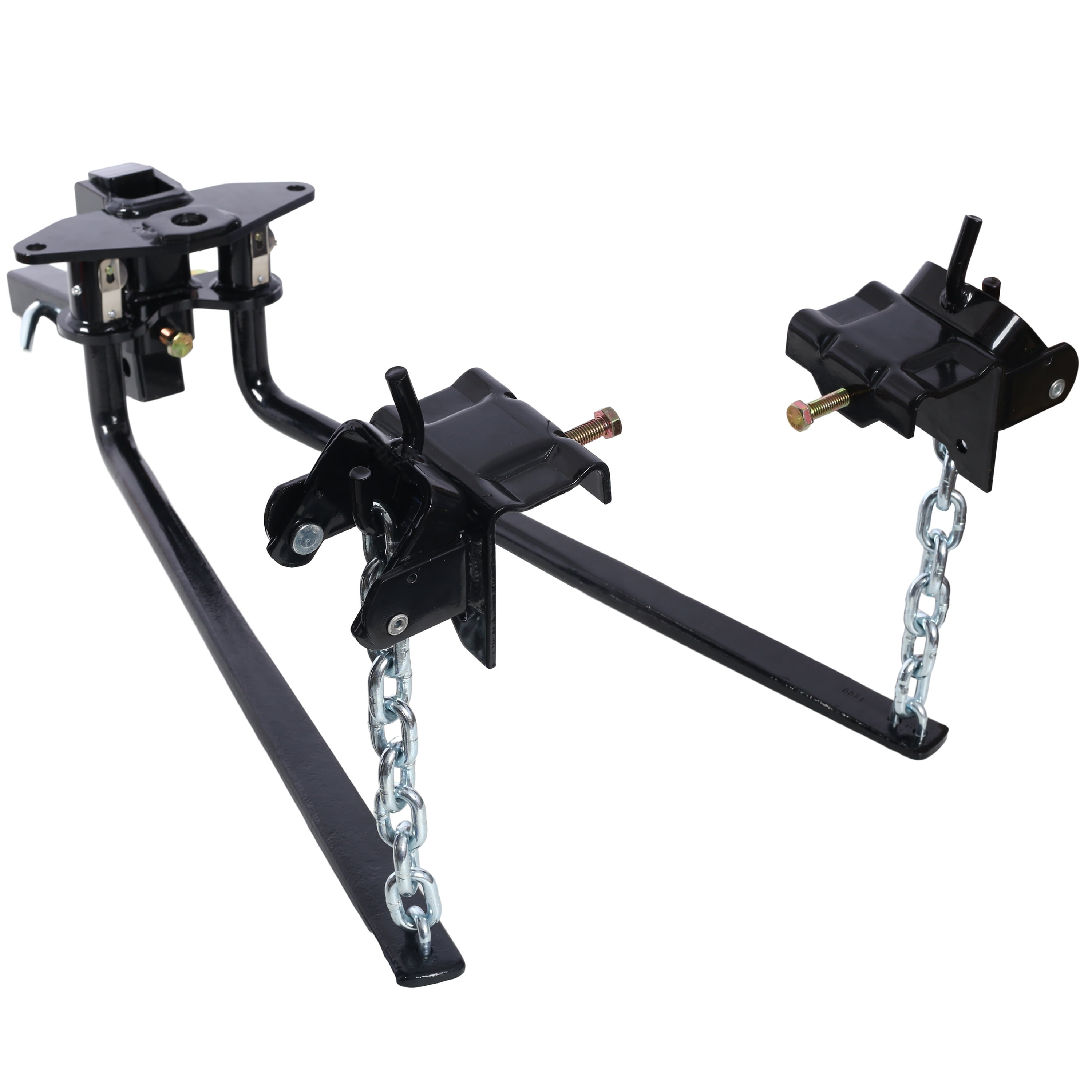
| Weight Distribution System | Spring-bar system rated for 10,000+ lbs | Redistributes tongue weight to the front axle of the tow vehicle. |
| Trailer Brakes | Electric or electric-over-hydraulic brakes on all axles | Provides necessary stopping power independent of the tow vehicle. |
| Brake Controller | Integrated or aftermarket proportional brake controller | Modulates trailer brakes synchronously with the tow vehicle pedals. |
Hitch Classes and Receiver Ratings
Hitch receivers are categorized by classes. A Class III hitch typically handles up to 5 000 pounds, making it insufficient for a 10 000-pound load without weight distribution, or more commonly, requiring a Class IV or Class V hitch receiver bolted directly to the vehicle's frame rails. Every component in the chain—including the hitch receiver, the drawbar, the ball mount, and the trailer ball itself—must be stamped with a rating equal to or exceeding the total weight of the trailer.
Trailer Brake Systems
At 10 000 pounds, relying solely on the tow vehicle’s brakes is illegal in almost every jurisdiction and mechanically impossible without risking brake fade or total system failure. Trailers in this weight class must feature operational brakes on all wheels. Integrated factory brake controllers or properly calibrated aftermarket proportional controllers are required to send an electrical current to the trailer's drum or disc brakes in direct proportion to the deceleration force of the tow vehicle.
Operational Safety and Physics at 10 000 Pounds
Operating a vehicle towing five tons demands heightened spatial awareness, defensive driving techniques, and an understanding of dynamic physics.
Tongue Weight Management
Tongue weight—the downward force the trailer coupler exerts on the hitch ball—should ideally fall between 10% and 15% of the total loaded trailer weight. For a 10 000-pound trailer, this means a tongue weight of 1,000 to 1,500 pounds. If the tongue weight is too low, the trailer can begin to sway dangerously at highway speeds. If it is too high, it unloads the front steering axle of the tow vehicle, reducing steering grip and headlight alignment.
Braking Distances and Stopping Power
Adding 10 000 pounds of momentum dramatically increases the distance required to bring a rig to a complete stop. Drivers must substantially increase following distances, anticipate traffic flow well in advance, and utilize lower transmission gears or exhaust brakes (common on diesel trucks) when descending steep grades to prevent overheating the service brakes.
Sway Control and Wind Resistance
Crosswinds, passing semi-trucks, and uneven road surfaces create aerodynamic forces that can push a heavy trailer around. Mechanical sway control devices or electronic stability control systems integrated into modern tow vehicles help dampen lateral movement and keep the trailer tracking straight behind the tow vehicle.
Common Mistakes to Avoid When Towing Heavy Loads
Attempting to tow near maximum capacity without adequate preparation introduces significant safety risks. Avoiding frequent miscalculations ensures a safer towing experience.
- Exceeding Payload Limits: Assuming that because a truck is rated to pull 10 000 pounds, it can also carry a heavy payload in the bed at the same time. Always check the payload sticker on the driver-side door jamb.
- Skipping Scale Verification: Guessing the weight of a loaded trailer rather than visiting a certified public scale (such as a CAT scale) to verify actual axle weights.
- Improper Cargo Distribution: Loading heavy items exclusively at the rear of the trailer, which destroys tongue weight and induces violent trailer sway.
- Neglecting Maintenance: Failing to inspect trailer wheel bearings, tire pressure, suspension components, and safety chains before every long trip.
Frequently Asked Questions
Can a half-ton truck really pull 10 000 pounds safely?
Yes, many modern half-ton trucks are engineered with maximum towing ratings of 10 000 pounds or more. However, this is a maximum rating achieved under specific configurations. In practice, payload capacity and high tongue weights often limit half-ton trucks before reaching their absolute maximum trailer weight rating.
Do I need a weight distribution hitch for a 10 000-pound trailer?
A weight distribution system is strongly recommended and often required by hitch manufacturers for trailers exceeding 5 000 pounds. For a 10 000-pound load, it is essential for leveling the tow vehicle, restoring steering control, and ensuring braking stability across all axles.
What is the difference between towing capacity and payload capacity?
Towing capacity is the maximum weight the vehicle can pull behind it via a hitch. Payload capacity is the maximum total weight of passengers, cargo, fuel, and trailer tongue weight that can be placed inside or on the tow vehicle itself. Both limits must be respected simultaneously.
How does altitude affect 10 000-pound towing power?
Naturally aspirated gasoline engines lose power at higher elevations due to thinner air (roughly a 3% to 4% loss per 1,000 feet of elevation gain). Turbocharged gasoline engines and modern diesel engines compensate much better for altitude, maintaining consistent torque delivery when pulling heavy loads through mountain passes.
Are commercial driver's licenses (CDLs) required to pull a 10 000-pound trailer?
In most jurisdictions, personal recreational towing of a 10 000-pound travel trailer or utility trailer does not require a CDL, provided the combined gross vehicle weight rating (GCWR) remains below federal or state commercial weight thresholds, typically 26,001 pounds for non-commercial combinations. Commercial applications are subject to different regulatory standards.
Next Actions and Verification Steps
Before hooking up a 10 000-pound load, consult your vehicle owner's manual to confirm the specific GCWR and towing limits for your exact VIN and axle ratio. Visit a certified weight scale with your vehicle and trailer fully loaded to verify that your front axle, rear axle, and total combined weights remain within the manufacturer's safe operating limits.