For eligible service members, veterans, and eligible surviving spouses, VA loans are widely considered one of the most powerful and advantageous mortgage products available on the market, frequently outperforming conventional and FHA loans by eliminating down payment requirements and private mortgage insurance. However, whether a VA loan is truly good for your specific financial situation depends on your long-term housing plans, cash flow management, and the unique fee structures associated with the program.
Navigating the complexities of home financing requires a clear understanding of how government-backed mortgage programs function compared to conventional lending standards. The Department of Veterans Affairs does not directly lend money; instead, it sets the rules for the program, provides guidelines for lenders, and guarantees a portion of the loan against default. This federal guarantee allows private lenders—such as banks, credit unions, and specialized mortgage companies—to offer more favorable terms to qualified borrowers. While the advantages are substantial, prospective buyers must evaluate the complete financial picture, including upfront funding fees, regional loan limits, and property condition requirements, before deciding if this path aligns with their goals.
Understanding the Fundamentals of VA Loans
Established under the Servicemen's Readjustment Act of 1944—commonly known as the G.I. Bill—the VA home loan program was designed to help returning service members reintegrate into civilian life by facilitating homeownership. Over the decades, the program has evolved to meet changing real estate markets, but its core mission remains unchanged: providing accessible, low-cost mortgage financing to those who have served the United States in uniform.
Unlike conventional mortgages that typically demand a substantial financial cushion, VA loans reduce the friction of entering the property market. Lenders take comfort in the partial guaranty provided by the federal government, which mitigates their risk if the borrower defaults. This structural safety net translates directly into lower interest rates, flexible underwriting criteria regarding debt-to-income (DTI) ratios, and the elimination of ongoing monthly mortgage insurance premiums, regardless of the size of the down payment.
Key Advantages That Make VA Loans Highly Desirable
The appeal of the VA loan program stems from several distinct financial benefits that are rarely packaged together in standard conventional loan products. Evaluating these benefits reveals why millions of veterans and military families choose this financing route for their primary residences.
Zero Down Payment Requirement
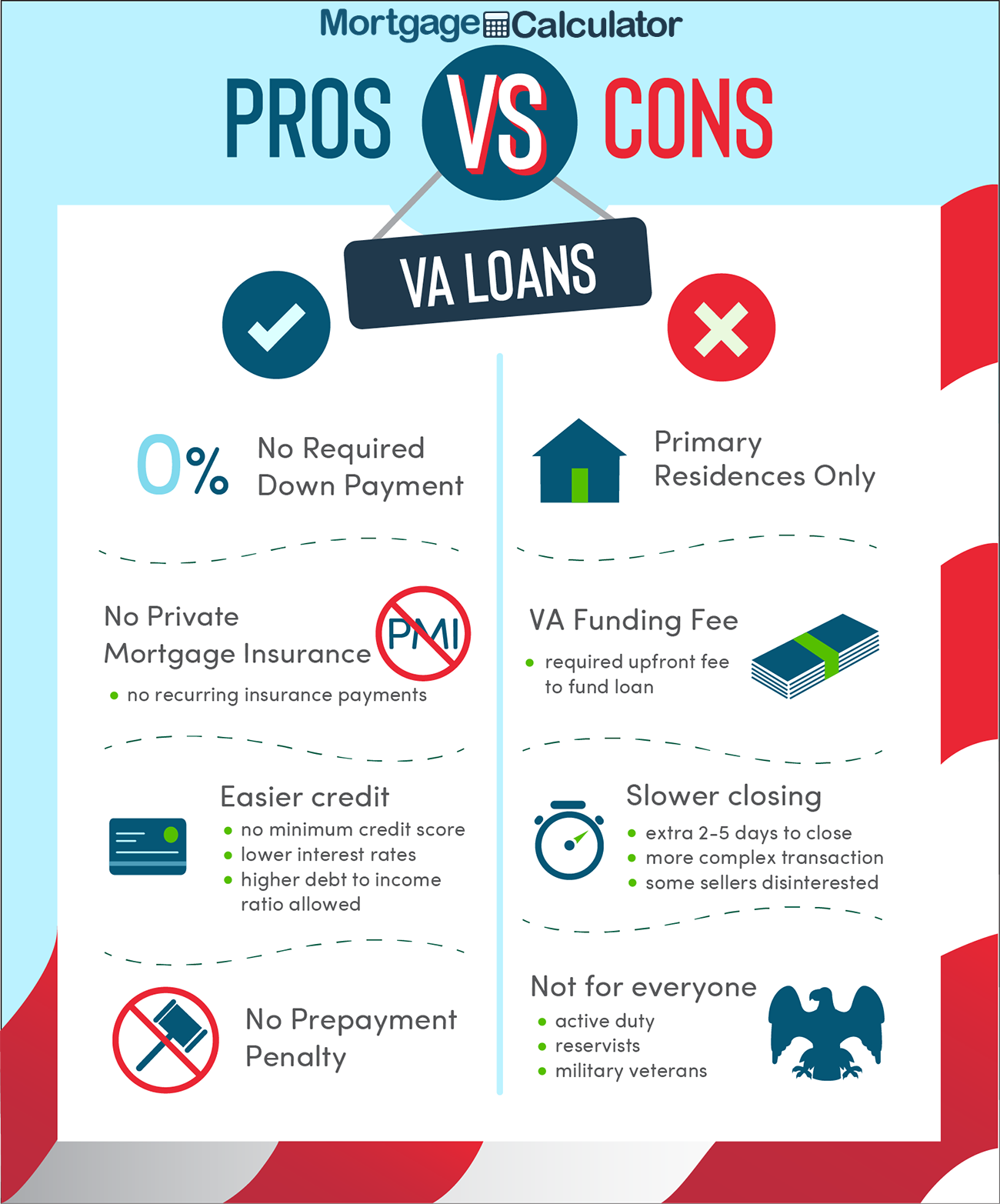
One of the most significant barriers to homeownership is saving for a down payment, which traditionally ranges from 3% to 20% of a home's purchase price. VA loans allow eligible borrowers to finance up to 100% of the home's value. This enables buyers to enter the housing market years sooner than they might otherwise be able to, preserving liquid savings for emergencies, maintenance, or other investments rather than locking cash into home equity immediately.
Elimination of Private Mortgage Insurance (PMI)
When conventional loan buyers put down less than 20%, lenders require private mortgage insurance to protect against loss, adding an ongoing monthly expense that does not build equity. VA loans never require monthly mortgage insurance. Instead, the program is sustained by a one-time VA funding fee. Removing PMI saves homeowners hundreds of dollars every month, significantly lowering the total cost of homeownership over the life of the loan.
Competitive Interest Rates
Because the federal government guarantees a portion of the loan, lenders assume less risk. This lower risk profile allows participating lenders to offer interest rates that are typically lower than average market rates for conventional mortgages. Over a 15-year or 30-year term, securing a lower interest rate can translate to tens of thousands of dollars in interest savings.
Lenient Credit and Qualification Standards
While lenders still review credit scores, income, and debt-to-income ratios, the VA guidelines are generally more forgiving than those for conventional financing. The VA does not set a minimum credit score requirement, though individual lenders may set their own baseline overlays. Furthermore, the underwriting process takes a holistic view of the borrower's residual income—the cash remaining after monthly obligations and living expenses are met—ensuring that homeownership is genuinely sustainable for military households.
Potential Drawbacks and Hidden Costs to Consider
Despite the impressive array of benefits, VA loans are not universally ideal for every buyer or property type. Recognizing the limitations and potential costs of the program ensures a well-rounded evaluation.
The VA Funding Fee
While buyers avoid monthly mortgage insurance, they must pay a one-time VA funding fee at closing. This fee ranges from 1.25% to 3.3% of the total loan amount, depending on factors such as the size of the down payment, whether it is a first-time or subsequent use, and the branch of service (with National Guard and Reserve members often seeing slight variations based on down payments). Borrowers can finance this fee into the loan amount, but doing so increases the principal balance and total interest paid over time. Veterans with a service-connected disability are exempt from this fee entirely.
Property Restrictions and Appraisal Rigor
The VA aims to protect buyers from purchasing substandard or unsafe housing. Consequently, the VA appraisal process involves a strict evaluation of property condition, focusing on safety, structural integrity, and sanitation (Minimum Property Requirements or MPRs). In competitive real estate markets featuring fixer-uppers or older homes, sellers may hesitate to accept VA offers if they fear the appraisal will flag required repairs that they are unwilling or unable to fix prior to closing.
Occupancy Requirements
VA loans are strictly intended for primary residences. Borrowers must certify that they intend to occupy the property as their home. You cannot use a VA loan to purchase an investment property, a vacation home, or a pure rental portfolio, though multi-unit properties (up to four units) are permissible as long as the borrower occupies one of the units.
Limitations in Highly Competitive Markets
In fast-moving real estate markets where multiple offers are common, some sellers and listing agents harbor misconceptions about VA loans, incorrectly believing they take longer to close or are more likely to fall through. While modern processing times for VA loans are comparable to conventional loans, buyers may need to work with experienced real estate agents who can effectively advocate for the strength of a VA pre-approval.
Comparing Mortgage Options: VA vs. Conventional vs. FHA
To determine if a VA loan is truly right for you, comparing its parameters against alternative mortgage products clarifies which vehicle best matches your financial profile.
| Feature | VA Loan | Conventional Loan | FHA Loan |
|---|---|---|---|
| Minimum Down Payment | 0% | 3% to 5% | 3.5% |
| Mortgage Insurance | None (One-time funding fee) | Required if down payment is under 20% (PMI) | Required upfront and monthly (MIP) for the life of the loan |
| Credit Score Requirements | Set by lender (typically 580–620+) | Generally 620+ (better rates at 740+) | Generally 580+ (3.5% down) or 500 (10% down) |
| Property Usage | Primary residence only | Primary, secondary, or investment | Primary residence only |
| Debt-to-Income (DTI) Limits | Flexible, focuses on residual income | Typically capped around 43% to 50% | Typically capped around 43% to 50% |
As the comparison demonstrates, the elimination of ongoing mortgage insurance and the lack of a down payment give the VA loan a structural advantage for eligible individuals purchasing a primary home.
Eligibility Requirements and Documentation
Before shopping for a home, applicants must confirm their eligibility through the Department of Veterans Affairs. Eligibility is established by obtaining a Certificate of Eligibility (COE). Service requirements vary based on the era of service, active-duty status, National Guard or Reserve participation, and discharge characterization.
- Active Duty Service Members: Generally eligible after serving 90 continuous days of active duty during wartime or 181 continuous days during peacetime.
- National Guard and Reserve Members: Generally eligible after completing 6 cumulative years of service, or 90 days of active-duty service under specific Title 10 or Title 32 orders.
- Veterans: Eligibility depends on length of service and meeting minimum active-duty requirements for the specific operational era.
- Surviving Spouses: Unremarried surviving spouses of service members who died on active duty, as a result of a service-connected disability, or who are missing in action/prisoners of war may also qualify.
Obtaining the COE can often be done instantaneously online through the Department of Veterans Affairs official portal, though complex service records may require manual mail-in processing.
When a VA Loan Might NOT Be the Best Choice
While the financial incentives are strong, specific scenarios exist where a conventional loan or paying cash might make more strategic sense:
- Substantial Down Payment and Excellent Credit: If you have saved a 20% down payment and possess an elite credit score, a conventional loan might secure a comparable or slightly lower interest rate without incurring the VA funding fee, depending on current market pricing and fee financing costs.
- Purchasing Investment Property: Because VA loans mandate primary occupancy, real estate investors looking to build a portfolio of rental properties cannot utilize this program.
- Buying a Distressed Property Requiring Major Renovation: If you are targeting a foreclosure or a property with severe deferred maintenance that fails VA minimum property requirements, sellers may refuse to make repairs, forcing you toward specialized renovation loans or cash purchases.
Frequently Asked Questions
Can I use a VA loan more than once?
Yes. VA loan entitlement is a lifetime benefit that can be reused. You can have multiple VA loans simultaneously under specific circumstances (such as a permanent change of station or remaining entitlement), or you can restore your entitlement after selling the previous home and paying off the prior mortgage in full.
Do I need a specific credit score to get a VA loan?
The VA does not establish a minimum credit score requirement. However, individual mortgage lenders establish their own underwriting overlays. While some lenders accept scores starting at 580, others prefer 620 or higher. Shopping around among lenders specializing in military lending is essential to find terms that match your credit profile.
What is the VA funding fee, and can it be avoided?
The VA funding fee is a government fee applied to help keep the program running without ongoing taxpayer subsidies. It varies based on your down payment and military category. Veterans who receive compensation for a service-connected disability are legally exempt from paying the funding fee entirely.
Can I use a VA loan to buy a condo or manufactured home?
Yes, but the property must meet specific regulatory hurdles. Condominiums must be located on the VA-approved condo list maintained by the Department of Veterans Affairs. Manufactured homes must be permanently affixed to a foundation and meet specific state and federal structural guidelines.
How does residual income factor into VA loan approval?
Unlike conventional loans that focus heavily on debt-to-income ratios, the VA uses a residual income calculation. This metric measures the net income remaining for a household after deducting federal, state, and local taxes, social security, maintenance, estimated utilities, and proposed mortgage payments. This ensures the borrower has sufficient cash left over for basic family living expenses.
Conclusion and Next Actions
For those who have earned the benefit through military service, the VA loan remains one of the most efficient, cost-effective pathways to homeownership available. By eliminating down payment hurdles and recurring mortgage insurance, it preserves personal liquidity while offering competitive borrowing costs. To determine if it is right for your household, begin by verifying your service eligibility, pulling your Certificate of Eligibility, and consulting with lenders experienced in military finance to compare custom loan estimates against conventional alternatives.