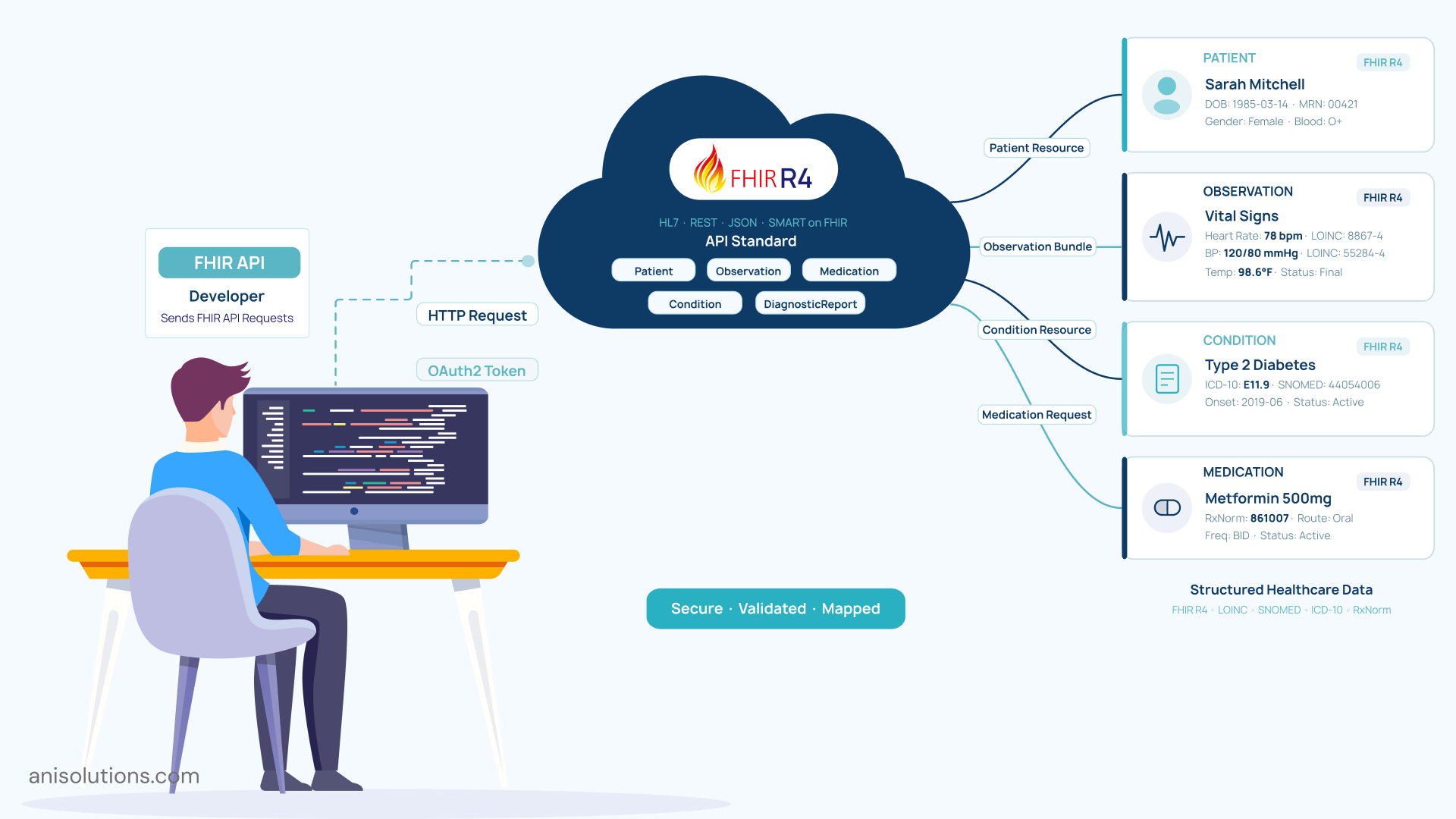
API data integration is the process of connecting distinct software applications, cloud platforms, and databases using Application Programming Interfaces to automate data exchange. It enables systems to transmit, transform, and synchronize data across enterprise environments in real time or scheduled batches, establishing a unified ecosystem without manual data entry.
Understanding API Data Integration and Its Strategic Role
Modern enterprises rely on dozens—often hundreds—of specialized software applications. From Enterprise Resource Planning (ERP) engines like SAP and Oracle to Customer Relationship Management (CRM) tools like Salesforce, data naturally becomes siloed inside individual applications. API data integration bridges these isolated repositories, allowing software applications to communicate programmatically through standardized request and response protocols.
Unlike legacy data integration methods that depended heavily on flat-file transfers, batch Secure File Transfer Protocol (SFTP) uploads, or direct database-to-database connections, API-driven integration abstracts the underlying database schemas. Instead of querying raw tables directly—which risks breaking database integrity and bypassing business logic—an Application Programming Interface exposes safe, structured endpoints governed by precise validation rules.
When systems exchange data via APIs, they enforce organizational rules at the application layer. For example, when an e-commerce platform sends a new order payload to an inventory system via a RESTful endpoint, the receiving API automatically checks inventory levels, validates shipping addresses, applies localized tax rules, and triggers fulfillment workflows. This abstraction layer ensures that underlying storage mechanisms can evolve without breaking connected services.
From an architecture perspective, API data integration forms the foundation of modern composable enterprises. It empowers organizations to adopt best-of-breed SaaS tools, replace monolithic legacy platforms with microservices, and feed real-time analytics engines. Whether supporting operational workflows or consolidating enterprise data warehouses, well-designed API integration pathways decrease operational overhead and minimize human error.
Core Protocols and Architectures for API Integration
Selecting the appropriate API architecture depends on payload size, latency constraints, network bandwidth, and the relationships between client and server systems. Four primary architectural styles dominate contemporary API data integration:
1. REST (Representational State Transfer)
REST remains the dominant architectural style for web-based data integration. Operating primarily over HTTP/HTTPS, REST relies on stateless communication and standardized HTTP methods (GET, POST, PUT, PATCH, DELETE) to manipulate resources identified by uniform resource identifiers (URIs). RESTful APIs typically exchange data in JSON (JavaScript Object Notation) or XML formats. Their widespread adoption stems from simplicity, cacheability, and native compatibility with modern web technologies.
2. GraphQL
Developed to solve the over-fetching and under-fetching problems common in traditional REST setups, GraphQL is an open-source query language for APIs. Instead of defining multiple fixed endpoints for different data entities, a GraphQL architecture exposes a single endpoint. Clients submit precise queries specifying exactly which fields and nested relationships they require. This capability makes GraphQL highly efficient for mobile integrations or complex data-mapping operations where minimizing network payload sizes is critical.
3. SOAP (Simple Object Access Protocol)
SOAP is a strict, protocol-based specification that relies exclusively on XML for message formatting. Unlike REST, SOAP defines rigid security, transactional consistency, and error-handling rules through standards like WS-Security and WS-AtomicTransaction. While SOAP carries higher protocol overhead and complex XML schemas (defined via WSDL documents), it remains prevalent in legacy enterprise systems, financial networks, and healthcare integrations where strict contract adherence and ACID compliance are required.
4. gRPC and WebSockets
For low-latency, high-throughput inter-service communication, gRPC (Google Remote Procedure Call) and WebSockets offer lightweight alternatives to standard HTTP REST APIs. gRPC uses HTTP/2 as its transport mechanism and Protocol Buffers (Protobuf) as its binary serialization format, significantly reducing network footprint and CPU usage compared to JSON parsing. WebSockets establish persistent, full-duplex TCP connections, making them ideal for bidirectional, real-time data streaming such as financial ticker updates or live telematics feeds.
Comparative Analysis of Integration Protocols
| Protocol / Architecture | Primary Data Format | Transport Protocol | Latency & Overhead | Best Use Cases |
|---|---|---|---|---|
| REST | JSON, XML, Plain Text | HTTP / HTTPS | Moderate overhead; easy caching | Web applications, general SaaS connections, CRUD operations |
| GraphQL | JSON | HTTP / HTTPS | Low network payload; moderate server CPU load | Complex client applications, mobile integrations, aggregations |
| SOAP | XML exclusively | HTTP, SMTP, JMS | High overhead due to XML verbose structures | Banking systems, legacy enterprise software, formal contracts |
| gRPC | Protocol Buffers (Binary) | HTTP/2 | Extremely low latency and minimal bandwidth | Microservice networks, high-frequency telemetry, internal services |
| WebSockets | Binary, JSON, Text | TCP (Persistent) | Very low overhead post-handshake | Real-time event streaming, live chat, interactive dashboards |
Primary API Data Integration Patterns
System architects leverage different integration patterns based on operational demands, system availability, and data consistency requirements.
Synchronous Request-Response Flow:
- Source System sends Sync Request to Target System.
- Target System sends Sync Response back to Source System.
Asynchronous Event Flow:
- Event Publisher sends Async Event (e.g., Webhook / Pub-Sub) to Message Queue / Event Bus.
- Message Queue / Event Bus forwards the event to Target Subscriber.
Request-Response (Synchronous)
In a synchronous request-response pattern, the calling client sends an HTTP request to the API endpoint and blocks its execution thread while waiting for the target system to process the data and return an HTTP response code (e.g., 200 OK or 201 Created). This approach is straightforward and necessary when the calling system requires immediate confirmation, such as authorization of a credit card charge. However, synchronous pattern efficiency declines if the target system suffers performance bottlenecks or network delays.
Event-Driven and Webhooks (Asynchronous)
Instead of continuously polling an API endpoint to check if data has changed—which consumes unnecessary network bandwidth and compute resources—event-driven architecture pushes data automatically when an action occurs. Webhooks serve as HTTP callbacks: when a specific event happens in the source system (for instance, a user updates their billing account), the source system issues an HTTP POST payload to a designated target URL in real time. This asynchronous pattern decouples systems, preventing bottlenecks during traffic spikes.
Batch Data Pipeline (ETL / ELT via APIs)
When moving large volumes of analytical data—such as syncing daily transaction histories into a cloud data warehouse like Snowflake or BigQuery—real-time single-record API requests create excessive network roundtrips. Batch API integration extracts large payloads periodically, leveraging bulk endpoints designed to handle paginated results or compressed file exports. The data is transformed and loaded into target analytics engines using Extract, Transform, Load (ETL) or Extract, Load, Transform (ELT) pipelines.
Publish-Subscribe (Pub/Sub) Message Queues
In enterprise architectures with dozens of downstream consumers, point-to-point API connections become unmanageable. Pub/Sub integration patterns introduce an intermediate message broker, such as Apache Kafka or RabbitMQ. Source systems publish data updates as events to centralized topics via producer APIs. Downstream systems subscribe to these topics independently via consumer APIs, consuming messages at their own processing capacity without impacting the publishing system.
Step-by-Step Implementation Framework
Implementing an enterprise-grade API data integration requires a systematic framework covering system discovery, mapping, resilient execution, and lifecycle management.
Step 1: Endpoint Identification and Authentication Setup
Begin by auditing source and target API documentation to verify available endpoints, HTTP methods, rate limits, and supported payload formats. Establish secure authentication mechanisms:
- OAuth 2.0: The industry standard for delegated authorization, utilizing access tokens and refresh tokens.
- API Keys & Secrets: Suitable for server-to-server integrations inside secure perimeters, passed via custom HTTP request headers (e.g., Authorization: Bearer token).
- Mutual TLS (mTLS): Enforces cryptographic certificate verification on both client and server sides for high-security environments.
Step 2: Data Mapping, Schema Validation, and Transformation
Data structures rarely match across distinct systems. Map source payload attributes to target API schema requirements. Implement validation routines to check data types, mandatory fields, string lengths, and date formats (such as ISO 8601) prior to transmission. Transformation layers convert data formats on the fly—translating nested JSON arrays into flat relational records or converting currency values based on current conversion tables.
Step 3: Rate Limiting, Throttling, and Resiliency Design
Third-party APIs enforce rate limits (e.g., 100 requests per minute) to prevent server overload. Integrations must respect HTTP 429 (Too Many Requests) response headers. Implement resilience mechanics:
- Exponential Backoff with Jitter: When an API request fails due to temporary network glitches or rate limits, retry the request after a randomized delay that increases exponentially.
- Circuit Breakers: If a target API experiences high failure rates, temporarily suspend outbound calls to prevent cascading system failures and resource exhaustion.
Step 4: Error Handling, Dead-Letter Queues, and Logging
Design robust error-handling pipelines that distinguish between transient errors (e.g., network timeouts, HTTP 503 Service Unavailable) and permanent errors (e.g., HTTP 400 Bad Request due to malformed JSON). Unprocessable payloads must be routed to a Dead-Letter Queue (DLQ) for manual inspection and re-processing. Log structured correlation IDs with every request to track data lineage across system boundaries.
Step 5: Testing, Staging, and Production Deployment
Thoroughly test API integrations in sandbox environments before promoting to production. Perform unit testing on data transformation logic, integration testing using mock API tools (such as Postman or WireMock), and load testing to evaluate system behavior under peak traffic conditions. Maintain continuous monitoring using Application Performance Monitoring (APM) suites to track payload latency, success metrics, and error rates.
Enterprise Build vs. Buy: Custom Code vs. iPaaS Solutions
Organizations must decide whether to engineer custom API integrations in-house or adopt commercial integration platforms.
| Custom Code (Python, Node.js, Go, SDKs) | iPaaS (MuleSoft, Boomi, Workato) |
|---|---|
| - Maximum flexibility- Zero vendor licensing costs- High engineering overhead- Manual maintenance of API changes | - Fast deployment with pre-built connectors- Visual flow builders- Subscription cost model |
Custom Code Development
Custom API integration involves writing dedicated microservices or scripts using languages like Python, Node.js, Java, or Go.
- Advantages: Offers complete flexibility over data transformation, caching strategies, and security protocols. Eliminates ongoing vendor software licensing costs and avoids vendor lock-in.
- Disadvantages: Demands significant software engineering labor, continuous maintenance, hand-written test suites, and manual updates whenever vendor APIs change or deprecate endpoints.
Integration Platform as a Service (iPaaS)
iPaaS solutions—such as MuleSoft, Dell Boomi, Workato, and Zapier—provide cloud-hosted environments equipped with pre-built connectors for popular enterprise SaaS applications.
- Advantages: Accelerates deployment times through low-code/no-code visual workflow builders, built-in retry mechanisms, standard compliance features, and automated schema updates.
- Disadvantages: Introduces substantial recurring subscription costs, potential vendor lock-in, and occasional performance overhead or customization limits for edge cases.
Security, Governance, and Compliance Standards
Exposing and consuming data APIs introduces attack vectors that must be defended using zero-trust architecture principles.
In-Transit and At-Rest Encryption
All API communication must take place over HTTPS using Transport Layer Security (TLS 1.3 preferred, TLS 1.2 minimum) to prevent man-in-the-middle eavesdropping. Sensitive data fields (such as Social Security numbers, payment details, or medical identifiers) should be encrypted at rest using AES-256 before storage in intermediary databases or message queues.
API Gateways and Perimeter Security
Deploy enterprise API Gateways (such as Kong, Apigee, or AWS API Gateway) at the perimeter. Gateways centralize essential governance responsibilities:
- Authenticating incoming requests and verifying JWT (JSON Web Token) signatures.
- Enforcing global rate limits and IP whitelisting/blacklisting.
- Protecting endpoints against OWASP API Security Top 10 vulnerabilities, including SQL injection, cross-site scripting (XSS), and Broken Object Level Authorization (BOLA).
Regulatory Compliance and Data Sovereignty
Data integrations crossing geographical borders must adhere to global data privacy statutes, including the European Union's General Data Protection Regulation (GDPR), the California Consumer Privacy Act (CCPA), and HIPAA for healthcare data. Ensure that API integration pipelines respect data residency rules, strip Personally Identifiable Information (PII) where unnecessary, and audit all data access logs to maintain verifiable compliance trails.
Common Integration Challenges and How to Overcome Them
1. API Versioning and Breaking Changes
SaaS vendors frequently update their platforms, occasionally deprecating legacy endpoints or altering field names within JSON responses.
- Solution: Design API consumers to handle non-breaking additions gracefully. Implement automated contract testing using frameworks like Pact to detect unexpected schema alterations during deployment cycles. Ensure your custom APIs use explicit URIs or header versioning (e.g.,
/v1/customersvs./v2/customers).
2. High Latency and Data Throughput Bottlenecks
Synchronous data transfers involving millions of records can degrade performance and lead to request timeouts.
- Solution: Convert bulk operations to asynchronous batch APIs or streaming mechanisms. Utilize HTTP pagination (cursor-based or offset-based) to chunk large datasets into manageable sizes, and cache static lookup data using memory stores like Redis.
3. Handling Unstructured and Evolving Data
Rigid integration schemas can break when dealing with semi-structured JSON objects containing dynamic user attributes or unstructured attachments.
- Solution: Implement flexible schema parsing methods and fallback mapping rules. Use document-oriented schemas or JSON Schema validation layers that safely preserve unrecognized attributes in dynamic metadata fields rather than throwing fatal execution errors.
Recommended Next Steps for Implementation
- Conduct a System and API Inventory: Document every software application, database, and third-party SaaS tool in your organization, along with its available API capabilities, current rate limits, and authentication methods.
- Standardize Architectural Patterns: Establish clear enterprise guidelines detailing when teams should utilize REST, GraphQL, WebHooks, or message brokers like Kafka.
- Select Your Integration Infrastructure: Evaluate whether your business objectives are best served by custom-coded microservices, a centralized iPaaS solution, or a hybrid integration pipeline.
- Build a Shared Security Framework: Deploy an API gateway to enforce mandatory TLS 1.3 encryption, OAuth 2.0 token validation, strict rate limiting, and centralized logging across all endpoints.
- Establish Continuous Monitoring: Set up automated APM dashboards to log response latencies, HTTP error rates, and retry counts to resolve integration bottlenecks before they impact operational workflows.
Frequently Asked Questions
What is the difference between an API and data integration?
An API (Application Programming Interface) is a set of rules and protocols that allows one software application to communicate with another. Data integration is the broader strategy and process of combining data from different sources to provide a unified view. An API is a technical mechanism used to execute data integration.
What is the difference between REST APIs and SOAP APIs for data integration?
REST is a lightweight, architectural style that uses standard HTTP verbs and typically exchanges JSON data, making it flexible and fast for web applications. SOAP is a strict protocol relying exclusively on XML schemas with standardized enterprise security and ACID compliance rules, making it preferred for complex financial and legacy enterprise integrations.
How do webhooks differ from traditional API data polling?
Polling requires a client system to repeatedly send HTTP requests to an API at regular intervals to check for new or updated data, which wastes bandwidth when no changes exist. Webhooks use an event-driven model where the server automatically pushes data to a client-provided HTTP endpoint immediately when a specific event occurs.
What is an iPaaS and when should an enterprise use one?
An Integration Platform as a Service (iPaaS) is a cloud-based suite of tools that simplifies connecting software applications across cloud and on-premise environments. Enterprises should use an iPaaS when they need to rapidly integrate dozens of standard SaaS applications using pre-built connectors without spending software engineering resources to build and maintain custom integration code.
How do rate limits impact API data integration pipelines?
Rate limits cap the maximum number of API calls a client can make within a specified timeframe. If an integration pipeline exceeds these limits, the target server returns an HTTP 429 error and rejects further requests. Integrations must incorporate rate-limiting compliance mechanisms, such as request queuing, batch processing, and exponential backoff retry strategies, to operate reliably.