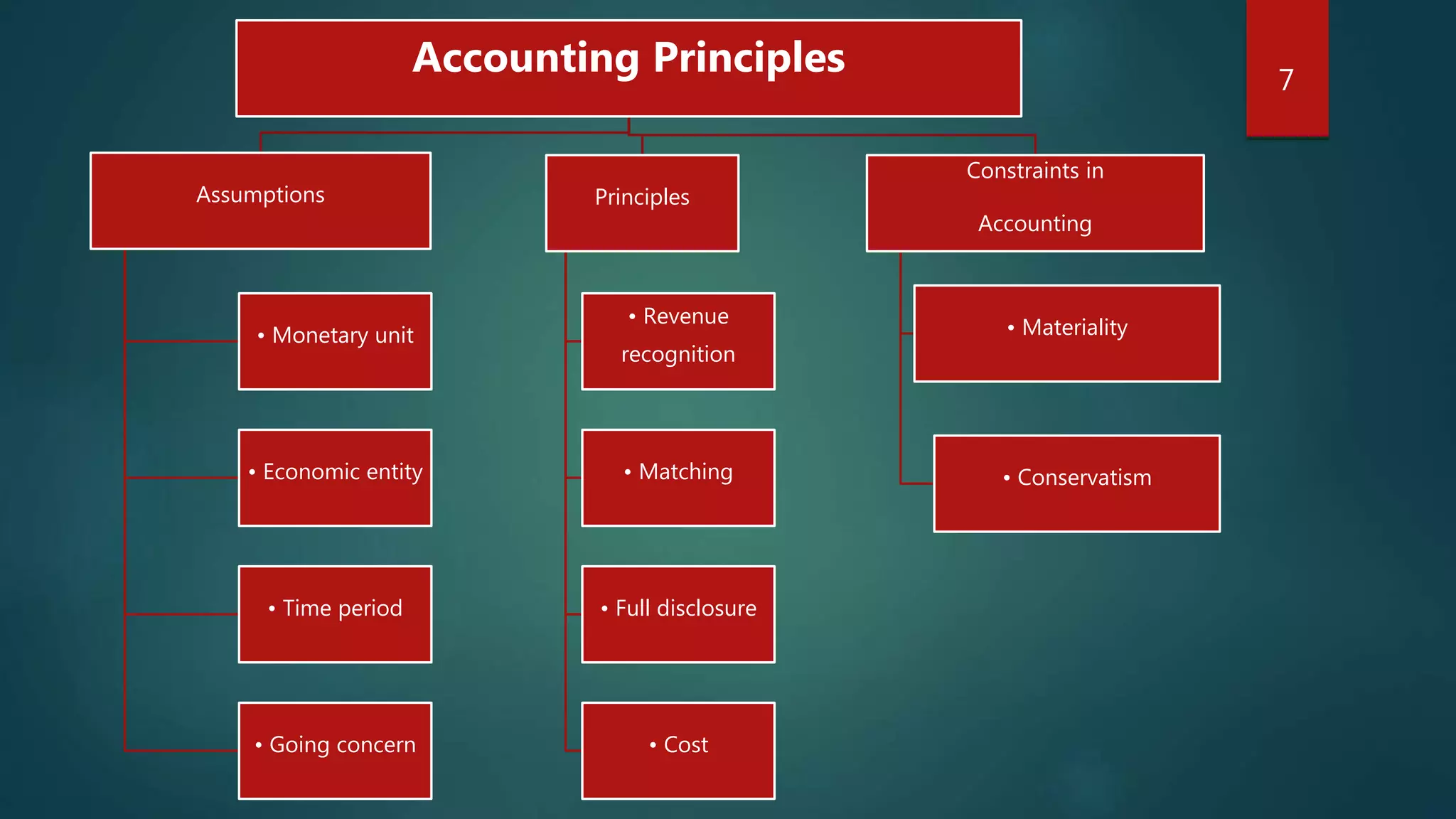
The 5 principles of accounting—Historical Cost, Revenue Recognition, Matching, Full Disclosure, and Objectivity—form the fundamental framework that ensures financial statements are accurate, consistent, and comparable. These core principles guide standard accounting practices under Generally Accepted Accounting Principles (GAAP) and International Financial Reporting Standards (IFRS), allowing investors, regulators, and business owners to evaluate financial performance reliably.
What Are the 5 Core Accounting Principles?
Financial accounting relies on standardized rules to ensure that a company’s financial records reflect its true economic position. Without uniform guidelines, every business could report earnings, assets, and liabilities using custom definitions, making performance comparisons between competitors impossible and opening the door to fraudulent reporting.
In modern financial management, accounting guidelines are governed primarily by standard-setting bodies such as the Financial Accounting Standards Board (FASB) in the United States and the International Accounting Standards Board (IASB) internationally. Together, GAAP and IFRS establish specific rules (known as accounting standards) built upon foundational concepts.
While accounting frameworks contain numerous detailed standards—such as revenue accounting standard ASC 606 or lease accounting standard ASC 842—they all stem from five key principles:
- The Historical Cost Principle
- The Revenue Recognition Principle
- The Matching Principle (Expense Recognition)
- The Full Disclosure Principle
- The Objectivity Principle (Verifiability)
These five principles dictate when revenues and expenses are recorded, how assets and liabilities are measured on the balance sheet, and what additional context must be disclosed in financial reporting notes.
Deep Dive into the 5 Principles of Accounting
1. The Historical Cost Principle
The Historical Cost Principle mandates that assets, liabilities, and equity investments must be recorded on financial statements at their original acquisition price. Regardless of market fluctuations, inflationary pressure, or perceived current valuation changes, the baseline balance sheet figure remains grounded in the actual price paid at the time of purchase.
How Historical Cost Works in Practice
When a corporation purchases real estate for $500,000, that property is recorded on the balance sheet at $500,000. If an independent appraisal five years later estimates the property value at $1,200,000, standard GAAP historical cost rules prohibit the company from marking up the property's carrying value on the balance sheet simply to reflect market appreciation.
Why Historical Cost Is Used
- Verifiability: Historical cost relies on concrete evidence, such as signed contracts, invoices, wire receipts, and canceled checks.
- Elimination of Bias: Allowing business managers to revalue assets upwards based on internal estimates introduces subjective bias and potential manipulation.
- Consistency: Financial statements remain stable over time, free from daily equity market or real estate volatility.
Exceptions and Fair Value Accounting
While historical cost is the traditional foundation, modern financial accounting permits exceptions under fair value accounting rules. Short-term marketable securities, liquid financial instruments, and derivatives are frequently marked to market under ASC 820 / IFRS 13. Furthermore, long-lived tangible assets must be tested periodically for impairment. If an asset's market value drops permanently below its book value, an impairment loss must be written down, ensuring assets are not overstated on the balance sheet.
2. The Revenue Recognition Principle
The Revenue Recognition Principle establishes the precise criteria for determining when revenue must be recognized on the income statement. Under the accrual accounting method, revenue is recognized when it is earned and realizable—meaning the performance obligation to the customer has been satisfied—regardless of when cash payment actually arrives.
The Modern 5-Step Model (ASC 606 / IFRS 15)
To standardize revenue recognition globally, standard setters introduced a framework that breaks revenue recognition into five distinct steps:
- Identify the contract with a customer.
- Identify the performance obligations (distinct goods or services promised) within the contract.
- Determine the transaction price (including fixed amounts, variable consideration, or discounts).
- Allocate the transaction price to each performance obligation based on relative standalone selling prices.
- Recognize revenue when (or as) the entity satisfies each performance obligation.
Cash vs. Accrual Revenue Timing
Consider a Software-as-a-Service (SaaS) provider that sells an annual software subscription for $12,000 on January 1, receiving full cash payment upfront. Under cash-basis accounting, the full $12,000 would be recorded as revenue in January. However, under the Revenue Recognition Principle (accrual basis):
- On January 1, the business records $12,000 as cash (asset) and $12,000 as deferred (unearned) revenue (a liability).
- Each month throughout the year, as the customer receives the software service, the business recognizes $1,000 of earned revenue on the income statement while reducing the unearned revenue liability by $1,000.
3. The Matching Principle (Expense Recognition)
The Matching Principle dictates that all expenses incurred to generate revenue must be recognized in the exact same accounting period as the revenue they helped create. This principle forms the engine of accrual-basis financial statements, ensuring that net income accurately reflects operating profitability during a given period.
Application across Business Operations
If costs were recorded only when cash left the bank account, a company's monthly profitability would fluctuate wildly. The matching principle aligns timing through several core mechanisms:
- Cost of Goods Sold (COGS): When a retailer buys inventory for $50 per unit in February and sells it for $100 in April, the $50 purchase cost remains an asset (Inventory) on the balance sheet throughout February and March. The $50 cost is recognized as an expense (COGS) on the income statement only in April, when the corresponding $100 revenue is recognized.
- Depreciation Expense: Capital assets like equipment, vehicles, or buildings deliver economic benefit over many years. Rather than expensing a $100,000 delivery truck in the month of purchase, the cost is spread out over its estimated useful life (e.g., $10,000 per year for 10 years) to match the annual revenues the vehicle helps generate.
- Accrued Sales Commissions: If a sales representative closes a major enterprise deal in December, earning a $15,000 commission that will be paid out in January payroll, the business must record the $15,000 commission expense in December. This ensures the expense matches the December revenue.
4. The Full Disclosure Principle
The Full Disclosure Principle requires companies to disclose all material financial information, operational data, and underlying assumptions that could influence the judgment or decisions of a reasonable financial analyst, investor, or lender.
Financial statements are not merely three summary tables (Balance Sheet, Income Statement, Cash Flow Statement); they include comprehensive Notes to the Financial Statements (footnotes) that detail accounting policies, contingencies, and risks.
What Must Be Disclosed?
The full disclosure principle mandates comprehensive context across key areas:
- Accounting Policies: The specific methodologies used by management (e.g., FIFO vs. LIFO for inventory valuation, straight-line vs. accelerated depreciation).
- Contingent Liabilities: Pending litigation, regulatory investigations, or warranty commitments that may lead to future financial losses.
- Subsequent Events: Material events occurring between the end of the reporting period and the date financial statements are officially issued (e.g., a major factory fire or acquisition).
- Segment Reporting: Performance breakdowns by business units, customer groups, or geographical territories for public entities governed by the U.S. Securities and Exchange Commission (SEC).
5. The Objectivity Principle (Verifiability)
The Objectivity Principle asserts that financial statements must be built entirely upon objective, verifiable evidence rather than subjective opinions, management speculation, or biased estimates. Every transaction entered into the general ledger should be supported by audit-proof documentation.
Audit Trails and Verifiable Documentation
Under the objectivity principle, an auditor must be able to trace every entry on a balance sheet or income statement back to independent source documents, such as:
- Bank statements and clearing records
- Vendor invoices and purchase orders
- Sales receipts and shipping manifests
- Formal appraisal reports by licensed third parties
- Signed employment contracts and payroll logs
By enforcing strict documentation standards, the objectivity principle protects business owners and external stakeholders from accounting distortions, unintentional clerical mistakes, and fraud.
Summary Matrix: The 5 Accounting Principles at a Glance
The following table summarizes how each principle functions, its core objective, its primary financial statement impact, and standard exceptions.
| Accounting Principle | Primary Objective | Key Financial Statement Impact | Common Business Example | Standard Exception / Nuance |
|---|---|---|---|---|
| Historical Cost | Record assets at verified purchase price to eliminate subjective valuation. | Balance Sheet (Property, Plant & Equipment, Intangibles) | Equipment recorded at the $50,000 purchase price despite market appreciation. | Fair value accounting for trading securities; required impairment write-downs. |
| Revenue Recognition | Record revenue when performance obligations are satisfied, not when cash is received. | Income Statement (Revenue) & Balance Sheet (Deferred Revenue / Accounts Receivable) | Recognizing monthly software revenue on an prepaid annual SaaS contract. | Percentage-of-completion method for long-term construction projects. |
| Matching Principle | Match operational expenses directly to the specific revenues they helped generate. | Income Statement (COGS, Operating Expenses) & Balance Sheet (Prepaids, Accruals) | Expensing sales commissions in the period the related sale occurs. | Immediate expensing of general administrative costs (period costs) with no direct revenue link. |
| Full Disclosure | Provide all relevant financial context to prevent misleading reporting. | Footnotes and Supplementary Financial Notes | Disclosing a pending lawsuit that could create future financial liability. | Omission of immaterial items that would not alter an investor's decision (Materiality constraint). |
| Objectivity | Base accounting entries on verifiable, third-party source documentation. | General Ledger, Audit Trails, and System Records | Verifying inventory purchases against supplier invoices and receiving logs. | Management estimates required for bad debt allowances or asset useful lives. |
Practical Scenario: The 5 Principles Working Together
To understand how these five principles interact in a real business environment, consider a mid-sized technology manufacturer, Apex Robotics Inc.
Apex Robotics Inc. Transaction Flow:
Objectivity: Purchase Order & Invoice Verified by Auditors
Historical Cost: Asset Entry at Purchase Price ($200,000)
Matching Principle: Depreciate Equipment Over 5-Year Useful Life
Revenue Recognition: Deliver Robots, Recognize Revenue; Cash Received vs. Unearned Revenue Balance
Full Disclosure: Disclose Warranty Liabilities & Accounting Method in Notes
Objectivity: Apex purchases specialized robotic assembly machinery for $200,000. The accounting department files the purchase order, bill of lading, vendor invoice, and bank transfer record as objective evidence.
Historical Cost: Apex records the machinery on its balance sheet under Property, Plant, and Equipment (PP&E) at the original cost of $200,000, ignoring local machinery market price swings.
Matching Principle: The machinery has an estimated useful life of 5 years. Apex records $40,000 per year in depreciation expense, matching the equipment's cost against the revenue produced by the assembly line each year.
Revenue Recognition: Apex delivers 10 custom automation systems to a client on December 15 under a contract totaling $500,000. Although the client receives net-60 payment terms (paying in February), Apex recognizes the $500,000 revenue in December because the performance obligation was fully satisfied upon delivery.
Full Disclosure: In its year-end financial footnotes, Apex explicitly details its warranty obligation policies for sold machinery and discloses an ongoing patent dispute with a competitor.
Related Accounting Constraints and Assumptions
While the 5 principles provide core operational guidance, accountants apply them within four fundamental assumptions and constraints:
- The Going Concern Assumption: Accountants assume that a business will continue operating indefinitely unless clear evidence suggests upcoming liquidation or insolvency.
- The Economic Entity Assumption: A business entity's financial transactions must be kept completely separate from the personal finances of its owners, shareholders, or related corporate parent companies.
- The Monetary Unit Assumption: Financial records only include transactions that can be expressed in a stable monetary currency (e.g., USD, EUR), assuming the currency's purchasing power remains relatively stable.
- The Materiality Constraint: Financial reporting focuses on significant information. An item is considered material if its omission or misstatement could alter the decisions of a user relying on the report. Small transactions (such as buying a $15 office trash can) are expensed immediately rather than capitalized as long-term assets.
Common Mistakes and Compliance Pitfalls
Failing to comply with these accounting principles can lead to balance sheet distortions, restatements, tax penalties, or regulatory enforcement actions. Below are common pitfalls businesses encounter:
1. Premature Revenue Recognition
Recognizing revenue before a product has been delivered or a service completed is one of the most frequent causes of corporate accounting restatements. Recording revenue prematurely inflates current-period income while distorting future earnings.
2. Mismatched Period Expenses
Expensing inventory when it is purchased rather than when it is sold distorts monthly gross profit margins. Similarly, failing to accrue earned employee bonuses or commissions at year-end artificially inflates current-year net income at the expense of the following period.
3. Capitalizing Operational Costs
Under historical cost rules, routine repair and maintenance expenses (such as fixing a building roof leak) must be expensed immediately as incurred. Incorrectly capitalizing these routine operational expenses as long-term assets artificially inflates total balance sheet assets and boosts short-term net profit.
4. Omission of Contingent Liabilities
Failing to disclose pending legal disputes, environmental compliance obligations, or potential tax assessments in financial footnotes violates the full disclosure principle, leaving businesses vulnerable to shareholder lawsuits and regulatory audits.
Frequently Asked Questions
What is the primary difference between GAAP and IFRS regarding these principles?
While both frameworks share the same core underlying principles, GAAP is traditionally more rules-based, offering detailed, explicit guidance for specific transactions and industries. IFRS is principles-based, offering broader conceptual guidance that requires greater professional judgment. For example, IFRS permits the revaluation of certain long-term tangible assets to fair value under specific conditions, whereas U.S. GAAP strictly enforces historical cost.
Why is the historical cost principle sometimes criticized by financial analysts?
Critics argue that historical cost can make balance sheets outdated during periods of high inflation or rapid market appreciation. For instance, commercial real estate purchased 30 years ago may be carried at a fraction of its true current market value, disguising the business's actual economic worth. However, standard setters retain historical cost because it is objective and verifiable, unlike subjective market appraisals.
How does the matching principle impact a company's cash flow statement?
The matching principle drives accrual accounting, which deliberately separates income reporting from actual cash movements. Because revenues and expenses are matched to the period they occur—rather than when cash changes hands—net income rarely equals net cash flow. The Statement of Cash Flows reconciles these timing differences by adjusting net income for non-cash expenses (such as depreciation) and changes in working capital (such as accounts receivable and accounts payable).
Do small, privately held businesses have to follow all 5 accounting principles?
Privately held businesses are not legally required by federal securities laws to follow GAAP or IFRS unless required by external stakeholders. However, commercial banks, lenders, and potential buyers almost universally demand GAAP-compliant financial statements prepared under these principles before issuing loans or completing acquisitions. Additionally, standard accounting practices simplify tax filings and internal decision-making.
What is the relationship between ASC 606 and the revenue recognition principle?
Accounting Standards Codification (ASC) Topic 606 is the standardized accounting rule developed by FASB and IASB to enforce the broader Revenue Recognition Principle. ASC 606 provides a uniform 5-step implementation framework that replaces older, industry-specific revenue guidelines, ensuring companies across all sectors recognize revenue consistently.
Key Takeaways and Next Actions
The 5 principles of accounting—Historical Cost, Revenue Recognition, Matching, Full Disclosure, and Objectivity—form the structural foundation of modern business reporting. Adhering to these core principles ensures financial transparency, regulatory compliance, and reliable operational metrics.
Recommended Next Steps for Business Owners and Finance Teams:
- Review Revenue Policies: Audit customer contracts to verify that your business records revenue in strict accordance with ASC 606 / IFRS 15 performance obligations.
- Standardize Expense Matching: Establish formal period-end accrual schedules for employee commissions, supplier expenses, and asset depreciation to align costs with revenue.
- Maintain Audit Trails: Ensure every general ledger transaction is supported by verifiable source documentation, such as invoices, contracts, and bank settlements.
- Enhance Footnote Disclosures: Ensure annual financial statements include detailed accounting policies, asset valuation methods, and material contingency disclosures.
- Consult Qualified Professionals: Work with a Certified Public Accountant (CPA) or chartered accountant to review your internal financial controls and balance sheet reporting against established standards.
Disclaimer: This guide is provided for educational and informational purposes only and should not be construed as legal, tax, or professional accounting advice. Always consult with a qualified Certified Public Accountant (CPA) or independent financial advisor regarding specific financial reporting requirements and regulatory standards.