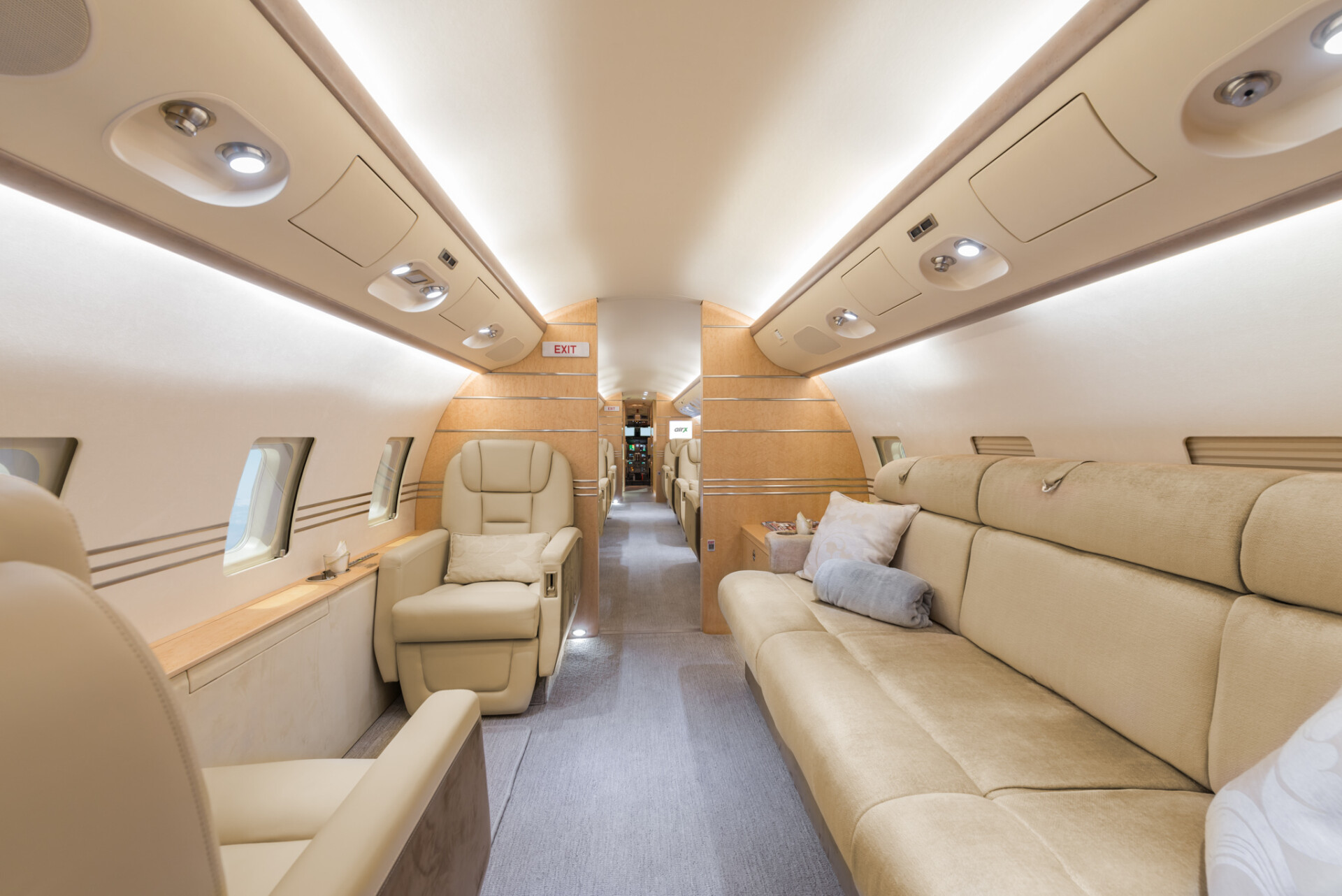
The Bombardier Challenger 850 represents a unique niche in the business aviation market, offering the cabin volume of a long-range heavy jet at the price point of a mid-size aircraft. While the "40 million dollar" figure often associated with this jet stems from high-end custom refurbishments and historical celebrity acquisitions, it remains a benchmark for luxury, providing one of the largest interior spaces in its class. In 2026, the Challenger 850 continues to be a preferred choice for corporate flight departments and private owners who prioritize "living room" comfort over extreme transcontinental range.
Origins and Evolution: From Regional Airliner to Executive Suite
The Bombardier Challenger 850 is not a clean-sheet design; rather, it is the corporate evolution of the Bombardier CRJ200 regional airliner. This heritage is the aircraft's greatest strength. Because it was originally engineered to endure the rigors of commercial airline service—performing multiple takeoffs and landings per day with minimal downtime—the airframe is exceptionally robust and reliable.
When Bombardier decided to market the CRJ200 as an executive jet, they rebranded it as the Challenger 850. The transition involved stripping the high-density airline seating (usually 50 seats) and replacing it with a bespoke, luxury interior typically configured for 12 to 16 passengers. By utilizing a proven commercial platform, Bombardier was able to offer a massive cabin—comparable to the Global 6000—but with the simpler systems and lower acquisition costs of a regional jet.
In 2026, the Challenger 850 occupies a "vintage luxury" status. While production officially ended in 2012, the secondary market remains active because there are few aircraft that can match its interior dimensions without a significantly higher price tag. Owners who invested in $40 million total-package overhauls have created "flying apartments" that remain competitive with newer models in terms of passenger experience, if not in raw fuel efficiency or avionics.
Decoding the $40 Million Price Tag
To understand the "40 million dollar" valuation, one must distinguish between the aircraft’s base market value and its "all-in" customized cost. When the Challenger 850 was in production, its list price sat around $32 million. However, the most famous association with the $40 million figure comes from the high-profile purchase by Beyoncé for Jay-Z, which featured extensive custom modifications, including a living room, kitchen, bedroom, and two bathrooms.
The Cost of Customization
For a Challenger 850 to reach a $40 million valuation in the current 2026 market, it typically involves:
- Complete Interior Refurbishment: Replacing standard executive seating with high-end materials like Loro Piana fabrics, rare wood veneers, and gold or platinum hardware can cost $5 million to $8 million.
- Avionics Upgrades: Retrofitting the cockpit with modern flight decks, such as the Collins Aerospace Pro Line Fusion or similar NextGen upgrades, ensures compliance with 2026 airspace requirements and adds significant value.
- Connectivity Suites: Installing high-speed Ka-band or Ku-band satellite internet (like Starlink Aviation or Viasat) allows for seamless 4K streaming and global connectivity, a prerequisite for modern owners.
- Maintenance Status: An aircraft with "engines on program" (such as GE OnPoint) and fresh 96-month or 192-month inspections commands a premium, as these heavy maintenance events can cost millions.
2026 Market Realities
In 2026, a standard pre-owned Challenger 850 without extreme customization typically trades between $8 million and $14 million, depending on total time on the airframe and engine status. The $40 million figure remains a "replacement value" or "lifestyle valuation" often cited in the context of high-net-worth asset management rather than a standard brokerage listing price.
Technical Specifications and Performance Data
The Challenger 850 is powered by two General Electric CF34-3B1 turbofan engines. These engines are known for their extreme reliability, having logged millions of hours in regional airline service. While they are not as fuel-efficient as the latest generation of geared turbofans, their maintenance predictability is a major plus for operators.
Key Performance Metrics
The 850 is designed for "hub-to-hub" missions rather than "ultra-long-haul" flights. Its range is approximately 2,811 nautical miles (5,206 km), which allows for non-stop travel from New York to Los Angeles or London to Dubai under certain conditions. However, it lacks the range to cross the Pacific or perform long trans-Atlantic missions without a fuel stop, especially when carrying a full passenger load.
| Feature | Specification | Notes |
|---|---|---|
| Max Cruise Speed | Mach 0.80 (459 ktas) | High-speed cruise capability |
| Normal Cruise Speed | Mach 0.74 (424 ktas) | Optimized for fuel efficiency |
| Service Ceiling | 41,000 feet | Above most commercial weather |
| Maximum Range | 2,811 nm | With 8 passengers and NBAA IFR reserves |
| Takeoff Distance | 6,305 feet | Requires standard executive airports |
| Landing Distance | 2,910 feet | Excellent short-field landing performance |
| Engine Model | GE CF34-3B1 | 8,729 lbs of thrust per engine |
| Cabin Volume | 1,625 cubic feet | Larger than many $50M+ jets |
The Interior: A "Living Room in the Sky"
The primary reason an owner chooses a Challenger 850 over a faster or longer-range jet is the cabin. The 850 offers a "wide-body" feel that is rare in its price bracket. The cabin is typically divided into three distinct zones, allowing passengers to work, dine, and sleep in separate environments.
Cabin Dimensions
- Length: 48.4 feet (14.75 meters)
- Width: 8.2 feet (2.49 meters)
- Height: 6.1 feet (1.85 meters)
The 6-foot-plus ceiling height allows most passengers to stand upright comfortably, a critical factor for long-duration flights. The width of the cabin allows for double-club seating or a large divan that can be converted into a bed. In a $40 million custom configuration, the aft section of the cabin is often turned into a private stateroom, providing a level of privacy usually reserved for much larger aircraft like the Boeing Business Jet (BBJ) or Airbus Corporate Jet (ACJ).
Baggage and Amenities
Because it is based on a regional jet airframe, the 850 features a massive internal baggage compartment (202 cubic feet) that is accessible during flight. This is a significant advantage over competitors where baggage is often stored in an unpressurized external hold. The galley is typically full-sized, capable of supporting multi-course hot meal service for 15+ passengers.
Operational Costs and Ownership in 2026
Operating a large-cabin jet like the Challenger 850 requires a significant financial commitment. In 2026, fuel prices and sustainable aviation fuel (SAF) mandates have influenced the variable costs of operation.
Variable Costs
The largest variable cost is fuel. The Challenger 850 burns approximately 280 to 320 gallons per hour. At 2026 prices, this translates to roughly $2,000 to $2,800 per hour in fuel alone. Other variable costs include landing fees, catering, and crew per diems.
Fixed Costs
Fixed costs include crew salaries (two pilots and typically one flight attendant), hangarage, insurance, and recurrent training. For a jet of this size, annual fixed costs often range from $600,000 to $900,000.
Maintenance Cycles
Prospective owners must be aware of the "96-month" and "192-month" inspections. These are heavy maintenance events where the entire interior is removed, and the airframe is inspected for corrosion and fatigue. For an aircraft approaching its 20th year, these inspections can reveal necessary structural repairs. It is highly recommended that any 850 be enrolled in an engine maintenance program like GE OnPoint to avoid the multi-million dollar "sticker shock" of a scheduled engine overhaul.
Comparison: Challenger 850 vs. Its Peers
When evaluating the Challenger 850 against other options in 2026, the trade-off is always space vs. range.
- Vs. Challenger 650: The 650 is a newer, purpose-built business jet with more advanced avionics and better fuel efficiency. However, the 850’s cabin is significantly longer, offering more "zones" for passengers.
- Vs. Gulfstream G450: The G450 offers significantly more range and speed. However, on the pre-owned market, a G450 with a comparable cabin volume is often more expensive to maintain and operate due to the complexity of Gulfstream's proprietary systems.
- Vs. Falcon 2000EX: The Falcon is the "efficiency king," burning much less fuel and offering better runway performance. However, its cabin feels cramped compared to the "cavernous" 850.
The 850 remains the "value play" for those who need to transport large groups (12-16 people) over medium distances in absolute comfort.
Practical Considerations for Buyers and Charterers
If you are considering the acquisition or charter of a Challenger 850 in 2026, several factors are paramount:
Pre-Purchase Inspection (PPI)
Never purchase a Challenger 850 without a thorough PPI at an authorized Bombardier Service Center. Pay special attention to the landing gear (which has a life cycle limit) and the APU (Auxiliary Power Unit), as these are high-cost items.
2026 Compliance
Ensure the aircraft is equipped with ADS-B Out (Version 2), FANS 1/A+, and CPDLC. In 2026, these are no longer "optional extras" but requirements for flying in most controlled airspaces globally.
Charter Revenue
Many 850 owners place their aircraft on a Part 135 charter certificate to offset operating costs. The 850 is a popular charter choice for sports teams, music tours, and large corporate groups because it can carry more passengers than a standard heavy jet while remaining at a lower hourly charter rate ($7,000–$10,000 per hour).
Frequently Asked Questions
Can the Challenger 850 fly non-stop from London to New York?
Generally, no. While the 850 has a respectable range, a westbound trans-Atlantic flight against prevailing headwinds usually requires a fuel stop in Gander or Iceland. It is primarily a trans-continental (US) or intra-European/Middle Eastern aircraft. For non-stop trans-Atlantic missions, one would typically look at a Challenger 605/650 or a Global series aircraft.
How many passengers can a Challenger 850 carry?
In its most common executive configuration, it carries 12 to 16 passengers. Some high-density corporate versions can carry up to 19. This is significantly more than the 8 to 10 passengers typically found on mid-size jets with similar acquisition costs.
What is the hourly operating cost of a Challenger 850 in 2026?
The total hourly cost, including fuel, maintenance reserves, and engine programs, is approximately $5,500 to $7,500 per hour. This does not include the fixed costs like crew salaries and insurance, which are paid regardless of how much the plane flies.
Is the Challenger 850 still supported by Bombardier?
Yes, Bombardier continues to provide extensive parts and technical support for the Challenger 850 and the CRJ200 airframe. Because there are still hundreds of CRJ200s in service worldwide, parts availability is generally better than for older, purpose-built business jets.
Why is it called a "40 million dollar" jet if they sell for less now?
The $40 million figure is a "total project cost" associated with high-profile owners who purchased the aircraft and then spent millions more on bespoke interiors and state-of-the-art technology. It reflects the value of the asset as a customized luxury product rather than the base price of the metal airframe.
Recommendation for 2026
The Bombardier Challenger 850 remains an exceptional "value-per-square-foot" proposition. If your missions are primarily under 5 hours and involve more than 10 passengers, it is arguably the most cost-effective way to fly in a heavy-jet environment. However, buyers should be wary of aircraft not enrolled in engine programs and should budget for modern avionics upgrades to ensure the aircraft remains viable through the end of the decade. For those looking for the "Jay-Z experience," the $40 million benchmark serves as a reminder that in aviation, the interior and the maintenance status are often more valuable than the airframe itself.