Navigating the complexities of Rockwell Automation's Logix5000 control systems requires a structured approach to hardware configuration, tag-based programming, and network diagnostics. This training overview explores the core competencies, software environments, and practical skills necessary to design, commission, and troubleshoot modern programmable logic controller applications.
Introduction to the Logix5000 Ecosystem
The Allen-Bradley Logix5000 family—encompassing ControlLogix, CompactLogix, and GuardLogix controllers—represents the backbone of modern industrial automation. Developing proficiency in these systems demands more than a passing familiarity with ladder logic; it requires an integrated understanding of hardware layout, real-time operating systems, tag databases, and multi-disciplinary communication protocols.
Whether you are a maintenance technician tasked with keeping a manufacturing line operational or a systems integrator designing a greenfield automation architecture, a rigorous training framework is essential. This overview examines the foundational concepts, structured learning paths, essential software tools, and troubleshooting methodologies that define a complete Logix5000 educational journey.
Foundational Concepts and Hardware Architecture
Before writing a single line of control logic, engineers and technicians must master the physical and electrical architecture of the Logix5000 platform. Unlike legacy fixed-configuration controllers, Logix5000 systems are modular, scalable, and built around a high-speed backplane.
ControlLogix versus CompactLogix Platforms
A primary division in the Logix5000 family lies between ControlLogix and CompactLogix controllers. ControlLogix systems are designed for large-scale, process-intensive, and high-availability applications. They feature modular chassis, redundant power supplies, and decoupled processing where motion, safety, and standard control can reside in separate or integrated controllers within the same rack.
CompactLogix systems target machine-level control. They integrate the controller, power supply, and local I/O into a more compact footprint, making them cost-effective for OEMs and standalone machines while sharing the exact same instruction set and programming environment.
Backplane Communication and Chassis Design
Understanding how data moves across the backplane is critical for system performance. ControlLogix racks utilize a producer-consumer communication model over the ControlBus backplane. Instead of master-slave polling, devices produce data onto the backplane network autonomously, and any other module configured to consume that data reads it instantly. Training programs emphasize proper slot placement, power supply loading calculations, and firmware revision matching to prevent communication bottlenecks.
The Software Environment: Studio 5000 Logix Designer
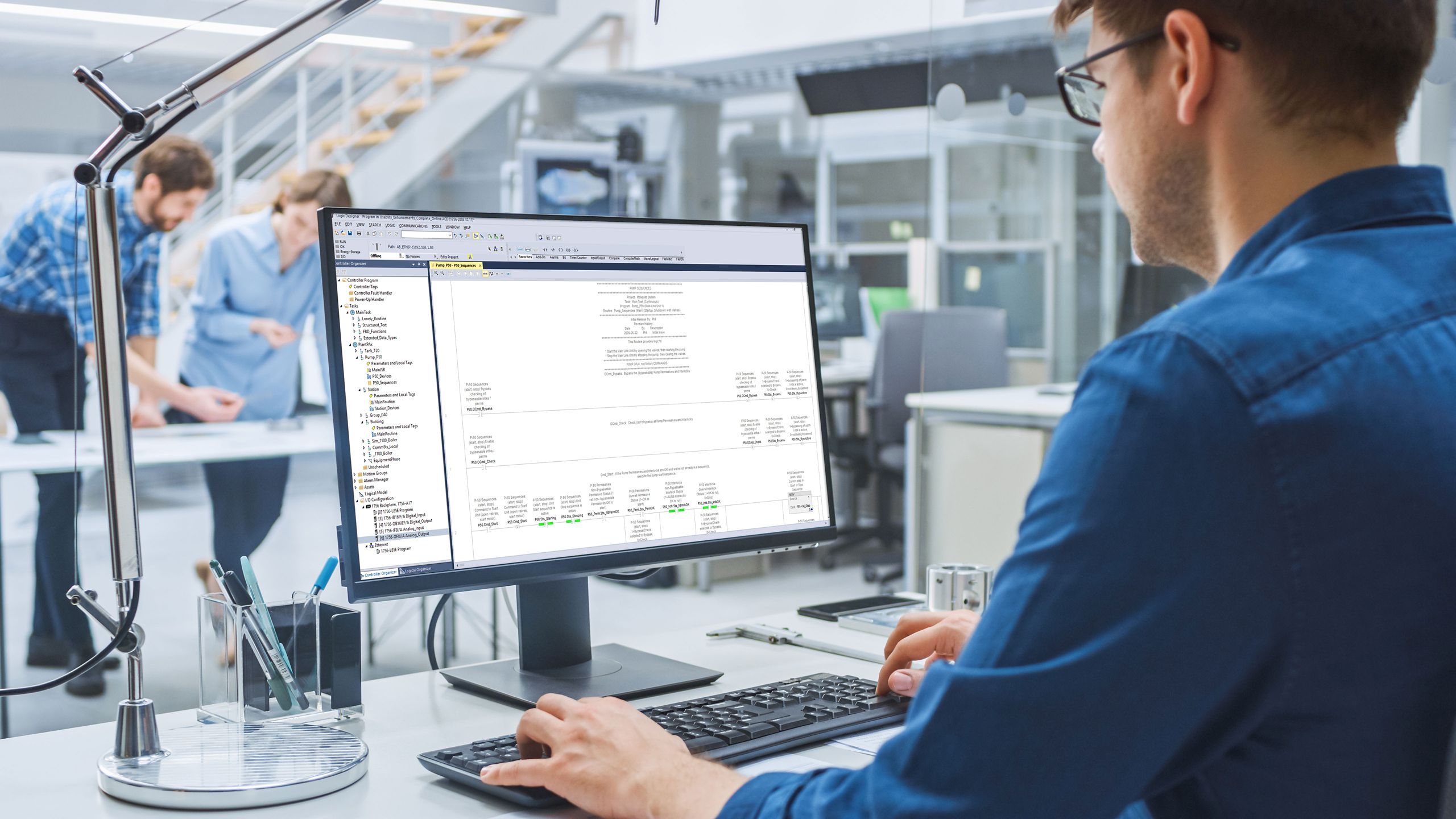
The programming and configuration hub for all Logix5000 controllers is Studio 5000 Logix Designer. Transitioning from older software packages like RSLogix 5000, Studio 5000 integrates multiple engineering tools into a single collaborative framework.
- Studio 5000 Logix Designer Environment
- Controller Organizer (Hardware & Task Configuration)
- Logical Organizer (Application Code & Organization)
- Tag Database (Scoped Tags, Aliases, and Arrays)
- Add-On Instructions (AOIs for Modular Reusability)
The Controller Organizer and Logical Organizer
Studio 5000 introduces a dual-organizer view. The Controller Organizer manages hardware configuration, communication modules, motion groups, and task execution schedules. The Logical Organizer allows programmers to structure code into functional program folders, mirroring plant areas or machine sequences. Understanding how tasks, programs, and routines execute sequentially or periodically is a cornerstone of advanced Logix5000 training.
Tag-Based Memory Architecture
Unlike legacy PLCs that rely on fixed memory addresses (such as N7:0 or B3:1), Logix5000 controllers utilize a dynamic, tag-based memory structure. Tags are named variables that can be scoped locally to a specific program or globally across the entire controller. Training covers:
- Base Tags: Standard data structures holding primitive types (BOOL, INT, DINT, REAL) or complex structures.
- Alias Tags: Pointers linking a tag name directly to a physical I/O terminal or another tag.
- Consumed/Produced Tags: Tags shared across controllers via Ethernet/IP networks without traditional message instructions.
Programming Languages and IEC 61131-3 Compliance
Rockwell Automation supports multiple programming languages within Studio 5000, adhering to the IEC 61131-3 international standard for programmable controllers. A robust training overview must address when and how to apply each language effectively.
| Programming Language | Best Suited For | Primary Characteristics |
|---|---|---|
| Ladder Diagram (LD) | Discrete control, interlocking, traditional maintenance troubleshooting | Graphical representation of relay contacts and coils; universally understood by maintenance staff. |
| Structured Text (ST) | Complex mathematical calculations, string manipulation, looping, and data parsing | Text-based, high-level language similar to Pascal or C; highly efficient for algorithm execution. |
| Function Block Diagram (FBD) | Continuous process control, analog scaling, PID loops, and drive integration | Graphical blocks wired together; ideal for signal processing and continuous loop control. |
| Sequential Function Chart (SFC) | Batch processing, sequential machine states, and recipe management | Step-and-transition structure; simplifies the visualization of complex machine modes. |
Network Protocols and Industrial Communications
Modern automation relies heavily on industrial Ethernet networks. Logix5000 controllers leverage EtherNet/IP (Industrial Protocol) as their primary communication backbone, utilizing standard commercial Ethernet cabling while adding CIP (Common Industrial Protocol) messaging layers for real-time control.
Explicit versus Implicit Messaging
Training programs distinguish sharply between two types of network traffic:
- Implicit Messaging (IO Data): Scheduled, high-priority, real-time data transfers used for rack I/O updates and drive control. Configured during setup, these packets stream continuously at user-defined Requested Packet Intervals (RPI).
- Explicit Messaging (CIP Data): Unscheduled, request-response communication used for configuration changes, reading diagnostic data from third-party devices, or communicating between controllers using
MSGinstructions.
Device Level Ring (DLR) and Linear Topologies
To ensure high availability, Logix5000 architectures frequently employ Device Level Ring topologies. Training covers how embedded switch technology allows devices to be wired in a physical ring, providing media redundancy that can recover from a single cable break without process interruption.
Commissioning, Troubleshooting, and Diagnostics
The ultimate test of any training program is its ability to equip personnel with rapid, methodical troubleshooting skills. Logix5000 systems offer powerful built-in diagnostic tools that minimize downtime.
Controller Status and Major Non-Recoverable Faults
When a controller faults, the "I/O OK" and "Run" indicators on the hardware change state. Training teaches engineers how to access the controller properties via Studio 5000, review the fault handler routines, and interpret error codes associated with major non-recoverable faults (MNRFs), such as stack overflows, illegal pointer references, or hardware communication timeouts.
Cross-Reference and Trends
Effective troubleshooting utilizes the Cross-Reference tool to track every instance where a specific tag or bit is referenced across all tasks, programs, and routines. Additionally, technicians learn to configure TrendX charts within Studio 5000 to monitor analog signals, PID loop performance, and discrete states in real-time, isolating intermittent mechanical or electrical issues.
Structured Training Pathways and Certification
Acquiring mastery over Logix5000 systems typically follows a phased educational roadmap, moving from fundamental awareness to advanced system design.
- Foundational Level: Introduction to ladder logic, basic hardware identification, and software navigation.
- Intermediate Level: Analog configuration, structured text programming, Ethernet/IP network setup, and standard troubleshooting.
- Advanced Level: Motion control programming (Integrated Motion over EtherNet/IP), GuardLogix safety programming, Add-On Instruction (AOI) creation, and redundant system design.
- Certification: Formal programs offered by Rockwell Automation or authorized distributors validate competency through rigorous practical examinations and proctored testing.
Summary and Next Actions
Mastering the Allen-Bradley Logix5000 platform requires a balanced commitment to understanding physical hardware, mastering the Studio 5000 software environment, and applying structured diagnostic techniques. To advance your expertise, begin by reviewing the official Rockwell Automation literature for your specific controller series, set up a test environment or emulator (Emulate 5000) to practice tag configuration, and enroll in certified hands-on training modules targeting your specific industry requirements.