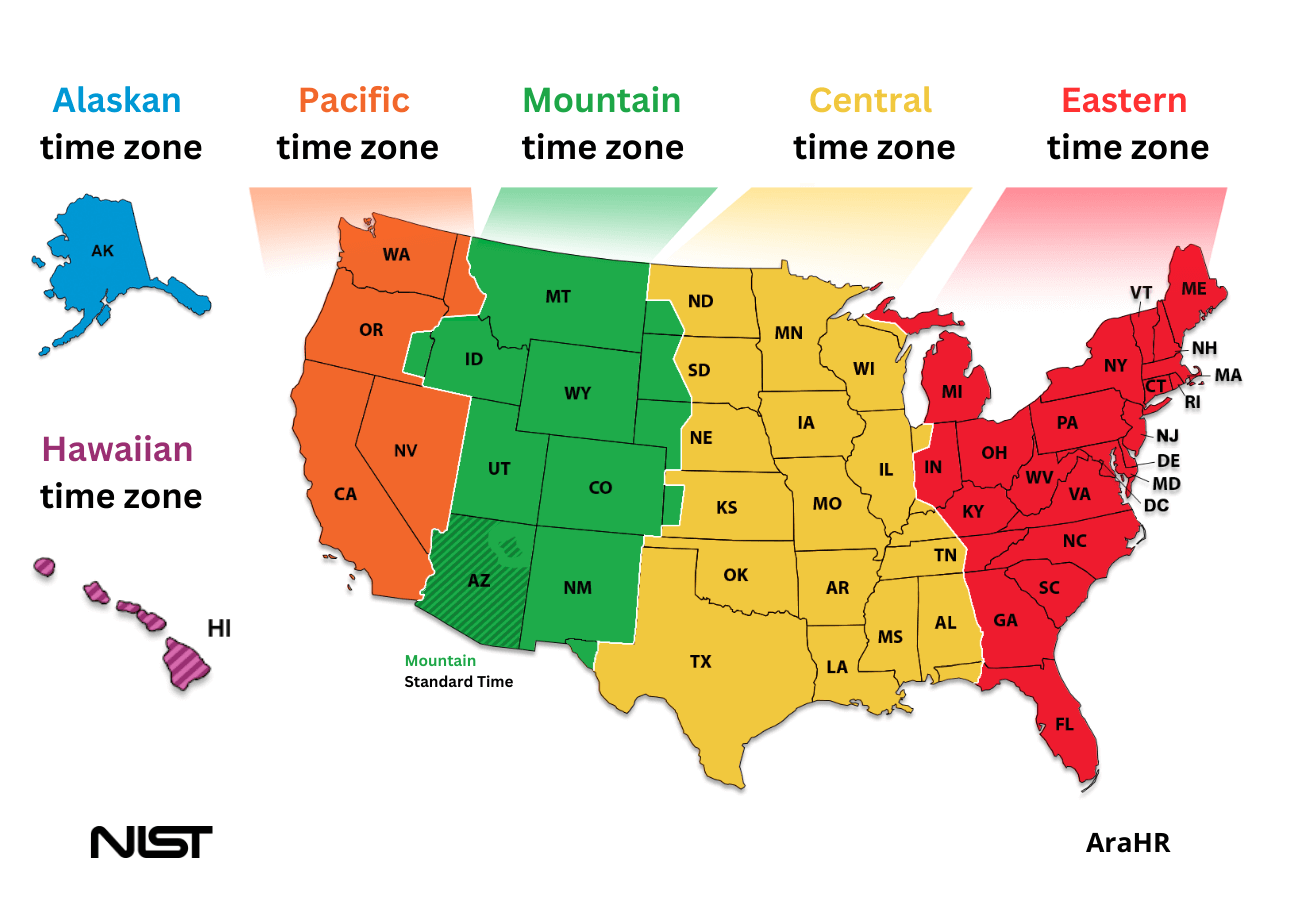
Arizona officially observes Mountain Standard Time (MST) year-round and does not participate in Daylight Saving Time (DST). Although Arizona’s clocks align with Pacific Daylight Time (PDT) during the summer months, the state remains legally and technically on MST. This unique status ensures Arizona avoids the biannual clock shifts practiced by most of North America.
The Distinction Between MST and PST in Arizona
To understand why Arizona is on MST and not PST, it is essential to distinguish between the two zones and how they interact with Daylight Saving Time. The United States is divided into several time zones, with Pacific Standard Time (PST) being UTC-8 and Mountain Standard Time (MST) being UTC-7.
Arizona is geographically located within the Mountain Time Zone. Because the state does not "spring forward" in March, its offset remains at UTC-7 throughout the entire year. Meanwhile, states in the Pacific Time Zone, such as California and Nevada, move from PST (UTC-8) to PDT (UTC-7) in the summer. This shift creates the common misconception that Arizona "switches" to Pacific Time. In reality, Arizona stays still while the West Coast moves to match it.
In 2026, as in previous decades, this lack of change means that for roughly eight months of the year, Arizona time is identical to California time. However, for the remaining four months of winter, Arizona is one hour ahead of California and aligned with Denver, Colorado, and Salt Lake City, Utah.
Historical Context: Why Arizona Opted Out of Daylight Saving Time
The decision for Arizona to remain on standard time is not a matter of geography alone, but a calculated legislative choice. The federal government passed the Uniform Time Act of 1966, which mandated a synchronized schedule for Daylight Saving Time across the country. However, the Act allowed state legislatures to opt out of the practice via local ordinance.
In 1967, Arizona briefly experimented with Daylight Saving Time. The results were widely unpopular. By 1968, the Arizona State Legislature voted to exempt the state from the annual time shift. The primary driver behind this decision was the extreme desert climate.
In the 1960s, as air conditioning became a standard necessity rather than a luxury, state officials realized that an extra hour of daylight in the evening was a liability, not an asset. If Arizona were to observe DST, the sun would stay up until nearly 9:00 PM during the peak of summer, when temperatures frequently exceed 110°F (43°C). This would force residents to run high-powered cooling systems for an additional hour of peak daylight, leading to massive spikes in energy consumption and utility costs. By staying on MST, the sun sets earlier, allowing the desert environment to begin cooling down sooner in the evening.
The Navajo Nation and Hopi Reservation Exception
The most complex aspect of Arizona’s timekeeping is the geographic "donut" created by tribal lands in the northeastern part of the state. While the majority of Arizona ignores Daylight Saving Time, the Navajo Nation does observe it.
The Navajo Nation’s territory extends across Arizona, New Mexico, and Utah. To maintain a consistent schedule across its entire jurisdiction, the tribal government chose to follow the federal DST schedule. This means that during the summer, the Navajo Nation is one hour ahead of the rest of Arizona.
To complicate matters further, the Hopi Reservation, which is entirely surrounded by the Navajo Nation, follows the rest of Arizona in rejecting DST. A traveler driving through this region in the summer would experience multiple time changes within a few hours:
- Flagstaff (Arizona): MST (e.g., 12:00 PM)
- Tuba City (Navajo Nation): MDT (1:00 PM)
- Moenkopi (Hopi Reservation): MST (12:00 PM)
- Window Rock (Navajo Nation): MDT (1:00 PM)
For logistics and travel in 2026, it is critical to verify the specific tribal affiliation of your destination when visiting northeastern Arizona between March and November.
Comparing Arizona Time with Surrounding States
Understanding the relationship between Arizona (MST), the West Coast (PST/PDT), and the Mountain West (MST/MDT) requires a clear view of the annual cycle. The following table illustrates how Arizona relates to its neighbors throughout the year.
| Time Period | Arizona (Excluding Navajo) | Pacific (CA, NV) | Mountain (CO, UT, NM) |
|---|---|---|---|
| Winter (Nov – Mar) | MST (UTC-7) | PST (UTC-8) | MST (UTC-7) |
| Status vs. Arizona | Baseline | 1 Hour Behind | Same Time |
| Summer (Mar – Nov) | MST (UTC-7) | PDT (UTC-7) | MDT (UTC-6) |
| Status vs. Arizona | Baseline | Same Time | 1 Hour Ahead |
In 2026, the transition dates for states that observe DST are March 8 (clocks move forward) and November 1 (clocks move back). On these specific dates, Arizona’s relationship with California and Colorado shifts, though Arizona’s internal clocks remain untouched.
The Economic and Practical Impact of Staying on MST
The decision to remain on MST has significant implications for business, broadcasting, and transportation. Because Arizona does not change its clocks, many organizations must adjust their operations twice a year to maintain synchronization with the rest of the country.
Television and Broadcasting
In the era of traditional broadcast television, Arizona was a "swing state" for scheduling. During the summer, live events (like sports or awards shows) would air an hour earlier than they did in the winter. While streaming services have mitigated this issue for on-demand content, live programming in 2026 still requires Arizona viewers to carefully check local listings during the transition months.
Remote Work and Corporate Scheduling
For the millions of professionals working remotely in 2026, Arizona’s time zone is a frequent source of "meeting mishaps." An Arizona employee working for a New York-based company is three hours behind in the winter but only two hours behind in the summer. Similarly, an Arizona freelancer working with a client in Los Angeles must remember that they are on the same time in July but an hour apart in January.
Transportation and Flight Schedules
Airlines operating out of Phoenix Sky Harbor International Airport (PHX) or Tucson International Airport (TUS) do not change their local flight times, but the arrival and departure times in other cities will shift. For example, a flight from Phoenix to New York might depart at 8:00 AM year-round, but it will arrive at 4:00 PM in the winter and 3:00 PM in the summer. Travelers should always rely on the "local time" printed on their boarding passes, as these are automatically adjusted for DST.
Technical Management of "Arizona Time"
In the world of computing and digital devices, Arizona is treated as a distinct entity. Modern operating systems (Windows, macOS, iOS, Android) do not simply ask for your time zone; they ask for your location.
The IANA Time Zone Database, which is the global standard for time zone data, uses the identifier America/Phoenix. This specific ID instructs the device to maintain a -0700 UTC offset permanently, ignoring the DST transition signals sent to other Mountain Time zones like America/Denver.
When setting up a new device or server in 2026, users should always select "Phoenix" or "Arizona" specifically. Selecting "Mountain Time" without the Arizona qualifier will often cause the device to automatically "spring forward" in March, leading to incorrect timestamps for emails, calendar invites, and system logs.
Environmental and Health Considerations
Recent studies in the 2020s have analyzed the impact of DST on human health, specifically regarding circadian rhythms and sleep deprivation. The "spring forward" transition has been linked to temporary increases in heart attacks and traffic accidents in states that observe the change.
Arizona avoids these seasonal health spikes. By maintaining a consistent schedule, residents do not suffer the "social jetlag" associated with losing an hour of sleep in March. Furthermore, the Arizona Department of Water Resources and energy providers have consistently supported the MST-only stance, noting that it helps smooth out the "duck curve" of energy demand by preventing an artificial extension of evening heat exposure during the hottest months of the year.
Common Misconceptions About Arizona Time
Despite the clarity of the law, several myths persist about Arizona's relationship with time.
- "Arizona is on PST in the summer." Technically, this is incorrect. Arizona is on MST (UTC-7). California is on PDT (UTC-7) in the summer. While the time is the same, the name of the time zone is different.
- "The whole state ignores DST." As noted, the Navajo Nation is a significant exception. If you are in Window Rock or Chinle, you are on Daylight Time.
- "Arizona is thinking about switching." While bills are occasionally introduced in the state legislature to move Arizona to permanent Daylight Saving Time (which would put them at UTC-6), these have historically failed. The consensus remains that the current system serves the desert climate best.
Frequently Asked Questions
Does Arizona ever change its clocks?
No, the vast majority of Arizona stays on Mountain Standard Time (MST) all year long. The only exception is the Navajo Nation in the northeastern part of the state, which does observe Daylight Saving Time to stay consistent with its tribal lands in New Mexico and Utah.
Why does my phone say I'm in the same time zone as Los Angeles during the summer?
During the summer, the Pacific Time Zone (where Los Angeles is located) moves to Pacific Daylight Time (PDT), which has a UTC-7 offset. Since Arizona is always on MST (also a UTC-7 offset), the two locations show the same time. However, your phone is likely correctly identifying that you are on MST, not PST.
What time zone should I select for an Arizona-based meeting?
When using digital calendars like Google Calendar or Outlook, you should specifically select "(GMT-07:00) Arizona" or "Phoenix." Do not select "Mountain Time (US & Canada)," as that setting will automatically adjust for Daylight Saving Time, which will cause your meeting times to be incorrect for half of the year.
Is Arizona two or three hours behind New York?
It depends on the time of year. During the winter (November to March), Arizona is two hours behind New York (EST). During the summer (March to November), when New York moves to Daylight Time (EDT), Arizona is three hours behind.
Does the sun set later in Arizona because of MST?
Actually, the sun sets earlier in Arizona compared to what it would if the state observed DST. If Arizona were on Daylight Time in the summer, the sun would set around 8:40 PM in Phoenix in late June. Because Arizona stays on Standard Time, the sun sets around 7:40 PM, which helps the ground and buildings begin cooling down an hour sooner.
How does Arizona time affect the border with Mexico?
The Mexican state of Sonora, which borders Arizona to the south, also does not observe Daylight Saving Time. This creates a synchronized "Mega-Region" that facilitates easier cross-border trade and commuting, as the time remains the same on both sides of the border throughout the year.
Practical Recommendations for 2026
If you are traveling to or doing business with Arizona in 2026, follow these steps to ensure you stay on schedule:
- Confirm Location for Tribal Visits: If your travel involves the Grand Canyon, Antelope Canyon, or Monument Valley, double-check if you are entering the Navajo Nation. If you are, your phone may automatically jump ahead one hour in the summer.
- Manual Overrides for Smart Home Devices: Some older smart home systems struggle with the Arizona exception. Ensure your "Home Location" is set to a specific Arizona city rather than a general time zone.
- Aviation Buffer: If you have a connecting flight in Phoenix during the March or November transition weeks, re-verify your itinerary. While the Arizona time doesn't change, the departure times of your connecting flights in other states will likely have shifted.
- Energy Planning: For residents, remember that the early sunset is your best friend. Use the early evening darkness to purge heat from your home before the nighttime temperatures bottom out.