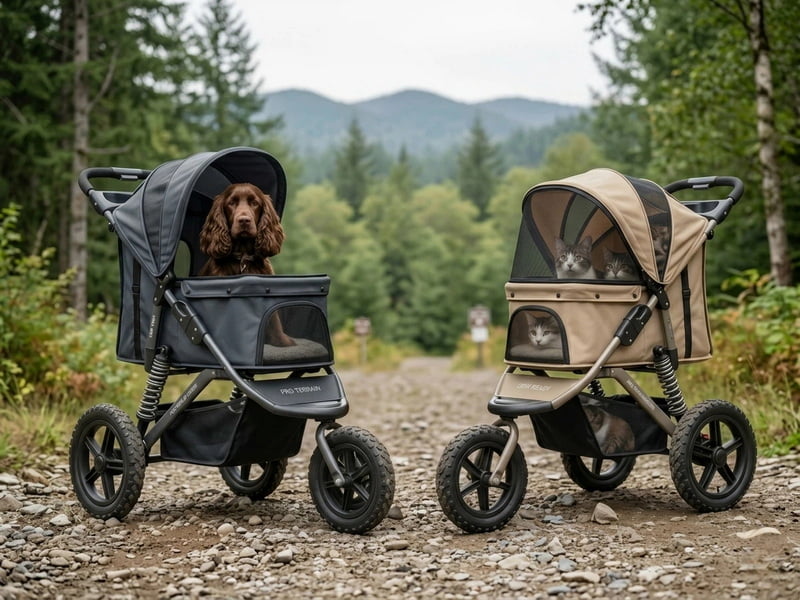
An all-terrain pet stroller is a specialized mobility tool designed with heavy-duty suspension, large pneumatic or puncture-proof tires, and reinforced frames to navigate rugged surfaces like gravel, sand, and forest trails. These strollers allow senior, injured, or small pets to accompany owners on outdoor excursions that standard strollers cannot handle.
Understanding the Anatomy of an All-Terrain Pet Stroller
To distinguish a true all-terrain pet stroller from a standard urban model, one must look at the structural engineering and material composition. Standard strollers are designed for flat pavement and often feature small, hard plastic wheels that vibrate excessively on uneven ground. In contrast, an all-terrain model is built to absorb impact and maintain stability across unpredictable landscapes.
The foundation of a high-quality all-terrain stroller is its frame. By 2026, most premium manufacturers utilize anodized aluminum alloys. This material provides a high strength-to-weight ratio, ensuring the stroller can support larger breeds (sometimes up to 110 pounds) without becoming too heavy for the owner to push uphill. Aluminum is also naturally resistant to corrosion, which is critical if the stroller is frequently exposed to mud, rain, or coastal salt air.
The most defining feature, however, is the wheel and tire system. True off-road capability relies on large-diameter wheels, typically ranging from 12 to 16 inches. Larger wheels have a better "angle of attack," allowing them to roll over obstacles like tree roots or stones rather than getting stuck against them. The choice between air-filled (pneumatic) tires and "never-flat" foam-filled tires is a common pivot point for buyers. Pneumatic tires offer the superior shock absorption necessary for rocky trails, while foam-filled tires provide peace of mind against punctures in areas with thorns or sharp debris.
Technical Specifications: Tires, Suspension, and Bearings
When evaluating the technical depth of an all-terrain pet stroller, the internal mechanics of the wheels are as important as the external rubber. High-performance models incorporate stainless steel ball bearings within the wheel hubs. These bearings reduce friction, allowing the stroller to glide with minimal effort even when loaded with a heavy pet.
Suspension systems in 2026 have evolved to mirror mountain bike technology. Many strollers now feature adjustable rear suspension, where the tension can be dialed in based on the pet's weight. A 10-pound Pomeranian requires a softer suspension to avoid "bouncing" in the cabin, whereas a 60-pound older Golden Retriever requires a stiffer setting to prevent the frame from bottoming out on bumps. This mechanical adaptability protects the pet’s joints and spine from micro-trauma during long treks.
Furthermore, the "wheelbase"—the distance between the front and rear wheels—is wider on all-terrain models. This wider stance provides a lower center of gravity, significantly reducing the risk of the stroller tipping over when navigating side-slopes or making sharp turns on uneven dirt paths. The front wheel often features a locking swivel mechanism; it swivels for maneuverability in tight spaces but locks into a fixed position for stability during high-speed jogging or when traversing deep sand.
Material Durability and Weather Resistance
The cabin of an all-terrain pet stroller must withstand more than just the pet’s weight; it must endure the elements. Most professional-grade strollers use 600D (Denier) polyester or higher. This heavy-duty fabric is water-resistant and tear-resistant, protecting the interior from snagging branches or inclement weather.
Ventilation is another technical requirement. All-terrain excursions often involve higher physical exertion for the pet owner and longer exposure to the sun for the pet. Therefore, manufacturers use industrial-grade nylon mesh. Unlike the flimsy mesh found on budget strollers, this material is "claw-proof," preventing anxious or excited pets from scratching their way out. The mesh must be strategically placed to allow cross-ventilation, ensuring the internal cabin temperature remains safe even during summer hikes.
Additionally, many 2026 models include PU (Polyurethane) coatings on the fabric. This coating doesn't just repel water; it provides UV protection. Prolonged exposure to high-altitude sunlight can degrade standard fabrics and, more importantly, can lead to heatstroke in pets. A UV-resistant canopy acts as a critical safety barrier for pets with thin fur or light-colored skin.
Selecting the Right Stroller for Specific Terrains
Not all "off-road" environments are the same, and different mechanical features prioritize different terrains. A stroller that excels on a sandy beach may not be the optimal choice for a steep, rocky mountain trail.
Beach and Soft Sand Navigation
Sand is one of the most difficult surfaces for any wheeled vehicle. On the beach, the primary goal is "flotation"—preventing the wheels from sinking. Strollers with extra-wide, air-filled tires are best here. The lower the tire pressure (within manufacturer limits), the more the tire spreads out, creating a larger surface area that "floats" on top of the sand.
Forest Trails and Rocky Paths
For wooded areas, maneuverability and ground clearance are the priorities. A three-wheel "jogger" design is usually preferred because the single front wheel can be easily lifted or pivoted around obstacles. High ground clearance is necessary to ensure the under-basket of the stroller does not drag on rocks or high grass.
Urban "Rough" Terrain
For owners who live in cities with cobblestone streets, cracked sidewalks, or extensive gravel paths, a four-wheel all-terrain model might be more appropriate. These offer maximum stability during frequent stops and starts. While they may lack the extreme agility of a three-wheeler, their four-point contact system provides a very smooth ride on repetitive bumps like brickwork.
Comparison of Stroller Types by Terrain Suitability
| Feature | Urban Standard | All-Terrain Jogger | Heavy-Duty Expedition |
|---|---|---|---|
| Primary Surface | Pavement, Malls | Gravel, Dirt Trails | Sand, Rocks, Mud |
| Wheel Material | EVA Plastic | Pneumatic Rubber | Reinforced Foam/Air |
| Suspension | None or Basic Spring | Dual Rear Shocks | Adjustable All-Wheel |
| Front Wheel | Small, Double Swivel | 12" Locking Swivel | 16" Fixed or Locking |
| Weight Capacity | Up to 30 lbs | Up to 75 lbs | Up to 110+ lbs |
| Braking System | Foot Brake (Rear) | Hand & Foot Brake | Disc Brakes (Premium) |
Ergonomics for the Human Handler
While the pet's comfort is paramount, an all-terrain pet stroller must also be ergonomically sound for the person pushing it. Pushing a 50-pound dog through a grassy field is a significant physical task.
Adjustable Handlebars: Look for strollers with multi-position or telescoping handlebars. This allows the pusher to maintain a neutral wrist position and an upright posture, preventing lower back strain during long walks. It also ensures that people of different heights can share the pushing duties comfortably.
Stride Clearance: High-performance all-terrain strollers are designed with a rear axle that is curved or positioned further forward. This creates "stride clearance," ensuring that the person pushing does not accidentally kick the back of the stroller or the brake bar while walking or running with a long gait.
Braking Systems: On hilly terrain, a standard foot-operated parking brake is insufficient. Technical all-terrain models often feature a handlebar-mounted hand brake. This allows the operator to control the speed of the stroller on descents, preventing the weight of the pet from "runaway" momentum. This is a critical safety feature for anyone planning to use the stroller on hiking trails with significant elevation changes.
Safety Protocols and Best Practices
Using an all-terrain pet stroller requires a different safety mindset than using a traditional stroller. The increased speeds and uneven surfaces introduce risks that must be managed.
- Interior Tethers: Always use the built-in safety tethers. An all-terrain stroller can encounter sudden jolts when hitting a hidden dip or root. Without a tether, a pet could be tossed from the cabin or may attempt to jump out if they see wildlife, leading to injury.
- Weight Distribution: Ensure the pet is centered in the cabin. If a pet leans too far to one side while the stroller is on an incline, the center of gravity shifts, increasing the risk of a tip-over. Many owners of smaller pets use bolsters or blankets to keep the pet snugly positioned in the center.
- Tire Maintenance: For pneumatic tires, maintaining the correct PSI (pounds per square inch) is vital. Under-inflated tires make the stroller significantly harder to push and increase the risk of the tire rim being damaged on rocks. Over-inflated tires result in a harsh, bouncy ride for the pet.
- Visibility: If hiking in areas shared with cyclists or near roads, ensure the stroller has reflective stripping. In 2026, many strollers also include integrated LED safety lights for dawn or dusk excursions.
Troubleshooting Common Issues
The Stroller "Pulling" to One Side: If the stroller consistently veers left or right on a flat surface, first check the tire pressure. An under-inflated tire on one side will create drag. If the pressure is equal, the front wheel alignment may need adjustment. Most all-terrain strollers have an alignment screw near the front fork to correct this.
Squeaking or Stiff Movement: Exposure to dirt and moisture can strip the lubrication from the wheel axles. Do not use standard WD-40, as it can attract more grit. Instead, use a dry silicone lubricant or a specialized bicycle chain lube on the bearings and pivot points. This keeps the mechanism smooth without creating a "grime paste."
Folding Mechanism Jams: Grit or sand often gets trapped in the folding joints after a beach trip. Never force the mechanism. Instead, use compressed air or a soft brush to clear the debris from the hinges. Regularly rinsing the frame (but avoiding the internal bearings) with fresh water after salt-air exposure will prevent the "crust" that often leads to jamming.
Frequently Asked Questions
Can I use an all-terrain pet stroller for a cat?
Yes, but with precautions. Cats are generally more agile and prone to "bolting" than dogs. An all-terrain stroller for a cat must have a completely enclosed mesh canopy with locking zippers. The rugged suspension is actually very beneficial for cats, as they are highly sensitive to the vibrations of standard strollers, which can cause them significant stress.
Are pneumatic (air-filled) tires better than foam-filled tires?
Pneumatic tires offer the best shock absorption and are superior for very rocky or bumpy terrain. However, they require maintenance and can go flat. Foam-filled "never-flat" tires are better for owners who want a maintenance-free experience and primarily traverse gravel or groomed trails rather than "true" off-road wilderness.
How do I clean the stroller after a muddy hike?
Most all-terrain strollers feature removable fabric liners. These should be hand-washed with mild detergent. For the frame, use a low-pressure hose to wash off mud. Avoid using high-pressure power washers, as these can force water and grit into the sealed ball bearings, leading to premature wear and rust.
Can I run or jog with any all-terrain pet stroller?
Not necessarily. While many all-terrain strollers are "joggers," you should specifically look for a model that mentions a "fixed front wheel" or a "locking front wheel." Jogging with a front wheel in swivel mode can lead to "speed wobble," which is dangerous for both the pet and the runner.
Is it worth getting a stroller for a large dog?
For large dogs with hip dysplasia, arthritis, or post-surgical recovery needs, an all-terrain stroller is often the only way to get them into nature. Ensure you check the weight capacity and the "cabin dimensions" specifically, as a dog may fit the weight limit but be too tall or long to sit comfortably.
Final Recommendation for New Buyers
When choosing an all-terrain pet stroller in 2026, prioritize the wheel system and suspension above aesthetic features. If you plan on frequenting rugged trails, invest in a three-wheel model with at least 12-inch pneumatic tires and a hand-operated braking system. Always measure your pet while they are in a sitting and laying position to ensure the cabin provides enough room for them to shift comfortably during long outings. For those living in coastal areas, ensuring the frame is made of high-grade aluminum will significantly extend the lifespan of the investment by preventing rust.