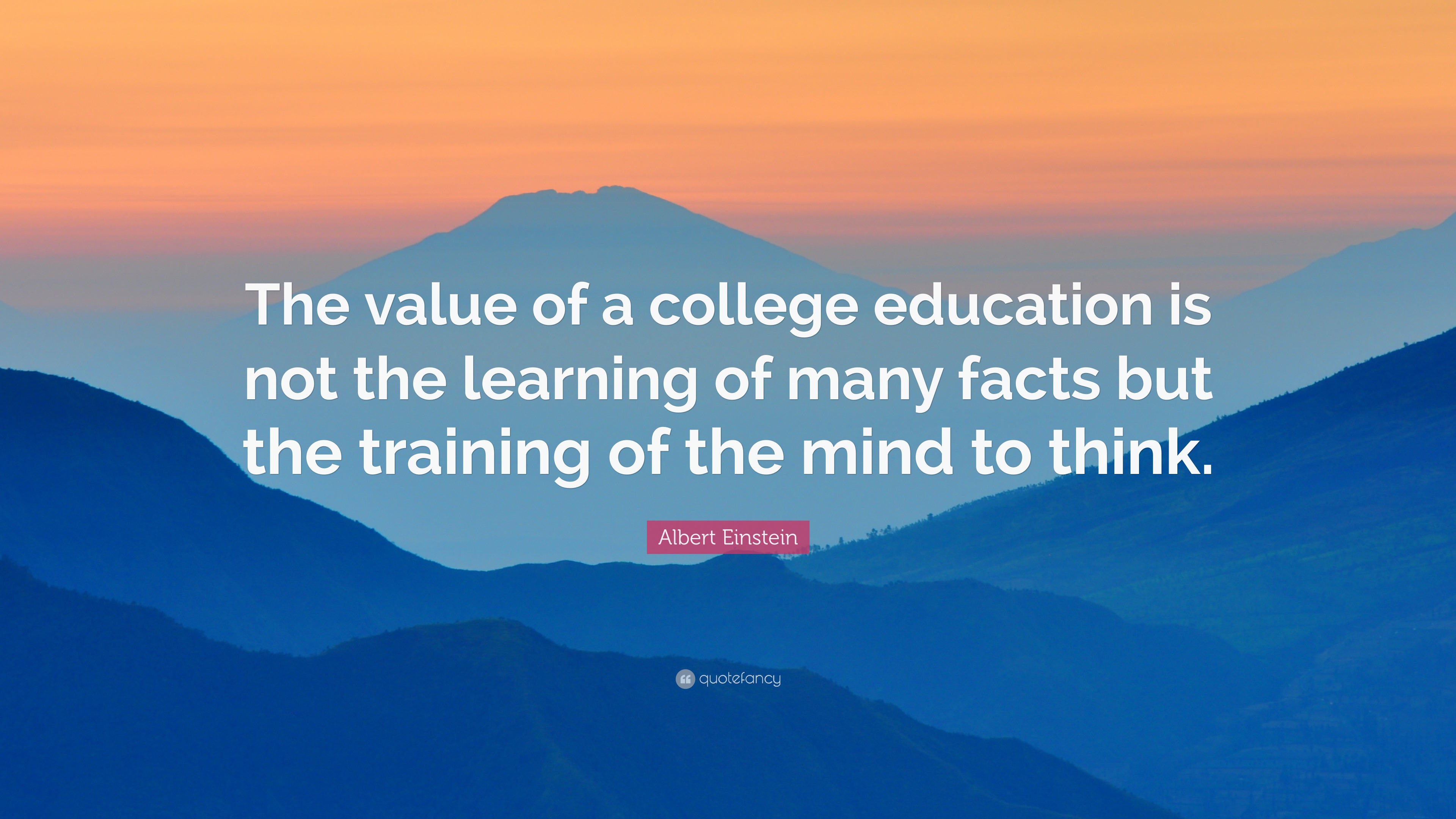
Albert Einstein viewed learning not as the passive accumulation of facts, but as the active training of the mind to think. His philosophy emphasizes that true intellectual growth stems from "holy curiosity," imagination, and the courage to challenge established norms rather than simply excelling at rote memorization.
Albert Einstein is perhaps the most famous physicist in history, but his legacy extends far beyond the theory of relativity. His reflections on the nature of the human mind have shaped modern educational philosophy. To understand Einstein’s quotes on learning is to understand a worldview that prioritizes the process of inquiry over the product of knowledge. In 2026, as we navigate an era where information is instantly accessible via artificial intelligence and global networks, Einstein's distinction between "information" and "knowledge" has never been more relevant.
The Primacy of Imagination Over Knowledge
One of the most frequently cited Albert Einstein learning quotes is: "Imagination is more important than knowledge. For knowledge is limited to all we now know and understand, while imagination embraces the entire world, and all there ever will be to know and understand."
This statement, originally made during an interview with George Sylvester Viereck in 1929, serves as the cornerstone of Einstein's approach to learning. To Einstein, knowledge represented the static library of the past—the things we have already discovered and verified. While necessary, knowledge is inherently finite. Imagination, however, is the engine of progress. It allows the learner to venture into the unknown and propose "what if" scenarios that lead to breakthroughs.
The Role of Thought Experiments (Gedankenexperiments)
Einstein practiced what he preached through his famous "thought experiments." Instead of starting with complex mathematics, he often began with a simple visual concept. For instance, he famously imagined what it would be like to ride alongside a beam of light. This leap of imagination was the prerequisite for the mathematical frameworks he later developed.
For modern learners, the takeaway is clear: do not become so bogged down in the technical details of a subject that you lose the ability to visualize the "big picture." Learning is most effective when it is fueled by a creative vision of how things work, rather than just the ability to recite formulas or dates.
The Cultivation of "Holy Curiosity"
Einstein often resisted the label of "genius," preferring to describe himself as someone who simply refused to stop asking questions. He once wrote, "I have no special talent. I am only passionately curious."
This humility points to a fundamental truth about learning: curiosity is a more reliable driver of success than raw IQ. When a learner is "passionately curious," the labor of study ceases to be a chore and becomes a pursuit of discovery. Einstein referred to this drive as "holy curiosity," a trait he felt was often stifled by formal education systems.
Protecting the Spirit of Inquiry
Einstein was a vocal critic of the rigid, competitive nature of schools in his time (and by extension, the pressures that persist in 2026). He believed that the most important task for an educator was to protect the natural curiosity of the child. He noted that it is a "miracle that modern methods of instruction have not yet entirely strangled the holy curiosity of inquiry."
To apply this principle, learners must seek environments that encourage questioning. If you are learning a new skill or academic subject, the goal should not just be to find the "right" answer for an exam, but to understand the "why" behind the answer. True learning occurs in the friction between what we know and what we wonder about.
Distinguishing Information from Knowledge
In a world saturated with data, Einstein’s warning that "Information is not knowledge" serves as a vital guardrail. He understood that being able to access a fact is not the same as understanding the principles that govern it.
In the current landscape of 2026, where generative AI can provide instant summaries of any topic, the danger of confusing "having the answer" with "understanding the concept" is acute. Einstein’s view suggests that knowledge requires:
- Integration: How does this new fact fit into what I already know?
- Application: Can I use this information to solve a problem?
- Critical Thinking: Why is this information accurate, and what are its limitations?
True knowledge is the result of processing information through the lens of experience and logic. Simply "knowing" that E=mc² is information; understanding the relationship between energy, mass, and the speed of light is knowledge.
The Relationship Between Learning and Failure
Einstein’s perspective on mistakes is summarized in his famous observation: "A person who never made a mistake never tried anything new."
In most educational settings, mistakes are penalized. However, in the realm of scientific discovery and deep learning, mistakes are data points. Einstein spent years pursuing dead ends and refining his theories. He understood that the path to a breakthrough is paved with failed attempts.
Developing Intellectual Resilience
To learn like Einstein, one must develop a high tolerance for ambiguity and error. If you are not making mistakes, it likely means you are operating within the boundaries of what you already know. Growth occurs at the edge of your competence, where the risk of failure is highest.
By reframing failure as a necessary byproduct of innovation, learners can reduce the anxiety associated with difficult subjects. Whether you are learning a new language, coding, or exploring theoretical physics, the "wrong" turns are often where the most significant cognitive connections are made.
Categorizing Einstein's Core Learning Philosophies
The following table categorizes Einstein's primary views on learning to help students and professionals apply them to their own development goals.
| Philosophy Category | Core Concept | Practical Application |
|---|---|---|
| Cognitive Approach | Imagination > Knowledge | Use visualization and metaphors to understand complex systems before diving into data. |
| Motivation | Passionate Curiosity | Focus on subjects that spark genuine interest; ask "why" until the fundamental logic is clear. |
| Validation | Experience vs. Rote | Move beyond memorization. Test theories through practice, experimentation, or teaching others. |
| Resilience | Necessity of Errors | Accept that confusion and mistakes are signs of progress, not signs of inadequacy. |
| Simplicity | Deep Understanding | If you cannot explain a concept simply, you do not understand it well enough yet. |
The "Feynman-Einstein" Connection: Simplicity in Learning
Although often attributed to various thinkers, the sentiment "If you can't explain it simply, you don't understand it well enough" is a hallmark of Einstein’s intellectual standard. He believed that the ultimate goal of learning was to reach such a profound level of understanding that the complexities of a subject could be distilled into their essence.
This is often referred to as the "Feynman Technique" today, but it was a principle Einstein lived by. When he worked on the General Theory of Relativity, he wasn't looking for more complexity; he was looking for the simplest possible geometric explanation for gravity.
For a learner in 2026, this is a powerful diagnostic tool. To verify your own learning:
- Choose a topic you are studying.
- Attempt to explain it to someone who has no background in the field.
- Identify the gaps in your explanation where you resort to jargon or "hand-waving."
- Go back to the source material to fill those specific gaps.
Common Misattributions and Fact-Checking
Because Einstein is a global icon of intelligence, many quotes are falsely attributed to him to lend them "intellectual weight." As a senior technical editor, it is essential to distinguish genuine Einstein quotes from those that are apocryphal.
The "Fish Climbing a Tree" Quote
You will often see the quote: "Everybody is a genius. But if you judge a fish by its ability to climb a tree, it will live its whole life believing that it is stupid."
Verification: There is no evidence in the Einstein Papers Project or his recorded speeches that he ever said this. While the sentiment aligns with his critique of standardized education, the phrasing is likely from a later pedagogical source and was attributed to Einstein to give it more "authority" in the late 20th century.
The Definition of Insanity
The quote: "The definition of insanity is doing the same thing over and over again and expecting different results."
Verification: This is almost certainly not Einstein's. Its earliest known appearances are in Narcotics Anonymous literature and novels from the early 1980s. Einstein was more concerned with the underlying laws of physics than with the psychological definition of "insanity" in this context.
Applying Einstein’s Wisdom in 2026
In the current year, the nature of learning has shifted from "finding" to "filtering." We no longer need to go to a library to find the speed of light; we need to know how to use that information to innovate.
- Prioritize Deep Work: Einstein was known for his ability to focus intensely for long periods. In an age of digital distraction, the ability to engage in "deep work" (as coined by Cal Newport) is a competitive advantage.
- Cross-Disciplinary Thinking: Einstein didn't just study physics; he was a violinist and a philosopher. He often found that his musical intuition helped him solve scientific problems. Modern learners should avoid hyper-specialization and instead seek out diverse mental models.
- Value the "Useless" Pursuit: Einstein spent the last decades of his life pursuing a Unified Field Theory, which many colleagues thought was a waste of time. He didn't succeed in his lifetime, but his persistence pushed the boundaries of what others thought possible. Don't be afraid to study something simply because it interests you, even if there is no immediate "market value" for that knowledge.
Frequently Asked Questions
What did Einstein mean by "Education is what remains after one has forgotten what one has learned in school"?
This quote emphasizes that the true purpose of education is not the specific facts (which we often forget), but the cognitive habits, critical thinking skills, and character traits we develop during the process. The "remainder" is the ability to think, reason, and solve problems independently of a textbook.
Did Einstein really fail math in school?
No, this is a popular myth. Einstein was a brilliant mathematician from a very young age. By the age of 15, he had mastered differential and integral calculus. The myth likely started because the grading system in his school was reversed, making a "1" the highest grade instead of the lowest, which confused later biographers.
How did Einstein feel about self-taught learning?
Einstein was a strong proponent of "autodidacticism" or self-directed learning. He often felt that the rigid structure of the university system was too restrictive. He spent much of his time at the Patent Office in Bern teaching himself complex physics and mathematics while performing his official duties. He believed that an internal drive to learn was far superior to external pressure from an institution.
Why did Einstein think imagination was more important than knowledge?
He believed that knowledge was a static collection of past discoveries, whereas imagination was the active force that allowed us to envision things that don't yet exist. Without imagination, there would be no new theories, no innovation, and no scientific progress. It is the "bridge" between the known and the unknown.
How can I apply Einstein's learning principles to my career?
Focus on the "Why" behind your industry’s trends rather than just the "What." Cultivate a habit of "passionate curiosity" about your field, and don't be afraid to question the "standard operating procedures" if they don't seem logical. Finally, treat every mistake as a learning opportunity rather than a failure of your professional identity.
Practical Recommendation for Further Learning
To truly embody the Einsteinian spirit of learning, your next step should be to engage in a "thought experiment" related to your current field of study. Instead of looking for a solution in a manual or via an AI prompt, spend 30 minutes visualizing the problem from first principles. If you are learning to code, visualize the flow of data through the system. If you are studying history, imagine yourself in the decision-room of a historical figure. By engaging your imagination before your information-retrieval skills, you begin to train your mind to think like a scientist.
For the most authentic primary sources of his thoughts, consult the Einstein Papers Project at the California Institute of Technology (Caltech). This archive provides the most accurate context for his letters, diaries, and academic papers, ensuring that you are learning from the man himself rather than the myths surrounding him.