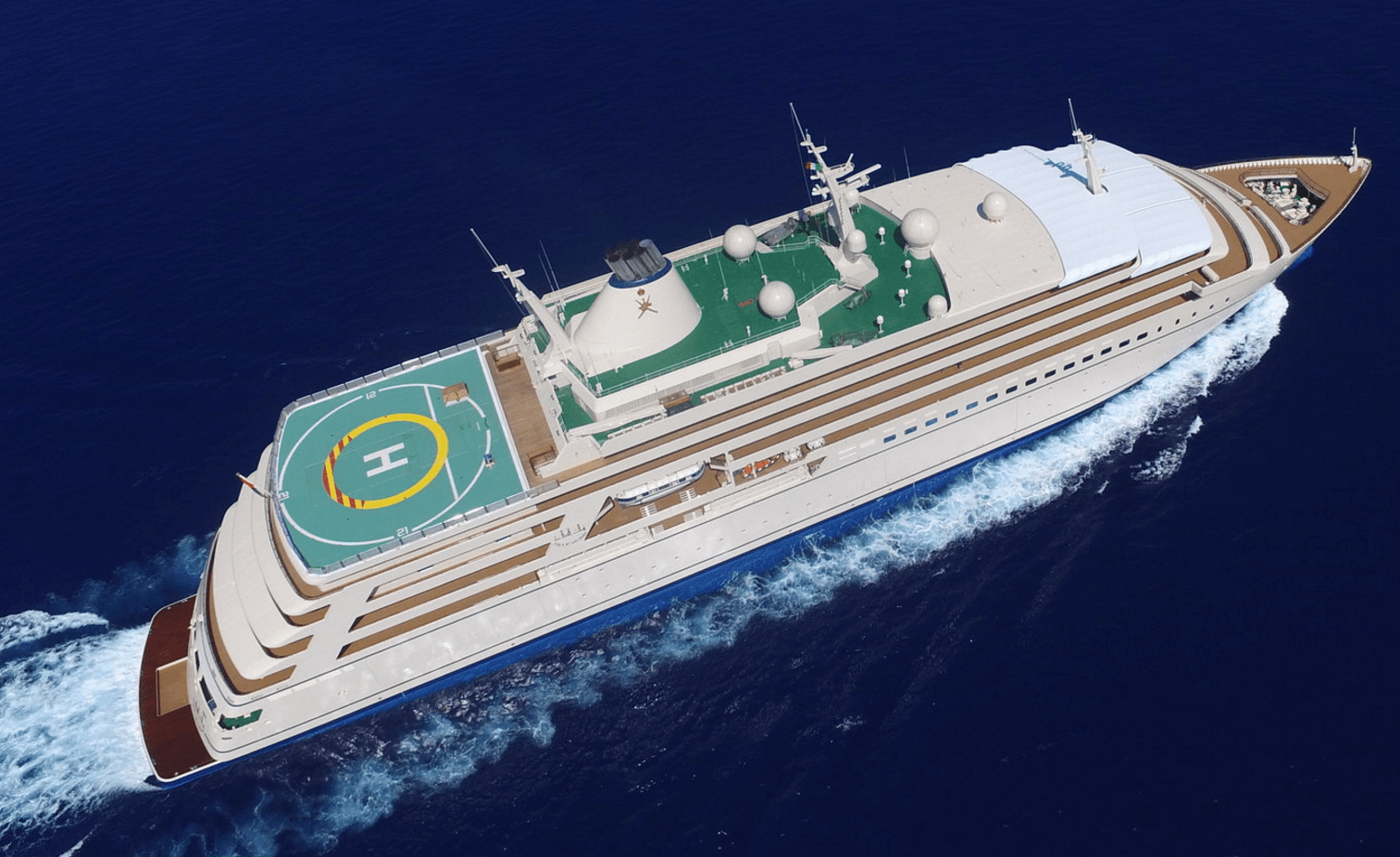
The Al Salamah yacht is a premier example of maritime engineering and sovereign luxury, serving as a prominent vessel within the Saudi Arabian royal fleet. Built by Lürssen and HDW, this 139-meter superyacht was once the world's third-largest, featuring eight decks, a full-scale hospital, and accommodations for nearly 100 guests and crew.
The Genesis of Al Salamah: Project MI05
The story of the Al Salamah began in the late 1990s under the secretive project name MI05. Commissioned by the late Prince Sultan bin Abdulaziz, then the Crown Prince and Minister of Defense and Aviation of Saudi Arabia, the vessel was intended to be more than just a leisure craft. It was designed as a mobile seat of government, a private retreat, and a state-of-the-art medical facility capable of supporting the Prince's needs during extended periods at sea.
Construction of a vessel of this magnitude required a collaborative effort between two German shipbuilding giants: Lürssen in Bremen and HDW (Howaldtswerke-Deutsche Werft) in Kiel. The decision to involve two yards was largely driven by the sheer scale of the project and the tight delivery schedule requested by the Saudi royal family. While Lürssen acted as the primary contractor and lead designer, HDW provided the massive construction sheds and technical infrastructure necessary to house a hull that would eventually displace over 12,000 gross tons.
Launched in 1999, Al Salamah represented a significant leap in superyacht volume. At the time of its delivery, it dwarfed almost every other private vessel in existence, setting a new benchmark for what was possible in the "megayacht" category. Its robust, ship-like appearance signaled a departure from the sleek, sporty aesthetics of smaller yachts, prioritizing internal volume, stability, and long-range autonomy.
Technical Specifications and Engineering Marvels
To understand the Al Salamah, one must look at the sheer numbers that define its presence on the water. As of 2026, even with the advent of newer, longer vessels like the Azzam or REV Ocean, Al Salamah remains one of the most voluminous yachts ever built.
Hull and Propulsion
The vessel features a steel hull and an aluminum superstructure, a standard combination for large yachts that balances strength with a manageable center of gravity. With a beam of 23.5 meters (77 feet) and a draft of nearly 5 meters, the yacht possesses the stability of a commercial cruise ship.
Powering this 12,234 GT behemoth are twin MTU 20V 1163 TB73 diesel engines. Each engine produces roughly 8,700 horsepower, allowing the yacht to reach a top speed of 21.5 knots. For a vessel of this weight, such speed is an engineering feat. Its cruising speed is typically maintained at 17 knots, providing a range that allows for transoceanic voyages without the need for frequent refueling stops.
Interior Volume and Layout
The interior of Al Salamah was designed by the legendary Terence Disdale Design. Disdale is known for his "beach house" aesthetic, but for Al Salamah, the brief was significantly more formal and regal. The layout spans eight decks, which is extraordinary for a yacht of 139 meters. Many modern yachts of similar length only feature five or six decks, highlighting how Al Salamah maximizes its vertical space to increase total floor area.
- Gross Tonnage: 12,234 GT
- Decks: 8
- Guest Cabins: 22 (approximate)
- Crew Capacity: 94 to 100 members
The crew-to-guest ratio is nearly three-to-one, ensuring that every occupant receives the level of service expected within the Saudi royal court. This high crew count is also necessary to maintain the complex mechanical systems and the specialized facilities located on the lower decks.
The Floating Palace: Onboard Amenities and Features
The Al Salamah was built with specific requirements that reflected the lifestyle and responsibilities of Prince Sultan bin Abdulaziz. Unlike many charter yachts that focus on water toys and beach clubs, Al Salamah was designed for official business, large-scale entertaining, and high-level medical care.
The Specialized Medical Suite
One of the most distinctive features of the Al Salamah is its onboard hospital. During the later years of Prince Sultan’s life, this facility was staffed by world-class medical professionals. The suite included an operating theater, an X-ray room, and an intensive care unit. This ensured that the Prince could travel globally while maintaining immediate access to the highest standard of healthcare, a prerequisite for the aging leadership of the time.
Grand Entertaining Spaces
The yacht features a massive formal dining room capable of seating dozens of dignitaries. The interior styling heavily utilizes gold leaf, fine marbles, and rare woods, creating an environment of "Classic Arabic Luxury."
In addition to the formal areas, the yacht includes:
- A Private Cinema: Equipped with the latest projection technology of its era and lavish seating.
- A Gymnasium and Spa: Featuring traditional hammams and modern fitness equipment.
- Extensive Business Suites: Large offices and meeting rooms with encrypted communication arrays to allow the Prince to conduct state affairs.
- A Hair Salon and Beauty Suite: To cater to the royal family and their guests during long voyages.
Outdoor Living and Protection
The exterior decks offer vast areas for relaxation, though they are often shielded from public view by high bulwarks and tinted glass—a necessity for the privacy-conscious Saudi royals. A large helipad is located on the upper deck, capable of receiving mid-sized helicopters to ferry guests and officials directly to the vessel while at sea.
Ownership and Historical Transition
For over a decade, Al Salamah was the crown jewel of Prince Sultan bin Abdulaziz’s private fleet. Following his passing in 2011, the vessel’s future became a subject of intense speculation in the maritime community. For a period, the yacht was listed for sale through high-end brokerages, with an asking price rumored to be in the hundreds of millions of dollars.
However, selling a vessel of this size and specific configuration is a complex task. The "hospital-grade" requirements and the massive crew overhead make it a difficult asset for a typical billionaire to operate. Eventually, reports surfaced that the vessel was gifted to the Royal Family of Bahrain as a gesture of regional diplomacy and friendship between the two kingdoms. In recent years, including the current 2026 timeframe, the vessel has been seen frequently in the waters around Manama, though it still retains its historical identity as a "Saudi royal vessel" in most maritime databases and historical records.
Al Salamah Compared to Modern Superyachts
In the world of superyachts, technology and size benchmarks move quickly. When Al Salamah was delivered in 1999, it was a titan. By 2026, it has been surpassed in length by several vessels, yet it remains a "top 20" contender in terms of volume.
| Feature | Al Salamah | Azzam (Current Record Holder) | Eclipse (Abramovich) |
|---|---|---|---|
| Length | 139.3m | 180.6m | 162.5m |
| Gross Tonnage | 12,234 GT | 13,136 GT | 13,000+ GT |
| Top Speed | 21.5 Knots | 31.5 Knots | 21.0 Knots |
| Build Year | 1999 | 2013 | 2010 |
| Primary Focus | Volume & Medical | Speed & Length | Technology & Security |
As shown in the table, while newer yachts like Azzam are significantly longer, Al Salamah’s gross tonnage is remarkably close to vessels that are 20 to 40 meters longer. This is because Al Salamah is built "wider and taller," focusing on interior living space rather than a sleek, elongated profile. This architectural choice makes it one of the most comfortable vessels in heavy seas, as its high displacement minimizes the sensation of motion.
Maintenance and Refit: Keeping a Legend Alive
Maintaining a 139-meter steel yacht requires a constant cycle of maintenance. For Al Salamah to remain operational in 2026, it has undergone multiple major refits. These refits typically involve:
- Navigation Upgrades: Replacing late-90s radar and sonar with modern satellite-integrated systems.
- Environmental Compliance: Installing newer exhaust scrubbers and waste management systems to meet tightening international maritime laws (MARPOL).
- Interior Refreshing: While the "regal" style remains, soft goods and electronics are frequently updated to maintain the standards of a royal residence.
The cost of such maintenance is estimated at approximately 10% of the vessel's original construction cost annually. For Al Salamah, this translates to tens of millions of dollars per year in crew salaries, fuel, docking fees, and technical upkeep.
Practical Considerations for Maritime Enthusiasts
For those tracking the Al Salamah, it is important to note that the vessel is strictly private. It does not operate on the charter market, and access is restricted to the royal family and their invited guests.
Sighting the Vessel
The yacht is most frequently spotted in:
- Jeddah, Saudi Arabia: Its traditional home port.
- Manama, Bahrain: Its current primary base of operations.
- The French Riviera (Antibes/Monaco): Occasional summer visits for high-level diplomatic meetings.
Technical Documentation
Researchers interested in the technical specifics of Al Salamah can find official registry information through the International Maritime Organization (IMO) using the identification number 9190913. Detailed build photographs are rare due to the confidentiality agreements signed by Lürssen and HDW during the construction phase in the late 90s.
FAQ: Frequently Asked Questions
Is Al Salamah available for private charter?
No, Al Salamah is a private royal vessel and has never been available for public or commercial charter. It is used exclusively for the private and official business of the royal families of Saudi Arabia and Bahrain.
How many people can sleep on the Al Salamah?
The yacht is designed to accommodate approximately 40 to 50 guests across 22 lavish cabins, supported by a crew of nearly 100. This high crew-to-guest ratio ensures a seamless luxury experience and the operation of the onboard medical facilities.
Why does Al Salamah have so many decks?
Al Salamah features eight decks to maximize internal volume. This vertical design allows for specialized areas, such as a full-sized hospital, extensive office suites, and separate quarters for different levels of staff and security, which would not fit on a standard five-deck yacht of the same length.
Who designed the interior of the Al Salamah?
The interior was designed by Terence Disdale Design, one of the most prestigious names in the yachting industry. The style is a blend of traditional Arabic majesty and classic European luxury, featuring high-end materials like marble and gold leaf.
What is the current status of Al Salamah in 2026?
As of 2026, the vessel remains in active service. While it was originally the flagship of the Saudi royal fleet, it is now primarily associated with the Bahraini royal family following a diplomatic transfer. It continues to be meticulously maintained and is frequently seen in the Persian Gulf.
Final Recommendation for Maritime Researchers
The Al Salamah remains a vital case study in the evolution of the "Gigayacht." For those studying maritime history or naval architecture, it represents a pivotal moment where yachts transitioned from private boats into "floating sovereign territories." To understand its full impact, one should compare its volumetric design to the more modern "long and lean" philosophy of yachts built after 2010. While it may no longer be the longest vessel afloat, its sheer presence and the complexity of its internal systems—particularly the medical and administrative suites—ensure its place in the annals of great ships.