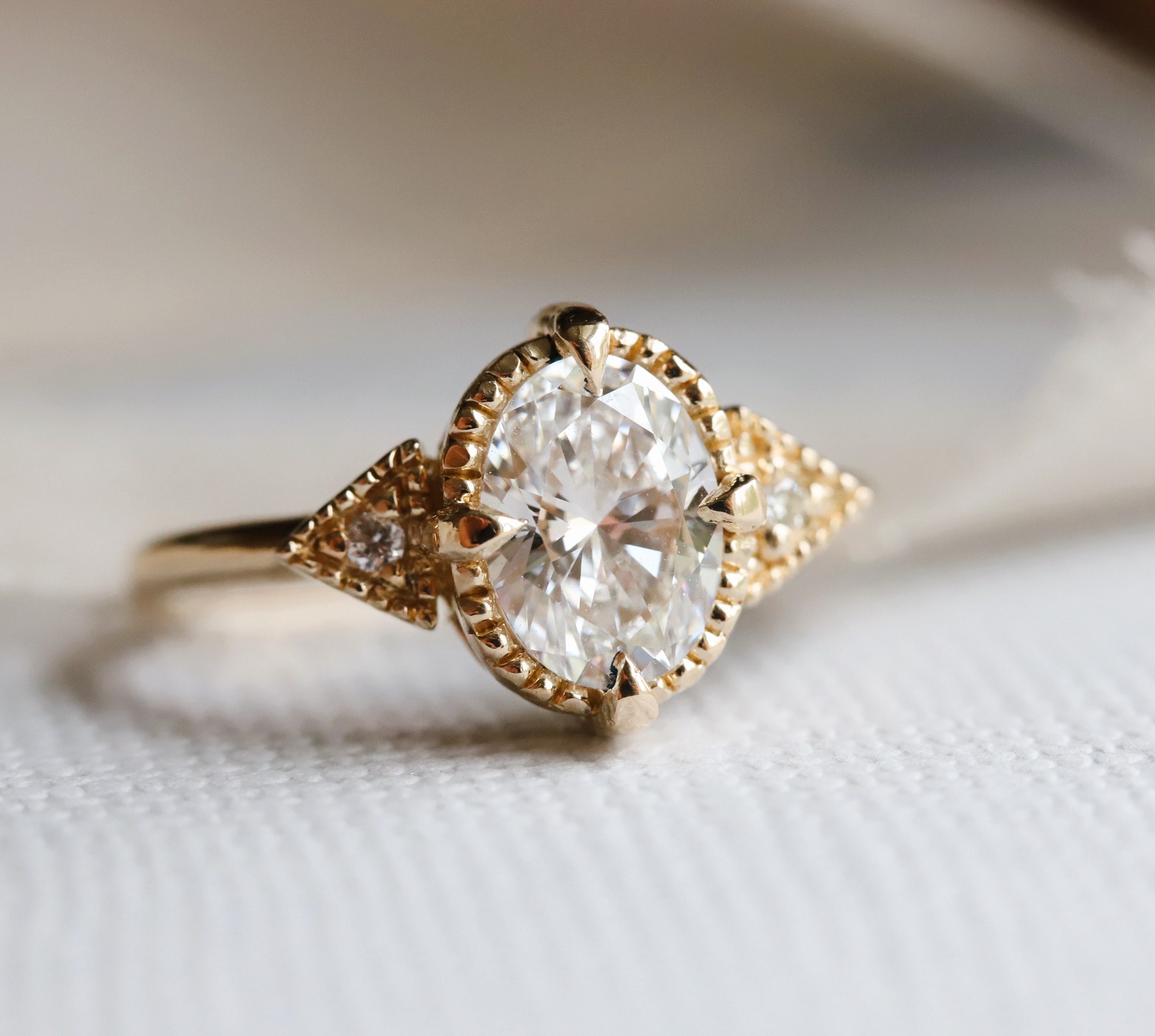
The engagement ring Aidan Shaw gave to Carrie Bradshaw in the fourth season of Sex and the City is a 3-carat Asscher-cut diamond set in a minimalist platinum band. While the relationship famously ended, the ring remains a benchmark for classic jewelry design, specifically noted for its clean step-cut facets and sophisticated "quiet luxury" aesthetic.
The Narrative Evolution of the Aidan Shaw Engagement Rings
To understand the specific details of the ring that eventually graced Carrie’s finger (and later her neck), one must distinguish between the two separate rings involved in the storyline. The transition between these two pieces served as a significant plot device, reflecting the friction and eventual compromise within the Aidan and Carrie relationship.
The Original Misstep: The Pear-Shaped Ring
Before the successful proposal, Carrie accidentally discovers an engagement ring hidden in Aidan’s gym bag. This first ring was a pear-shaped diamond set on a yellow gold band. In the context of the show’s fashion-forward protagonist, this choice was a catastrophic failure.
The narrative used this ring to highlight the disconnect between Aidan’s traditional, rustic sensibilities and Carrie’s high-fashion, Manhattan aesthetic. Carrie’s physical reaction—nausea—was triggered not just by the prospect of marriage, but by the "wrongness" of the jewelry itself. At the time, pear-shaped diamonds on gold bands were viewed by the character as dated or "suburban," a far cry from her desired identity.
The Correction: The Asscher-Cut Selection
Recognizing the error (with the help of Samantha Jones), Aidan returned the pear-shaped ring and selected a piece that better suited Carrie’s style. This second ring is the one most fans refer to when discussing the "Aidan ring." It represented Aidan’s attempt to see Carrie for who she truly was—a woman who appreciated architectural lines and modern elegance rather than traditional romantic motifs.
Technical Specifications of the Asscher-Cut Ring
The second ring is a masterclass in early 2000s high-end jewelry, though its design is timeless enough to remain popular in 2026. Below are the technical breakdowns based on the prop’s design and the narrative descriptions provided by the show’s costume department and jewelry partners.
The Diamond Cut: Asscher
The defining feature of the ring is the Asscher cut. Patented in 1902 by the Asscher Brothers of Holland, this cut is a square-shaped step cut with deeply cropped corners.
- Facet Structure: It typically features 58 facets. The step-cut arrangement creates a "hall of mirrors" effect rather than the "crushed ice" sparkle seen in round brilliant cuts.
- Visual Profile: The Asscher cut has a higher crown and a smaller table than a standard emerald cut, which gives it a distinct vintage appeal while maintaining a clean, geometric silhouette.
- Clarity Requirements: Because the Asscher cut has a large, open table, inclusions are much easier to see. For a character like Carrie, it is assumed the stone would be at least a VS1 or VVS2 clarity grade to maintain its icy transparency.
Carat Weight and Dimensions
The ring is widely cited as featuring a 3-carat center stone. At this weight, an Asscher-cut diamond measures approximately 8mm by 8mm. This size is significant; it is large enough to be a status symbol in New York City's social circles but modest enough to fit Carrie’s relatively slender hands without appearing gaudy.
Metal and Setting
Unlike the first ring’s yellow gold, the final ring was crafted in 950 Platinum.
- Setting Style: The stone is held by four delicate prongs. This minimalist approach ensures that the focus remains entirely on the diamond’s geometry.
- Band Design: The band is a simple, high-polish platinum wire or "comfort fit" band, approximately 2mm in width. It lacks pavé diamonds or side stones, adhering to a "less is more" philosophy that contrasts sharply with the "Big" engagement ring seen later in the series.
Comparison of Carrie Bradshaw’s Engagement Rings
Throughout the series and subsequent films, Carrie’s engagement rings have sparked intense debate among jewelry enthusiasts. Comparing Aidan’s choice to the famous "Black Diamond" from Mr. Big provides context for why the Aidan ring is considered the more "classic" of the two.
| Feature | Aidan’s "Correct" Ring | Mr. Big’s "Black Diamond" Ring |
|---|---|---|
| Center Stone | 3ct White Diamond | 5ct Black Diamond |
| Cut | Asscher Cut | Round Brilliant/Cushion Hybrid |
| Metal | Platinum | 18k White Gold/Blackened Rhodium |
| Accents | None (Solitaire) | White Diamond Pavé Halo |
| Symbolism | Stability and Clarity | Uniqueness ("Because you are not like anyone else") |
| Estimated Value (2026) | $45,000 - $65,000 | $25,000 - $40,000 |
Pricing and Market Value in 2026
In 2026, the cost of replicating the Aidan Shaw engagement ring varies significantly based on whether the buyer opts for a natural earth-mined diamond or a lab-grown alternative.
Natural Diamond Valuation
A natural 3-carat Asscher-cut diamond of high quality (G color, VS1 clarity) currently commands a premium. Because Asscher cuts are rarer than round or oval cuts, the "search cost" for a perfectly symmetrical stone adds to the price.
- Center Stone: $38,000 - $55,000
- Platinum Setting: $1,500 - $2,500
- Total Estimated Retail: $39,500 - $57,500
Lab-Grown Diamond Valuation
For those looking to capture the "Carrie Look" without the Manhattan price tag, lab-grown diamonds have become the standard in 2026.
- Center Stone: $2,800 - $4,500
- Platinum Setting: $1,500 - $2,500
- Total Estimated Retail: $4,300 - $7,000
The significant price gap in 2026 reflects the stabilization of the lab-grown market, though the Asscher cut remains one of the more difficult shapes to find in high-quality lab rough due to the precision required for the step-cut facets.
Why the Asscher Cut Suited the "Aidan Era"
The choice of an Asscher cut for Aidan’s second proposal was a deliberate stylistic shift. At the time of the show’s original airing, the Asscher cut was experiencing a massive resurgence in popularity. It represented a bridge between the Art Deco elegance of the 1920s and the modern minimalism of the early 2000s.
For Aidan—a furniture designer who worked with his hands and appreciated the integrity of materials—a step-cut diamond made sense. It is a "workman’s" high-end cut; it relies on the precision of the craftsman’s angles rather than the chaotic sparkle of a brilliant cut. It mirrored Aidan’s personality: honest, structured, and sturdy.
However, the fact that Carrie eventually wore the ring on a mulberry silk cord around her neck rather than on her finger was the ultimate foreshadowing. She loved the ring as an object of beauty, but she could not commit to the life it represented. The technical "perfection" of the ring could not overcome the emotional hesitation of the wearer.
Common Mistakes When Buying an Asscher Cut
If you are using the Aidan Carrie engagement ring details as inspiration for a 2026 purchase, there are several technical pitfalls to avoid. The Asscher cut is one of the least "forgiving" diamond shapes.
- Ignoring the "Windmill" Effect: A high-quality Asscher cut should have clear, defined "windmills" (the lines created by the facets meeting at the center). If these are blurry or asymmetrical, the ring will lose its architectural appeal.
- Skimping on Clarity: Unlike a Round Brilliant, which hides tiny spots with its sparkle, an Asscher cut acts like a window. Do not go below a VS2 clarity grade if you want a stone that looks "eye-clean."
- Depth Percentage Issues: A "dead" Asscher cut is often caused by a stone that is too shallow. Look for a depth percentage between 60% and 70% to ensure the "hall of mirrors" effect is prominent.
- Color Sensitivity: Step cuts tend to hold onto color more than other shapes. If you want the "icy" look of Carrie’s ring, aim for a Color Grade of G or higher. In a platinum setting, a J-color stone may appear slightly yellow.
FAQ: Aidan Carrie Engagement Ring Details
Did Carrie keep the Aidan engagement ring?
In the series, Carrie eventually returns the ring to Aidan after their second breakup. However, the ring makes a brief reappearance in the Sex and the City movie when she is cleaning out her apartment, serving as a nostalgic reminder of "the one who got away."
Who actually designed the ring for the show?
While the show frequently featured pieces from Harry Winston and Tiffany & Co., the Aidan engagement ring was a collaboration between the costume department and local New York jewelers. It was designed to look like a high-end boutique piece without being tied to a specific "big box" brand name, emphasizing Aidan's independent spirit.
Is an Asscher cut the same as an Emerald cut?
No. While both are step cuts, an Asscher cut is square with deeply cropped corners, whereas an Emerald cut is rectangular. The Asscher cut generally has more "fire" or light dispersion than a traditional Emerald cut due to its specific facet arrangement and higher crown.
Why did Carrie wear the ring on a necklace?
Carrie claimed she wore the ring around her neck because it was "closer to her heart," but the narrative implication was that she felt "choked" by the commitment of wearing it on her finger. This styling choice became a significant fashion trend in the early 2000s.
How many carats was the first (pear-shaped) ring?
The first ring was estimated to be approximately 1.5 to 2 carats. Its smaller appearance and yellow gold setting contributed to Carrie's disappointment, as it felt "modest" and "traditional" in a way that didn't align with her identity as a fashion icon.
Final Recommendations for Buyers
If you are seeking to replicate the Aidan Shaw engagement ring in 2026, prioritize Clarity and Cut over Carat weight. An Asscher cut only works if the diamond is pristine and the facets are perfectly aligned. A 2-carat Asscher with excellent symmetry will look significantly more "expensive" and true to the Sex and the City aesthetic than a 4-carat stone with visible inclusions. For the most authentic look, specify a "Square Emerald Cut" with a 1.00 to 1.05 length-to-width ratio set in a four-prong platinum cathedral or wire mounting.