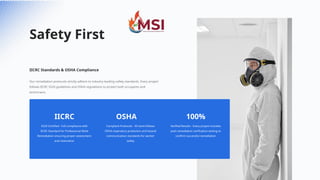
The ANSI/IICRC S520 Standard for Professional Mold Remediation provides a procedural framework based on reliable restoration principles and research. Following this 8-step guide ensures that mold contamination is physically removed, the underlying moisture issue is addressed, and the indoor environment is returned to a healthy, "Condition 1" state.
The ANSI/IICRC S520 is the industry-recognized gold standard for professional mold remediation. Unlike many localized or informal cleaning methods, the S520 focuses on the science of microbiology and engineering controls. As of 2026, the current edition remains the primary reference for remediators, insurance adjusters, and indoor environmental professionals (IEPs). The standard emphasizes that the primary goal of remediation is the physical removal of mold and contaminated materials, rather than simply attempting to "kill" or encapsulate mold spores with chemicals.
Understanding the Core Philosophy of S520
Before beginning the eight steps, it is essential to understand how the IICRC defines the state of a building. The S520 categorizes indoor environments into three "Conditions":
- Condition 1 (Normal Ecology): An indoor environment that may contain settled spores, fragments, or remnants of mold, but whose identity, location, and quantity are reflective of a normal fungal ecology for a similar indoor environment.
- Condition 2 (Settled Spores): An indoor environment which is primarily contaminated with settled spores or mold fragments that were dispersed from a Condition 3 area, but which do not exhibit active mold growth.
- Condition 3 (Actual Growth): An indoor environment contaminated with the presence of actual mold growth and associated spores. This includes growth that is active or dormant, visible or concealed.
The remediation process is specifically designed to move a structure from Condition 3 or 2 back to Condition 1.
Step 1: Inspection and Preliminary Assessment
The first step in any S520-compliant project is a thorough assessment of the structure. This is not merely a visual check for "black spots" but a forensic evaluation of the building’s history and current state. In many complex cases, the S520 recommends (and sometimes requires) the involvement of an independent Indoor Environmental Professional (IEP).
An IEP conducts initial testing to determine the extent of the contamination and identify the mold species present. This data allows the remediation team to create a "Scope of Work." During this phase, professionals use moisture meters, infrared cameras, and hygrometers to find the source of the moisture. Without identifying and fixing the water intrusion—whether it be a pipe leak, high humidity, or groundwater seepage—any remediation efforts will eventually fail as the mold returns.
Step 2: Health and Safety Protocols
The S520 prioritizes the safety of both the workers and the occupants. Before any material is disturbed, a site-specific health and safety plan must be implemented. This includes the selection of appropriate Personal Protective Equipment (PPE).
Remediators typically utilize:
- Respiratory Protection: N-95, R-95, or P-100 respirators, depending on the concentration of contaminants.
- Protective Clothing: Disposable suits (such as Tyvek) to prevent the cross-contamination of clothing and the spread of spores to other areas.
- Eye and Glove Protection: Non-porous gloves and goggles to protect against spores and any cleaning agents used.
Occupant safety is also addressed. In some 2026 protocols, if the contamination is extensive or if occupants have compromised immune systems, the S520 guidelines may suggest temporary relocation to prevent exposure during the "disturbance" phase of remediation.
Step 3: Area Containment and Engineering Controls
To prevent the spread of mold spores to unaffected areas (cross-contamination), specialized containment is required. The S520 identifies different levels of containment based on the size of the affected area and the potential for aerosolization.
Source Containment involves taping plastic sheeting directly over small areas of growth. Local Containment involves building a mini-enclosure around the work area. Full Containment involves sealing off entire rooms or sections of a building using 6-mil fire-retardant polyethylene sheeting.
A critical component of containment is the creation of a "Decontamination Chamber" or airlock, where workers can put on and take off PPE without releasing spores into the "clean" zones of the property.
Step 4: Air Pressure Management and Filtration
Physical barriers are rarely enough on their own. The S520 dictates the use of High-Efficiency Particulate Air (HEPA) filtration and negative air pressure. By using an Air Scrubbing machine or Negative Air Machine (NAM), professionals pull air out of the containment zone and exhaust it outside the building.
This creates "negative pressure," ensuring that if there is a small leak in the plastic containment, air will suck into the contaminated area rather than blowing out into the rest of the home. These machines must run 24/7 during the remediation process and often for 24–48 hours after the physical cleaning is complete to "scrub" the air of any remaining airborne particles.
Step 5: Physical Removal of Contaminated Materials
The heart of the S520 standard is the physical removal of mold. The standard is very clear: "killing" mold with bleach or biocides is not a substitute for removing it. Dead mold spores can still be allergenic or toxic.
The approach depends on the porosity of the material:
- Porous Materials (Drywall, Insulation, Carpet): These materials generally cannot be fully cleaned if they are Condition 3. They must be removed, double-bagged, and disposed of. The removal must extend at least 12–24 inches beyond the visible mold to ensure "clean" margins.
- Semi-Porous Materials (Wood Framing, Concrete): These can often be saved through abrasive cleaning methods such as wire brushing, sanding, or HEPA-vacuuming. In 2026, many professionals also utilize media blasting (dry ice or soda blasting) for large-scale attic or crawlspace remediation.
- Non-Porous Materials (Metal, Glass, Hard Plastics): These can usually be cleaned and reused following a thorough wipe-down.
Step 6: Detailed Cleaning (The HEPA Sandwich)
Once the bulk of the contaminated material is removed, the remaining surfaces within the containment zone must undergo a meticulous cleaning process often referred to in the industry as the "HEPA Sandwich."
This process involves:
- HEPA Vacuuming: Vacuuming all surfaces (including walls, floors, and studs) to remove settled spores.
- Damp Wiping: Wiping surfaces with an antimicrobial cleaner or a surfactant solution.
- Second HEPA Vacuuming: A final vacuuming pass once the surfaces have dried to catch any particles that were loosened during the wipe-down.
The goal is to leave the area "white-glove clean." If dust or debris remains, the project is likely to fail the post-remediation verification.
Step 7: Post-Remediation Verification (PRV)
The S520 standard highly recommends that a project be verified by an independent third party (the IEP) before the containment is removed. This step is the "Final Exam" of the remediation process.
The PRV typically includes:
- Visual Inspection: Ensuring no visible mold, dust, or debris remains.
- Moisture Testing: Confirming the moisture source has been successfully eliminated and materials are at "dry" standards.
- Air and Surface Sampling: Comparing the air inside the containment to the air outside the building. To pass, the indoor air must be statistically similar to or better than the outdoor "baseline" air.
The remediator should never perform their own PRV. This separation of duties is a core tenet of the ANSI/IICRC S520 to prevent conflicts of interest and ensure occupant safety.
Step 8: Final Documentation and Reconstruction
The final step is the formal close-out of the project. This involves providing the property owner with a comprehensive documentation package. In 2026, this is often handled via digital portals that include moisture maps, daily logs of air pressure readings, photos of the containment, and the passing PRV report.
Only after the PRV passes and the documentation is complete can the containment be dismantled. At this stage, the "Remediation" is officially over, and "Restoration" (the rebuilding of drywall, flooring, etc.) can begin. It is important to note that the S520 covers the removal of the problem; the rebuilding is governed by a different standard, the IICRC S500 (Standard for Professional Water Damage Restoration).
Comparison of Material Handling Under S520
The following table outlines how different materials are categorized and treated according to the S520 standard when they reach Condition 3 (Active Growth).
| Material Type | Examples | Typical S520 Action | Reasoning |
|---|---|---|---|
| Highly Porous | Carpeting, Ceiling Tiles, Insulation | Remove and Dispose | Mold hyphae (roots) penetrate deep into the fibers; cleaning is impossible. |
| Porous | Drywall, Plywood, OSB | Remove and Dispose | The paper backing on drywall provides a food source; spores embed in the gypsum core. |
| Semi-Porous | Structural Timbers (2x4s), Masonry | Abrasive Cleaning | Mold typically grows on the surface; the density of the wood prevents deep penetration. |
| Non-Porous | Tile, Bathtubs, Metal Studs | Damp Wipe / Clean | Mold cannot penetrate the surface; it sits on top of dust/biofilm. |
| Personal Items | Clothing, Upholstery | Professional Laundering | Depends on the value and extent of growth; often discarded if Condition 3. |
Frequently Asked Questions
Why does the S520 prioritize physical removal over "spraying" mold?
The IICRC S520 is based on the principle that even dead or dormant mold spores can cause health issues, including allergic reactions and respiratory irritation. Many over-the-counter products claim to "kill" mold, but they leave the physical structure of the spore behind. If the spores remain, they can still release mycotoxins. Physical removal ensures the contaminant is gone, not just neutralized.
Can I perform S520 remediation myself?
While a homeowner can follow the steps, the S520 is a professional standard that requires specialized equipment, such as calibrated air scrubbers and commercial-grade HEPA vacuums. Furthermore, without the training to properly manage air pressure and containment, a DIY attempt often results in spreading mold spores throughout the rest of the house, significantly increasing the eventual professional repair costs.
What happens if the Post-Remediation Verification (PRV) fails?
If the independent IEP determines that the air samples are too high or visible dust remains, the remediator must reclean the area while it is still under containment. The S520 requires that the containment stay up and the air scrubbers stay running until a passing grade is achieved. This ensures that no contaminants escape the work zone before the job is verified as complete.
How long does a standard 8-step remediation take?
While every project varies, a typical residential mold remediation following the S520 steps usually takes between 3 to 7 days. This timeframe allows for the setup of containment, the physical removal of materials, a minimum of 24–48 hours of "air scrubbing," and the time required for lab results to return for the PRV.
Is bleach recommended in the S520 standard?
The S520 does not explicitly "ban" any specific chemical, but it generally discourages the use of bleach on porous surfaces. Bleach is mostly water; while the chlorine stays on the surface, the water can soak into materials like wood or drywall, potentially feeding the mold roots that the chlorine cannot reach. The standard emphasizes surfactants and detergents that aid in the physical release of spores from surfaces.
Final Recommendations for Property Owners
When hiring a mold remediation company in 2026, always verify that they work "in accordance with the ANSI/IICRC S520." Ask for a written work plan that reflects these eight steps. Ensure that the company plans to use negative air pressure and that they encourage (or require) a third-party IEP to perform the final clearance testing.
Following the S520 is not just about cleaning; it is about liability protection and ensuring the long-term health of the building's occupants. By adhering to these scientifically backed procedures, you can be confident that the mold issue has been resolved at its source.