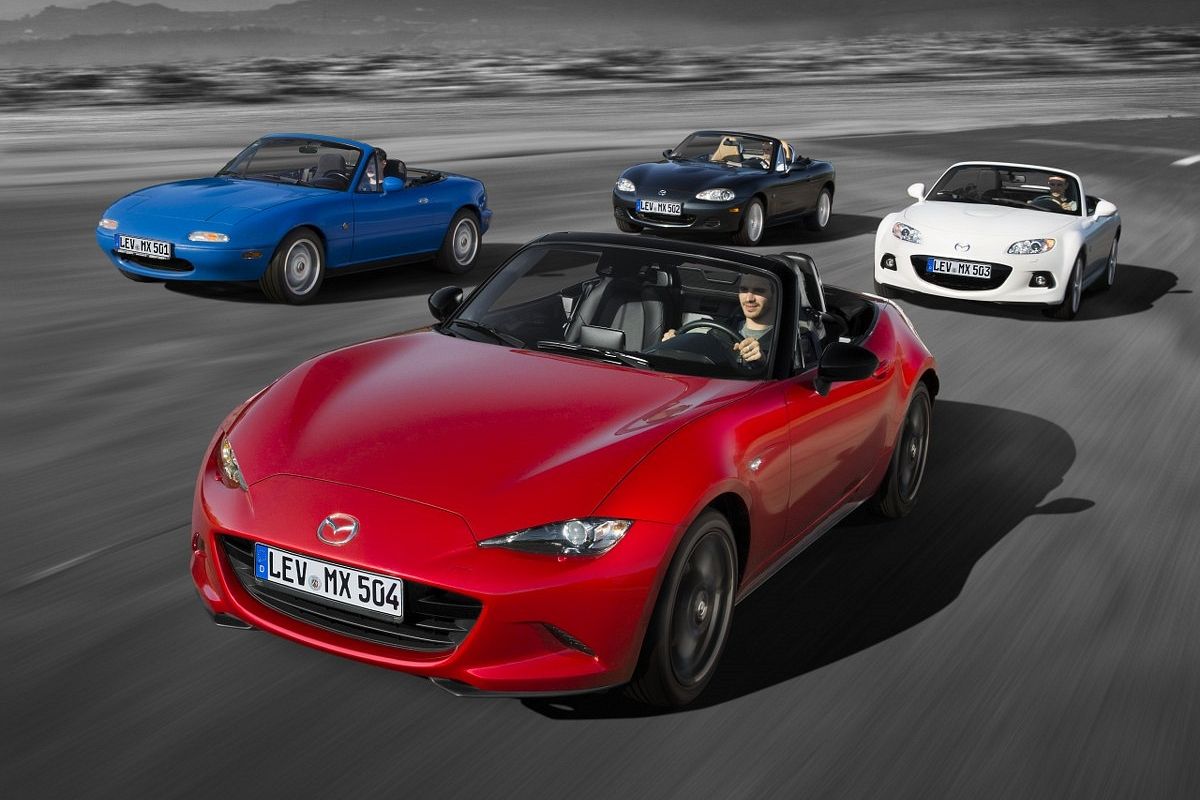
The 5th generation Mazda MX-5 Miata, designated as the NE series, marks a pivotal evolution in the world’s best-selling roadster. Released for the 2026 model year, the NE balances Mazda’s strict "Jinba Ittai" (horse and rider as one) philosophy with essential electrification, ensuring the iconic sports car meets global emissions standards while preserving its lightweight, rear-wheel-drive soul.
The Evolution of an Icon: From ND to NE
The transition from the 4th generation (ND) to the 5th generation (NE) Miata represents the most significant engineering challenge in the model’s 37-year history. Since its debut in 1989, the Miata has been defined by simplicity and low mass. However, the automotive landscape of 2026 demands higher safety standards and lower carbon footprints, forcing Mazda to innovate within a very narrow margin of error.
Historically, the Miata has followed a predictable cycle of refinement. The NA gave us the concept; the NB refined the mechanics; the NC explored a larger, more robust platform; and the ND returned to the lightweight roots of the original. The NE, however, does not have the luxury of simply "cutting weight." It must integrate a battery and motor system—components that are inherently heavy—without compromising the 50/50 weight distribution that enthusiasts demand.
Mazda’s development of the NE began under the shadow of the "Iconic SP" concept car, which debuted at the Japan Mobility Show. This concept signaled a move toward a more curvaceous, sophisticated design language and explored the use of a rotary-EV system. While the production NE maintains a more traditional internal combustion heart assisted by electric power, the influence of that concept's aerodynamics and packaging is evident in every line of the new car.
The Powertrain Pivot: Electrification Without Compromise
The headline for the 5th generation Miata is its electrified powertrain. In 2026, Mazda has implemented a highly specialized version of its Skyactiv-G engine, integrated with a 48-volt mild-hybrid system. This "M-Hybrid Boost" system is designed specifically to fill the torque gaps inherent in a small-displacement naturally aspirated engine.
Hybridization and Torque Delivery
Unlike heavy plug-in hybrids, the NE's mild-hybrid setup focuses on performance efficiency. The integrated starter generator (ISG) provides a small but immediate burst of torque from a standstill. This allows Mazda to maintain a lightweight 2.0-liter four-cylinder engine that revs freely to 7,500 RPM, while the electric assist smooths out the power curve. This ensures that even with the slight weight penalty of a battery, the "seat-of-the-pants" feel remains sharp and responsive.
Transmission Options
One of the most critical decisions for the NE generation was the retention of the six-speed manual transmission. While many manufacturers have abandoned the manual in favor of faster dual-clutch systems, Mazda engineers recognized that the manual gearbox is central to the Miata identity. The NE’s manual has been strengthened to handle the instant torque of the hybrid system while retaining the short-throw, mechanical feel that defines the brand. For those seeking an automatic, a new eight-speed planetary-gear transmission provides faster shifts than the outgoing six-speed unit found in the ND.
The "Gram Strategy" in the Era of Batteries
Mazda’s "Gram Strategy"—the practice of scrutinizing every single bolt and bracket to save weight—was revitalized for the NE. To offset the weight of the 48V battery and electric motor, Mazda increased the use of high-tensile steel and aluminum throughout the chassis.
The NE platform utilizes a new evolution of the Skyactiv-Chassis. By using ultra-high-tensile steel (up to 1,500 MPa) in the A-pillars and headers, Mazda was able to reduce the thickness of the metal without sacrificing rollover protection. The suspension components, particularly the rear multi-link setup, feature more forged aluminum pieces than ever before.
The result is a vehicle that, despite its hybrid components, remains under the 2,500-pound threshold (approx. 1,130 kg) for most trims. This is a remarkable feat of engineering in 2026, where the average passenger vehicle has ballooned in weight due to safety and electrification requirements.
Design Aesthetics: Kodo Evolved
The design of the 5th generation Miata moves away from the sharp, aggressive "frowning" headlights of the ND and returns to a more organic, fluid silhouette. This is the latest iteration of Mazda’s Kodo: Soul of Motion design language.
Exterior Styling
The NE features a lower hood line, made possible by the compact packaging of the hybrid engine. The front fascia incorporates "active aero" shutters that close at high speeds to reduce drag and open when the engine requires maximum cooling. The rear of the car sees a return to rounder tailpipe housings and a more integrated trunk spoiler, reminiscent of the first-generation NA but with modern LED light signatures that wrap around the rear quarters.
Aerodynamics and Efficiency
Aerodynamic efficiency is crucial for the NE to meet its 2026 fuel economy targets. The underbody is almost entirely flat, a feature usually reserved for high-end supercars. This reduces lift and turbulence, making the car feel more stable at highway speeds—a common critique of previous lightweight roadsters.
Interior Technology and Human-Machine Interface
Inside the NE, Mazda has maintained a driver-centric cockpit while upgrading the technology to meet modern expectations. The infotainment system is now a flush-mounted unit that supports wireless smartphone integration, but Mazda has resisted the industry trend of moving all controls to a touchscreen.
- Tactile Controls: The climate control remains operated by physical dials, allowing the driver to make adjustments without taking their eyes off the road.
- Instrument Cluster: A large, central analog tachometer remains the centerpiece, flanked by high-resolution digital displays for navigation and hybrid energy flow.
- Seating Position: The hip point has been lowered slightly to enhance the sense of connection to the road. Mazda's "Kinematic Posture Control" (KPC) software has been updated to work in tandem with the hybrid system, applying subtle braking to the inner rear wheel during high-G cornering to suppress body roll.
Technical Specifications Comparison: ND vs. NE
To understand the leap taken with the 5th generation, it is helpful to compare the outgoing ND2/ND3 specifications with the new NE 2026 model.
| Feature | Mazda MX-5 Miata (ND3) | Mazda MX-5 Miata (NE - 2026) |
|---|---|---|
| Engine | 2.0L Skyactiv-G I4 | 2.0L Skyactiv-G + 48V M-Hybrid |
| Horsepower | 181 hp | 192 hp (Combined) |
| Torque | 151 lb-ft | 175 lb-ft (Combined) |
| Transmission | 6-Speed MT / 6-Speed AT | 6-Speed MT / 8-Speed AT |
| Weight (Base) | ~2,341 lbs | ~2,460 lbs |
| 0-60 MPH | 5.7 Seconds | 5.5 Seconds |
| Differential | Asymmetric LSD | Electronic-Torque Vectoring LSD |
| Standard Safety | i-Activsense | i-Activsense Gen 2 (GSR2 Compliant) |
Driving Dynamics: The NE on the Road
The true test of any Miata generation is how it handles a winding backroad. For the NE, the addition of electric torque-fill has fundamentally changed the car's exit speeds. Where the ND required the driver to keep the revs high to stay in the powerband, the NE offers a more robust "shove" out of slow corners.
The steering remains an electrically power-assisted rack (EPAS), but Mazda has increased the steering ratio slightly for a quicker turn-in. Because the hybrid battery is placed low and toward the center of the car, the polar moment of inertia remains low, allowing the car to rotate with the same agility that made the NA a legend.
Suspension and Braking
The NE continues to use a double-wishbone front suspension and a multi-link rear. In the "Club" and "Grand Touring" trims, Bilstein dampers return, tuned specifically for the slightly heavier curb weight. The braking system has been upgraded to include larger rotors and a revised master cylinder, providing a firmer pedal feel and better heat dissipation during spirited driving.
Market Context and Pricing in 2026
In 2026, the Miata stands almost alone in its segment. With many competitors like the Audi TT and various small BMW convertibles having moved upmarket or been discontinued, the Miata’s primary rivals are the Toyota GR86 and Subaru BRZ. However, neither of those competitors has integrated hybrid technology as seamlessly as Mazda.
Pricing for the 5th generation has seen a moderate increase due to the cost of hybrid components and advanced materials.
- Sport (Base): Approximately $31,500
- Club (Performance-focused): Approximately $35,000
- Grand Touring (Luxury-focused): Approximately $37,500
Despite the price increase, the NE remains the most affordable way to access a purpose-built, rear-wheel-drive sports car with a manual transmission and an open top.
Safety and Compliance: Meeting Global Standards
The NE was designed to be a "global car" from the outset. This meant complying with the European Union’s General Safety Regulation 2 (GSR2), which mandates advanced driver assistance systems (ADAS) like lane-keep assist and advanced emergency braking.
Integrating these sensors—cameras and radar—without adding excessive weight or cluttering the clean front design was a major hurdle. Mazda hidden the radar sensors behind the front emblem and used a miniaturized camera system at the top of the windshield to maintain the car's sleek profile.
Maintenance and Long-Term Ownership
For long-term owners, the transition to a hybrid system brings new questions regarding maintenance. Mazda has designed the 48V system to be "service-free" for the first 100,000 miles. The battery is air-cooled and positioned away from the heat of the exhaust to ensure longevity.
Standard maintenance items, such as oil changes and brake fluid flushes, remain similar to previous generations. The 2.0L engine is an evolution of the proven Skyactiv-G architecture, which has shown exceptional reliability in Mazda's long-term fleet tests.
Frequently Asked Questions
Is the 5th generation Miata fully electric?
No, the 2026 NE Miata is not a fully electric vehicle (BEV). It utilizes a 48-volt mild-hybrid system paired with a 2.0-liter internal combustion engine. This setup allows Mazda to keep the weight low while improving fuel efficiency and meeting 2026 emissions standards.
Does the NE Miata still have a manual transmission?
Yes, Mazda has officially retained the six-speed manual transmission for the NE generation. It has been specifically reinforced to handle the additional torque provided by the hybrid electric motor.
How does the weight of the NE compare to the ND?
The NE is slightly heavier than the ND, primarily due to the addition of hybrid batteries and advanced safety sensors required by 2026 regulations. However, through the use of high-tensile steel and aluminum, Mazda has kept the weight increase to approximately 120 pounds, maintaining a total curb weight under 2,500 lbs for most trims.
Will there be a Retractable Fastback (RF) version of the NE?
Mazda has confirmed that a power-folding hardtop model will continue for the 5th generation. It features an improved roof mechanism that is both faster and lighter than the previous RF model, though it carries a slight weight premium over the cloth-top version.
Where is the 5th generation Miata built?
The NE Miata continues to be manufactured at Mazda’s Ujina Plant No. 1 in Hiroshima, Japan. This facility has been the home of Miata production since the first NA rolled off the line in 1989.
Practical Recommendation for Buyers
If you are considering the 5th generation Miata, the Club trim remains the "sweet spot" for enthusiasts. It includes the limited-slip differential, Bilstein dampers, and front strut tower brace that maximize the car's handling potential. For those who use their Miata as a daily driver, the Grand Touring offers significantly better sound insulation and more comfortable heated leather seats, making it a viable long-distance tourer.
The NE generation proves that the sports car is not dead in the age of electrification. By focusing on "Gram Strategy" and driver engagement, Mazda has successfully transitioned its most famous model into a new era without losing the characteristics that made it a global phenomenon.