A 50-year mortgage is currently not available in the United States because it does not meet the "Qualified Mortgage" standards established by federal regulators. Furthermore, government-sponsored enterprises like Fannie Mae and Freddie Mac do not purchase loans with terms exceeding 30 years, preventing the secondary market liquidity necessary for lenders to offer such products.
The dream of homeownership in 2026 continues to face the significant hurdle of high property valuations and fluctuating interest rates. In response, many prospective buyers find themselves searching for ways to lower their monthly obligations. One theoretical solution that frequently arises is the ultra-long-term loan, specifically a 50-year mortgage. While these products exist in some international markets, such as Japan or parts of Europe, the American financial landscape remains firmly rooted in the 30-year cycle. Understanding why this limit exists requires a deep dive into the mechanics of the secondary mortgage market, federal regulations, and the mathematical reality of long-term interest accrual.
The Role of Government-Sponsored Enterprises (GSEs) and Liquidity
The primary reason a 50-year mortgage is unavailable to American consumers is the structure of the secondary mortgage market. In the United States, most residential mortgages are not held by the bank that originated them. Instead, lenders sell these loans to Government-Sponsored Enterprises (GSEs), primarily Fannie Mae (Federal National Mortgage Association) and Freddie Mac (Federal Home Loan Mortgage Corporation). These entities package the loans into Mortgage-Backed Securities (MBS) and sell them to global investors.
For this system to function, the loans must be standardized. These standards, known as "conforming loan limits" and "conforming guidelines," specifically dictate the maximum term of a mortgage. Currently, the maximum allowable term for a conforming loan is 30 years. Because Fannie Mae and Freddie Mac will not purchase a 50-year loan, a private bank that chooses to issue one would be forced to keep that loan on its own books for half a century.
Holding a 50-year asset on a balance sheet is incredibly risky for a commercial bank. It ties up capital for decades, making the bank less "liquid"—meaning it has less cash available to issue new loans or meet short-term obligations. Without the ability to sell the loan to the GSEs, lenders lose the incentive to offer anything beyond the 30-year standard. This lack of a secondary market essentially chokes off the supply of ultra-long-term financing before it can even reach the consumer.
The Qualified Mortgage (QM) Rule and Federal Regulation
Beyond the preferences of investors and GSEs, the legal framework established by the Consumer Financial Protection Bureau (CFPB) creates a significant barrier. Following the 2008 financial crisis, the Dodd-Frank Wall Street Reform and Consumer Protection Act introduced the concept of the "Qualified Mortgage" (QM).
A Qualified Mortgage is a category of loans that have certain, more stable features that help make it more likely that a borrower can afford the loan. Lenders who issue QM loans receive certain legal protections against lawsuits from borrowers who later claim the lender did not sufficiently verify their "ability to repay." To be considered a Qualified Mortgage, a loan must adhere to strict criteria, one of which is a maximum loan term.
Under current CFPB regulations, a loan term cannot exceed 30 years to qualify for the most common "Safe Harbor" QM status. While there are some exceptions for small creditors or specific rural areas, the vast majority of the lending industry adheres strictly to the 30-year limit to avoid the immense legal and financial liability of non-QM lending. If a lender were to issue a 50-year mortgage, it would be classified as a "Non-QM" loan. These loans typically come with significantly higher interest rates and more stringent down payment requirements to compensate for the increased risk, often making them more expensive than a standard 30-year loan, even with the longer repayment period.
The Diminishing Returns of Amortization
From a financial perspective, many borrowers assume that stretching a loan from 30 to 50 years would drastically reduce their monthly payment. However, the mathematics of amortization—the process of paying off a debt over time through regular installments—reveals a reality of diminishing returns.
In the early years of any mortgage, the majority of the monthly payment goes toward interest rather than the principal balance. When a loan term is extended to 50 years, the principal is spread so thin that the interest dominates the payment for almost the entire first half of the loan's life.
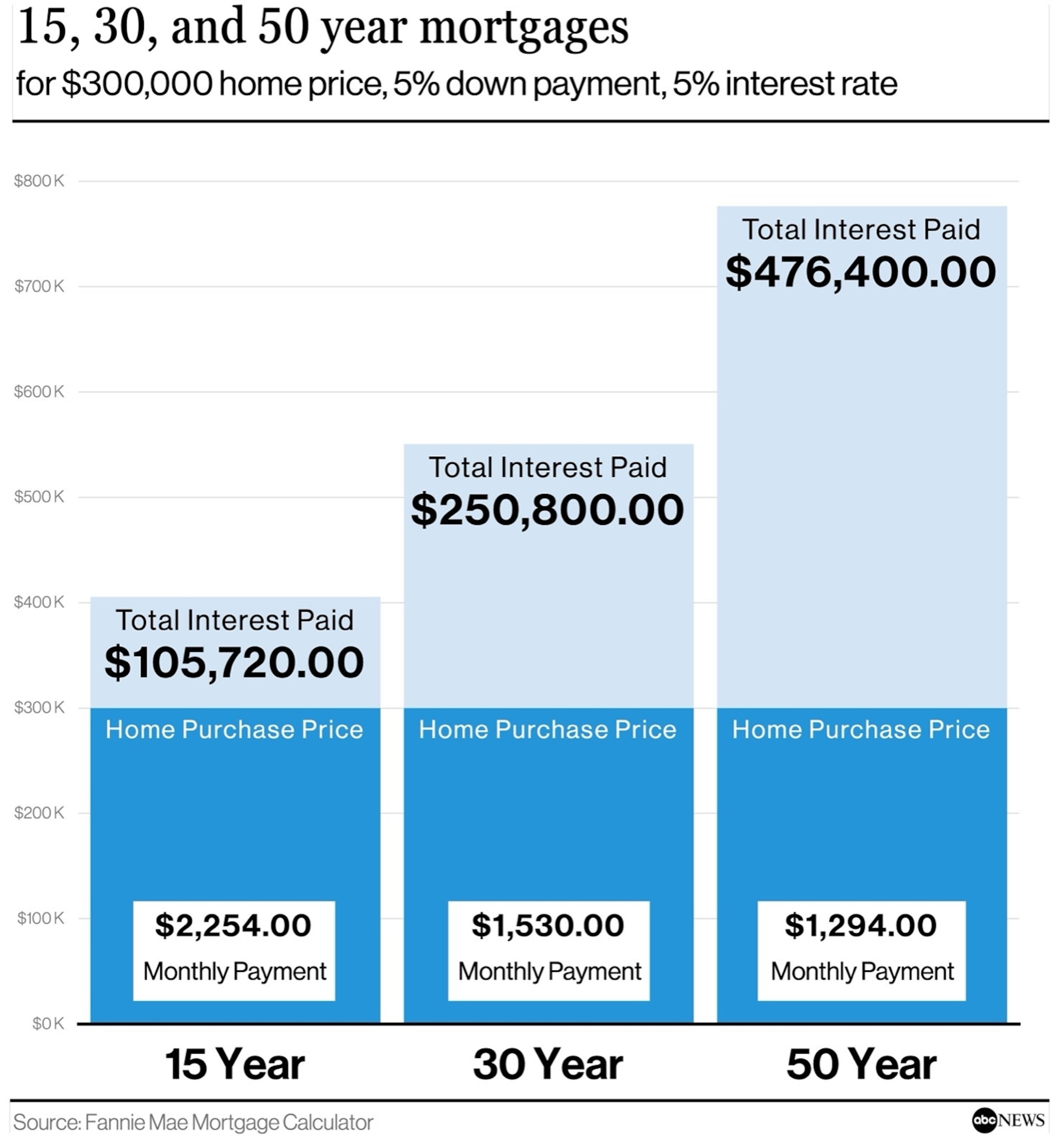
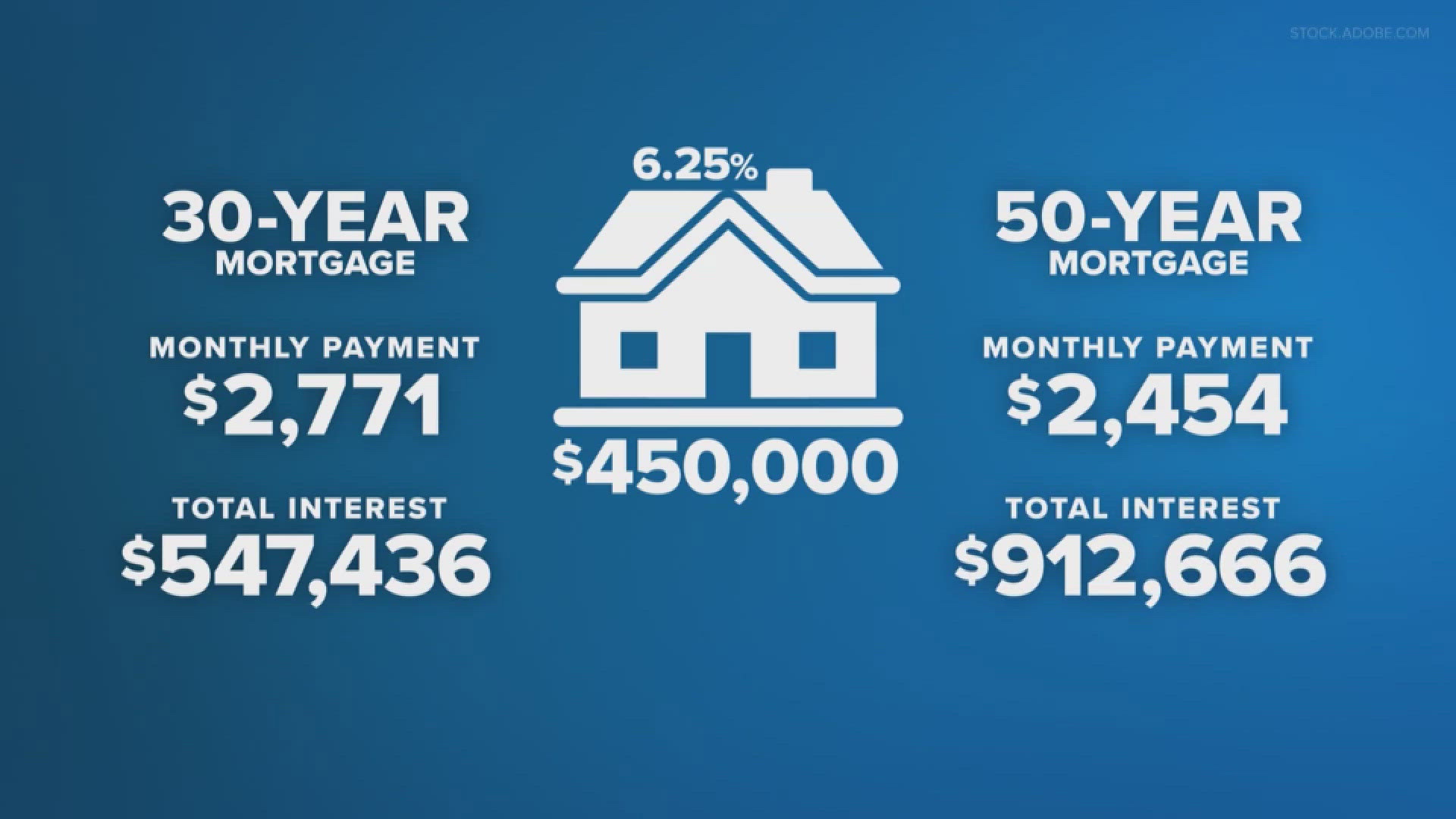
Consider a hypothetical $400,000 loan at a 6.5% interest rate. The difference in monthly principal and interest payments between a 30-year and a 50-year term is surprisingly small, but the difference in total interest paid is astronomical. By the time the 50-year loan is paid off, the borrower would have paid nearly double the amount of interest compared to the 30-year option. Most financial advisors argue that the marginal monthly savings do not justify the massive increase in total debt obligation. Furthermore, the rate of equity accumulation in a 50-year mortgage is so slow that a homeowner might find themselves "underwater" (owing more than the home is worth) if the local housing market experiences even a minor dip.
Comparison of Mortgage Terms (Hypothetical $400,000 Loan at 6.5% APR)
| Loan Term | Monthly Payment (P&I) | Total Interest Paid | Total Cost of Loan |
|---|---|---|---|
| 15 Years | $3,485 | $227,300 | $627,300 |
| 20 Years | $2,982 | $315,680 | $715,680 |
| 30 Years | $2,528 | $510,080 | $910,080 |
| 40 Years* | $2,354 | $729,920 | $1,129,920 |
| 50 Years* | $2,272 | $963,200 | $1,363,200 |
*Note: 40-year and 50-year terms are largely unavailable for standard purchases; these figures are for illustrative comparison only.
Interest Rate Risk and Inflation for Lenders
Lenders also avoid 50-year mortgages due to the extreme "interest rate risk" associated with such a long duration. Interest rate risk is the danger that interest rates will rise in the future, leaving the lender stuck with an old, low-interest loan while they have to pay higher rates to their own depositors or creditors.
Over a 30-year period, the economy can go through several cycles of inflation and recession. Over a 50-year period, those risks are compounded significantly. If a bank issued a 50-year mortgage at 6% in 2026, and by 2046 inflation had driven market rates to 10%, that 6% loan would be a losing asset for the bank for another 30 years.
To mitigate this risk, a lender would likely need to charge a much higher interest rate on a 50-year loan than on a 15- or 30-year loan. This "term premium" often negates the monthly payment savings that the borrower was seeking in the first place. For the lender, the uncertainty of the global economy over five decades is simply too great to price accurately without making the loan unattractive to the consumer.
The 40-Year Mortgage: A Rare Alternative
While the 50-year mortgage is non-existent, the 40-year mortgage occasionally appears as a niche product or a tool for loan modification. During periods of economic hardship, some federal programs, such as those under the Federal Housing Administration (FHA), have allowed for 40-year loan modifications to help struggling homeowners avoid foreclosure. By extending the term to 40 years, the monthly payment is reduced just enough to make it manageable for a borrower who has suffered a permanent income loss.
However, as a product for new home purchases, the 40-year mortgage remains extremely rare. Some "Non-QM" lenders offer them to investors or borrowers with unique financial profiles, but they frequently come with "interest-only" periods. In an interest-only 40-year mortgage, the borrower pays only the interest for the first 10 years, and then the loan amortizes over the remaining 30 years. While this provides temporary relief, it does not build equity during the initial decade, which can be a dangerous strategy in a volatile real estate market.
International Context: Why Other Countries Have Long Terms
Consumers often point to countries like Japan, Sweden, or France, where 50-year or even "intergenerational" mortgages (spanning 75 to 100 years) have existed. The reason these work elsewhere but not in the U.S. is usually tied to different banking regulations and housing philosophies.
In Japan, for example, the "flat 35" or 50-year loans were popularized during periods of extremely low or even negative interest rates and stagnant property values. In some European countries, mortgages are "portable," meaning you can move the loan from one house to another, or they are tied to the person rather than the property. In the U.S., the mortgage is intrinsically tied to the specific property and is expected to be settled upon the sale of that property. Because the average American moves every 7 to 10 years, a 50-year mortgage is fundamentally mismatched with the actual behavior of U.S. homeowners.
Potential Hazards of Ultra-Long-Term Debt
If a 50-year mortgage were to become available, it would carry significant risks for the average consumer that go beyond just the high interest cost:
- Equity Stagnation: Because the principal is paid down so slowly, the homeowner builds very little equity in the first two decades. If they need to sell the house due to a job transfer or family emergency, they may find that after closing costs and Realtor fees, they walk away with almost nothing.
- Maintenance Costs vs. Loan Term: Most major home systems (roofs, HVAC, plumbing) have a lifespan of 15 to 30 years. On a 50-year mortgage, a homeowner would likely need to finance major renovations or replacements at least twice before the original loan is even paid off. This can lead to a cycle of debt where the homeowner is perpetually borrowing against a property that isn't gaining equity fast enough to support it.
- Retirement Planning: A 30-year mortgage taken out at age 30 is paid off by age 60, allowing the homeowner to enter retirement without a housing payment. A 50-year mortgage taken out at age 30 wouldn't be settled until the borrower is 80, which significantly complicates financial security in one's later years.
Practical Alternatives for Affordability
Since the 50-year mortgage is not a viable option, borrowers in 2026 should look toward other established methods for managing monthly housing costs:
- Adjustable-Rate Mortgages (ARMs): If you plan to move within 5 to 7 years, a 5/1 or 7/1 ARM often provides a lower initial interest rate than a 30-year fixed mortgage, reducing the monthly payment during the time you actually own the home.
- Down Payment Assistance Programs: Many state and local agencies offer grants or "silent seconds" (low-interest secondary loans) that reduce the amount you need to borrow, thereby lowering the monthly payment on a standard 30-year term.
- Buydowns: Borrowers can pay "points" at closing to permanently lower their interest rate. Alternatively, "temporary buydowns" (like a 2-1 buydown) lower the rate for the first two years of the loan, providing a "step-up" period as the borrower's income potentially increases.
- Assuming a Mortgage: Some older FHA or VA loans are "assumable," meaning a buyer can take over the seller's existing mortgage at its original (potentially lower) interest rate.
Frequently Asked Questions
Is there any US lender that offers a 50-year mortgage? No, there are currently no major retail lenders in the U.S. offering a 50-year mortgage for residential home purchases. The regulatory and secondary market requirements essentially cap the term at 30 years for all standard loan products.
Why did I hear about 40-year mortgages recently? You likely heard about them in the context of loan modifications. The FHA and some GSEs allowed for 40-year extensions for borrowers facing foreclosure to help lower their monthly payments to a sustainable level. These are generally not available for new home purchases.
Would a 50-year mortgage make houses more affordable? While it would slightly lower the monthly payment, it often has the unintended consequence of driving home prices higher. When buyers can afford a larger loan through longer terms, they tend to bid up the prices of houses, which can negate the affordability benefits for the next wave of buyers.
Can I pay off a 30-year mortgage over 50 years? No, you must adhere to the repayment schedule of your contract. However, you can do the opposite: you can pay off a 30-year mortgage faster by making extra principal payments, which saves you a significant amount of interest.
Does a 50-year mortgage exist for commercial real estate? Commercial lending operates under different rules than residential lending. While 25- or 30-year amortizations are common in commercial real estate, 50-year terms are still exceptionally rare due to the lifecycle of commercial buildings and the risk profiles of business lenders.
Final Recommendation
If you are struggling with affordability in the 2026 housing market, avoid searching for non-existent ultra-long-term loans like the 50-year mortgage. Instead, focus on improving your credit score to qualify for the lowest possible 30-year fixed rate, or explore state-sponsored down payment assistance programs. If your goal is the lowest possible monthly payment and you do not intend to stay in the home for more than a decade, a 7/1 or 10/1 Adjustable-Rate Mortgage (ARM) remains the most effective and widely available legal alternative to the 30-year standard. Always consult with a qualified mortgage professional to model the total interest cost of any loan before committing.
Financial Advice Disclaimer: This article is for informational purposes only and does not constitute legal, tax, or financial advice. Mortgage regulations and product availability may vary by state and are subject to change based on federal policy.