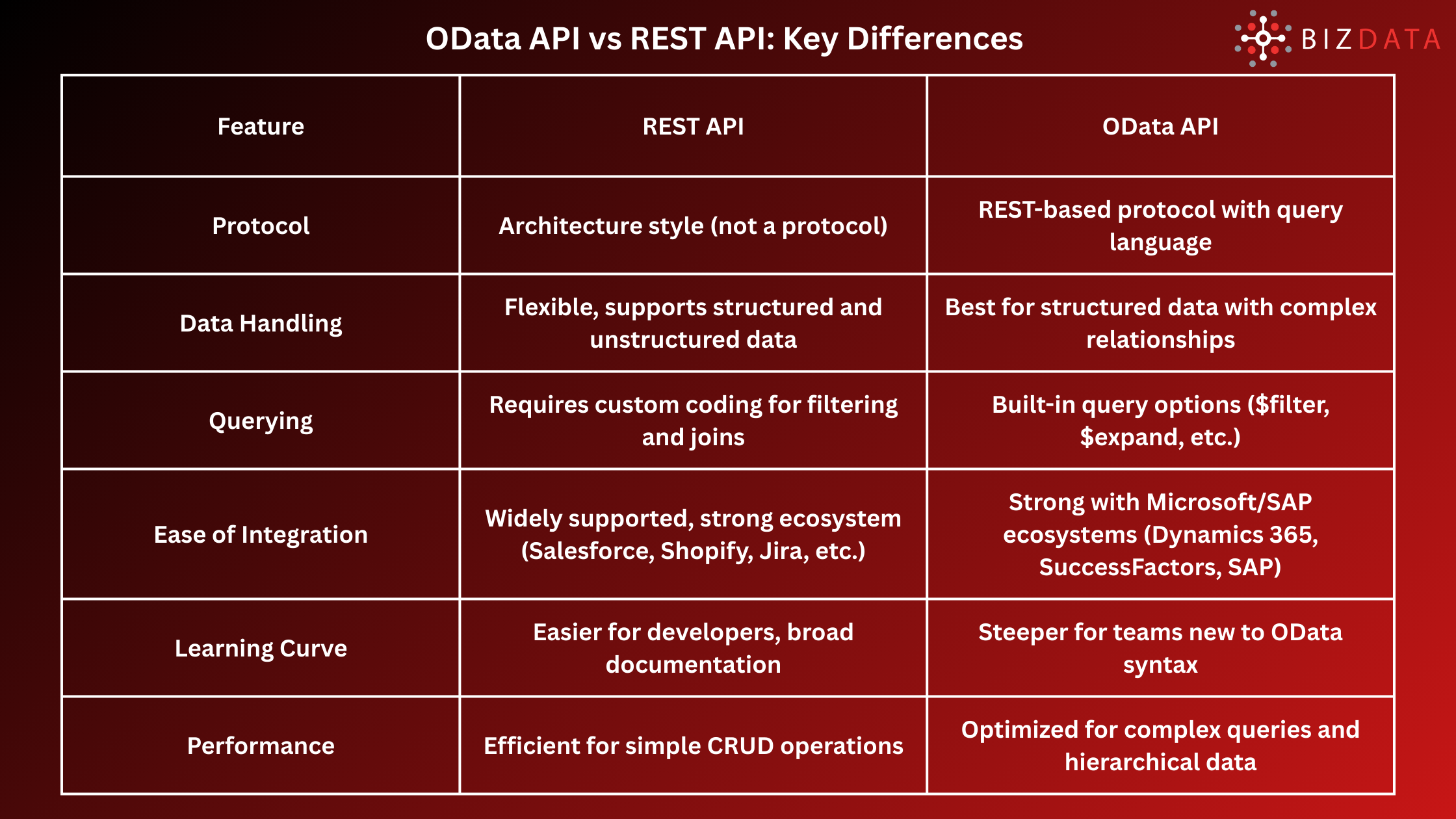
OData (Open Data Protocol) provides a standardized way to build and consume RESTful APIs by allowing clients to query and manipulate data using simple URL syntax. In 2026, it remains a cornerstone for enterprise-level API design, enabling developers to create flexible, self-documenting services that reduce the need for custom filtering logic and multiple endpoint variations.
By adopting OData, organizations solve the "endpoint explosion" problem—where a single resource requires dozens of different endpoints to satisfy various UI filtering and sorting requirements. Instead of building unique routes for every possible query, OData provides a unified query language that sits directly on top of your HTTP protocol.
The Evolution of OData in 2026
As of 2026, OData v4.01 is the mature standard used across major ecosystems, including .NET 10, Java (via Apache Olingo), and modern Node.js environments. While alternative technologies like GraphQL have gained traction for front-end flexibility, OData remains the preferred choice for enterprise resource planning (ERP) systems, business intelligence (BI) tools, and scenarios where strict metadata and standardized hypermedia are required.
The protocol functions as a bridge between the database and the client, abstracting the complexities of SQL or NoSQL while providing a syntax that is easy for developers to parse. The following examples demonstrate how to leverage OData to solve common API design challenges in a production environment.
1. Dynamic Filtering and Logical Querying ($filter)
The most common challenge in API design is providing users with the ability to filter datasets based on specific criteria. Without OData, developers often resort to passing multiple query string parameters (e.g., ?category=electronics&minPrice=100), which requires manual parsing and mapping to database queries on the backend.
The Scenario
Imagine a Global Logistics Platform where users need to find shipments that are currently "In Transit," have a priority level of "High," and were shipped after a specific date.
The OData Implementation
Using the $filter system query option, the client can construct a complex query directly in the URL:
GET /api/Shipments?$filter=Status eq 'InTransit' and Priority eq 'High' and ShippedDate gt 2026-01-01T00:00:00Z
Why This Matters
- Standardization: The
eq(equals),ne(not equals),gt(greater than), andlt(less than) operators are standardized. Any developer familiar with OData can understand the query without reading custom documentation for your specific API. - Backend Efficiency: Modern OData libraries automatically translate these filters into optimized SQL or LINQ queries. This prevents the "Over-fetching" of data and ensures that the filtering happens at the database level rather than in the application memory.
- Complex Logic: OData supports nested logic using parentheses and built-in functions like
contains(),startswith(), andendswith(). For example, searching for a customer name:?$filter=contains(CustomerName, 'Solutions').
2. Relational Data Expansion ($expand)
One of the biggest performance bottlenecks in RESTful design is the "N+1 Problem," where a client fetches a list of items and then must make a separate API call for each item to retrieve its related data (e.g., fetching an order and then fetching the details for every line item in that order).
The Scenario
An E-commerce Management System needs to display an Order Dashboard. Each order row must show the customer's name and the list of products associated with that order.
The OData Implementation
The $expand query option allows the client to request related entities in a single HTTP request:
GET /api/Orders?$expand=Customer,OrderItems($expand=Product)
Why This Matters
- Reduced Latency: By bundling related entities into a single response, you eliminate the overhead of multiple HTTP handshakes. In 2026, where mobile-first and edge-computing are dominant, reducing round-trips to the server is critical for user experience.
- Granular Control: The
$expandoption can be nested (as shown above withProductinsideOrderItems). This gives the front-end developer the power to define exactly what the object graph should look like for a specific view. - Data Integrity: Since the data is fetched in one transaction-like scope on the backend, the client receives a consistent snapshot of the related records.
3. Precision Payload Selection ($select)
API performance is not just about how fast the server responds, but also about the size of the payload being transferred. Many database tables contain 50+ columns, but a mobile app might only need to display the "Name" and "ID" on a list screen.
The Scenario
A mobile application for a Field Service Technician needs to list all "Work Orders" assigned to them. The "Work Order" entity in the database contains large binary blobs (photos), long descriptions, and historical logs that are not needed for the initial list view.
The OData Implementation
The $select query option acts like the SELECT clause in SQL, allowing the client to specify exactly which properties to return:
GET /api/WorkOrders?$select=ID,Subject,ScheduledTime,Location
Why This Matters
- Bandwidth Conservation: By excluding heavy columns or unnecessary metadata, the JSON response size can be reduced by 80-90%. This is vital for users on limited data plans or unstable 5G/6G connections in 2026.
- Reduced Serialization Time: The server spends less time converting database objects into JSON strings because it only processes a fraction of the properties.
- Security/Privacy: You can design your OData service to prevent certain sensitive fields from being "selectable," ensuring that internal-only data never leaves the server.
4. Controlled Pagination and Record Counting ($top, $skip, $count)
When dealing with millions of records, an API must never return the entire dataset in one go. Doing so would crash the client and overwhelm the server. Professional API design requires robust pagination.
The Scenario
A Corporate Audit Tool needs to display a paginated table of "Financial Transactions." The UI shows 25 records per page and needs to know the total number of transactions to calculate the total number of pages.
The OData Implementation
OData provides $top (limit), $skip (offset), and $count to handle server-side pagination:
GET /api/Transactions?$top=25&$skip=50&$count=true&$orderby=TransactionDate desc
Why This Matters
- Predictable Performance: By limiting the result set size, you ensure that response times remain consistent regardless of the total dataset size.
- Stateless Navigation: The client can easily jump to any page by calculating the skip value (
(pageNumber - 1) * pageSize). - Total Record Awareness: The
$count=trueparameter tells the server to return the total count in the@odata.countmetadata field. This allows the UI to render pagination controls (e.g., "Page 3 of 400") without making a separate query. - Order Consistency: Pagination is useless without consistent ordering. OData’s
$orderbyensures that the sequence of records remains stable as the user moves between pages.
5. Aggregation and Data Analytics ($apply)
In 2026, APIs are no longer just about CRUD (Create, Read, Update, Delete). They are increasingly used for real-time analytics and reporting. OData's "Extension for Data Aggregation" allows clients to perform calculations on the fly.
The Scenario
A Retail Manager wants to see the "Total Sales Volume" grouped by "Product Category" for the current quarter, but they don't want to download every single sales record to do the math in Excel.
The OData Implementation
The $apply query option allows for transformations like grouping and aggregation:
GET /api/Sales?$apply=groupby((Category), aggregate(Amount with sum as TotalRevenue))
Why This Matters
- Offloading Computation: The heavy lifting of summing millions of rows is performed by the database engine, which is highly optimized for such tasks, rather than the client-side JavaScript.
- Simplified Reporting: This eliminates the need for a separate "Reporting API." The same endpoint that serves raw data can also serve aggregated insights.
- Reduced Data Transfer: Instead of sending 10,000 sales records, the server sends a small JSON object containing 5 or 6 category totals.
Comparing OData to Other API Paradigms
To understand where OData fits in your 2026 technical stack, it is helpful to compare it with standard REST (without OData) and GraphQL.
| Feature | Standard REST | OData v4.01 | GraphQL |
|---|---|---|---|
| Query Flexibility | Low (Hardcoded) | High (URL-based) | Very High (Schema-based) |
| Metadata Support | Minimal | Strong (CSDL/XML) | Strong (Introspection) |
| Tooling/Ecosystem | Universal | Enterprise (MS, SAP, Salesforce) | Modern Web/Mobile |
| Over-fetching | Common | Minimal (via $select) |
None |
| Implementation Effort | Low | Moderate | High (Schema/Resolvers) |
| Pagination | Custom/Inconsistent | Standardized | Custom/Relay Standard |
Best Practices for Designing OData APIs in 2026
Designing a successful OData API requires more than just enabling a library. To ensure security and performance, follow these professional guidelines:
Set Query Limits
Never allow unrestricted $expand or $top. A malicious user could send a request like $expand=Table1($expand=Table2($expand=Table3)) to cause a Denial of Service (DoS) by forcing the server to perform massive joins. Use server-side configurations to limit the maximum expansion depth and the maximum page size.
Use Attribute-Based Routing
In modern frameworks like .NET 10, use attributes to explicitly enable OData features on a per-controller or per-action basis. This prevents "Leaky Abstractions" where internal database structures are unintentionally exposed as queryable fields.
[EnableQuery(MaxExpansionDepth = 2, PageSize = 100)] public IQueryable Get() { return _db.Products; }
Validate Input
Even though OData libraries handle most parsing, always validate that the filters being applied are appropriate for the user's permissions. For instance, if a user belongs to "Department A," ensure that a filter for "Department B" is automatically intercepted or restricted via a global query filter.
Versioning
OData services should be versioned just like any other API. Use URL versioning (e.g., /v1/api/) or header-based versioning. While OData is flexible, breaking changes in the underlying data model (like renaming a property) will still break client queries that rely on specific property names in the $filter or $select strings.
Frequently Asked Questions
Is OData still relevant in 2026?
Yes. While GraphQL is popular for consumer-facing apps, OData is the standard for business applications and internal enterprise platforms. Its ability to provide a "SQL-like" experience over HTTP with zero custom coding for filters makes it incredibly efficient for data-heavy backends.
Can OData be used with NoSQL databases?
Absolutely. Many OData providers now support CosmosDB, MongoDB, and other NoSQL stores. The OData query is translated into the specific query language of the underlying store (e.g., the Mongo Query Language), allowing you to maintain a consistent API layer across different storage technologies.
Does OData work with Microservices?
OData is excellent for microservices that need to expose data to other services or a gateway. However, be cautious with $expand across microservice boundaries; typically, expansion should only occur within the data owned by a single service. For cross-service data, an API Gateway or GraphQL Federation layer is often used.
How does OData handle security?
OData does not define its own security protocol; it relies on standard web security like OAuth2 and OpenID Connect. Security is typically implemented by filtering the IQueryable result set based on the authenticated user's claims before the OData engine applies the client's URL filters.
Is OData difficult to cache?
Because OData uses unique URLs for every query (e.g., ?filter=ID eq 1 vs ?filter=ID eq 2), standard CDN caching can be less effective than with static endpoints. However, because OData uses standard GET requests, it is fully compatible with HTTP caching headers like ETag and Cache-Control.
Final Recommendations
When designing your next API, consider the following next actions to implement OData effectively:
- Audit Your Current Endpoints: Identify APIs where you have multiple "Search" or "Filter" parameters. These are prime candidates for conversion to OData.
- Start Small: You do not need to implement the entire OData specification. Start by enabling
$filterand$topto solve the most immediate client needs. - Use Metadata: Take advantage of the
$metadataendpoint. In 2026, many low-code platforms and frontend frameworks can "read" your OData metadata to automatically generate forms, tables, and client-side models, saving hundreds of hours of development time. - Prioritize Performance: Always use server-side paging and monitor the execution plans of the queries generated by your OData middleware to ensure they are using database indexes correctly.