The 2010 Auburn Tigers football season stands as one of the most dominant, dramatic, and scrutinized campaigns in the history of college athletics. Guided by offensive coordinator Gus Malzahn's revolutionary spread-option scheme and anchored by transfer quarterback and Heisman Trophy winner Cam Newton, the Tigers navigated a grueling Southeastern Conference (SEC) schedule and a dramatic BCS National Championship Game to finish with a flawless 14-0 record. Beyond the on-field excitement, the season remains a watershed moment defined by breathtaking comebacks, relentless offensive production, and intense off-field investigations that tested the program's resilience.
The Foundation: Building the 2010 Auburn Roster and Scheme
To understand how the 2010 Auburn Tigers achieved perfection, one must examine the unique convergence of coaching philosophy, roster replenishment, and tactical innovation that took place ahead of head coach Gene Chizik's second year at the helm. Following an 8-5 campaign in 2009, the coaching staff recognized that competing against perennial SEC powerhouses like Alabama, LSU, and Florida required a distinct competitive advantage. That advantage arrived in the form of a versatile, physically imposing junior college transfer quarterback and a refined offensive playbook designed to exploit modern defensive structures.
Gus Malzahn’s up-tempo spread offense was engineered to force defenses into simple alignments, rely on numerical advantages, and wear down opponents through sheer pace. In 2010, this system reached its zenith. The scheme utilized a heavy dose of read-option runs, deep play-action passes, and formation adjustments that kept opposing coordinators on their heels. However, a scheme is only as effective as the players executing it. Auburn secured a transformative piece when Cam Newton transferred from Blinn College after beginning his career at the University of Florida. Standing 6-foot-6 and weighing nearly 250 pounds, Newton combined the running capability of a fullback with the arm strength of an elite pocket passer, rendering conventional defensive game plans obsolete.
Key Architectural Pillars of the 2010 Auburn Offense
- The Power Spread Concept: Blending traditional single-wing and wishbone running principles with modern four-wide receiver formations.
- The Inverted Veer: Utilizing Newton as the primary ball-carrier on interior zone reads, forcing linebackers to choose between stopping the running back or the quarterback.
- Vertical Play-Action Passing: Leveraging the threat of the run game to create massive throwing windows downfield for wide receivers like Darvin Adams and Emory Blake.
The Regular Season: Navigating the Gauntlet
The SEC schedule is notoriously unforgiving, and the 2010 Tigers faced a relentless slate that included multiple ranked opponents and hostile road environments. Yet, week after week, Auburn displayed a remarkable ability to find ways to win, often erasing massive deficits through explosive second-half adjustments.
The defining characteristic of the regular season was not blowouts—though several occurred—but rather the sheer number of dramatic comebacks. In mid-September, Auburn hosted Clemson and escaped with a narrow 27-24 overtime victory, a game that hinted at the team's clutch capabilities. Two weeks later, the Tigers traveled to Starkville, Mississippi, and grinded out a 17-14 win over Mississippi State, showcasing that they could win ugly defensive struggles when necessary.
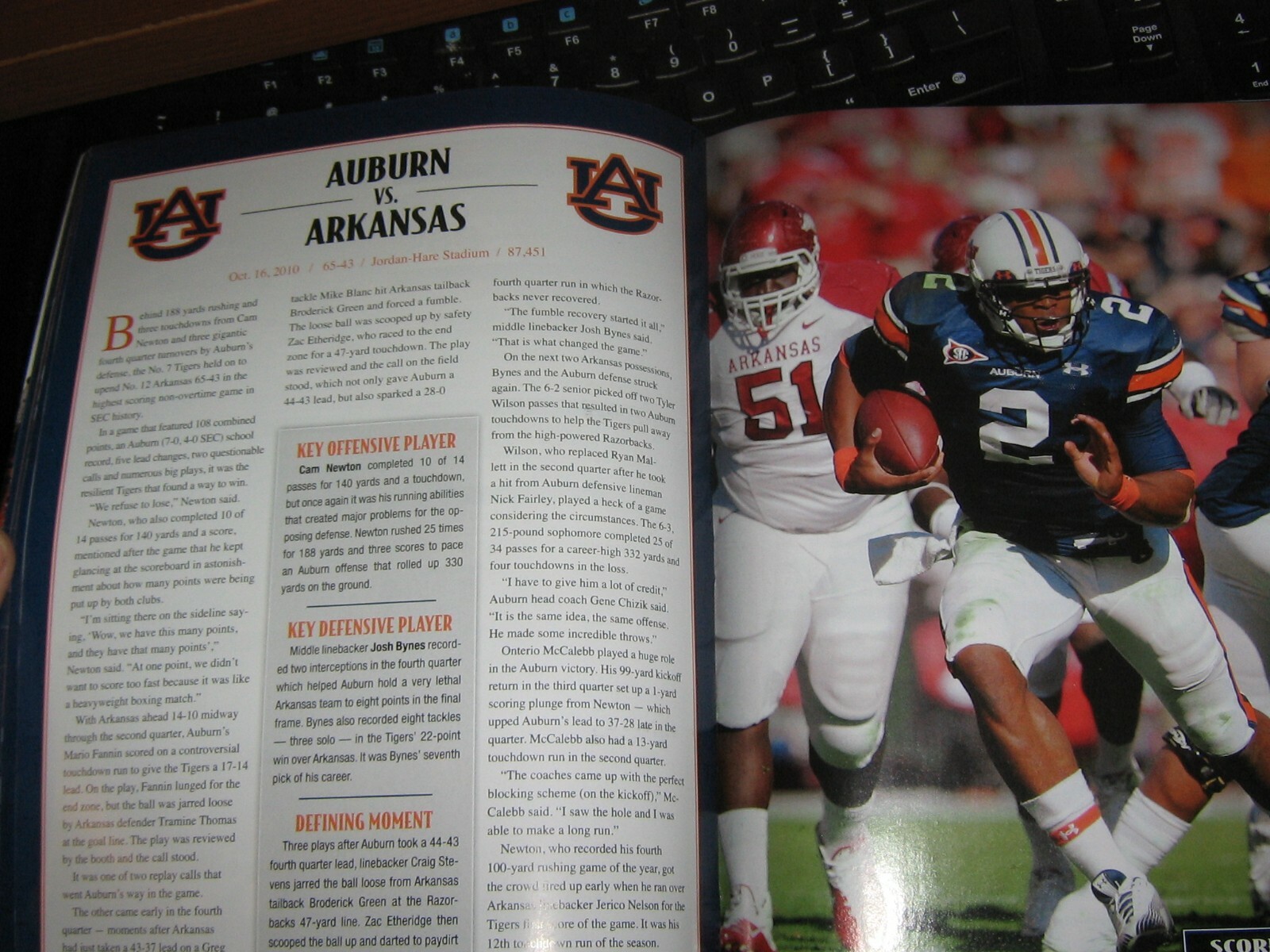
The crucible of the season arrived on October 9, when undefeated Auburn hosted top-ranked Oregon? No, the early October showdown featured a fierce battle against the South Carolina Gamecocks, but the marquee SEC test came on October 23 against sixth-ranked LSU. In that contest, Newton rushed for 217 yards and two touchdowns, including a legendary 49-yard scamper through the heart of the LSU defense, securing a 24-17 victory that propelled Auburn to the top tier of national championship contenders.
The Iron Bowl Miracle
No discussion of the 2010 Auburn regular season is complete without recounting the November 26 Iron Bowl against the arch-rival Alabama Crimson Tide in Tuscaloosa. Defending national champion Alabama jumped out to a stunning 24-0 lead by early in the second quarter, utilizing precise passing from quarterback Greg McElroy and stifling defense. Jordan-Hare Stadium north—Bryant-Denny Stadium—was deafening, and a blowout appeared all but certain.
What followed was one of the greatest comebacks in college football history. Newton and the Auburn offense slowly chipped away at the deficit, aided by adjustments that neutralized Alabama's pass rush. By the third quarter, momentum had completely shifted. Newton connected with Darvin Adams for a crucial touchdown pass, and a subsequent defensive stop set up the defining play of the game: a 36-yard touchdown pass down the left sideline to a wide-open Philip Lutzenkirchen, giving Auburn a 28-27 lead they would not relinquish. The Tigers completed the largest comeback in Iron Bowl history, sealing their spot in the SEC Championship Game.
The SEC Championship Game and Championship Vibe
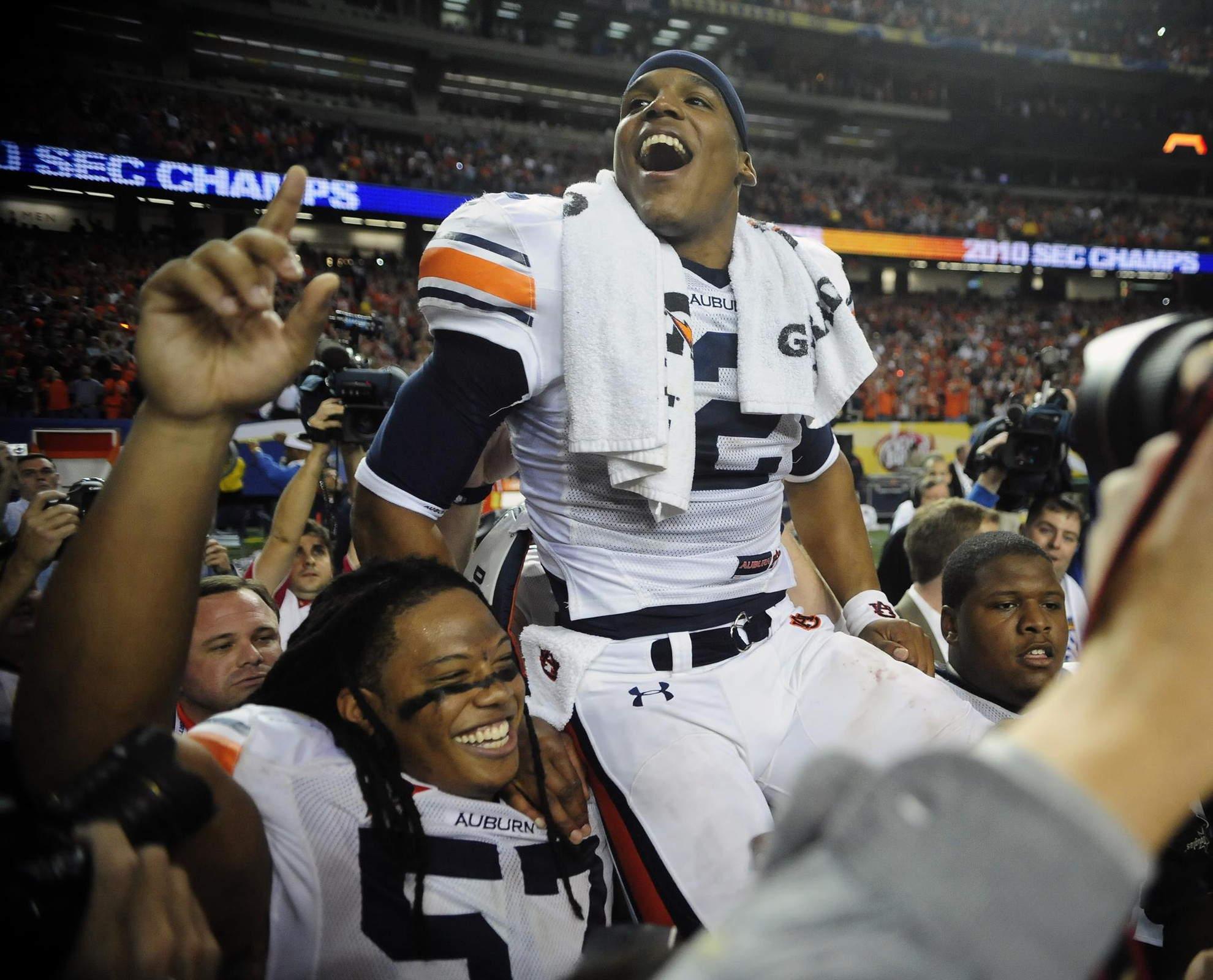
Having conquered the regular season with an unblemished 12-0 record, Auburn faced the South Carolina Gamecocks for a second time in the SEC Championship Game at the Georgia Dome in Atlanta on December 4, 2010. Unlike their regular-season nail-biter, which Auburn won 35-27, the title game turned into an offensive exhibition of historic proportions.
Newton put on a masterclass, accounting for six total touchdowns (four passing, two rushing) and accumulating 392 yards of total offense. The Tigers overwhelmed South Carolina by a score of 56-17, securing Auburn's first SEC title since 2004 and officially punching their ticket to the BCS National Championship Game. The victory also cemented Newton's status as the runaway favorite for the Heisman Trophy, an award he would formally accept a week later in New York City.
| Game / Opponent | Date | Final Score | Significance |
|---|---|---|---|
| Clemson | September 18, 2010 | 27-24 (OT) | Early non-conference test proving clutch capability. |
| at South Carolina (Regular Season) | September 25, 2010 | 35-27 | Crucial early SEC road/division win. |
| LSU | October 23, 2010 | 24-17 | Showcase win against a top-10 defense; Newton's 217-yard rushing game. |
| at Alabama (Iron Bowl) | November 26, 2010 | 28-27 | Completed the largest comeback in Iron Bowl history from a 24-0 deficit. |
| South Carolina (SEC Championship) | December 4, 2010 | 56-17 | Domination to secure the SEC title and BCS berth. |
| Oregon (BCS National Championship) | January 10, 2011 | 22-19 | Dramatic final-seconds win for the national title. |
The 2011 Tostitos BCS National Championship Game
On January 10, 2011, Auburn squared off against the high-flying, undefeated Oregon Ducks in the Tostitos BCS National Championship Game at University of Phoenix Stadium in Glendale, Arizona. Billed as a clash between two elite, up-tempo offenses—Gus Malzahn's Auburn attack versus Chip Kelly's Oregon system—the game ultimately devolved into a tense, hard-fought defensive chess match.
Throughout the evening, both offenses struggled to find their usual rhythm against surprisingly resilient opposing defenses. Auburn’s defense, led by coordinator Ted Roof and featuring standout performances from defensive tackle Nick Fairley, relentlessly harassed Oregon quarterback Darron Thomas and bottled up elusive running back LaMichael James. Fairley won Defensive MVP honors after registering three tackles for loss and a forced fumble that altered the game's momentum.
Trailing late, Oregon mounted a frantic fourth-quarter comeback, culminating in a game-tying touchdown and a successful two-point conversion with 2:33 remaining on the clock, knotting the score at 19-19.
With time winding down, Auburn orchestrated a legendary final drive. Starting from their own 20-yard line, Newton methodically moved the chains, aided by a clutch 20-yard reception by tight end Byran Thomas and a pivotal 30-yard run by running back Michael Dyer. On that famous run, Dyer was initially ruled down after being tackled by an Oregon defender, but replay reviews showed his knee never touched the turf while he rolled on top of the defender. Dyer alertly bounced up and scampered down to the Oregon 23-yard line.
With four seconds remaining, freshman kicker Wes Byrum trotted onto the field to attempt a 19-yard field goal. Byrum split the uprights as time expired, securing a 22-19 victory and delivering Auburn its first consensus national championship since 1957.
Off-Field Controversy and Investigations
While the 2010 Auburn Tigers achieved ultimate glory on the gridiron, the season was simultaneously marred by intense national controversy and investigations regarding the recruitment of Cam Newton.
In the weeks leading up to the BCS National Championship Game, allegations surfaced that Newton's father, Cecil Newton, had solicited payments from Mississippi State University during his son's recruitment process. The allegations sparked a massive media firestorm and prompted simultaneous investigations by the National Collegiate Athletic Association (NCAA) and Southeastern Conference.
The investigation scrutinized whether Cam Newton or Auburn University had knowledge of any pay-for-play schemes. Ultimately, the NCAA conducted an exhaustive probe and concluded in March 2011 that while Cecil Newton had attempted to solicit money from Mississippi State, investigators found no evidence that Cam Newton or Auburn athletic personnel had knowledge of or participated in any violations. Consequently, Cam Newton was ruled immediately eligible prior to the national championship game, and Auburn’s 2010 season records, SEC title, and national championship remained fully intact. Despite the official exoneration, the saga cast a long shadow over the program and remains one of the most heavily debated compliance stories in college football history.
Legacy and Historical Significance of the 2010 Campaign
Years after the confetti settled in Glendale, the 2010 Auburn Tigers season continues to be analyzed through multiple lenses. Tactically, it served as a watershed moment for the evolution of modern college football offenses, proving definitively that spread-option schemes could successfully dominate the bruising defenses of the SEC and win a national title.
Individually, Cam Newton's lone season at Auburn is widely regarded as one of the greatest individual athletic campaigns in American sports history. Earning the Heisman Trophy, SEC Offensive Player of the Year, consensus All-American honors, and national championship MVP in a single four-month span created a standard of single-season dominance matched by very few players before or since.
For the Auburn University faithful, the 2010 season represents an era of unparalleled excitement, dramatic finishes, and lifelong memories. From the miraculous escape in Tuscaloosa to the nail-biting kick in Arizona, the campaign cemented itself in college football lore as a masterclass in resilience, star power, and competitive execution.
Frequently Asked Questions
What was the final record of the 2010 Auburn Tigers?
The 2010 Auburn Tigers finished the season with a perfect 14-0 record, winning the SEC Western Division, the SEC Championship Game, and the BCS National Championship.
Who won the Heisman Trophy for Auburn in 2010?
Quarterback Cam Newton won the 2010 Heisman Trophy in a landslide vote, becoming the third player in Auburn history to win the prestigious award, following Pat Sullivan in 1971 and Bo Jackson in 1985.
What was the controversy surrounding Cam Newton during the 2010 season?
An investigation was launched by the NCAA and SEC regarding allegations that Newton's father solicited money from Mississippi State during the recruiting process. The NCAA ultimately found no evidence that Cam Newton or Auburn coaches knew about or participated in any rule violations, allowing him to play and keeping the team's records intact.
How did Auburn win the BCS National Championship Game?
Auburn defeated Oregon 22-19 in the championship game played on January 10, 2011. The game was decided by a 19-yard game-winning field goal by kicker Wes Byrum as time expired, set up by a late offensive drive that featured a crucial 30-yard run by running back Michael Dyer.
Who was the offensive coordinator for the 2010 Auburn Tigers?
Gus Malzahn served as the offensive coordinator and primary architect of Auburn's high-powered spread-option offense during the 2010 championship season. He later returned to Auburn as the head coach from 2013 to 2020.