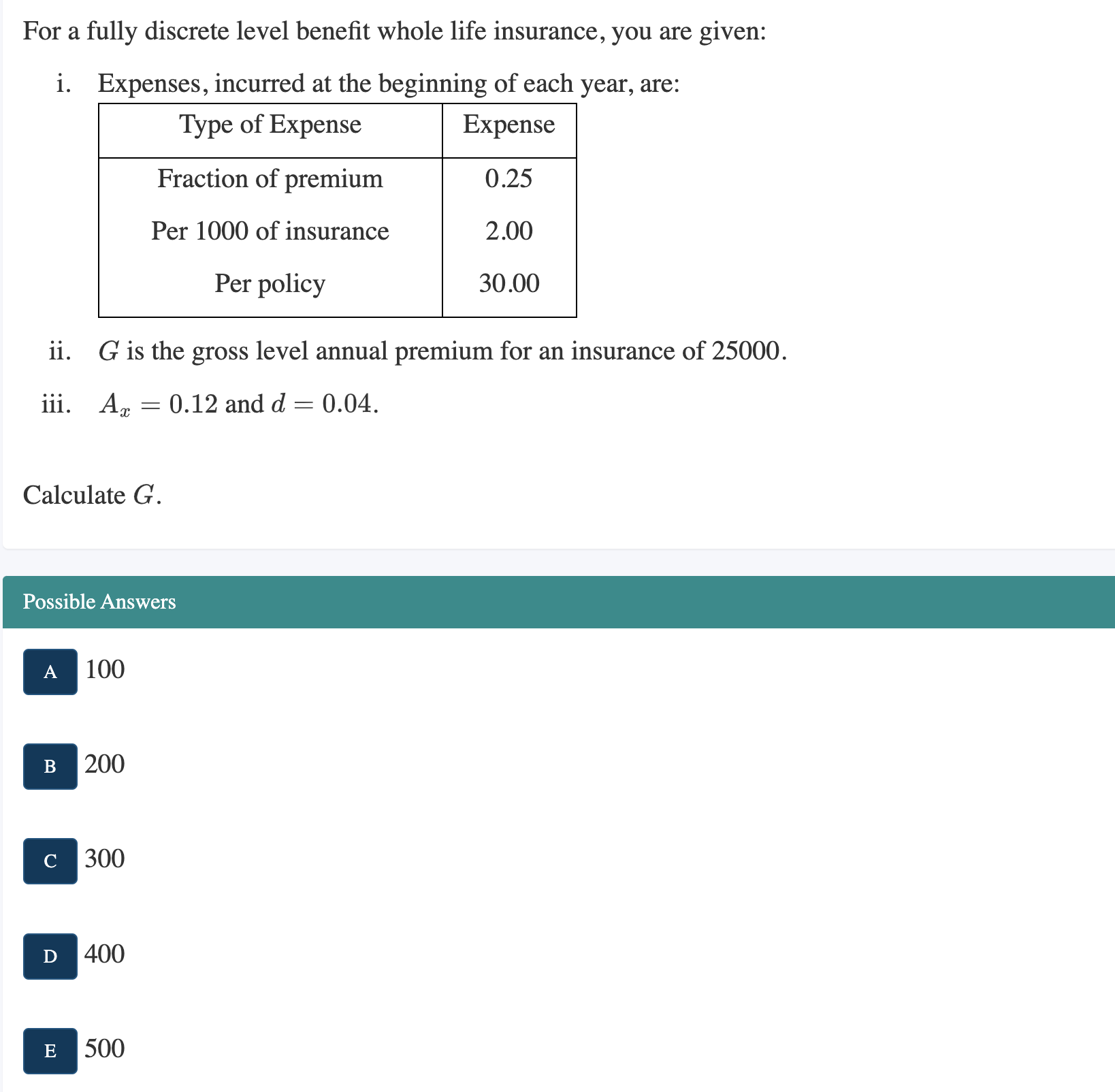
The 174 benefit reserve at year ten for fully discrete whole life insurance of 1,000 represents the mathematical liability an insurer holds in the tenth policy year for a standard 1,000 face-amount contract, calculated using specific actuarial assumptions like mortality and interest rates. This metric illustrates the accumulation of level premium surpluses required to fund future death claims under a fully discrete policy model.
Introduction to Actuarial Valuations in Whole Life Insurance
Actuarial science underpins the financial stability of the life insurance industry, bridging probability theory, statistics, and finance. When an individual purchases a permanent insurance product, such as a traditional whole life policy, the insurer undertakes a long-term financial obligation. To ensure that funds are consistently available to pay future death benefits, actuaries calculate statutory and net level premium reserves.
A specific benchmark often analyzed in actuarial examinations and theoretical coursework is the 174 benefit reserve at year ten for fully discrete whole life insurance of 1,000. This figure represents the prospective or retrospective net level reserve value at the conclusion of the tenth policy year. Understanding this valuation requires exploring the mechanics of fully discrete contracts, the distinction between prospective and retrospective reserve formulas, and the underlying variables of mortality and interest.
Defining Fully Discrete Whole Life Insurance
To comprehend why a reserve is calculated in a specific manner, one must first examine the structural characteristics of a fully discrete whole life insurance contract. In actuarial terminology, "fully discrete" implies two distinct structural conditions regarding the timing of financial flows:
- Discrete Premium Payments: Premiums are paid at discrete intervals—typically annually at the beginning of each policy year—rather than continuously.
- Discrete Benefit Payouts: The death benefit is assumed to be paid out at the end of the discrete policy year in which death occurs, rather than at the exact moment of death (which would denote a continuous payment model).
This discrete framework simplifies the complex continuous calculus of mortality into manageable annual steps. For a whole life policy with a face amount of 1,000, the policyholder pays a level annual net premium, denoted as $P$, at the start of every year they survive. In return, the insurance company promises to pay 1,000 at the end of the year of death, whenever that may occur.
The Role of Net Level Premiums
The net level premium ($P$) is calculated using the equivalence principle, which dictates that the actuarial present value (APV) of all future premium payments at issue must equal the actuarial present value of all future benefit payouts. Because the premium remains level across the entire lifetime of the insured, early premiums exceed the actual cost of mortality for younger ages.
This excess cash creates a surplus that the insurance company invests. Over time, as the insured ages and the annual probability of death increases, the cost of insurance surpasses the level premium payment. The accumulated reserves—such as the benchmark 174 benefit reserve at year ten—bridge this financial gap, ensuring the insurer remains solvent without needing to raise premiums as the policyholder grows older.
Mechanics of the Year Ten Benefit Reserve
The benefit reserve at the end of year ten, commonly designated symbolically as $10V$ or $V{10}$, quantifies the policyholder's equity and the insurer's liability at that specific milestone. For a 1,000 face amount policy, the reserve value tells us how much money the insurance company must hold per active policy at duration 10, assuming standard mortality tables and a designated valuation interest rate.
Prospective Reserve Calculation
Actuaries generally calculate reserves using two primary methodologies that yield identical numerical results: the prospective method and the retrospective method.
The prospective reserve looks forward. It defines the reserve at year ten as the actuarial present value of future benefits minus the actuarial present value of future net level premiums. Expressed conceptually:
$$\text{Reserve}_{10} = \text{APV}(\text{Future Benefits}) - \text{APV}(\text{Future Net Premiums})$$
As the insured has survived for ten years, their remaining life expectancy is shorter, increasing the present value of future benefits. However, they also have fewer years of premium payments remaining. The balance between these two decreasing present values dictates the exact numerical reserve, which under specific standard actuarial table assumptions evaluates to 174 per 1,000 of coverage.
Retrospective Reserve Calculation
Conversely, the retrospective reserve looks backward. It measures the reserve at year ten by examining the history of the policy from issue to the tenth anniversary:
$$\text{Reserve}_{10} = \text{Accumulated Value of Past Premiums} - \text{Accumulated Value of Past Benefit Costs}$$
In this view, the past net level premiums collected over the first ten years, compounded at the assumed valuation interest rate, are reduced by the accumulated cost of providing temporary death protection (insurance protection provided to the cohort) over that same decade. The remainder represents the funds that must be retained inside the reserve pool.
Key Variables Influencing the 174 Reserve Figure
The specific valuation of 174 per 1,000 at year ten is not a universal constant; it is the mathematical output of specific baseline parameters. Changing any underlying assumption alters the resulting reserve value.
| Parameter Category | Standard Variable Description | Impact on Reserve Calculations |
|---|---|---|
| Valuation Interest Rate | The guaranteed rate of return used to discount future cash flows (e.g., 2.5%, 3.5%, or 5%). | Higher interest rates reduce the present value of future benefits, generally lowering the required reserve. |
| Mortality Table | Standard actuarial tables reflecting death rates by age and gender (e.g., CSO tables). | Higher assumed mortality increases the cost of future claims, raising the required reserve. |
| Issue Age | The exact age of the insured when the policy is purchased. | Younger issue ages build reserves more gradually; older issue ages require steeper early reserve accumulation. |
| Policy Duration | The exact elapsed time since policy inception (in this case, exactly 10 years). | Reserves typically increase during the early-to-middle years of a whole life contract before leveling off. |
The Interaction Between Interest Rates and Mortality
The interplay between the valuation interest rate and the mortality table forms the bedrock of statutory reserving. When actuaries set regulatory reserves, they rely on conservative parameters mandated by regulatory bodies such as the National Association of Insurance Commissioners (NAIC) in the United States or equivalent global authorities.
If an exercise or regulatory valuation yields a 174 benefit reserve at year ten for a 1,000 policy, it reflects a precise alignment of the chosen issue age, mortality table, and interest rate. For example, a contract issued at a younger age under a standard regulatory table will have accumulated precisely 174 units of reserve per 1,000 of face amount by the close of the tenth policy year.
Comparison of Reserve Types in Life Insurance
To properly contextualize a net level benefit reserve like the 174 figure, it is helpful to contrast it with other common types of reserves and values associated with whole life contracts.
| Reserve or Value Type | Primary Purpose | Calculation Basis | Relationship to Net Level Reserve |
|---|---|---|---|
| Net Level Premium Reserve | Statutory solvency and theoretical matching of future obligations. | Uses exact net level premiums without accounting for initial acquisition expenses. | Serves as the theoretical baseline for regulatory comparisons. |
| Modified Preliminary Term (MPT) Reserve | Aligns statutory accounting with high initial acquisition costs (commissions, underwriting). | Relieves early-year reserve strain by modifying first-year premium recognition. | MPT reserves are typically lower than net level reserves in early years (such as year ten), but converge over time. |
| Cash Surrender Value | The actual monetary payout a policyholder receives if they voluntarily terminate the contract. | Net level reserve minus an allowable surrender charge (amortized acquisition expenses). | Usually slightly lower than the net level reserve, particularly in early policy years. |
Practical Implications for Insurers and Policyholders
While calculations like the 174 benefit reserve at year ten for fully discrete whole life insurance of 1,000 often appear primarily in actuarial textbooks, professional examinations (such as Society of Actuaries exams), and regulatory filings, they carry direct operational and financial consequences.
Solvency Regulation and Statutory Accounting
Insurance regulators require companies to hold assets equal to or greater than their total statutory reserves. If an insurer has thousands of similar whole life policies at duration ten, they must maintain certified assets backing that 174 per 1,000 liability. This ensures that even if unexpected mortality spikes occur, the company maintains structural liquidity to fulfill every contractual promise.
Policyholder Equity and Non-Forfeiture Benefits
The accumulation of reserves directly enables non-forfeiture benefits. Because a whole life policy builds a positive reserve over time, the policyholder possesses tangible equity. If the insured decides to stop paying premiums after ten years, they do not lose all their value. Instead, the accumulated reserve can be utilized to purchase reduced paid-up insurance, extended term insurance, or paid out as a cash surrender value.
Common Misconceptions Regarding Year Ten Reserves
Misunderstandings frequently arise regarding what a reserve value represents within a permanent life insurance policy. Clarifying these points prevents common analytical errors.
- Reserves Are Not Individual Bank Accounts: A reserve is not an earmarked savings account belonging to an individual policyholder. It is a collective mathematical liability calculated across an entire portfolio of insured lives.
- Reserves Differ From Cash Values: While related, the net level reserve does not automatically equal the cash surrender value. Insurers are permitted by regulation to deduct surrender charges during early policy years to recover acquisition costs.
- Reserves Are Not Profit: Holding a reserve is a regulatory liability requirement, not retained corporate profit. These funds must be carefully invested in secure fixed-income securities or government bonds to match future liabilities.
Conclusion and Next Actions
The 174 benefit reserve at year ten for fully discrete whole life insurance of 1,000 is a precise actuarial metric demonstrating how long-term insurance liabilities are funded through level premium structures and interest compounding. For students of actuarial science, mastering this concept requires fluency in both prospective and retrospective valuation equations. For insurance professionals, recognizing the interplay between mortality assumptions, interest rates, and reserve growth remains vital for risk management and regulatory compliance. Reviewing standard actuarial notation texts and practicing prospective reserve summations using standard mortality tables will reinforce these foundational calculations.