Solid shapes, known in mathematics as three-dimensional or 3D figures, are geometric objects that possess length, width, and height, occupying physical space rather than resting entirely on a flat plane.
In geometry, studying solid shapes involves examining their foundational properties, including faces (flat or curved surfaces), edges (line segments where faces meet), and vertices (corners where edges converge). Understanding these 12 solid shape examples helps students, educators, and design professionals accurately calculate surface areas, volumes, and structural integrity across various physical and digital applications.
Foundations of Three-Dimensional Geometry
Before exploring individual geometric examples, it is necessary to establish how three-dimensional figures differ from two-dimensional shapes. While a square or a circle exists strictly on a flat Cartesian plane with only length and width, a solid shape extends into a third dimension—depth or height. This expansion gives them volume (the measure of space inside) and total surface area (the total area of all outer boundaries).
Three-dimensional geometry relies heavily on three core components:
- Faces: The flat or curved boundaries that form the exterior of the solid.
- Edges: The straight or curved line segments where two faces intersect.
- Vertices: The points where three or more edges meet, often referred to as corners.
Recognizing these components allows mathematicians and engineers to classify solids into two primary families: polyhedra (solids with flat faces and straight edges) and non-polyhedra (solids that incorporate curved surfaces).
Polyhedra: Solids with Flat Faces
Polyhedra are strictly bounded by flat polygonal regions. Each face is a polygon, and every edge is shared by exactly two faces. The following examples represent the most common and structurally important polyhedra in geometry.
1. Cube
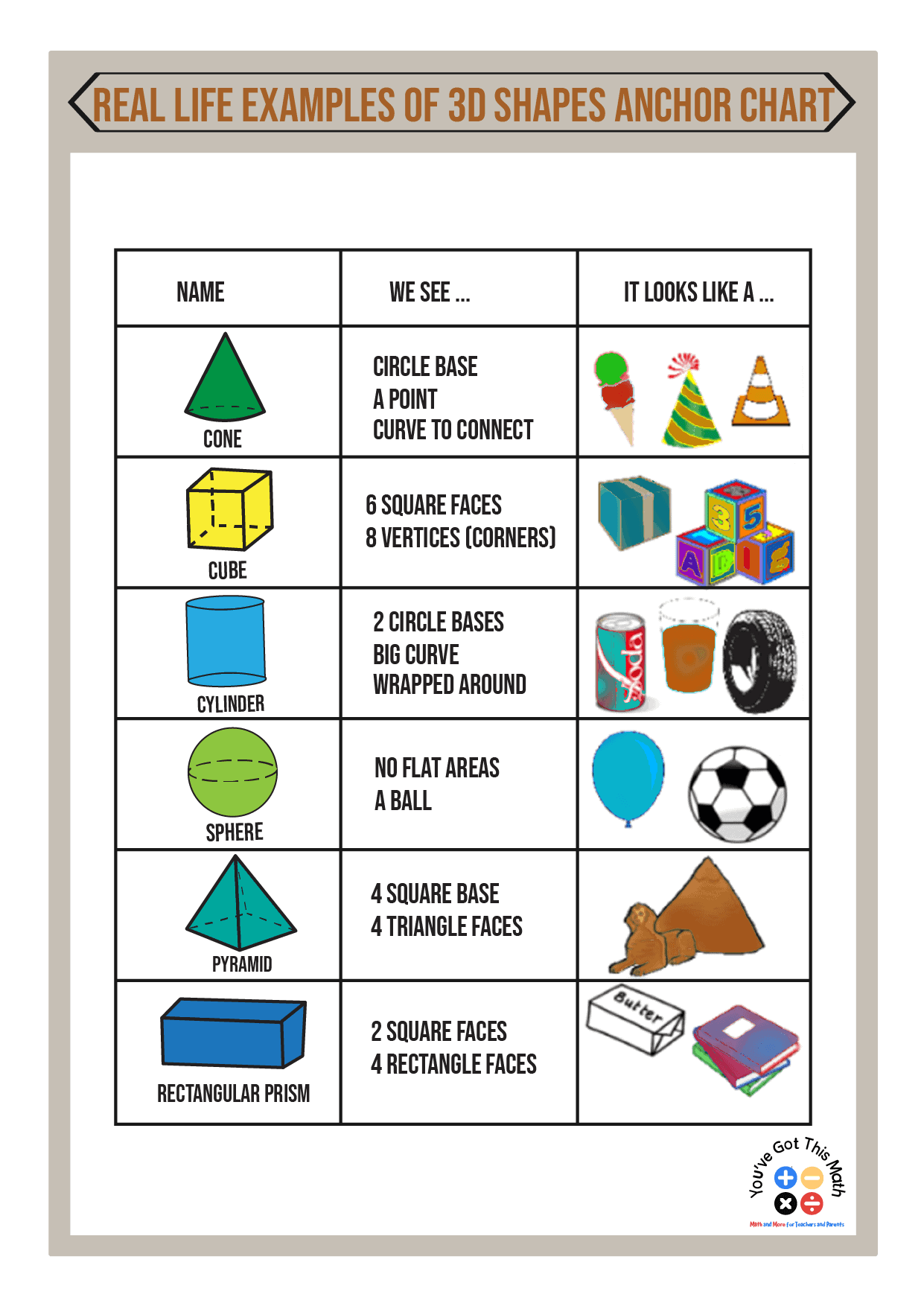
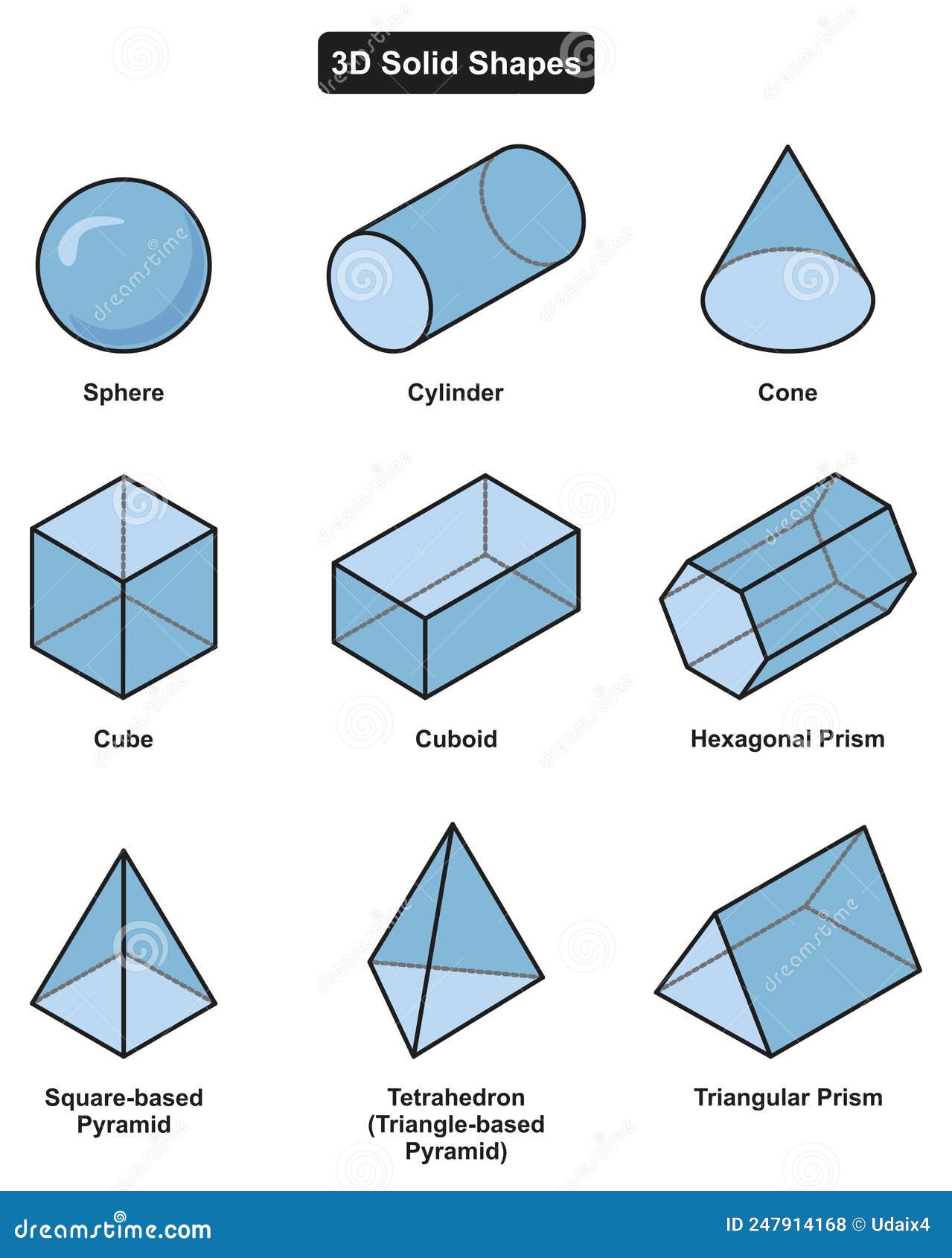
A cube is a regular hexahedron featuring six identical square faces, twelve equal-length edges, and eight vertices. Every angle between its adjacent faces is a right angle (90 degrees). Because of its uniform dimensions, calculating its properties is straightforward: surface area equals $6s^2$ (where $s$ is the side length), and volume equals $s^3$. Cubes are foundational in architecture, packaging design, and spatial modeling due to their structural stability and ability to tessellate space without gaps.
2. Rectangular Prism (Cuboid)
A rectangular prism is a six-faced polyhedron where all faces are rectangles. Unlike the cube, its length, width, and height do not have to be equal. It features 12 edges and 8 vertices. Rectangular prisms are ubiquitous in everyday life, appearing in objects such as shipping boxes, books, and rooms. The volume is calculated by multiplying length, width, and height ($V = l \cdot w \cdot h$), making it a primary model for storage and capacity calculations.
3. Triangular Prism
A triangular prism consists of two parallel, congruent triangular bases connected by three rectangular lateral faces. It features a total of 5 faces, 9 edges, and 6 vertices. This shape is frequently observed in engineering, optics (such as dispersing light through a glass prism), and roof construction. The volume is found by multiplying the area of the triangular base by the distance between the two bases (height of the prism).
4. Square Pyramid
A square pyramid features a flat square base and four triangular faces that meet at a single point at the top, known as the apex. It contains 5 faces, 8 edges, and 5 vertices. The historical significance of the square pyramid is globally evident in architectural wonders like the Egyptian pyramids, while its geometric properties provide high structural stability by distributing weight downward toward a wide base.
5. Tetrahedron (Triangular Pyramid)
A tetrahedron is the simplest of all convex polyhedra, consisting of a triangular base and three triangular lateral faces that meet at an apex. It has 4 faces, 6 edges, and 4 vertices. A regular tetrahedron features four equilateral triangles as faces. Because a triangle is the most rigid two-dimensional polygon, the tetrahedron forms the fundamental building block for structural truss systems and finite element analysis in mechanical engineering.
6. Pentagonal Prism
A pentagonal prism features two parallel, congruent pentagonal bases connected by five rectangular faces. In total, it has 7 faces, 15 edges, and 10 vertices. While less common in standard packaging than rectangular prisms, pentagonal geometry is frequently utilized in advanced chemical molecular structures, architectural columns, and specialized manufacturing components.
Non-Polyhedra: Solids with Curved Surfaces
Unlike polyhedra, non-polyhedral solid shapes incorporate curved boundaries, meaning they cannot be classified strictly by flat polygonal faces and straight edges.
7. Sphere
A sphere is a perfectly round geometrical solid where every point on its outer surface is equidistant from its center point. It possesses zero flat faces, zero straight edges, and zero vertices, relying entirely on a single continuous curved surface. Spheres have the minimum possible surface area for a given volume, making them nature's optimal shape for minimizing fluid resistance and containing pressurized contents, such as droplets of water, planets, and sports balls.
8. Cylinder
A cylinder consists of two parallel, congruent circular bases connected by a curved lateral surface. It features two circular faces, zero flat polygonal edges, and zero vertices. Industrial applications of cylinders include pipes, hydraulic pistons, and storage silos. The volume is calculated by multiplying the area of the circular base ($\pi r^2$) by the height of the cylinder ($h$).
9. Cone
A cone is a tapered geometric solid that features a flat circular base and a curved surface that smoothly tapers upward to a single point called the apex. It has 1 circular face, 1 curved surface, 1 continuous circular edge, and 1 vertex. Cones are widely utilized in traffic management markers, paper drinking cups, and acoustic speaker design due to their directional channeling properties.
10. Hemisphere
A hemisphere is formed when a sphere is cut exactly in half through its center point, creating a flat circular base alongside a dome-like curved surface. It features 1 flat face, 1 curved surface, 1 circular edge, and zero vertices. Hemispheres are heavily utilized in architectural dome construction, radar housings (radomes), and bowl manufacturing.
11. Torus
A torus is a ring-shaped solid generated by revolving a circle in a three-dimensional space about an axis that is coplanar with the circle. It features a continuous curved surface with zero flat faces, zero edges, and zero vertices, possessing a characteristic hole in the center. Common real-world examples include doughnuts, inflatable inner tubes, and specialized magnetic containment chambers (tokamaks) used in nuclear fusion research.
12. Square Frustum
A square frustum is created when a square pyramid is sliced horizontally by a plane parallel to its base, removing the top apex portion. It features a large square base at the bottom, a smaller square top face, and four trapezoidal lateral faces, totaling 6 faces, 12 edges, and 8 vertices. Frustums are commonly observed in everyday items such as lampshades, buckets, and certain architectural towers.
Comparison of Solid Shapes
To easily evaluate and compare these geometric figures, the following table summarizes their structural properties, including faces, edges, and vertices.
| Solid Shape | Category | Number of Faces | Number of Edges | Number of Vertices | Primary Defining Feature |
|---|---|---|---|---|---|
| Cube | Polyhedron | 6 | 12 | 8 | All square faces of equal area |
| Rectangular Prism | Polyhedron | 6 | 12 | 8 | Rectangular faces at right angles |
| Triangular Prism | Polyhedron | 5 | 9 | 6 | Two parallel triangular bases |
| Square Pyramid | Polyhedron | 5 | 8 | 5 | Square base tapering to an apex |
| Tetrahedron | Polyhedron | 4 | 6 | 4 | Triangular base and triangular sides |
| Pentagonal Prism | Polyhedron | 7 | 15 | 10 | Two parallel pentagonal bases |
| Sphere | Non-Polyhedron | 1 (curved) | 0 | 0 | All surface points equidistant from center |
| Cylinder | Non-Polyhedron | 2 (flat) + 1 (curved) | 0 | 0 | Two parallel circular bases |
| Cone | Non-Polyhedron | 1 (flat) + 1 (curved) | 1 (circular) | 1 | Circular base tapering to an apex |
| Hemisphere | Non-Polyhedron | 1 (flat) + 1 (curved) | 1 (circular) | 0 | Exact half of a sphere |
| Torus | Non-Polyhedron | 1 (curved) | 0 | 0 | Ring shape with a central hole |
| Square Frustum | Polyhedron | 6 | 12 | 8 | Pyramid with top sliced off parallel to base |
Practical Applications in Design and Calculation
Understanding the properties of these 12 solid shapes is not merely an academic exercise; it has direct implications across numerous professional fields:
- Architecture and Construction: Engineers utilize prisms, cylinders, and pyramids to calculate material loads, interior volume capacities, and foundation footprints. For instance, calculating the concrete required for a cylindrical column relies directly on cylinder volume formulas.
- Manufacturing and Packaging: Packaging designers use rectangular prisms and cylinders to maximize shelf space while minimizing cardboard or plastic waste. Optimizing surface-area-to-volume ratios reduces shipping costs and environmental impact.
- Computer Graphics and Gaming: 3D rendering engines construct complex digital models by mesh-building with simpler polyhedra, primarily triangles and tetrahedra, allowing computers to calculate light reflection and physics interactions efficiently.
Frequently Asked Questions
What is the main difference between a polyhedron and a non-polyhedron?
A polyhedron is a solid shape bounded exclusively by flat polygonal faces and straight edges, such as a cube or a pyramid. A non-polyhedron incorporates curved surfaces or circular boundaries, such as a sphere, cylinder, or cone.
How do you calculate the volume of a cylinder compared to a cone?
The volume of a cylinder is calculated using the formula $V = \pi r^2 h$, where $r$ is the radius and $h$ is the height. A cone with the exact same radius and height occupies exactly one-third of that volume, calculated as $V = \frac{1}{3}\pi r^2 h$.
Why are spheres considered structurally unique in geometry?
Spheres are unique because every point on their outer boundary is equidistant from the center. This geometry provides optimal pressure distribution and the minimum possible surface area for any given volume, which explains why fluids naturally form spherical droplets in zero gravity.
Can a pyramid have a base that is not a square?
Yes. While square pyramids are the most common in introductory geometry, pyramids can be constructed with any polygonal base, including triangular bases (tetrahedrons), pentagonal bases, or hexagonal bases.
Next Actions and Further Study
To deepen your understanding of three-dimensional geometry, begin by practicing surface area and volume calculations for each of the shapes outlined above using standard metric or imperial units. For students and design professionals, experimenting with computer-aided design (CAD) software or physical modeling blocks provides tangible insight into how these 12 solid shapes interact within physical and virtual environments.