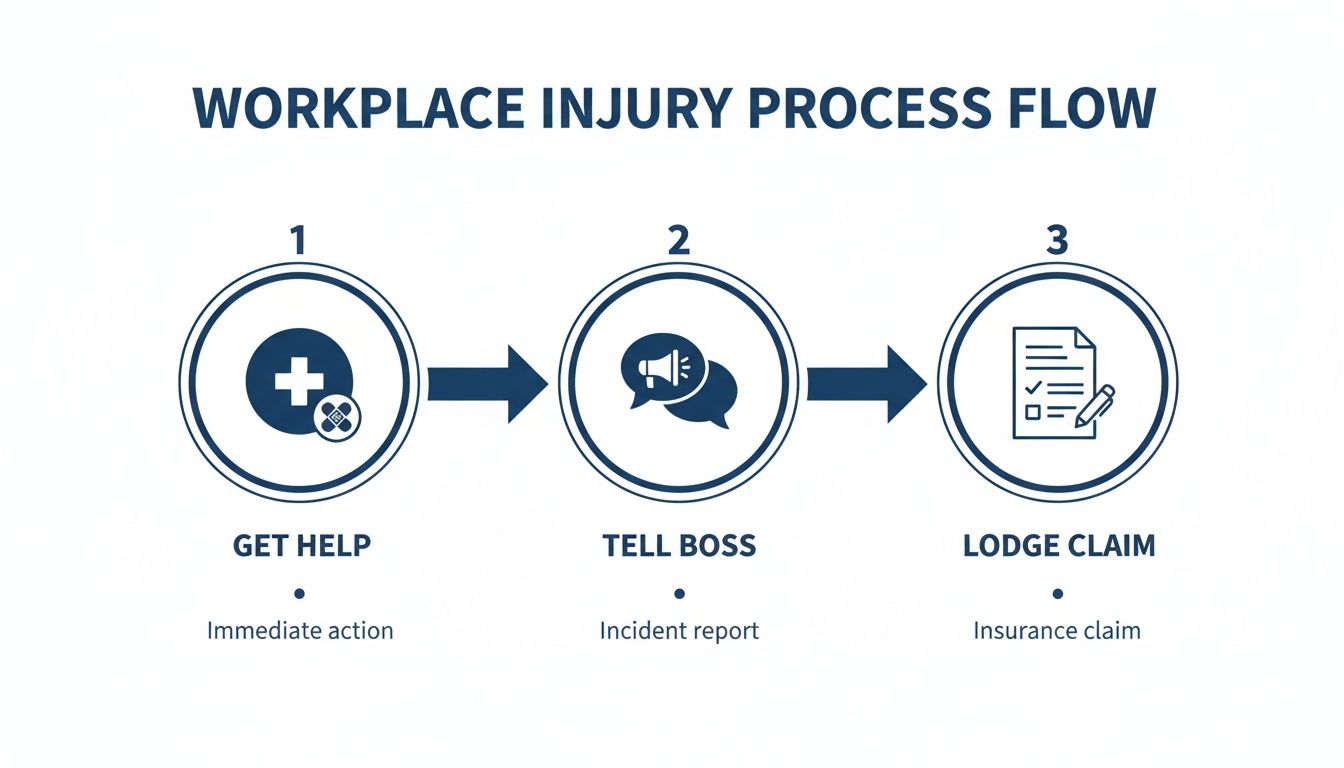
Filing a workers' compensation claim in Lebanon, New Jersey (ZIP code 08833) requires careful adherence to state timelines, employer notifications, and medical evaluation procedures. Injured workers must immediately report the incident to their employer, seek authorized medical care through the company’s designated healthcare network, and file official documentation with the New Jersey Division of Workers' Compensation to protect their right to wage replacement and medical benefits.
Understanding the New Jersey Workers' Compensation System
Navigating the workers' compensation landscape in Hunterdon County, specifically within the municipality of Lebanon, NJ (08833), begins with understanding that New Jersey operates under a no-fault system. This means that if you sustain an injury or contract an illness arising out of and in the course of your employment, you are generally entitled to medical treatment and temporary disability benefits regardless of who was at fault for the accident.
However, this no-fault framework does not mean the process is automatic or exempt from strict procedural rules. Employers and their insurance carriers scrutinize claims closely. Whether you work in light industrial parks, local retail spaces, healthcare offices, or commute from Lebanon along the Interstate 78 corridor, your compliance with state-mandated notification timelines dictates whether your claim is accepted or contested. Knowing the exact sequence of actions to take immediately following an accident ensures your health is prioritized and your financial security is legally protected under New Jersey statute.
Step 1: Seek Immediate Emergency Medical Attention
Your physical health and safety take absolute priority above all administrative steps. If you suffer a severe traumatic injury at your workplace in Lebanon, NJ 08833—such as a heavy machinery accident, a dangerous fall from a ladder, or sudden cardiac distress—you must seek immediate emergency medical care.
Call 911 or have someone transport you to the nearest emergency department. In the Lebanon area, primary regional facilities include Hunterdon Medical Center located nearby in Flemington, or other regional hospitals equipped to handle acute occupational injuries. When you arrive at the emergency room, explicitly inform the intake personnel and attending physicians that the injury occurred while you were performing your job duties. This ensures that the medical history explicitly links the workplace incident to the treatment provided, establishing a contemporaneous record that will be vital when your claim is reviewed by insurance adjusters later.
Step 2: Notify Your Employer Promptly and in Writing
Under New Jersey workers' compensation laws, you are legally required to give notice of your injury to your employer. While verbal notification to a direct supervisor or human resources manager is common, submitting this notice in writing provides an indisputable paper trail.
You should notify your employer as soon as possible after the accident occurs. Under state law, waiting too long to report an injury can jeopardize your right to benefits. In New Jersey, you generally have up to 90 days to provide written notice of an injury to your employer, but waiting until the outer limit invites skepticism from the insurance carrier and can lead to immediate claim denials. Your written notice should include the date, time, exact location of the accident within the workplace, and a clear description of how the injury happened and which body parts are affected. Keep a copy of this written notification for your personal records.
Step 3: Understand Employer-Mandated Medical Treatment Rules
One of the most common pitfalls injured workers encounter in New Jersey is seeking medical care outside of the insurance carrier's approved network. In New Jersey, the employer and their workers' compensation insurance carrier generally have the legal right to direct and choose the medical providers who treat your work-related injury.
Once you notify your employer of the injury, they are obligated to provide you with authorized medical providers. Do not automatically visit your personal family physician unless it is a life-threatening emergency, as the workers' compensation insurance carrier may refuse to pay bills rendered by unauthorized doctors. Ask your employer or their human resources department for a list of approved occupational health clinics or specialists near Lebanon, NJ 08833. Complying with this directive ensures that your medical evaluations, diagnostic imaging, and physical therapy sessions are fully covered by the insurance carrier.
Step 4: Attend All Authorized Medical Appointments and Follow Treatment Plans
Once you are assigned to an authorized treating physician, active and consistent participation in your medical recovery plan is mandatory. Missing scheduled medical appointments, failing to attend physical therapy, or ignoring prescribed work restrictions can be utilized by the insurance company to argue that you have recovered, are non-compliant, or that your ongoing pain is unrelated to the original workplace accident.
During your appointments, be completely honest and thorough with the physician regarding all symptoms, pain levels, and functional limitations. Ensure that the doctor documents every affected body part. If your physician issues temporary work restrictions—such as lifting limits, sitting or standing restrictions, or a complete medical leave of work—obtain these restrictions in writing and deliver copies immediately to both your employer and the workers' compensation insurance adjuster.
Step 5: File a Formal Claim Petition with the New Jersey Division of Workers' Compensation
While reporting the injury to your employer starts the internal claims process, securing formal legal jurisdiction and protecting your rights against future disputes often requires filing a formal Claim Petition (Form WC-364) with the New Jersey Division of Workers' Compensation.
This step is especially crucial if the insurance carrier delays your medical treatment, disputes the severity of your injury, denies temporary disability benefits, or refuses to acknowledge that the injury is work-related. Filing a formal petition places your case before a judge of compensation who can order medical treatment or wage benefits. While you can file this petition independently, many injured workers in Lebanon, NJ choose to retain a qualified New Jersey workers' compensation attorney to navigate the administrative nuances of the Division of Workers' Compensation, which operates district offices across the state, including locations accessible to Hunterdon County residents.
| Claim Stage | Primary Responsibility | Key Documentation / Action | Timeline / Deadline |
|---|---|---|---|
| 1. Emergency Care | Employee / Medical Staff | Emergency room treatment, initial medical records | Immediate (Day of incident) |
| 2. Employer Notice | Employee | Written incident report to supervisor / HR | As soon as possible; within 90 days statutory limit |
| 3. Medical Selection | Employer / Insurance Carrier | Assignment of authorized network physician | Within days of notice |
| 4. Claim Petition | Employee / Legal Counsel | Formal Claim Petition filed with NJ Division of Workers' Compensation | Within 2 years of injury or last benefit payment |
Step 6: Track and Verify Temporary Disability Benefit Payments
If your authorized treating physician determines that your injuries prevent you from working at all, or if your employer cannot accommodate your temporary work restrictions, you may be entitled to temporary total disability (TTD) benefits.
In New Jersey, TTD benefits generally equal 70% of your average weekly wage, subject to state-mandated minimum and maximum statutory caps established annually by the Department of Labor and Workforce Development. These benefits are tax-free and are designed to replace lost income while you are recovering. It is critical to track when these payments begin, ensure they arrive on a consistent schedule, and verify that the calculation of your average weekly wage accurately reflects your earnings, including overtime or multiple jobs if applicable under New Jersey law. If your checks are delayed or incorrect, notify your insurance adjuster or legal counsel immediately.
Step 7: Document All Expenses and Maintain an Injury Journal
A successful workers' compensation claim relies heavily on contemporaneous documentation. Beyond official medical reports and pay stubs, keeping a personal injury journal can dramatically strengthen your position if your case involves disputes over permanent disability or vocational rehabilitation.
Record the dates of all medical appointments, mileage traveled to and from doctors' offices in Hunterdon County and surrounding regions (as mileage reimbursement is frequently recoverable under New Jersey workers' compensation rules), out-of-pocket expenses for prescriptions or medical devices, and daily notes regarding your pain levels, physical limitations, and how the injury impacts your daily activities. This organized repository of information prevents memory lapses and provides clear, verifiable evidence during formal hearings or settlement negotiations.
Step 8: Understand the Difference Between Temporary and Permanent Disability
As your medical treatment progresses, your authorized physician will eventually reach a milestone known as Maximum Medical Improvement (MMI). MMI signifies that your condition has stabilized and further medical improvement is unlikely, even with ongoing treatment.
At this juncture, the nature of your claim shifts from temporary disability to evaluating permanent disability. New Jersey workers' compensation recognizes two primary types of permanent disability:
- Partial Total Disability: Your injury leaves you with a permanent physical impairment to a specific body part (such as a hand, knee, back, or eye) or a non-specific functional loss, but you are still capable of performing some form of work.
- Total Permanent Disability: Your injuries are so severe that you are rendered entirely incapable of gainful employment in any capacity.
Your authorized physician or an independent medical examiner will perform an evaluation to assign a permanent partial disability percentage rating, which dictates the structure of your final award or settlement.
Step 9: Evaluate Settlement Options or Finalize Your Award
When your medical treatment is complete and your permanent impairment rating is established, you and the insurance carrier will typically discuss resolving your case. In New Jersey, workers' compensation settlements generally take one of two forms:
- Section 20 Dismissal: A full and final lump-sum settlement where you agree to close your case permanently. In exchange for cash, you give up all future rights to medical treatment and additional wage benefits, even if your condition worsens in the future.
- Formal Award / Order Approving Settlement: A settlement that leaves your right to future medical treatment open for specific authorized conditions related to the accident, while paying out the permanent partial disability percentage determined by the court.
Evaluating whether a Section 20 settlement or an open formal award is in your best interest requires careful financial and medical forecasting. Consulting with an experienced New Jersey workers' compensation attorney before signing any settlement release is strongly recommended.
Step 10: Know Your Rights Regarding Retaliation and Appeals
Navigating a workers' compensation claim can occasionally create friction in the workplace. It is vital to understand your legal protections under New Jersey law. Under N.J.S.A. 34:15-39.1, it is illegal for an employer to discharge, coerce, or discriminate against an employee simply because they have filed a workers' compensation claim or testified in a proceeding.
If your claim is denied outright by the insurance carrier—whether they dispute that the accident occurred at work, claim the injury is a pre-existing condition, or argue that you were intoxicated at the time of the accident—do not panic. A denial is not the end of the road. It simply means your case must proceed through formal litigation within the New Jersey Division of Workers' Compensation, where a judge will review the evidence, hear testimony from medical experts, and render a binding legal decision.
Disclaimer: The information provided in this article is for educational and informational purposes only and does not constitute formal legal or medical advice. Workers' compensation laws are subject to specific statutory interpretations and individual case nuances. Readers in Lebanon, NJ 08833 should consult with a licensed New Jersey workers' compensation attorney or certified medical professional regarding their specific circumstances.
Frequently Asked Questions
Can I see my own doctor for a workplace injury in Lebanon, NJ?
Generally, no. In New Jersey, the employer and their workers' compensation insurance carrier have the legal right to direct your medical care. If you visit your personal physician without authorization, the insurance company may refuse to pay the medical bills. You must request a list of approved providers from your employer.
What should I do if my employer refuses to file my workers' compensation report?
If your employer ignores your verbal or written notice or refuses to file the claim with their insurance carrier, you can take direct action. You have the right to contact the New Jersey Division of Workers' Compensation directly and file a formal Claim Petition on your own behalf or with the assistance of a legal professional.
Are workers' compensation benefits taxable in New Jersey?
No. Temporary disability benefits, permanent disability awards, and medical expense payments received through the New Jersey workers' compensation system are entirely tax-free at both the state and federal levels. You do not need to report these benefits as taxable income on your annual tax returns.
What is the time limit for filing a workers' compensation claim in New Jersey?
In New Jersey, you generally must file a formal Claim Petition with the Division of Workers' Compensation within two years from the date of the accident, or within two years of the last payment of temporary disability benefits, whichever is later. Missing this strict statute of limitations can permanently bar you from recovering any benefits.
Can I be fired for filing a workers' compensation claim in New Jersey?
No. New Jersey state law strictly prohibits employers from firing, demoting, disciplining, or otherwise retaliating against an employee for seeking workers' compensation benefits or participating in a compensation proceeding. If you suspect you are facing workplace retaliation, document all incidents and consult an employment or workers' compensation attorney immediately.