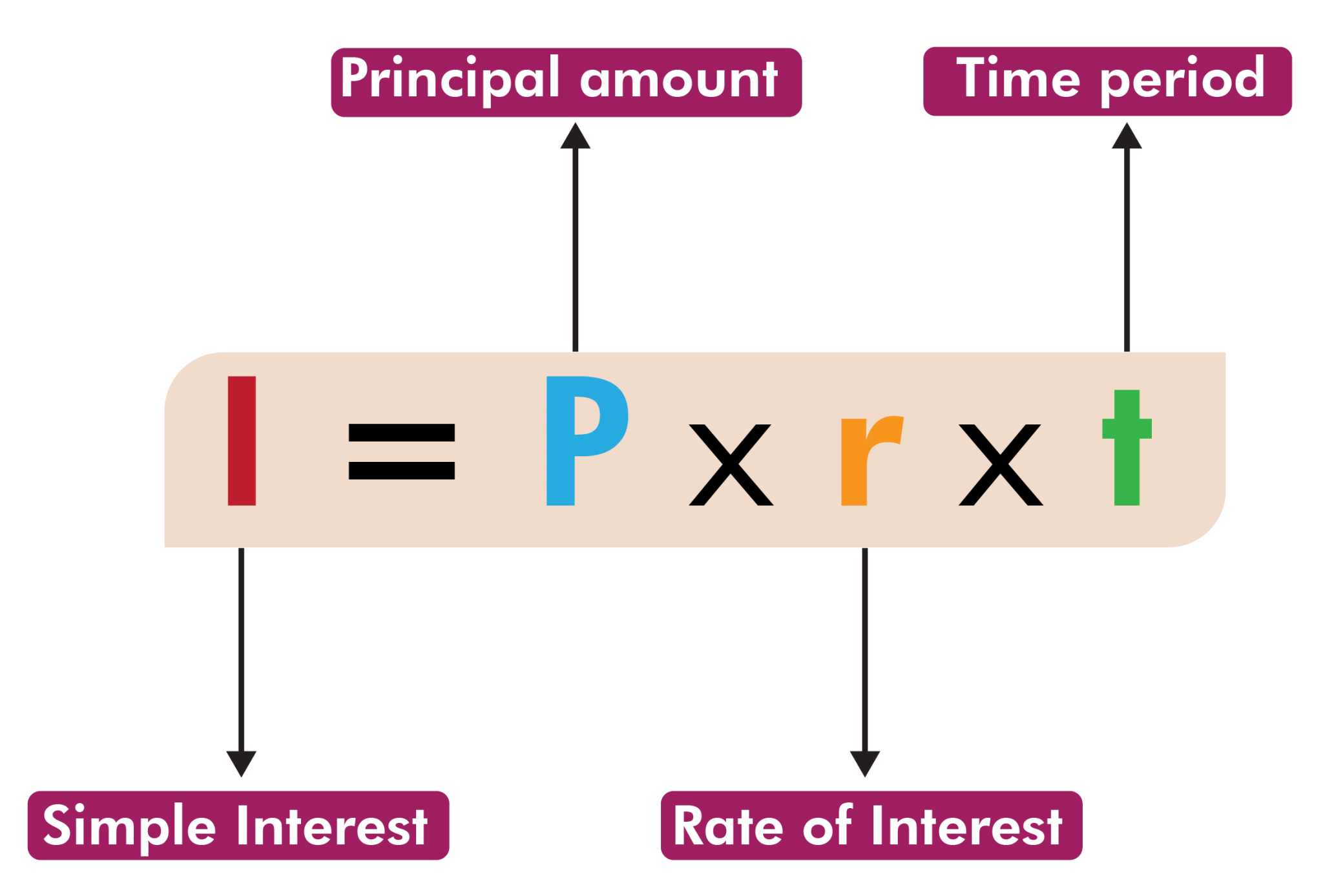
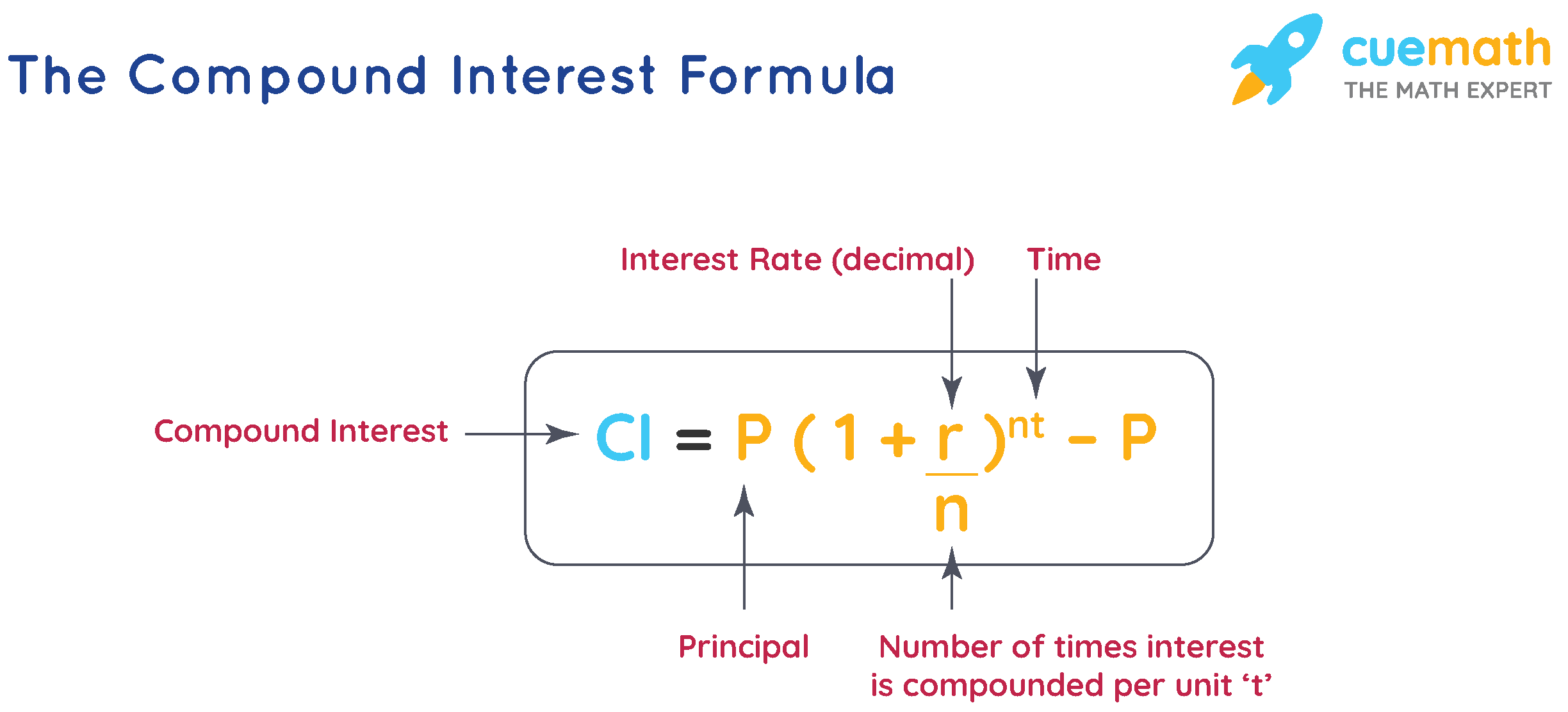
The annual rate of interest formula is used to calculate the percentage cost of a loan or the profit on an investment over a one-year period. For simple interest, the formula is r = I / (P × t), where 'r' is the rate, 'I' is interest earned, 'P' is principal, and 't' is time in years. For compound interest, the formula is more complex: r = n[(A/P)^(1/nt) - 1].
Understanding how to calculate the annual rate of interest is a fundamental skill for navigating the financial landscape of 2026. Whether you are evaluating a high-yield savings account, comparing mortgage offers, or calculating the return on a business investment, the ability to derive the interest rate allows for objective comparisons. While automated calculators are widely available, knowing the underlying mathematics ensures that you can verify terms, troubleshoot discrepancies, and plan for long-term financial health.
Defining the Variables of Interest Calculation
Before applying any formula, it is necessary to identify the specific variables involved. Financial equations rely on a standardized set of inputs to ensure accuracy. Regardless of whether you are dealing with a simple loan or a complex investment vehicle, the following components are universal:
- Principal (P): This is the initial amount of money borrowed or invested. It represents the "base" upon which interest is calculated.
- Interest Amount (I): This is the total dollar amount of interest paid or earned over the duration of the term.
- Total Accumulated Value (A): In compound interest scenarios, 'A' represents the final balance (Principal + Interest) at the end of the period.
- Annual Rate (r): This is the value we are solving for, expressed as a decimal (e.g., 0.05 for 5%) or a percentage.
- Time (t): The duration of the loan or investment, traditionally expressed in years. If the term is in months, it must be converted (e.g., 6 months = 0.5 years).
- Compounding Periods (n): The number of times interest is applied per year (e.g., $n=12$ for monthly, $n=4$ for quarterly, $n=365$ for daily).
The Simple Annual Rate of Interest Formula
Simple interest is the most straightforward method of calculation. It assumes that interest is calculated only on the original principal amount, without any "interest on interest." While less common in modern retail banking, simple interest is still used for short-term personal loans, certain types of bonds, and specific merchant credit arrangements.
The Formula
To find the annual rate ($r$), we rearrange the standard simple interest formula ($I = P \times r \times t$):
r = I / (P × t)
Step-by-Step Calculation
- Identify the Total Interest Paid: Subtract the principal from the total repayment amount.
- Multiply Principal by Time: Ensure time is in years.
- Divide Interest by the Result: This gives you the rate as a decimal.
- Convert to Percentage: Multiply by 100.
Example: Imagine you lent a colleague $2,000 for 18 months (1.5 years) and they paid you back $2,240.
- Interest ($I$) = $240
- Principal ($P$) = $2,000
- Time ($t$) = 1.5
- Calculation: $240 / (2,000 \times 1.5) = 240 / 3,000 = 0.08$
- Annual Rate: 8%
The Compound Annual Rate of Interest Formula
In 2026, most financial products—from credit cards to retirement accounts—utilize compound interest. Compounding means that the interest earned in one period is added to the principal, and the next period's interest is calculated on that new, larger balance. Because of this, solving for the annual rate requires algebraic manipulation involving exponents.
The Formula
When you know the final amount ($A$), the principal ($P$), the time ($t$), and the number of compounding periods ($n$), the formula for the annual rate ($r$) is:
r = n[(A/P)^(1/nt) - 1]
Breaking Down the Math
This formula looks intimidating, but it follows a logical sequence:
- A/P: This ratio shows how much the investment grew relative to its starting point.
- Exponent (1/nt): This accounts for the passage of time and the frequency of compounding, "averaging" the growth over each period.
- Subtract 1: This removes the original principal from the ratio, leaving only the growth rate.
- Multiply by n: This annualizes the rate if interest is compounded more than once a year.
Example: A certificate of deposit (CD) grows from $10,000 to $12,500 over 5 years, with interest compounded monthly ($n=12$).
- $A/P = 1.25$
- $nt = 12 \times 5 = 60$
- $(1.25)^{1/60} \approx 1.00372$
- $1.00372 - 1 = 0.00372$
- $0.00372 \times 12 = 0.04464$
- Annual Rate: 4.46%
Distinguishing Between APR and APY
A frequent point of confusion in financial agreements is the distinction between the Annual Percentage Rate (APR) and the Annual Percentage Yield (APY). While both are "annual rates," they serve different purposes and produce different numbers.
Annual Percentage Rate (APR)
The APR is the nominal interest rate. For loans, it often includes fees or costs associated with the transaction, but it does not account for the effect of compounding within the year. If a credit card has a 24% APR, the monthly interest rate is simply 2% ($24 / 12$).
Annual Percentage Yield (APY)
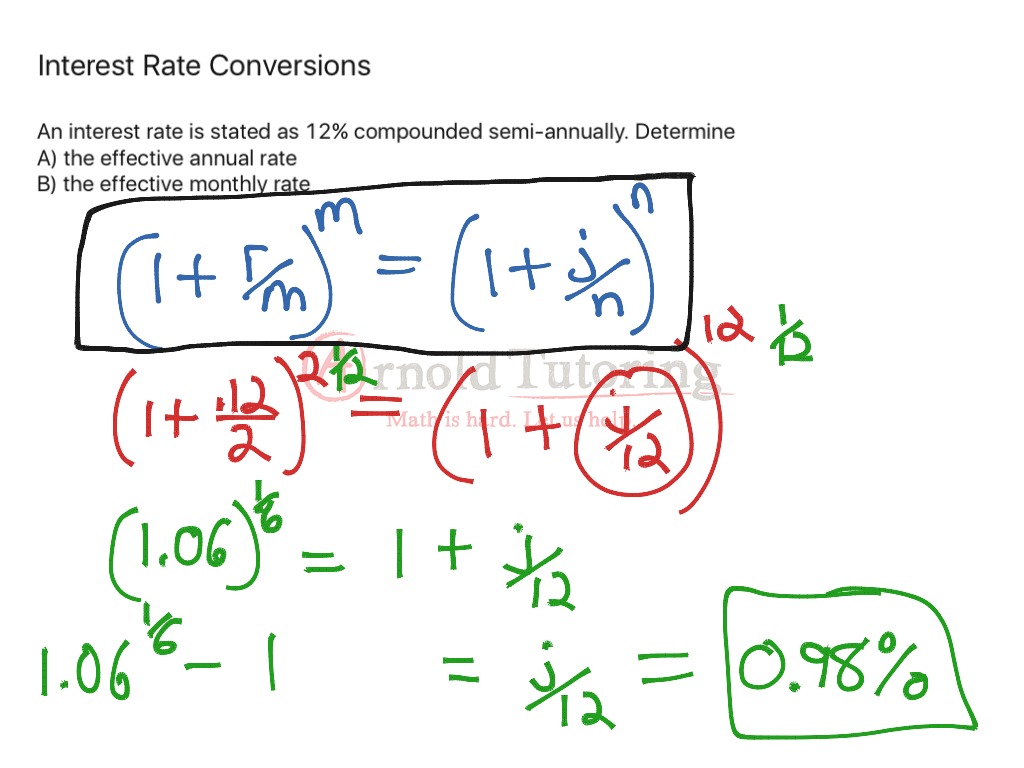
The APY, also known as the Effective Annual Rate (EAR), represents the actual interest earned or paid after accounting for compounding. Because interest is added to the balance, the APY is always higher than the APR (unless interest is only compounded once per year).
The APY Formula: APY = (1 + r/n)^n - 1
(Where $r$ is the stated APR and $n$ is the compounding frequency).
Comparison of Compounding Frequencies
The more frequently interest compounds, the higher the effective annual rate will be, even if the nominal rate remains the same. The table below illustrates the impact of compounding on a 10% nominal annual rate.
| Compounding Frequency | Nominal Rate (APR) | Calculation (n) | Effective Annual Rate (APY) |
|---|---|---|---|
| Annually | 10.00% | 1 | 10.000% |
| Semi-Annually | 10.00% | 2 | 10.250% |
| Quarterly | 10.00% | 4 | 10.381% |
| Monthly | 10.00% | 12 | 10.471% |
| Daily | 10.00% | 365 | 10.516% |
Real-World Factors Influencing the Annual Rate
When using the annual rate of interest formula, it is vital to remember that the "raw" mathematical result may not tell the whole story. Several economic factors influence the practical value of that interest rate in 2026.
The Impact of Inflation
The "Nominal Interest Rate" is the number you calculate using the formulas above. However, the "Real Interest Rate" accounts for inflation. If you earn 5% interest on a savings account but inflation is 3%, your actual purchasing power only increased by 2%. Real Interest Rate ≈ Nominal Rate - Inflation Rate
Tax Considerations
For investments, interest is often taxable income. The "After-Tax Interest Rate" is what actually hits your pocket. For example, if you are in a 25% tax bracket and earn 6% interest, your after-tax rate is actually 4.5% ($6 \times (1 - 0.25)$).
Fixed vs. Variable Rates
The annual rate formula assumes the rate remains constant over time ($t$). In variable-rate products, such as Adjustable-Rate Mortgages (ARMs), the rate may change based on an underlying index (like the Secured Overnight Financing Rate, or SOFR). In these cases, the formula only provides a "snapshot" of the current rate environment.
How to Calculate Annual Rates Using Software
While manual calculation is excellent for understanding, professional financial analysis in 2026 typically relies on spreadsheet software like Microsoft Excel or Google Sheets. These platforms have built-in functions that handle the algebraic heavy lifting.
The RATE Function
The RATE function is used to find the interest rate for an annuity (a series of equal payments).
Syntax: =RATE(nper, pmt, pv, [fv])
nper: Total number of payment periods.pmt: The payment made each period (use 0 if only calculating on a lump sum).pv: Present value (the principal).fv: Future value.
The IRR Function
For complex investments with irregular cash flows, the Internal Rate of Return (IRR) function is more appropriate. It calculates the annual rate that makes the net present value of all cash flows equal to zero. This is the gold standard for measuring business investment performance.
Common Mistakes in Interest Rate Calculations
Even experienced professionals can make errors when calculating annual interest rates. Avoiding these common pitfalls ensures financial accuracy:
- Misaligning Time and Frequency: If you use monthly compounding ($n=12$), ensure that your time ($t$) is in years and your total periods ($nt$) correctly reflect the number of months.
- Ignoring Fees: For loans, the "interest rate" is often lower than the APR. Always include mandatory fees in your total interest ($I$) calculation to find the true cost of borrowing.
- Decimal Errors: Always convert percentages to decimals before calculating. 5% must be entered as 0.05. A common mistake is entering 5% as 0.5, which represents 50%.
- Assuming Simple Interest: In the modern economy, almost all debt and savings compound. Using the simple interest formula for a credit card or a 401(k) will result in significant inaccuracies.
Frequently Asked Questions
What is the difference between nominal interest rate and annual percentage rate?
The nominal interest rate is the base interest charged on a loan, while the Annual Percentage Rate (APR) includes both the interest rate and any additional fees or costs (like points or origination fees) expressed as a yearly rate. Consequently, the APR provides a more comprehensive view of the total cost of a loan.
How do I calculate the annual interest rate if I only have monthly data?
If you have the monthly interest rate, you can find the nominal annual rate by multiplying it by 12. However, to find the effective annual rate (APY), you must use the formula: $(1 + \text{monthly rate})^{12} - 1$. For example, a 1% monthly rate is a 12% nominal annual rate but a 12.68% effective annual rate.
What does "n" represent in the compound interest formula?
The variable "n" represents the number of compounding periods per year. If interest is added to your account every month, $n=12$. If it is added every day, $n=365$. The higher the value of $n$, the more frequently your interest earns interest, leading to faster growth of the balance.
Can the annual rate of interest be negative?
Yes, in specific economic climates, real interest rates (nominal rate minus inflation) are frequently negative. In rare cases, central banks may set negative nominal interest rates to encourage spending, meaning a lender essentially pays a borrower to take money, or a depositor pays a bank to hold their funds.
Why is my calculated interest different from the bank's statement?
Banks often use "Daily Balance" methods where interest is calculated daily and applied monthly. Furthermore, some institutions use a 360-day year (the "Banker's Rule") instead of a 365-day year for certain calculations. Always check the "Terms and Conditions" for the specific day-count convention used by your provider.
Practical Recommendation for Readers
To gain mastery over your finances in 2026, begin by auditing your current financial products. Locate the "Truth in Lending" disclosures for your loans and the "Summary of Terms" for your investment accounts. Use the compound interest formula provided in this article to verify the APY listed on your statements. If you find a discrepancy, it is often due to the compounding frequency ($n$) or hidden fees. For most personal planning, using a spreadsheet with the =RATE or =EFFECT functions will provide the most reliable results for comparing different financial paths.
Disclaimer: This information is provided for educational purposes and does not constitute professional financial, legal, or tax advice. Interest rate regulations and banking practices may vary by jurisdiction. Consult with a certified financial advisor or tax professional before making significant investment or borrowing decisions.