The most famous Alan Shepard quote is known as "The Shepard’s Prayer," delivered just before his 1961 Freedom 7 launch: "Dear Lord, please don't let me f--- up." He is also widely celebrated for the impatient command, "Why don't you fix your little problem and light this candle?" which he barked during launch delays.
Alan Shepard was not just the first American in space; he was the personification of the "Right Stuff"—a combination of cool professionalism, biting wit, and a test pilot’s inherent disdain for technical delays. In the years leading up to 2026, his words have transitioned from mere historical footnotes into a cultural shorthand for performance under pressure. To understand an Alan Shepard quote, one must look past the bravado and examine the high-stakes environment of the early Space Race, where every word spoken over a radio frequency was etched into the permanent record of human achievement.
The Origin of "The Shepard’s Prayer"
Perhaps the most humanizing moment in the history of the Mercury program occurred in the cockpit of the Freedom 7 spacecraft on May 5, 1961. As Shepard waited through grueling countdown holds, he uttered a brief, private petition that has since become legendary among aviators, astronauts, and high-performance professionals alike.
The Real Story Behind the Prayer
While popular culture often presents "The Shepard’s Prayer" as a public broadcast, it was originally a private thought that Shepard later shared with the public and in his memoirs. The specific phrasing—"Dear Lord, please don't let me f--- up"—was a raw expression of the primary fear shared by almost all test pilots: not the fear of death, but the fear of making a mistake that would embarrass themselves or jeopardize the mission.
In the context of 1961, NASA was under immense pressure to catch up to the Soviet Union following Yuri Gagarin’s orbital flight just weeks earlier. Shepard knew that the eyes of the entire world were on him. A mechanical failure might be attributed to the hardware, but a pilot error would be a personal and national failure. By 2026, this quote has been adopted by everyone from surgeons to software engineers as a mantra for excellence and accountability.
The Sanitized Version
For years, the quote was often sanitized in textbooks and official NASA retrospectives to "Please, Lord, don't let me mess up." However, Shepard himself was always clear about his choice of words. He wasn't asking for divine intervention to save his life; he was asking for the focus required to do his job perfectly. This distinction is vital to understanding the psychology of the "Mercury Seven." They were men driven by an intense, almost pathological need for competence.
"Light This Candle": The Impatience of a Pioneer
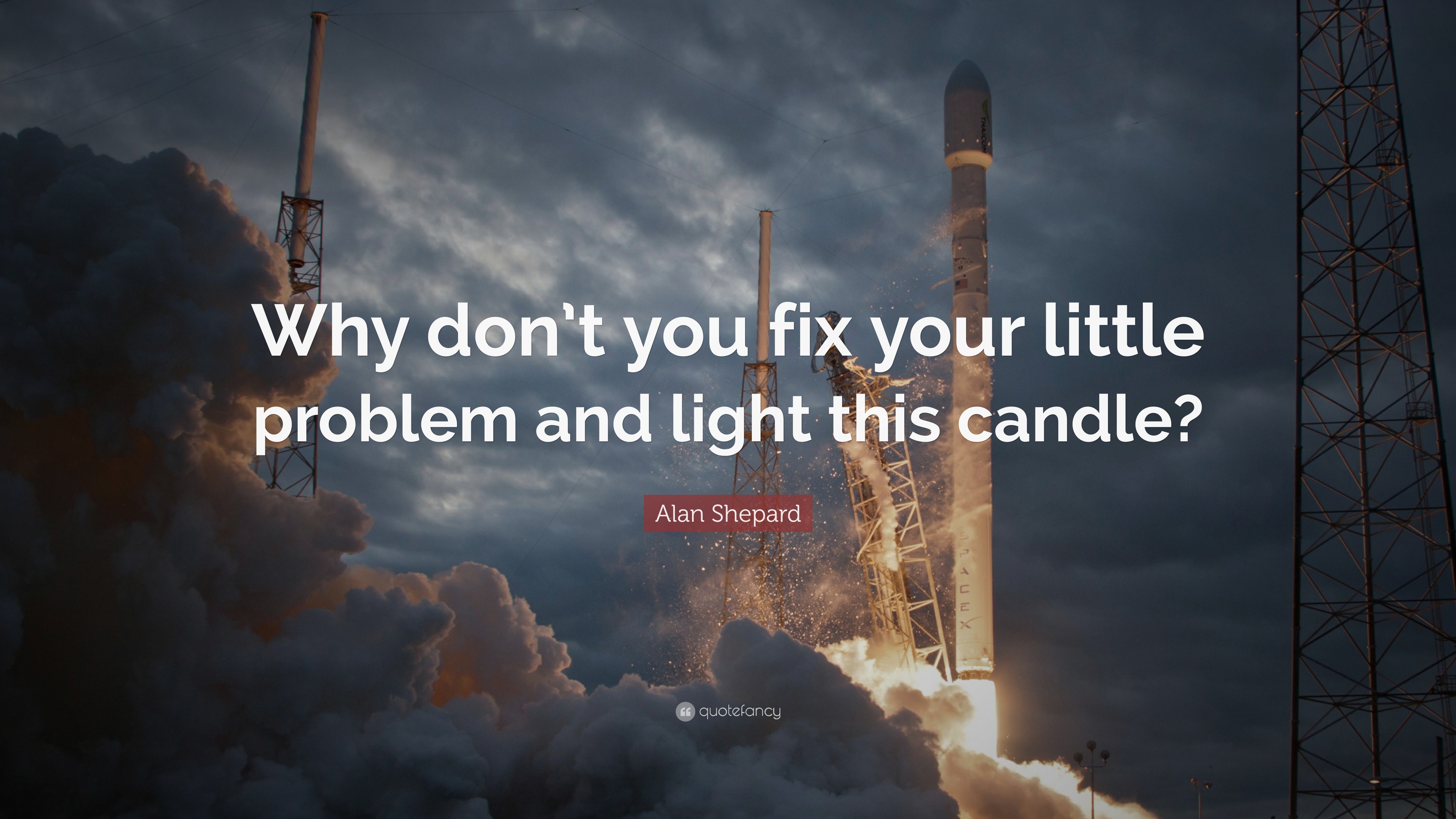
If "The Shepard's Prayer" showed his vulnerability, the phrase "Why don't you fix your little problem and light this candle?" showcased his legendary "Ice Commander" persona. This quote was born out of frustration during the launch of Mercury-Redstone 3.
The Context of the Delay
Shepard had been strapped into the cramped Freedom 7 capsule for hours. The launch, originally scheduled for early morning, was plagued by weather delays and technical glitches. One of the most famous (and uncomfortable) aspects of this wait was the fact that the capsule had no provision for waste management, as the flight was only intended to last 15 minutes. After hours of delays, Shepard famously had to relieve himself inside his suit—an incident that added to his mounting irritation.
When another technical hold was called due to a minor computer issue, Shepard’s patience finally evaporated. He spoke into his microphone, telling the ground crew to stop over-analyzing the minor details and proceed with the mission.
Why "Light This Candle" Endures
The phrase resonated because it captured the tension of the era. It represented the transition from the theoretical to the practical. In the decades since, "light this candle" has become a universal signal for "stop talking and start acting." It is used today in mission control centers and boardrooms to signal the end of deliberation and the beginning of execution. It highlights Shepard’s role as the "driver" of the spacecraft, pushing the engineers on the ground to match his level of commitment.
The "Lowest Bidder" Commentary on Spaceflight
One of the most cynical and frequently cited Alan Shepard quotes involves the reality of aerospace procurement. When asked what he was thinking about as he sat atop the Redstone rocket, Shepard reportedly quipped:
"It’s a very sobering feeling to be up in space and realize that one’s safety factor was determined by the lowest bidder on a government contract."
Fact-Checking the Attribution
While this quote is almost universally attributed to Alan Shepard, it has also been linked to John Glenn and Gus Grissom. It likely originated as a piece of "hangar talk" shared among the astronauts. However, Shepard popularized the sentiment during his many public speaking engagements and interviews.
The quote serves as a masterclass in gallows humor. It acknowledges the inherent risks of spaceflight—sitting on a controlled explosion managed by thousands of moving parts—while subtly criticizing the bureaucratic processes of the federal government. For modern readers in 2026, it remains a poignant reminder of the intersection between high-stakes exploration and the mundane realities of government spending.
Apollo 14: "It’s Been a Long Way, but We’re Here"
After being grounded for years due to Meniere's disease (an inner ear disorder), Shepard underwent experimental surgery to return to flight status. His return as the commander of Apollo 14 in 1971 was one of the great comeback stories in NASA history. Upon stepping onto the lunar surface, his first words were:
"It's been a long way, but we're here."
The Personal Significance
Unlike his Mercury quotes, which were defined by professional grit, this statement was deeply personal. It referred to the decade-long struggle Shepard faced to overcome a medical condition that had nearly ended his career. He was the only Mercury astronaut to walk on the Moon, and his words captured the relief of a man who had finally reached the "pinnacle of the mountain" after being told he might never fly again.
The Lunar Golf Shot
While not a philosophical quote, Shepard’s dialogue during his improvised golf game on the Moon is equally famous. Using a six-iron head attached to a sampling tool handle, he struck two golf balls. His description of the second ball’s flight—"Miles and miles and miles"—remains one of the most playful moments in the history of lunar exploration. It showed a side of Shepard that the public rarely saw: a man capable of pure, boyish wonder, even while performing a scientific mission.
Comparing Alan Shepard’s Key Quotes
The following table categorizes Shepard's most impactful quotes by mission, context, and the underlying message they conveyed to the public.
| Quote | Mission | Year | Core Sentiment |
|---|---|---|---|
| "Dear Lord, please don't let me f--- up." | Mercury-Redstone 3 | 1961 | Professional Accountability |
| "Why don't you fix your little problem and light this candle?" | Mercury-Redstone 3 | 1961 | Decisive Action / Impatience |
| "It’s been a long way, but we're here." | Apollo 14 | 1971 | Perseverance / Personal Triumph |
| "Safety factor determined by the lowest bidder..." | General/Interviews | N/A | Gallows Humor / Risk Awareness |
| "Miles and miles and miles." | Apollo 14 | 1971 | Wonder / Human Spirit |
The Legacy of Shepard’s Communication Style
Alan Shepard’s quotes are distinct from the poetic, carefully prepared remarks of later astronauts or the philosophical musings of Neil Armstrong. Shepard spoke like a test pilot. His language was economical, slightly abrasive, and intensely focused on the task at hand.
Impact on NASA Culture
Shepard’s "Light this candle" attitude helped define the early culture of NASA’s Manned Spacecraft Center (now Johnson Space Center). It established a precedent that, while safety was paramount, the ultimate goal was to fly. This bias toward action was essential during the 1960s, as the agency worked toward the aggressive goal of landing on the Moon before 1970.
Influence on Leadership and Performance
In 2026, Shepard is frequently studied in leadership seminars. His "Prayer" is used to discuss "extreme ownership"—the idea that an individual must take total responsibility for their performance, regardless of external factors. His ability to maintain his composure and humor while facing life-threatening risks continues to serve as a benchmark for high-pressure professions.
Frequently Asked Questions
Did Alan Shepard really say "f--- up" on the radio?
No. The "Shepard's Prayer" was a private thought he shared with his fellow astronauts and later with the public in interviews and his autobiography. During the actual mission, his radio transmissions were strictly professional and followed standard NASA protocols.
What did Shepard mean by "light this candle"?
In rocket terms, "lighting the candle" refers to the ignition of the booster engines. By 1961, it was common slang among engineers and pilots. Shepard used it to demand that the ground crew stop the "endless" troubleshooting of minor issues and proceed with the launch.
What were Alan Shepard's last words on the Moon?
As he prepared to leave the lunar surface, Shepard expressed his gratitude for the opportunity to return to flight. However, his most famous lunar remark remains his description of the golf ball’s flight: "Miles and miles and miles." His official departure was more technical, focusing on the ascent stage procedures.
Why is the "lowest bidder" quote so famous?
It highlights a fundamental truth of the aerospace industry: despite the heroic nature of the missions, the hardware is built by commercial contractors who won the job through competitive bidding. It resonates because it combines the grandeur of space with the gritty reality of economics.
How did Alan Shepard's quotes differ from Neil Armstrong's?
Neil Armstrong was known for his meticulously prepared and philosophical statements, such as "One small step for man..." Shepard, by contrast, was spontaneous and pragmatic. His quotes often reflected his immediate emotional or professional state rather than a desire to provide a quote for the history books.
Practical Recommendation for Further Study
To truly appreciate the nuance behind these quotes, it is recommended to read the biography Light This Candle: The Life and Times of Alan Shepard by Neal Thompson. This work provides the most comprehensive look at Shepard's career and clarifies the specific moments of frustration and triumph that led to his most famous lines. Additionally, listening to the original mission audio from the NASA archives (specifically for the Mercury-Redstone 3 mission) offers a glimpse into the calm, measured tone Shepard maintained even when he was "lighting the candle."