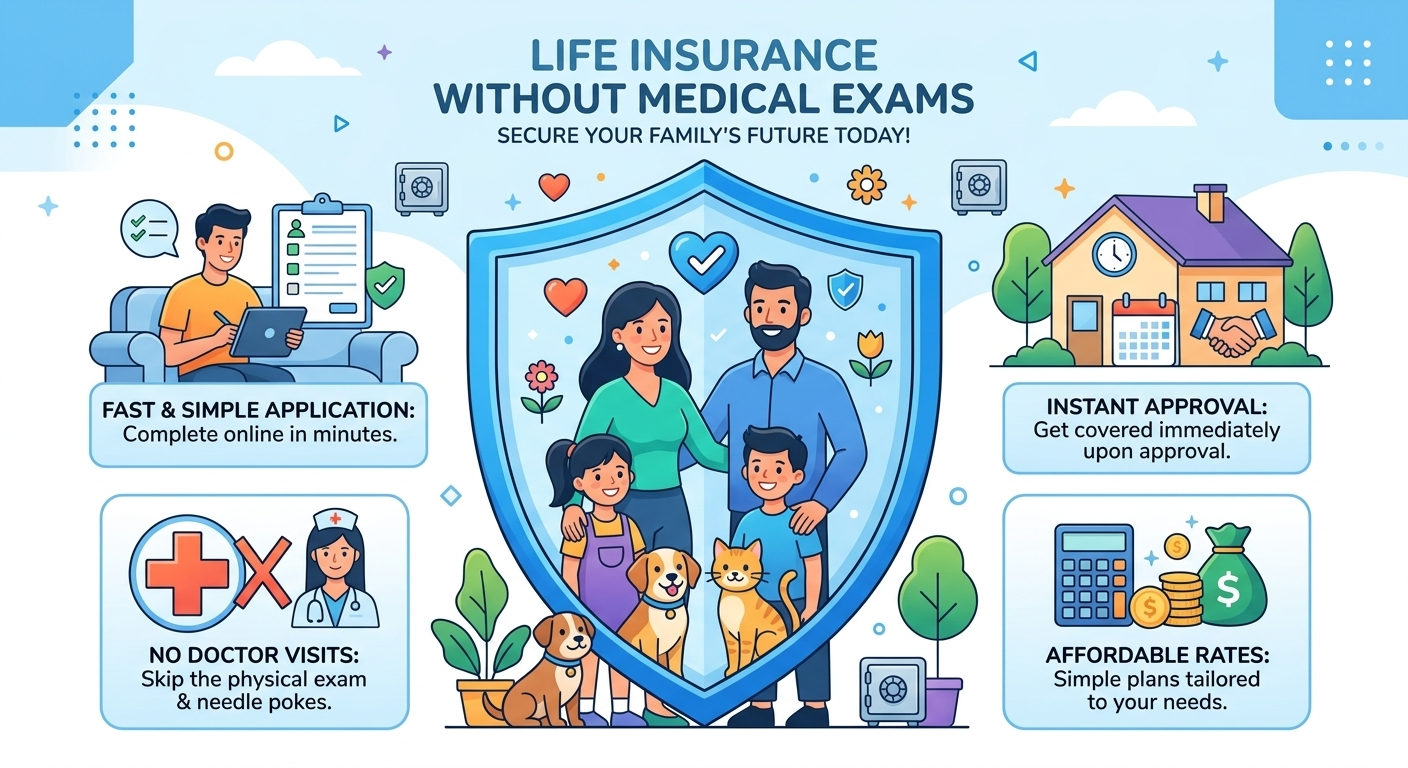
Affordable term life insurance without a medical exam, often referred to as "simplified issue" or "accelerated underwriting" life insurance, provides coverage without the traditional requirement of blood work, urine samples, or physical examinations. These policies prioritize speed and convenience, allowing applicants to obtain protection through digital questionnaires and algorithmic risk assessment, making them a practical choice for those who need immediate coverage or prefer to avoid clinical interactions.
The Mechanism of No-Exam Insurance
Traditional term life insurance typically requires a "paramedical" exam, where a technician visits your home or office to collect vitals. In 2026, the industry has shifted significantly toward "no-exam" or "fluidless" policies. These products function by utilizing public records, pharmacy benefit databases, and credit reports to verify your health history and lifestyle choices in real-time.
When you apply for such a policy, you complete an application—usually online—that asks a series of health-related questions. The insurance carrier’s underwriting engine then processes this data against medical records and digital footprints. Because the insurance company reduces its administrative costs by bypassing the physical exam, these savings are sometimes—though not always—passed on to the consumer. However, it is essential to understand that "no medical exam" does not mean "no medical review." If your answers or the digital data flags a health condition, the insurer may still request an attending physician’s statement (APS) or shift your application to a fully underwritten process.
Types of No-Exam Policies
Understanding the distinction between different types of non-medical insurance is crucial for matching your needs to the right product:
- Simplified Issue: These policies involve a health questionnaire but no physical exams. They are usually intended for healthy individuals who want a streamlined process. Approval can take anywhere from a few minutes to a few days.
- Guaranteed Issue: These policies require neither a medical exam nor health questions. They are typically designed for individuals who would otherwise be uninsurable due to serious health conditions. However, these policies often feature "graded death benefits," meaning if you die within the first two or three years of the policy, the insurer may only refund the premiums paid plus interest, rather than the full face value, unless the death is accidental.
- Accelerated Underwriting: Many major insurers now use this for their standard term products. If you are young and healthy, the computer system may waive the requirement for an exam. This is generally the most affordable route for healthy applicants.
Comparative Overview of Policy Types
| Feature | Simplified Issue | Guaranteed Issue | Accelerated Underwriting |
|---|---|---|---|
| Medical Exam | No | No | Usually No |
| Health Questions | Yes | No | Yes |
| Speed of Approval | Minutes/Days | Immediate | Minutes/Days |
| Cost | Moderate | Higher | Lowest |
| Benefit Payout | Full face value | Graded initially | Full face value |
Eligibility and Prerequisites
To qualify for the most affordable, high-quality no-exam term life insurance, you must generally meet specific criteria set by the insurer. By 2026, underwriting algorithms have become highly sophisticated. Applicants who have regular primary care physician checkups, stable prescription histories, and no history of high-risk activities are the primary targets for these policies.
Common prerequisites include:
- Age Limits: Most "no-exam" term policies are available to individuals between the ages of 18 and 60, though some insurers extend this to age 70.
- Residency: You must be a legal resident or citizen of the country in which you are applying.
- Health Status: While you don't need a perfect medical record, severe conditions—such as recent cancer treatment, advanced heart disease, or uncontrolled diabetes—often disqualify you from the best "simplified issue" rates.
- Policy Caps: Many insurers limit the death benefit on no-exam policies, often capping them at $500,000 to $1 million. If you require higher coverage amounts, you will likely be required to undergo a traditional medical exam.
The Cost-Benefit Tradeoff
The primary appeal of no-exam insurance is the efficiency of the transaction. However, consumers should be aware of the "convenience premium." In some cases, a policy that requires a medical exam may be cheaper than a no-exam policy for the exact same coverage amount.
Why does this occur? When an insurance company removes the medical exam, they lose access to granular health data (like cholesterol levels or specific blood glucose readings). To compensate for this "missing" information, insurers may adjust their pricing models to account for the potential for adverse selection—where applicants with undisclosed health issues gravitate toward policies that do not screen for them. Before committing to a no-exam policy, it is often wise to get a quote for a traditional policy to see if the potential savings of a physical exam are worth the extra time and effort.
Steps to Securing Your Policy
The process of applying for term life insurance without an exam is largely digital. Follow these steps to ensure a smooth experience:
- Assess Your Coverage Needs: Determine the duration of the term (e.g., 10, 20, or 30 years) and the death benefit amount required to cover your financial liabilities, such as mortgages or education costs.
- Gather Required Information: Have your personal identification, social security number, beneficiary information, and a list of current prescriptions ready. You should also be prepared to answer questions about your family’s medical history.
- Prepare for Digital Verification: Understand that the insurer will verify the information you provide. Providing inaccurate details is a common reason for application denial or the voiding of a policy later.
- Submit the Application: Most modern platforms allow for electronic signatures and payment, allowing the underwriting engine to process your application in real-time.
- Review the Offer: Once approved, read the policy document carefully. Pay attention to the "free look" period—typically 10 to 30 days—during which you can cancel the policy for a full refund of your first premium if you are not satisfied with the terms.
Common Mistakes to Avoid
- Under-reporting Health Issues: Insurance companies utilize MIB (Medical Information Bureau) reports and pharmacy records. If you omit a condition that appears in these databases, your application will likely be rejected for lack of transparency.
- Ignoring the Term Length: Choosing a term that is too short can be a mistake if your financial obligations, like a long-term mortgage, outlive the policy.
- Failing to Compare Quotes: Do not settle for the first no-exam offer you see. Use a licensed agent or an independent comparison tool to view rates from multiple A-rated carriers.
- Overlooking Beneficiary Designations: Ensure your beneficiaries are up to date and that you have designated both primary and contingent beneficiaries to avoid legal complications for your heirs.
Frequently Asked Questions
Are no-exam life insurance policies more expensive than traditional ones? Not necessarily. While some no-exam policies carry a convenience premium, many modern "accelerated underwriting" policies are priced competitively with traditional products because the digital automation reduces the insurer’s operational costs. The price depends heavily on your specific health profile and age.
How does an insurer verify my health without an exam? Insurers utilize third-party data aggregators. This includes checking your prescription history via pharmacy databases, reviewing your credit report to assess financial stability, and accessing the MIB database, which tracks previous life or health insurance applications you have submitted to other carriers.
Can I be denied for a no-exam policy? Yes. Even without an exam, you must answer medical questions. If you have significant health history, such as a recent diagnosis of a serious chronic illness, the insurer may decline the application or request further records from your doctor.
Is the death benefit paid out immediately if I pass away? Life insurance benefits are paid upon the submission of a valid death certificate to the insurance carrier. No-exam policies have the same claims process as traditional ones, though they may face slightly more scrutiny during the "contestability period"—usually the first two years—if the information provided on the application is found to be false.
Does "affordable" mean I can get coverage with no income? Insurers generally require "insurable interest," meaning you must demonstrate that your death would cause a financial loss. While you do not need to be wealthy, insurers typically require proof of employment or evidence of financial stability to justify the coverage amount you are requesting.
Final Recommendation
If you prioritize speed and wish to avoid the inconvenience of medical visits, a no-exam term life insurance policy is a viable financial tool in 2026. However, your decision should be balanced by comparing the premiums of no-exam policies against traditional fully-underwritten policies. If you are in excellent health, you might find that a traditional policy provides more value for your money. Regardless of the type chosen, prioritize working with a reputable, financially stable insurer and ensure all information provided on your application is accurate to protect your beneficiaries’ future claims.