Acquisition goodwill represents the intangible premium paid by an acquiring entity over the fair market value of a target company’s identifiable net assets. It arises exclusively in business combinations where the purchase price reflects anticipated future economic benefits, such as brand reputation, intellectual property, or synergies, that cannot be individually isolated or independently valued on a balance sheet.
The Conceptual Foundation of Goodwill in Acquisitions
In the realm of corporate finance and accounting, goodwill is not merely a plug figure used to balance the books after a merger or acquisition. It is an intangible asset that captures the "extra" value an acquirer expects to derive from an entity beyond its tangible and identifiable intangible assets. When Company A acquires Company B, it conducts a Purchase Price Allocation (PPA). During this process, the acquirer identifies every separable asset—from physical property and inventory to patents and customer lists—and determines their fair market value.
Often, the final purchase price exceeds the sum of these identifiable net assets. This excess is recorded as goodwill. It functions as a placeholder for the "synergistic" value: the expectation that the combined entity will be more profitable or efficient than the sum of the two separate parts. This might include cost savings from shared logistics, cross-selling opportunities, or an improved competitive market position that allows for future pricing power.
How Acquisition Goodwill is Calculated
The calculation of goodwill is a precise technical exercise governed by accounting standards, such as the Financial Accounting Standards Board (FASB) Accounting Standards Codification (ASC) Topic 805, "Business Combinations," or the International Financial Reporting Standards (IFRS) 3.
To determine the amount of goodwill, follow this foundational formula: Goodwill = (Purchase Price + Non-Controlling Interest) - (Fair Value of Identifiable Net Assets)
Step-by-Step Breakdown:
- Identify the Purchase Consideration: This includes cash paid, the fair value of any equity issued, and the fair value of contingent considerations (earnout provisions).
- Determine the Fair Value of Assets: Every asset, including previously unrecorded intangibles like developed software, trademarks, or customer contracts, must be appraised at its current market value.
- Subtract Liabilities: Identify all obligations, including debt, pension liabilities, and deferred tax liabilities, assumed in the transaction at their fair value.
- Calculate Net Identifiable Assets: The difference between the fair value of assets and the fair value of liabilities.
- Derive the Residual: Any remainder of the purchase price not allocated to these net assets is categorized as goodwill.
Accounting Treatment: Testing for Impairment
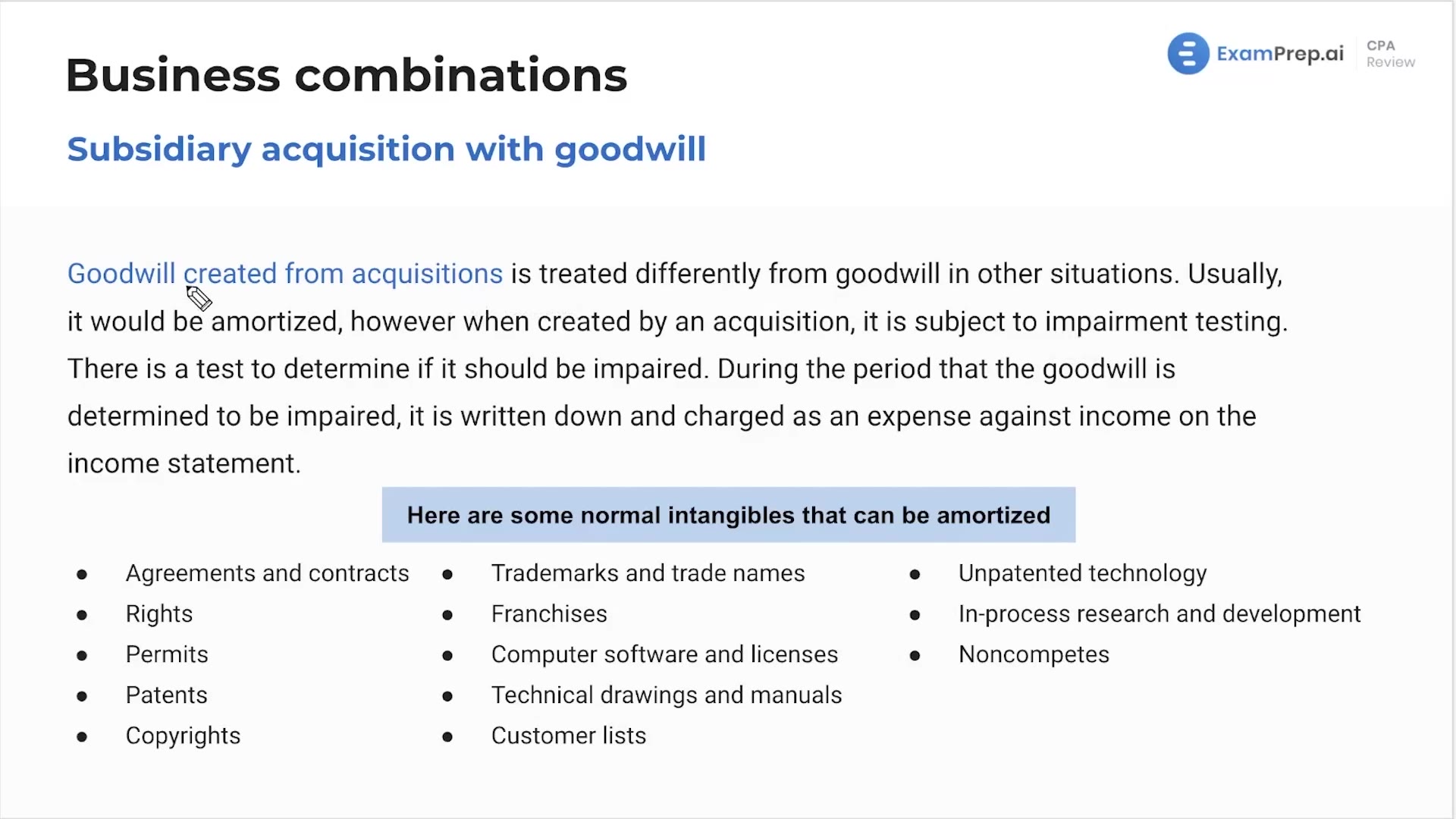
Unlike many other assets, goodwill does not have a finite useful life. Therefore, under current accounting standards (as of 2026), it is not amortized. Instead, it is subject to an annual impairment test. This test is a critical control mechanism to ensure that the value reported on the balance sheet reflects economic reality.
If the fair value of a reporting unit drops below its carrying amount, the company must recognize an impairment charge. This charge directly reduces the value of the goodwill on the balance sheet and results in a non-cash expense on the income statement, which can significantly impact earnings per share (EPS).
| Aspect | Description |
|---|---|
| Initial Recognition | Recorded at acquisition date based on residual purchase price. |
| Amortization | Not amortized; subject to annual impairment review. |
| Impairment Trigger | Economic downturn, industry shifts, or poor performance of the acquired unit. |
| Financial Impact | Impairment results in a non-cash expense, reducing net income. |
| Tax Treatment | Generally not tax-deductible until the entity is sold or liquidated. |
Prerequisites and Data Requirements for Valuation
To perform an accurate calculation of acquisition goodwill, financial analysts require rigorous documentation. The valuation process relies heavily on historical financial statements, tax returns, and comprehensive schedules of debt and legal obligations.
- Independent Appraisals: Professional valuation firms are typically retained to determine the fair market value of unique intangible assets. Relying on book value is insufficient, as book values rarely track with market realities.
- Synergy Assumptions: Management must explicitly document the rationale for the purchase price premium. Auditors will scrutinize these assumptions during annual impairment tests to determine if the "goodwill" continues to hold value.
- Contingent Consideration Models: If the deal includes earnouts based on future performance, the fair value of these payments must be estimated at the date of acquisition using probability-weighted models.
Common Pitfalls and Strategic Risks
The most significant risk associated with acquisition goodwill is "overpayment" for an asset. When market conditions shift—such as rising interest rates or sector-specific volatility—the expected synergies often fail to materialize. This leads to massive goodwill write-downs, which can be devastating to shareholder confidence and stock prices.
Another common mistake is the failure to properly distinguish between goodwill and identifiable intangible assets. Some companies may attempt to lump too much value into "goodwill" to avoid the amortization expenses associated with other identifiable intangibles like patents. Regulatory bodies like the SEC monitor these allocations closely. If an auditor concludes that an asset was "identifiable" but was erroneously categorized as goodwill, the company may be forced to restate its financial reports.
Tax Considerations and Legal Context
It is vital to distinguish between the accounting treatment of goodwill and the tax treatment. For financial reporting, goodwill stays on the books unless impaired. However, tax laws vary by jurisdiction. In the United States, under Section 197 of the Internal Revenue Code, purchased goodwill is generally amortizable for tax purposes over a 15-year period, regardless of its accounting treatment. This discrepancy creates a permanent difference between book income and taxable income, necessitating deferred tax accounting.
Comparing Goodwill and Other Intangibles
Understanding the nuance between goodwill and other assets is essential for anyone involved in mergers and acquisitions (M&A).
- Identifiable Intangibles: Examples include trade names, customer relationships, and proprietary technology. These have a measurable value and often a finite life; they are amortized over their expected economic life.
- Goodwill: Represents the "synergistic" value that cannot be attributed to a specific, separate asset. It is indefinite and only subject to impairment testing.
If you are an investor reviewing a firm’s balance sheet, a sudden increase in goodwill suggests recent acquisition activity. A sudden decrease suggests that the company has realized that its past acquisitions are not performing as expected, resulting in an impairment charge.
Frequently Asked Questions
1. Is goodwill the same as brand value? Not exactly. While brand value contributes to goodwill, goodwill is a broader accounting residual. It includes brand value, but also includes the value of synergies, assembled workforces, and strategic market positioning that cannot be sold separately from the business.
2. Why do companies sometimes write off goodwill? Companies write off (impair) goodwill when the assets acquired in the transaction no longer produce the level of cash flow originally projected. It is a formal admission that the company paid too much for the acquisition or that market conditions have rendered the original investment thesis obsolete.
3. Does goodwill provide any cash flow benefits? No. Goodwill is a non-cash accounting entry. It does not provide liquidity, nor does it represent cash that can be used to pay off creditors. It is strictly an asset on the balance sheet that reflects the history of paid premiums in acquisitions.
4. Can goodwill ever be negative? Yes, though rare, this is called a "bargain purchase." It occurs when an acquirer buys a company for less than the fair market value of its net assets. This results in an immediate gain on the income statement rather than the creation of an asset.
5. How often must goodwill be tested for impairment? Under standard accounting practices, goodwill must be tested at least annually at the reporting unit level. However, if a "triggering event"—such as a significant decline in share price or a major loss of key customers—occurs, an interim impairment test may be required.
Recommendation for Financial Stakeholders
If you are currently navigating an M&A process or reviewing the financial statements of a company with significant goodwill, prioritize a deep review of the company's impairment disclosures in their 10-K or annual reports. Look specifically for the assumptions used to justify the current carrying value of goodwill. If the company is relying on aggressive growth projections that deviate from current market trends, the goodwill may be at high risk for future impairment. When in doubt, consult with a qualified accountant or financial analyst who specializes in business combinations to ensure you are accurately interpreting the risks inherent in these intangible valuations.