An annuity life insurance policy is a financial arrangement that combines features of both insurance protection and retirement income generation. It functions primarily as a contract with an insurance company where you pay a lump sum or series of payments in exchange for a guaranteed stream of income later in life, often while incorporating a death benefit for designated beneficiaries.
Navigating the landscape of financial planning often requires balancing the dual objectives of wealth preservation and income security during retirement. While traditional life insurance focuses on protecting loved ones financially after your passing, annuities are specifically engineered to address the risk of outliving your money. When insurance providers package these mechanisms together—or when consumers evaluate them as complementary tools—understanding the underlying mechanics, structural variations, and regulatory safeguards becomes essential. This guide breaks down how these instruments work, their core categories, structural benefits, financial trade-offs, and critical considerations for 2026.
Understanding the Core Concepts
To fully understand an annuity life insurance policy, it is helpful to dissect the two distinct financial products involved: life insurance and annuities. Although they are frequently discussed together by financial advisors, they serve fundamentally different purposes in a comprehensive financial portfolio.
Life insurance is a risk-management contract designed to provide financial indemnity to dependents upon the insured individual's death. The primary metric of success for a standard term or permanent life insurance policy is the death benefit paid out tax-free to beneficiaries.
Annuities, by contrast, are accumulation and payout vehicles designed to manage longevity risk—the statistical probability that an individual will exhaust their financial assets during retirement. You provide capital to an insurance company, and in return, the insurer promises to make periodic payments starting at a specific point in the future.
When people search for an "annuity life insurance policy," they are typically referring to one of three scenarios:
- A combination product or rider attached to an insurance policy that provides both death benefits and annuitization options.
- A permanent life insurance policy (such as whole or universal life) whose cash value is eventually rolled over into an annuity.
- Confusion between the two terms, treating them as interchangeable retirement planning tools.
Clarifying these distinctions ensures that you evaluate each financial instrument based on its actual structural capabilities rather than generalized marketing terms.
How Annuity Contracts Operate
Annuity contracts operate in two distinct phases: the accumulation phase and the annuitization (or distribution) phase. Understanding these phases clarifies how money moves through the system and how growth is realized.
The Accumulation Phase
During the accumulation phase, the contract holder funds the annuity. This can be accomplished through a single lump-sum premium or via a series of flexible or scheduled contributions over time. During this period, the principal earns interest or investment returns based on the chosen contract structure. Crucially, any growth within a tax-deferred annuity is not subject to income taxes until withdrawals begin, allowing the balance to compound at a potentially faster rate than a taxable brokerage account.
The Distribution Phase
The distribution phase begins when the owner decides to start receiving income payments from the insurer. The insurer calculates these payments based on the accumulated account value, the age and life expectancy of the annuitant, and the chosen payout option. Once annuitization begins, the contract is locked into a rigid income stream, meaning you typically cannot access the remaining lump sum outside of the predetermined schedule.
Primary Types of Annuities
Annuities are categorized by how they invest funds and when they begin payouts. Selecting the appropriate type depends heavily on your risk tolerance, time horizon, and income needs.
Fixed Annuities
A fixed annuity offers a guaranteed interest rate set by the insurance company for a specified term. The principal is protected from market downturns, making this a conservative choice for risk-averse savers looking for predictable, stable growth during the accumulation phase.
Variable Annuities
Variable annuities allow your premiums to be invested in various sub-accounts, which typically mirror mutual funds invested in equities and fixed-income securities. The potential for higher returns exists, but the principal is exposed to market volatility. Consequently, account values can fluctuate significantly.
Indexed Annuities
Fixed indexed annuities (FIAs) sit between fixed and variable options. They offer a guaranteed minimum interest rate paired with earnings tied to the performance of a market index, such as the S&P 500. Insurers typically cap the maximum return (participation rate or cap rate) but protect the principal from market losses if the index declines.
Immediate Versus Deferred Annuities
- Immediate Annuities: Payouts begin almost immediately, usually within one month of the initial lump-sum premium payment. These are typically purchased by retirees who have a lump sum and want an immediate, predictable income stream.
- Deferred Annuities: Payouts are postponed to a future date, such as retirement age. This allows the asset pool time to accumulate value through tax-deferred growth before income distribution starts.
Comparing Annuities and Life Insurance
| Feature | Life Insurance | Annuity |
|---|---|---|
| Primary Purpose | Provide financial protection for dependents upon death. | Provide a guaranteed income stream during retirement. |
| Payout Trigger | The death of the insured individual. | The survival of the annuitant past a specified age. |
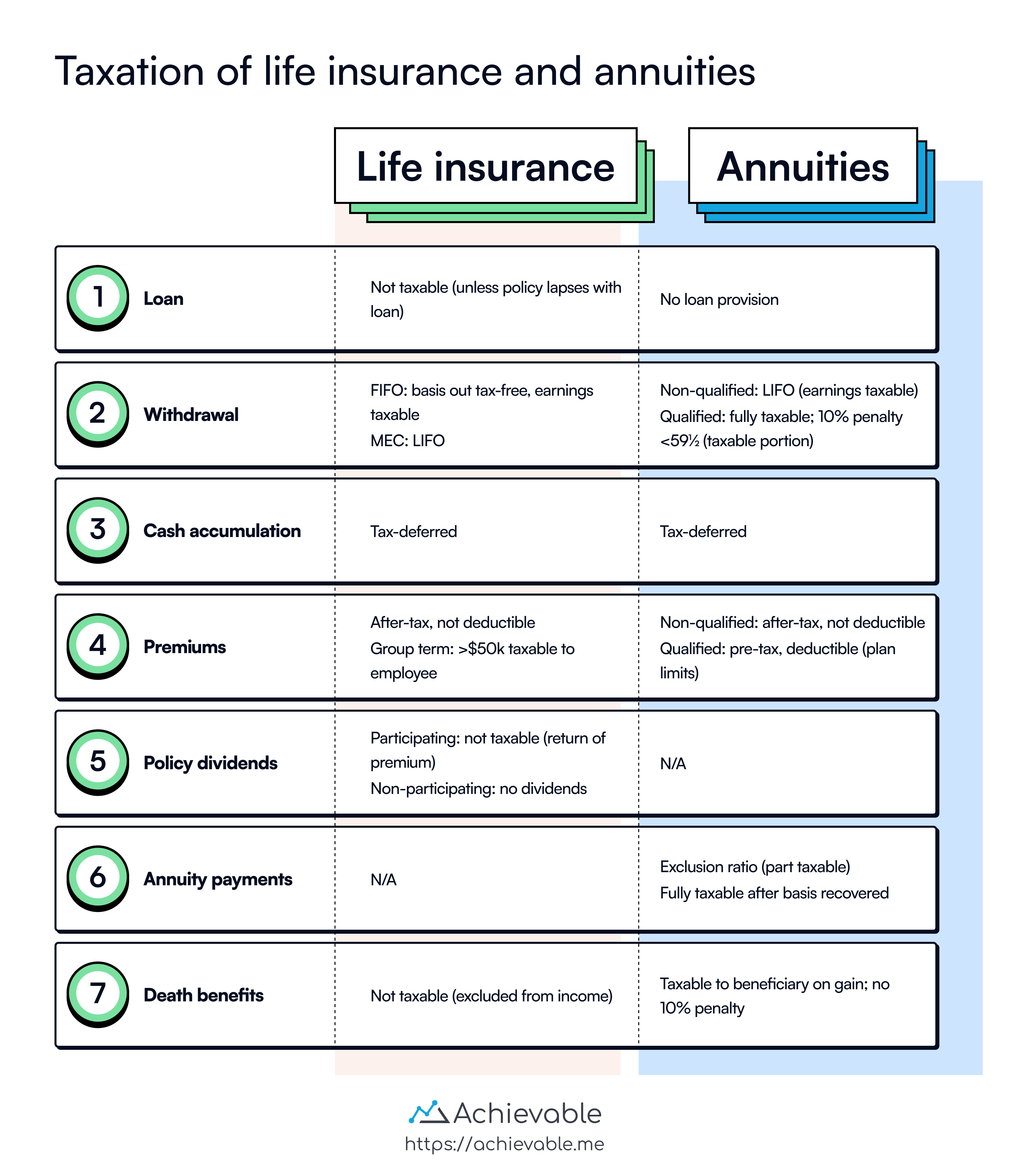
| Tax Treatment | Death benefit is generally income tax-free. | Growth is tax-deferred; withdrawals are taxed as ordinary income (LIFO rules). |
| Underwriting | Requires medical exams and health questionnaires (usually). | Generally requires little to no medical underwriting. |
| Longevity Protection | Does not protect against outliving your assets. | Specifically designed to eliminate the risk of outliving your money. |
Integrating Annuity Riders with Life Insurance
Many modern financial products allow policyholders to blend features through specialized riders—optional contract provisions that customize standard policies for an additional fee.
For instance, an individual might purchase a permanent life insurance policy and attach a long-term care rider or an annuitization rider. If the policyholder requires long-term care or reaches advanced age, the policy structure can redirect cash value or death benefit allocations toward covering living expenses or generating structured income streams. Conversely, some deferred annuities offer a ** guaranteed minimum death benefit (GMDB)**, ensuring that if the owner dies during the accumulation phase, beneficiaries receive at least the original principal amount, regardless of market performance.
Costs, Fees, and Tax Implications
Understanding the fee structure and tax treatment of an annuity life insurance policy or combination strategy is critical to evaluating its long-term financial viability.
Common Fees and Expenses
- Mortality and Expense (M&E) Charges: Fees assessed by insurance companies to cover administrative costs, insurance guarantees, and agent commissions. These are common in variable and indexed annuities.
- Surrender Charges: Penalties levied if you withdraw money or cancel the contract within a specified initial window (often 5 to 10 years after purchase). These charges typically decline incrementally each year.
- Investment Management Fees: Underlying fund management fees associated with variable sub-accounts.
- Rider Fees: Additional costs deducted from the account balance for optional benefits like enhanced death benefits or income guarantees.
Tax Considerations
Annuities benefit from tax-deferred growth, meaning you do not pay annual taxes on interest, dividends, or capital gains within the contract. However, when withdrawals commence, earnings are taxed as ordinary income rather than capital gains. Furthermore, withdrawals follow Last-In, First-Out (LIFO) accounting rules, meaning any money withdrawn is considered taxable earnings first until all gains have been exhausted. Withdrawals taken prior to age 59½ may also incur a 10% IRS early-withdrawal penalty.
Common Mistakes to Avoid
Navigating complex insurance and retirement products opens the door to costly oversights. Keep these common pitfalls in mind:
- Treating Annuities as Short-Term Investments: Because of high surrender charges and tax penalties for early withdrawal, annuities should be viewed as long-term financial commitments.
- Ignoring Inflation Risk: Fixed annuity payments lose purchasing power over time during periods of inflation unless the contract includes a cost-of-living adjustment (COLA) rider.
- Failing to Verify Insurer Financial Strength: Annuity guarantees are only as sound as the insurance company backing them. Always check independent rating agencies like A.M. Best, Moody's, or Standard & Poor's before purchasing.
- Overlooking State Guaranty Association Limits: State guaranty associations provide safety nets if an insurance company fails, but coverage limits vary by state and jurisdiction. Ensure your contract stays within protected thresholds.
Frequently Asked Questions
Can I lose money in an annuity?
Yes, depending on the type of annuity you choose. Variable annuities expose your principal to direct market risk, meaning account values can decrease. Fixed and fixed indexed annuities protect your principal from market downturns, though inflation and high surrender fees can still erode overall purchasing power.
What happens to an annuity when the owner dies?
If you selected a period-certain or joint-life payout option, payments may continue to a designated beneficiary. If you die during the accumulation phase of a deferred annuity, beneficiaries receive the accumulated value or a guaranteed minimum death benefit, subject to ordinary income tax on any earnings.
Are annuity payments subject to income tax?
Yes. While the portion of the withdrawal representing your original principal (cost basis) is tax-free, the earnings portion is taxed as ordinary income. They do not qualify for lower capital gains tax rates.
Can I cash out an annuity early?
You can access your funds, but doing so within the surrender charge period (often the first 5 to 10 years) will trigger steep surrender penalties from the insurance company, in addition to potential IRS taxes and early-withdrawal penalties if you are under age 59½.
Practical Next Steps
Before purchasing any annuity or life insurance product, consult with a fee-only fiduciary financial planner who does not earn commissions on product sales. Request a complete breakdown of all underlying fees, review the financial ratings of the issuing insurance provider, and map the product directly against your long-term retirement income goals and estate planning strategy.