AARP life insurance products, exclusively underwritten by New York Life Insurance Company, provide members with simplified access to term, whole, and guaranteed acceptance life insurance. These policies are designed for adults aged 50 to 80, typically requiring no medical exams and offering fixed premiums to ensure long-term financial predictability for final expenses or legacy planning.
The Partnership Between AARP and New York Life
Since 1994, AARP has partnered with the New York Life Insurance Company to offer life insurance products specifically tailored to the needs of its members. This program is the only life insurance program carries the AARP name and is backed by the financial strength of one of the oldest and most respected insurers in the United States.
As of 2026, New York Life continues to maintain exceptionally high financial strength ratings from major agencies such as A.M. Best (A++) and Standard & Poor’s (AA+). This stability is a critical factor for AARP members who are looking for a carrier that will reliably pay out claims decades into the future. The relationship between the two organizations allows for "simplified underwriting," which means that for many products, a physician’s exam is not required. Instead, eligibility is determined through a series of health questions and a review of medical databases.
For many seniors, the primary appeal of this partnership is the transparency of the products. Because AARP acts as a third-party endorser, the policies are designed to be straightforward, avoiding many of the complex riders and opaque fee structures found in the broader commercial life insurance market.
Exploring AARP Term Life Insurance Products
Term life insurance through AARP and New York Life is designed for those who need coverage for a specific period of time—often to cover a mortgage, support a spouse during retirement years, or provide a safety net while other assets grow.
Coverage and Eligibility
In 2026, AARP Term Life Insurance is generally available to members between the ages of 50 and 74. Spouses of members may also apply if they are between the ages of 45 and 74. Coverage amounts typically range from $10,000 to $100,000, though higher amounts may be available depending on specific state regulations and individual underwriting.
The Five-Year Premium Structure
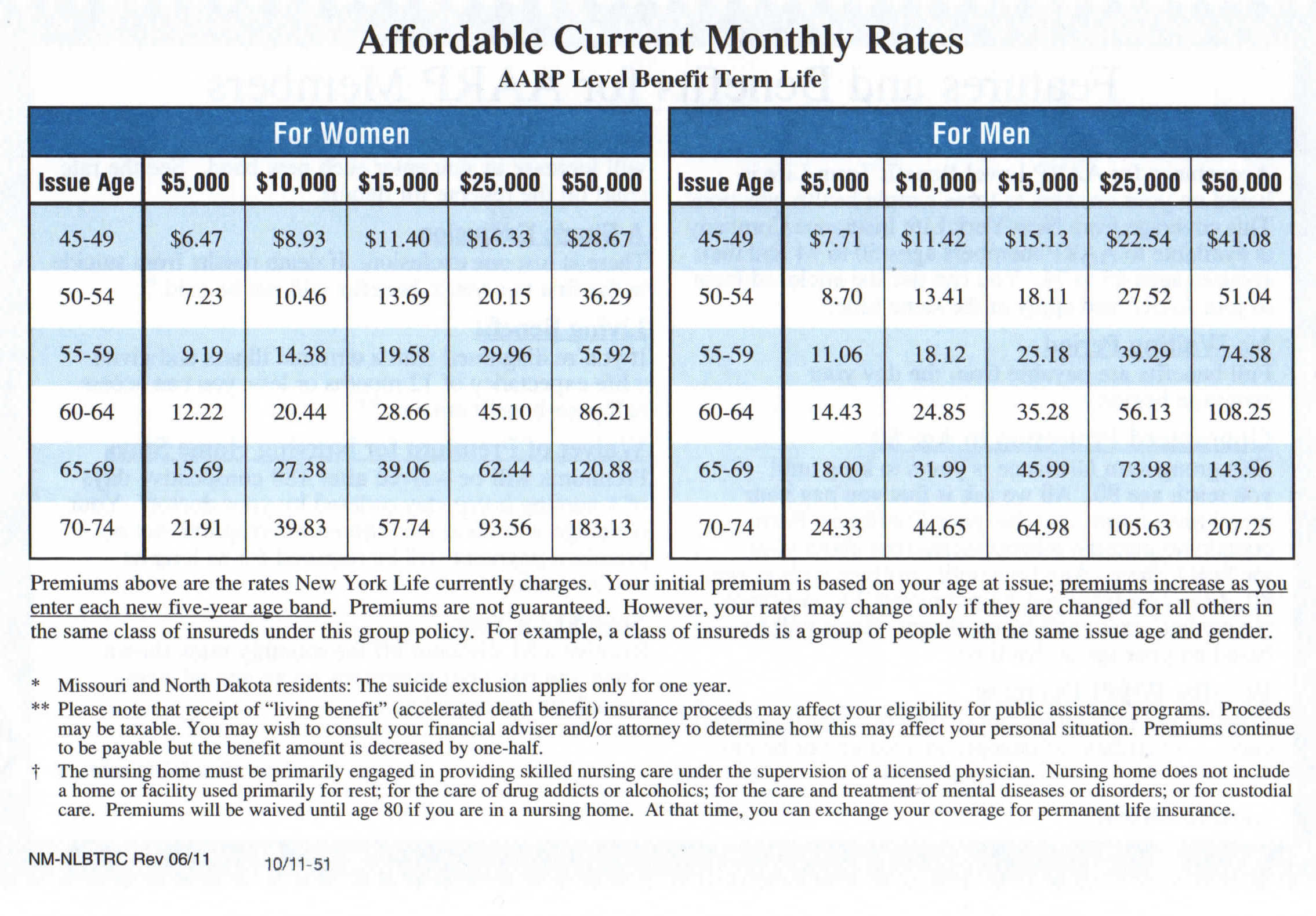
One of the most important technical aspects to understand about the AARP Term Life product is its premium structure. Unlike "level term" policies found elsewhere, which keep the same premium for 10 or 20 years, AARP term premiums are set in five-year age bands. This means that as you enter a new age bracket (e.g., turning 55, 60, or 65), your monthly premium will increase.
Conversion to Permanent Coverage
A significant benefit of the AARP Term Life policy is the right to convert to a permanent life insurance policy. This allows members to maintain coverage even after the term product would normally expire (usually at age 80). Conversion typically does not require a new medical exam, which is a vital safeguard if a member’s health has declined during the term period.
AARP Permanent Life Insurance (Whole Life)
For members who want coverage that never expires and premiums that never increase, AARP Permanent Life Insurance is the cornerstone product. Unlike term insurance, whole life insurance is intended to stay in force for the remainder of the insured's life, provided premiums are paid.
Level Premiums and Death Benefits
The primary advantage of the AARP Permanent Life product is predictability. Once you are accepted, your premium is locked in for life. It will not increase regardless of your age or changes in your health. Similarly, the death benefit—the amount paid to your beneficiaries—is guaranteed and will not decrease.
Cash Value Accumulation
Because this is a whole life product, it builds "cash value" over time. A portion of each premium payment is set aside and grows at a guaranteed rate. In the later years of the policy, members may be able to borrow against this cash value or use it as collateral. However, it is important to note that any outstanding loans at the time of death will be deducted from the total payout to beneficiaries.
Underwriting Requirements
While no medical exam is required, the permanent life product does require applicants to answer several health questions. These questions typically focus on major conditions such as heart disease, cancer, or recent hospitalizations. If an applicant has significant health issues, they may be redirected toward the "Guaranteed Acceptance" product described below.
AARP Guaranteed Acceptance Life Insurance
Recognizing that many seniors face health challenges that might disqualify them from traditional policies, New York Life offers a Guaranteed Acceptance product for AARP members.
No Health Questions or Exams
As the name implies, acceptance is guaranteed for AARP members aged 50 to 80 (and their spouses aged 45 to 80). There are no medical exams and no health questions. If you are an AARP member within the age range, you cannot be turned down for this coverage.
The Graded Death Benefit
The trade-off for guaranteed acceptance is a "graded death benefit" during the first two years of the policy. If the insured dies of natural causes within the first 24 months of the policy being active, the beneficiaries will not receive the full face value. Instead, they will typically receive a refund of all premiums paid plus 10% to 25% interest. If death occurs due to an accident, the full benefit is usually paid from day one. After the two-year waiting period has passed, the full death benefit is payable for any cause of death.
Use Case: Final Expenses
Because coverage amounts for guaranteed acceptance are typically lower—usually capped at $25,000—this product is primarily used for final expenses, such as funeral costs, small outstanding debts, or medical bills. It serves as a safety net for those who have been denied coverage elsewhere.
Comparing AARP Life Insurance Options
Choosing the right product depends on your health status, budget, and how long you need the coverage to last. The following table provides a comparison of the primary products offered through the AARP/New York Life partnership as of 2026.
| Feature | Term Life Insurance | Permanent (Whole) Life | Guaranteed Acceptance |
|---|---|---|---|
| Eligible Ages | 50–74 (Spouses 45–74) | 50–80 (Spouses 45–80) | 50–80 (Spouses 45–80) |
| Max Coverage | Typically up to $100,000+ | Typically up to $50,000 | Typically up to $25,000 |
| Premium Status | Increases every 5 years | Fixed for life | Fixed for life |
| Medical Exam | Not required | Not required | Not required |
| Health Questions | Yes | Yes | No |
| Waiting Period | No (Full benefit day 1) | No (Full benefit day 1) | Yes (2-year graded benefit) |
| Cash Value | No | Yes | Yes |
Pricing and Cost Considerations
When evaluating "aarp life insurance products new york life products," it is essential to look at the cost per thousand dollars of coverage. AARP products are often highly competitive for individuals who want the convenience of an online application without a medical exam. However, for individuals in excellent health who are willing to undergo a full medical underwriting process (including blood work and a physical), it may be possible to find lower rates on the open market.
Factors Influencing Your Premium
- Age: The older you are at the time of application, the higher your starting premium will be.
- Tobacco Use: Tobacco users will pay significantly higher premiums than non-smokers.
- Gender: In most states, premiums are calculated differently for men and women based on actuarial life expectancy.
- State of Residence: Some states have different regulations regarding maximum coverage amounts and premium structures.
Practical Steps to Apply for AARP Life Insurance
The application process is designed to be user-friendly, catering to a demographic that values both digital efficiency and personal service.
- Verification of Membership: You must be an active AARP member to apply. If you are not a member, you can generally join during the insurance application process.
- Requesting a Quote: Use the online portal provided by New York Life for AARP members. You will enter your age, state, and desired coverage amount to see an immediate estimate.
- Answering Health Questions: For the Term and Permanent products, you will answer a series of questions regarding your medical history. Be honest; providing false information can lead to a denial of claims later.
- Beneficiary Designation: You will need the Social Security numbers and contact information for your beneficiaries.
- Review Period: Most policies come with a "30-day free look" period. This means you can review the full policy document and, if you change your mind within 30 days, you can cancel for a full refund of any premiums paid.
Troubleshooting and Managing Your Policy
Once a policy is in place, managing it is handled directly through New York Life’s dedicated AARP service center. Common tasks include:
- Changing Beneficiaries: This can typically be done online or via a paper form. It is recommended to review your beneficiaries every few years or after major life events like a birth or divorce.
- Updating Payment Methods: Most members choose "Automatic Bank Check" to ensure premiums are never missed, which prevents the policy from lapsing.
- Filing a Claim: In the event of the insured's death, beneficiaries should contact New York Life directly. The company is known for a streamlined claims process, often requiring only a death certificate and a completed claim form.
For more information on the stability and historical performance of these products, you can consult the National Association of Insurance Commissioners (NAIC) or review New York Life’s official financial reports.
Frequently Asked Questions
Can I keep my AARP life insurance if I cancel my AARP membership?
Generally, you must be a member to apply for the insurance. However, once the policy is issued, most AARP life insurance products from New York Life allow you to keep the coverage even if you do not renew your AARP membership, though you may lose access to other member-specific discounts or services.
Does AARP life insurance require a physical exam?
No. One of the primary selling points of the AARP program is that none of the core products (Term, Permanent, or Guaranteed Acceptance) require a physical medical exam. Eligibility is determined through health questions and background medical database checks.
What is the maximum amount of coverage I can get?
For most AARP members, the maximum coverage for term insurance is $100,000, and for permanent life, it is $50,000. While these amounts are sufficient for final expenses and modest debt, individuals seeking multi-million dollar policies will likely need to look at New York Life’s traditional (non-AARP) product lines.
How do I know if I should choose Term or Permanent insurance?
If you only need coverage to protect a specific debt (like a 10-year mortgage) or until your children are financially independent, Term is often more affordable. If you want a policy that is guaranteed to pay out for funeral expenses no matter when you pass away, Permanent (Whole Life) is the more appropriate choice.
Is the 2-year waiting period on Guaranteed Acceptance standard?
Yes. Almost all guaranteed acceptance life insurance policies in the industry include a two-year graded death benefit. This protects the insurance company from individuals who may apply for insurance when they are terminally ill, ensuring the risk pool remains stable for all members.
Recommendation for Next Actions
If you are considering AARP life insurance products from New York Life in 2026, your first step should be to conduct a "needs analysis." Calculate your total funeral expenses, outstanding debts, and the income your spouse would need to maintain their standard of living.
Once you have a target coverage number, compare the AARP Term and Permanent quotes. If you are in relatively good health, the Permanent Life policy offers the best long-term value due to its fixed premiums. However, if you are currently on a tight budget and only need coverage for the next decade, the Term product provides a lower entry cost. Always take advantage of the 30-day free-look period to read the fine print before committing to the policy long-term.