Choosing between a 403(b) and a 457(b) plan depends primarily on your employer's offerings and your retirement timeline. While both offer tax-advantaged growth, 403(b) plans often provide better employer matching, whereas 457(b) plans offer a unique advantage: penalty-free withdrawals at any age once you separate from your employer.
If you work in the public sector, for a non-profit, or in a government role, you may find yourself with access to one or both of these retirement vehicles. While they share the same contribution limits and tax-deferred growth characteristics as the more common 401(k), the technical nuances regarding withdrawals, catch-up contributions, and eligibility can significantly impact your long-term wealth. As we navigate the 2026 financial landscape, understanding the implications of the SECURE 2.0 Act and current IRS limits is essential for optimizing your portfolio.
Understanding the 403(b) Plan: The Non-Profit Standard
The 403(b) plan, historically known as a Tax-Sheltered Annuity (TSA) plan, is designed for employees of public schools, certain non-profits, and cooperative hospital service organizations. If you are a teacher, professor, nurse, or minister, this is likely your primary retirement vehicle.
In 2026, the 403(b) continues to mirror the 401(k) in most structural aspects. Contributions are made via payroll deduction, reducing your taxable income for the year. The funds grow tax-deferred until withdrawal, at which point they are taxed as ordinary income. Many employers also offer a Roth 403(b) option, allowing for after-tax contributions that provide tax-free income in retirement—a strategy that has become increasingly popular as taxpayers hedge against future tax rate hikes.
One of the most significant advantages of the 403(b) is the prevalence of employer matching. Because these plans are often governed by the Employee Retirement Income Security Act (ERISA), employers frequently use them as a primary recruitment and retention tool, offering to match a percentage of the employee’s contributions. This "free money" is a powerful accelerator for compound interest. However, 403(b) plans are subject to the 10% early withdrawal penalty if funds are accessed before age 59½, unless a specific exception (like the Rule of 55) applies.
Understanding the 457(b) Plan: The Public Sector Advantage
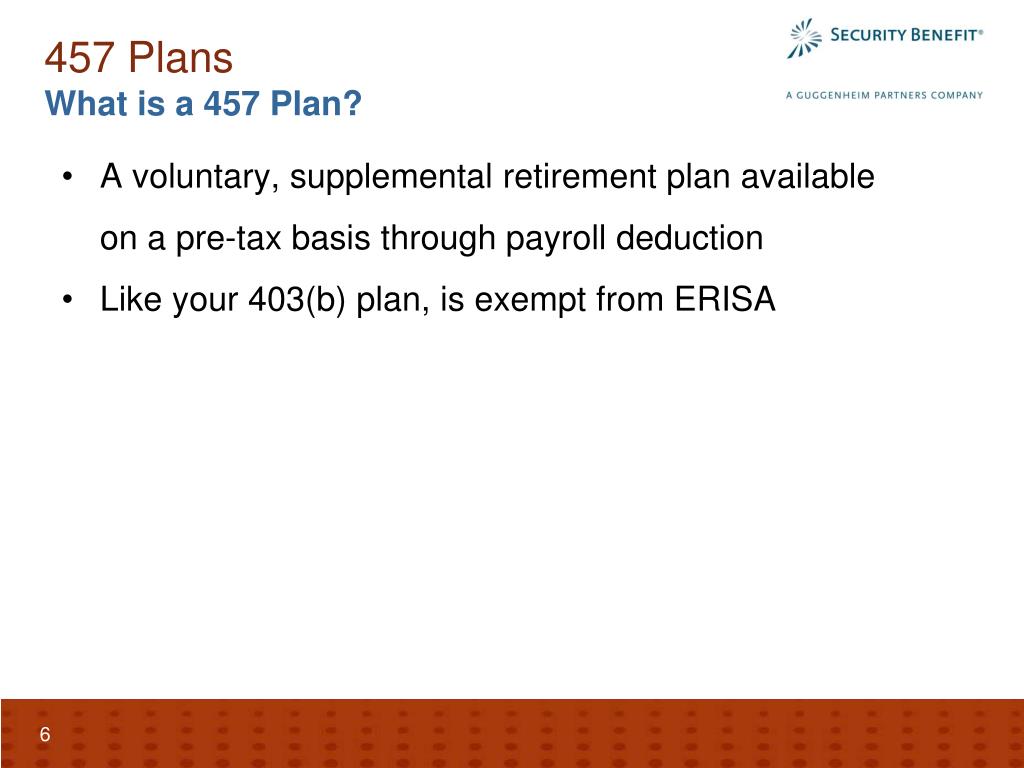
The 457(b) plan is a non-qualified, tax-advantaged deferred compensation plan. It is available to state and local government employees, as well as certain highly compensated employees at non-profit organizations (often referred to as "Top Hat" plans).
The defining characteristic of a governmental 457(b) plan—and the reason many financial advisors prefer it over a 403(b)—is the absence of a 10% early withdrawal penalty. While you still owe ordinary income tax on the distributions, you can access your funds as soon as you leave your employer, regardless of your age. This makes the 457(b) an ideal tool for "early retirees" or public safety officers who may retire in their 40s or 50s.
It is important to distinguish between Governmental 457(b) plans and Non-Governmental 457(b) plans. Governmental plans are held in a trust for the benefit of employees, offering high levels of security. In contrast, non-governmental 457(b) plans remain the property of the employer and are subject to the claims of the employer’s creditors. Furthermore, non-governmental 457(b) funds generally cannot be rolled over into an IRA; they must stay within the 457 system or be taken as a lump sum upon separation.
2026 Contribution Limits and the Power of "Double Dipping"
For the 2026 tax year, the IRS has adjusted contribution limits to account for inflation. Understanding these caps is vital for high earners looking to maximize their tax shelters.
- Standard Elective Deferral: The limit for 2026 is $24,000. This applies to both 403(b) and 457(b) plans.
- Catch-Up Contributions (Age 50+): Individuals aged 50 and older can contribute an additional $7,500, bringing their total to $31,500.
- SECURE 2.0 Special Catch-Up (Ages 60-63): Under the SECURE 2.0 Act, employees aged 60 to 63 in 2026 can contribute a higher catch-up amount—the greater of $10,000 or 150% of the standard catch-up limit. For 2026, this effectively allows a total contribution of approximately $35,250 for this specific age bracket.
The Double Contribution Strategy
Perhaps the most potent strategy available to those who have access to both a 403(b) and a governmental 457(b) is the ability to contribute the maximum to both plans simultaneously. Unlike the 401(k) and 403(b), which share a single contribution limit, the 457(b) limit is independent.
In 2026, a government employee under age 50 could theoretically shield $48,000 of income from taxes ($24k in the 403b + $24k in the 457b). For those over 50 or in the 60-63 "super catch-up" window, the combined total can exceed $70,000. This is a massive advantage for dual-career households or high-income educators and administrators.
Comparing Catch-Up Provisions: 15-Year Rule vs. 3-Year Rule
Beyond the standard age-50 catch-up, both plans offer unique "special" catch-up provisions that are often overlooked.
The 403(b) 15-Year Rule
If you have worked for the same qualified organization (such as a public school system or hospital) for at least 15 years, you may be eligible to contribute an additional $3,000 per year, up to a lifetime maximum of $15,000. This is known as the "Special 403(b) Catch-up." This can be used in addition to the age-50 catch-up, though the math can become complex. Many school districts are phasing this out in favor of simpler SECURE 2.0 provisions, so it is critical to verify with your plan administrator.
The 457(b) Three-Year Special Catch-Up
The 457(b) offers a much more aggressive catch-up for those nearing retirement. In the three years prior to the year you reach the plan's "normal retirement age," you can contribute up to twice the annual limit ($48,000 in 2026), provided you have "under-used" your contribution limits in previous years of employment. You cannot use both the age-50 catch-up and the three-year special catch-up in the same year; you must use whichever is greater.
Direct Comparison: 403(b) vs. 457(b)
| Feature | 403(b) Plan | 457(b) Plan (Governmental) |
|---|---|---|
| Primary Eligibility | Schools, non-profits, ministers | Gov. employees, certain non-profits |
| 2026 Contribution Limit | $24,000 | $24,000 |
| Employer Match | Very common | Less common |
| Early Withdrawal Penalty | 10% penalty before age 59.5 | No penalty after separation |
| Age 50+ Catch-up | Yes ($7,500) | Yes ($7,500) |
| Special Catch-up | 15-year service rule ($3k/yr) | 3-year pre-retirement rule (up to 2x limit) |
| Rollover Options | IRA, 401k, 403b, 457b | IRA, 401k, 403b, 457b |
| ERISA Protection | Often yes (if private non-profit) | No (government plans are exempt) |
Withdrawal Rules and the Penalty Gap
The primary reason many investors choose the 457(b) as their secondary or even primary vehicle is the flexibility of the distribution rules. In a 403(b) or 401(k), if you retire at age 52, you generally cannot touch your money without paying a 10% penalty to the IRS until you hit 59½. There is a "Rule of 55" that allows penalty-free access if you leave your job in or after the year you turn 55, but this is still restrictive.
The 457(b) operates on a "separation from service" trigger. If you resign, retire, or are terminated at age 45, you can begin taking distributions immediately. You will pay income tax on those distributions, but you avoid the 10% penalty. This makes the 457(b) an essential tool for police officers, firefighters, and other public servants who often have early pension eligibility but need a bridge to Social Security or Medicare age.
However, be aware of the "First Day of the Month" rule for 457(b) plans. Many 457 plans require that any change in your contribution amount (including stopping or starting) must be requested in the month prior to the month the change takes effect. This lack of administrative "real-time" flexibility is a relic of older tax codes but remains a common technical hurdle.
Investment Options, Fees, and ERISA
The quality of your retirement plan often depends on its underlying investment menu and fee structure.
403(b) plans have a checkered history regarding fees. Because they were originally built around annuities, many older plans are riddled with high-commission insurance products, surrender charges, and administrative layers. However, the 403(b) landscape has improved significantly. Many modern plans offer low-cost institutional shares of index funds from providers like Vanguard, Fidelity, or TIAA.
457(b) plans are typically curated by state or local deferred compensation boards. Because these boards aggregate thousands of employees, they often have significant bargaining power to negotiate low administrative fees. However, because governmental 457(b) plans are not subject to ERISA (the federal law that sets minimum standards for most voluntarily established retirement and health plans in private industry), they lack some of the federal fiduciary protections that private-sector 403(b) plans provide.
Which Plan Fits You? Decision Framework for 2026
If your employer offers both, how do you decide where to put your first dollar?
- Follow the Match: If your employer offers a match on the 403(b) but not the 457(b), prioritize the 403(b) up to the matching limit. This is an immediate 100% return on your investment that no market gain can beat.
- Assess Your Retirement Age: If you plan to retire before age 55, the 457(b) is your best friend. The ability to access funds without a penalty is a massive strategic advantage.
- Evaluate Fees: Compare the Expense Ratios and "Asset-Based Fees" of both plans. If the 403(b) is filled with high-cost annuities but the 457(b) offers a 0.05% S&P 500 index fund, the 457(b) is the clear winner for long-term growth.
- Maximize Both: If you have a high household income and are behind on retirement savings, contribute the maximum to both. This is one of the few "loopholes" in the tax code that allows for nearly $50,000 in individual tax-deferred savings.
SECURE 2.0 and the 2026 Mandates
As of 2026, several provisions of the SECURE 2.0 Act are in full effect. One of the most critical is the "Roth Catch-up" requirement. For high earners (those earning over $145,000 in the previous year, though this threshold is inflation-adjusted for 2026), any catch-up contributions made to a 403(b) or 457(b) must be made on a Roth (after-tax) basis.
This change prevents high earners from getting a current-year tax break on their catch-up contributions, but it forces the creation of a tax-free bucket of money for retirement. If your employer has not yet updated their plan to allow Roth contributions, you may be temporarily barred from making catch-up contributions until they do. Ensure you check your plan's 2026 summary of material modifications to see how this affects your strategy.
For more information on current contribution limits and tax regulations, you can visit the IRS Retirement Plans page. To learn more about the differences between ERISA and non-ERISA plans, the Department of Labor (DOL) provides extensive resources.
FAQ
Can I roll over a 457(b) into a 403(b) or IRA?
Yes, if it is a governmental 457(b), you can roll it over into an IRA, 401(k), or 403(b) once you leave your job. However, once you roll 457(b) funds into an IRA or 403(b), they become subject to the 10% early withdrawal penalty rules of the new account. If you want to keep the penalty-free withdrawal benefit, you should keep the funds in the 457(b) or roll them into another governmental 457(b) plan.
What happens to my 457(b) if my employer goes bankrupt?
If you have a governmental 457(b), your money is held in a trust and is safe from creditors. If you have a non-governmental (private non-profit) 457(b), the assets are technically the property of the employer. In the event of bankruptcy, those funds could be used to pay the employer's creditors. This is why private non-profit 457(b) plans are generally only recommended for executives who understand the risk.
Can I use the 403(b) 15-year catch-up and the 457(b) catch-up at the same time?
Yes. Because the 403(b) and 457(b) have independent contribution limits, you can maximize the elective deferrals and the specific catch-up provisions for each plan simultaneously. This is a primary reason why public sector employees can often accumulate significant wealth faster than their private-sector counterparts.
Are 403(b) and 457(b) plans subject to Required Minimum Distributions (RMDs)?
Yes. Both plans are subject to RMD rules. Under SECURE 2.0, the RMD age has been pushed back. For those reaching age 72 after 2022, the age is 73. Starting in 2033, the age increases to 75. In 2026, most retirees will be looking at an RMD age of 73. Note that Roth accounts within these plans are no longer subject to RMDs during the owner's lifetime as of 2024.
Which plan is better for a teacher?
Most teachers should prioritize the 403(b) if there is an employer match. However, many school districts offer "403(b) 7" accounts, which are mutual fund-based and often cheaper than the traditional annuity-based 403(b). If the 403(b) options are poor, the 457(b) is often a superior alternative due to lower fees and withdrawal flexibility.
Final Recommendation
For most employees, the 403(b) is the better starting point due to the likelihood of an employer match. However, the 457(b) is the superior strategic tool for those planning an early retirement or those who have already maximized their other tax-advantaged accounts. In 2026, the ideal path is to utilize both: secure the full employer match in your 403(b), then shift additional savings to the 457(b) to take advantage of the penalty-free withdrawal feature. Always review your plan’s specific fee disclosure document (404a-5) to ensure you aren't losing your gains to excessive administrative costs.