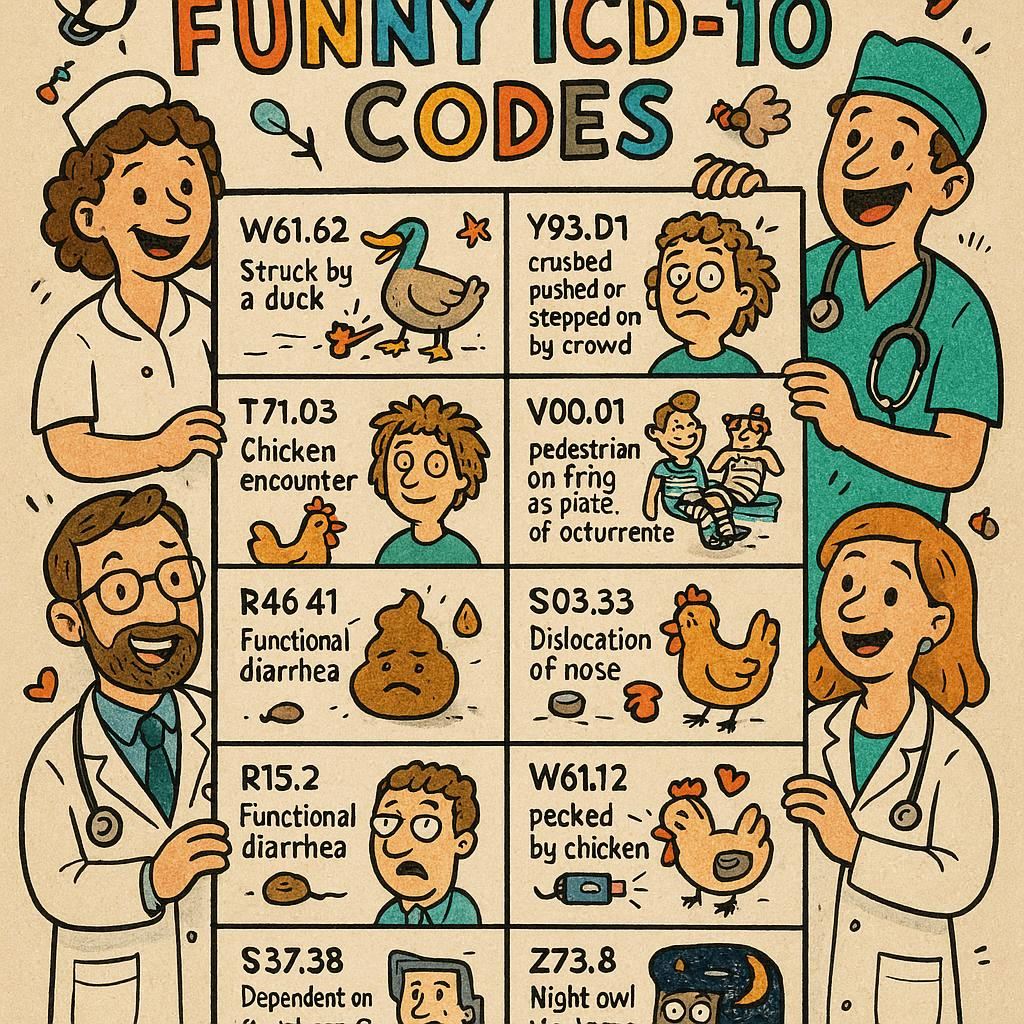
Medical coding is a precise, high-stakes profession that demands absolute accuracy and strict adherence to standardized clinical terminology. However, amid the thousands of codes used to document injuries, illnesses, and external causes, certain entries stand out for their uncanny, almost comedic specificity. One such code that frequently finds itself the subject of water-cooler humor among healthcare professionals is W61.01XD: Bitten by parrot, subsequent encounter.
While medical coders are trained to remain professional and objective, the sheer absurdity of needing a distinct, internationally recognized billing code for a parrot-related injury serves as a lighthearted reminder of the complexity—and occasional quirkiness—of the International Classification of Diseases, 10th Revision (ICD-10).
The Reality of ICD-10 Complexity
To understand why a code like "bitten by parrot" exists, one must first appreciate the scale of the ICD-10 system. Managed by the World Health Organization (WHO) and adapted for clinical use in the United States by the Centers for Medicare & Medicaid Services (CMS) and the National Center for Health Statistics (NCHS), the ICD-10-CM (Clinical Modification) contains over 70,000 unique codes.
This exhaustive catalog is designed to capture every conceivable medical scenario, from routine checkups to the most bizarre accidental injuries. The goal is not to judge the circumstances of an injury, but to provide data that can be used for epidemiology, resource allocation, and research. When a patient arrives at a facility with a finger wounded by a pet bird, the coder cannot simply select "animal bite." The system requires specific parameters regarding the creature involved and the stage of the treatment.
Decoding W61.01XD: Breaking Down the Anatomy
The humor associated with W61.01XD often stems from the granular nature of the code, which tells a complete story in just a few characters. To a coder, the code is a logical sequence of identifiers, but to the uninitiated, it reads like a punchline.
- W61.0: This is the base category, identifying an encounter with a parrot.
- 1: This specific digit narrows the incident down to a "bite." If the patient had been pecked, the code would be W61.02.
- X: This is a placeholder character used to maintain the integrity of the code structure in the ICD-10 system, ensuring that future expansions remain organized.
- D: This is the most crucial part for the medical record, signifying a "subsequent encounter." This informs the insurer that the patient is not in the emergency room for the initial trauma, but is returning for follow-up care—perhaps to change a bandage or monitor for infection.
The necessity of the "subsequent encounter" tag is where the humor truly shines. It implies that a patient had a primary consultation for a parrot bite, went home, and was required to return to the doctor—all because of the same avian interaction.
Why Specificity Matters in Healthcare Data
While it is easy to chuckle at the thought of a parrot-related medical billing trail, the existence of such codes is vital to the healthcare ecosystem. Public health officials track these codes to identify trends. If there were a sudden, statistically significant surge in W61.01XD reports in a specific geographic region, researchers might investigate whether an exotic bird trade issue or an increase in bird-ownership trends is contributing to public health risks.
Furthermore, medical coding serves as the language of reimbursement. Without a specific code, the billing process for an insurance claim could be rejected or delayed. By providing a code for a parrot bite, the system ensures that the provider is appropriately compensated for the time and resources spent treating that specific injury, regardless of how unusual the cause may be.
A Comparative Look at Other "Unusual" Codes
Parrot bites are by no means the only entries in the ICD-10 database that raise eyebrows. The system is replete with codes that capture the fascinating, often chaotic nature of human existence. When coders compare notes, they often point to these "amusing" entries to highlight the extreme lengths the system goes to maintain diagnostic precision.
| ICD-10 Code | Description | Context for Use |
|---|---|---|
| W61.01 | Bitten by parrot | Used for initial trauma involving parrot teeth or beaks. |
| V91.07 | Burn due to water-skis on fire | Used when recreational water equipment catches fire. |
| W56.22 | Struck by orca | Used for injuries sustained during close contact with orcas. |
| Y92.146 | Swimming pool of prison as place of occurrence | Used for legal and administrative tracking of injuries. |
| W61.12 | Struck by macaw | Distinct from a parrot bite, acknowledging the physical impact. |
These examples demonstrate that the ICD-10 system acts as a massive digital diary of humanity's mishaps. Whether it is a prison swimming pool or a vengeful macaw, the system requires an accounting for every detail.
The Professional Life of a Medical Coder
For those working in the field, codes like W61.01XD offer a brief moment of levity in a day otherwise filled with repetitive, complex tasks. A coder’s primary objective is to translate clinical documentation into a language that insurance companies can process. This involves reading physician notes, identifying the primary diagnosis, and selecting the most accurate code that reflects the patient’s condition.
The high-pressure nature of this work—often involving tight deadlines and strict compliance audits—means that discovering an eccentric code serves as a minor morale booster. It reinforces the idea that medicine is not just about chronic disease management; it is about documenting the wild, unpredictable, and sometimes hilarious things that happen to people every day.
Challenges of Navigating the ICD-10 Manual
The primary challenge for any medical coder is the sheer volume of information. Navigating the manual requires an expert understanding of anatomy, pathology, and the hierarchical nature of the ICD-10 structure. Mistakes can lead to claim denials, which in turn affect the financial health of the medical practice.
When a coder encounters a scenario involving a parrot, they must be careful. If they code it as an "unspecified bird" instead of a "parrot," they might be failing to capture the level of detail requested by the insurance provider's specific coverage guidelines. Thus, the absurdity of the code is secondary to the technical skill required to apply it correctly. A coder who laughs at the code is the same coder who knows exactly which digit to change to differentiate between a bite, a peck, or a scratch.
Ensuring Accuracy in Unusual Circumstances
How does a coder determine when to use these niche codes? It all comes down to the quality of the clinician's notes. If a doctor writes "patient sustained hand injury from a household pet," the coder has to query the doctor for more information. Does "household pet" mean a dog, a cat, or a parrot?
In 2026, many healthcare facilities are utilizing advanced computer-assisted coding (CAC) software. These tools are designed to suggest the most likely codes based on keywords within the electronic health record (EHR). Even with such technology, the human coder remains the final gatekeeper. The software might suggest a code, but the coder must verify that it matches the narrative of the medical event, ensuring that the "parrot bite" is not actually a misunderstanding of a different type of incident.
Addressing Common Misconceptions About Coding
There is a common misconception among the general public that medical coding is purely automated or that it does not require significant human oversight. Many believe that if a patient tells the doctor they were bitten by a parrot, the computer automatically spits out the correct billing code.
In reality, the translation from a patient’s story to a medical code is a nuanced process. Coders must interpret the context, check for comorbidities, and ensure that the diagnosis code aligns with the procedure code. For instance, if a patient is bitten by a parrot, they may also require a tetanus shot. A coder must ensure that the treatment (the vaccine) is medically necessary and supported by the diagnosis (the bite). The "hilarious" code is merely one piece of a much larger, highly orchestrated financial and clinical puzzle.
FAQ: Common Questions Regarding ICD-10 Coding
1. Is it common to have such specific codes for animal interactions? Yes, the ICD-10 system is designed to be highly specific. Because external cause codes are used for public health research, having a clear distinction between a parrot bite, a dog bite, or a stingray encounter allows agencies to compile accurate data on how different animals affect human health.
2. Does a code like W61.01XD increase the cost of insurance? No. The code itself does not influence premiums. It is simply a way to identify the source of the injury for billing and tracking purposes. The cost is determined by the treatment provided, not by the identity of the animal involved.
3. Do coders actually memorize these codes? It is impossible to memorize all 70,000+ codes. Experienced coders become very familiar with the common categories and learn how to navigate the code books or search the digital databases efficiently. They memorize the rules of coding, not every individual alphanumeric string.
4. What happens if a coder uses the wrong code for a parrot bite? If a coder uses an inaccurate code, it may lead to an insurance claim denial, resulting in administrative delays for the medical facility. If the error is consistent across many claims, it could lead to an audit by insurance companies or federal regulators.
5. How often are these codes updated? The ICD-10-CM is updated annually to include new medical findings, technologies, and classifications. While the "parrot bite" code is well-established, new codes are added every October to account for emerging medical needs and changes in how we describe injuries and illnesses.
Next Steps for Aspiring Coders
For those interested in the intricacies of the ICD-10 system, the path to becoming a professional coder involves obtaining certifications such as the Certified Professional Coder (CPC) credential through the AAPC (formerly the American Academy of Professional Coders). These programs emphasize the importance of accuracy and detail, teaching students that while the profession has its share of "hilarious" moments, the integrity of the data is the highest priority.
If you find yourself fascinated by the categorization of human experience—from the mundane to the bizarre—a career in medical coding offers a unique window into the world of healthcare. It is a profession where you contribute to the backbone of medical research and hospital finance, all while keeping an eye out for the next entry that proves truth is stranger, and often funnier, than fiction.