Installment loans in Canada are worth it if you need to borrow a specific amount for a necessary expense and can secure an interest rate significantly lower than that of a payday loan or a high-interest credit card. They provide predictable monthly payments and the opportunity to build credit history through consistent reporting.
An installment loan is a foundational financial product where you borrow a lump sum of money and pay it back over a fixed period through scheduled payments, or "installments." In the Canadian landscape of 2026, these loans have become a primary alternative to both traditional bank personal loans and high-cost predatory lending. However, determining their "worth" requires a deep dive into the cost of capital, your specific credit profile, and the regulatory environment that governs Canadian lenders.
Understanding the Mechanics of Installment Loans
To judge the value of an installment loan, one must first understand how it differs from other forms of credit. Unlike a credit card, which is revolving credit, an installment loan has a defined end date. Once the final payment is made, the account is closed.
In Canada, these loans typically range from $500 to $50,000, with terms spanning six months to five years. The interest is usually calculated as an Annual Percentage Rate (APR), which includes both the interest rate and any mandatory fees. Because the payments are fixed, you are protected from the "minimum payment trap" common with credit cards, where interest charges can keep you in debt for decades if you only pay the bare minimum.
The Impact of Amortization
Amortization is the process of spreading out loan payments over time. In the early stages of an installment loan, a larger portion of your payment goes toward interest. As the balance decreases, more of your payment is applied to the principal. Understanding this schedule is vital. If you plan to pay off the loan early, you should ensure your lender does not charge "prepayment penalties," which are increasingly regulated but still exist in some subprime contracts.
The 2026 Regulatory Landscape in Canada
As of 2026, the Canadian lending market operates under stricter federal guidelines than in previous decades. A significant shift occurred when the federal government moved to lower the maximum allowable interest rate under the Criminal Code of Canada.
Previously, the legal limit was an effective annual rate of 60%. In recent years, the push toward a maximum APR of 35% has reshaped the "worth" of installment loans for many Canadians. This change was designed to protect vulnerable borrowers from the debt cycles associated with high-interest subprime lending. When evaluating a loan today, if the APR exceeds 35%, it is a significant red flag, as it likely falls outside the modernized federal standards for mainstream consumer credit.
Furthermore, provinces like Ontario, British Columbia, and Quebec have their own consumer protection acts that mandate clear disclosure of the total cost of borrowing. This transparency makes it easier for consumers to perform a "worth" analysis by looking at the total dollars paid over the life of the loan versus the immediate utility of the cash.
When an Installment Loan is "Worth It"
Deciding to take on debt is a strategic choice. There are specific scenarios where an installment loan is not just a tool of convenience, but a smart financial move.
1. Debt Consolidation
If you are carrying balances on multiple credit cards with interest rates hovering around 19.99% to 29.99%, an installment loan at 12% to 15% is objectively worth it. By consolidating these debts, you reduce the total interest paid and simplify your finances into a single monthly payment. This "interest rate arbitrage" is one of the most effective uses of installment credit.
2. Credit Score Rehabilitation
For Canadians with thin credit files or recovering scores, an installment loan from a lender that reports to Equifax and TransUnion can be a powerful tool. Credit mix accounts for 10% of your FICO score. Transitioning from only having credit cards to having a mix of revolving and installment credit can boost your score, provided every payment is made on time.
3. Essential Large Purchases
When an emergency arises—such as a major car repair or a home furnace failure—and your emergency fund is insufficient, an installment loan is a safer alternative than a payday loan. Payday loans often carry effective APRs of 300% to 500%, whereas even a high-interest installment loan is capped significantly lower.
The Risks and Hidden Costs
The "worth" of a loan is quickly eroded if you fall into common traps. In 2026, while transparency has improved, borrowers must still be vigilant regarding several factors.
- Origination Fees: Some lenders charge a fee upfront to process the loan, often ranging from 1% to 5% of the loan amount. This fee is usually deducted from the proceeds, meaning if you borrow $10,000, you might only receive $9,500.
- Optional Insurance: Lenders frequently push "loan protection insurance" (life, disability, or unemployment coverage). In most cases, these products are expensive and provide limited value compared to independent term life insurance.
- The Refinancing Trap: Some alternative lenders will contact you once you have paid off 50% of your loan, offering to "top it up" to the original amount. This resets the amortization clock and keeps you in a perpetual state of debt, significantly increasing the total interest you pay.
Comparing Loan Types in the Canadian Market
To visualize where installment loans sit in the hierarchy of Canadian credit, consider the following comparison based on 2026 market averages:
| Feature | Bank Personal Loan | Online Installment Loan | Credit Card Cash Advance | Payday Loan |
|---|---|---|---|---|
| Typical APR | 7% – 12% | 15% – 35% | 22% – 29% | 300% – 500%+ |
| Credit Requirement | Good to Excellent | Fair to Good | Existing Card Limit | No Credit Check |
| Approval Speed | 2 – 7 Business Days | 24 – 48 Hours | Instant | Instant |
| Repayment Term | 1 – 5 Years | 6 Months – 5 Years | Variable | 14 – 62 Days |
| Max Amount | $50,000+ | Up to $15,000 | Card Limit | $1,500 |
How to Verify a Legitimate Lender
In Canada, the Financial Consumer Agency of Canada (FCAC) provides resources to help citizens understand their rights. A loan is only "worth it" if the lender is a legitimate, regulated entity.
- Check Provincial Licensing: Every province requires non-bank lenders to be licensed. You can usually find a list of licensed lenders on the website of your provincial consumer protection bureau (e.g., Consumer Protection BC or Ontario’s Ministry of Public and Business Service Delivery).
- Physical Address and Contact: Legitimate lenders have a verifiable Canadian physical address and a customer service line. Be wary of lenders that only operate via WhatsApp or untraceable email addresses.
- No Upfront Fees: It is illegal in Canada for a lender to ask for "insurance" or "collateral" payments before the loan is funded. Any request for money upfront is a hallmark of a loan scam.
Expert Strategies for Managing an Installment Loan
If you decide an installment loan is right for you, following a disciplined approach will maximize its value.
Automate Your Payments: Set up a Pre-Authorized Debit (PAD) from your bank account to coincide with your payday. This ensures you never miss a payment, avoiding late fees and protecting your credit score.
Check for Prepayment Options: Aim for a "flexible" loan. If you receive a tax refund or a work bonus, applying that extra cash directly to the principal of your installment loan can save you hundreds of dollars in interest and shorten the life of the loan significantly.
Avoid Over-Borrowing: Just because a lender approves you for $10,000 doesn't mean you should take it. Calculate exactly what you need for your specific purpose. Borrowing extra "just in case" results in paying interest on money that is likely sitting idle in your chequing account.
Alternatives to Consider Before Applying
Before committing to an installment loan, evaluate these potentially cheaper alternatives:
- Line of Credit (LOC): If you have a decent credit score, a personal line of credit often offers a lower interest rate than a fixed installment loan and provides more flexibility.
- Credit Counseling: If you are seeking an installment loan because you are overwhelmed by debt, a non-profit credit counselor (such as those through Credit Counselling Canada) might help you set up a Debt Management Plan (DMP) which could lower your interest rates to near zero.
- Employer Advances: Some Canadian companies now offer "earned wage access" programs that allow you to tap into money you’ve already earned before payday for a nominal fee, which is significantly cheaper than any loan.
Frequently Asked Questions
Does an installment loan hurt my credit score?
Initially, you may see a small dip in your credit score due to the "hard inquiry" performed by the lender. However, in the long term, an installment loan can significantly improve your score as you build a history of on-time payments and diversify your credit mix.
Can I get an installment loan with bad credit in Canada?
Yes, many alternative lenders specialize in "subprime" installment loans for those with poor credit. While these are easier to qualify for, they carry the highest legal interest rates (near 35% APR). You should only consider these if the loan solves a critical financial problem and you have a guaranteed way to make the payments.
Is it better to use a credit card or an installment loan?
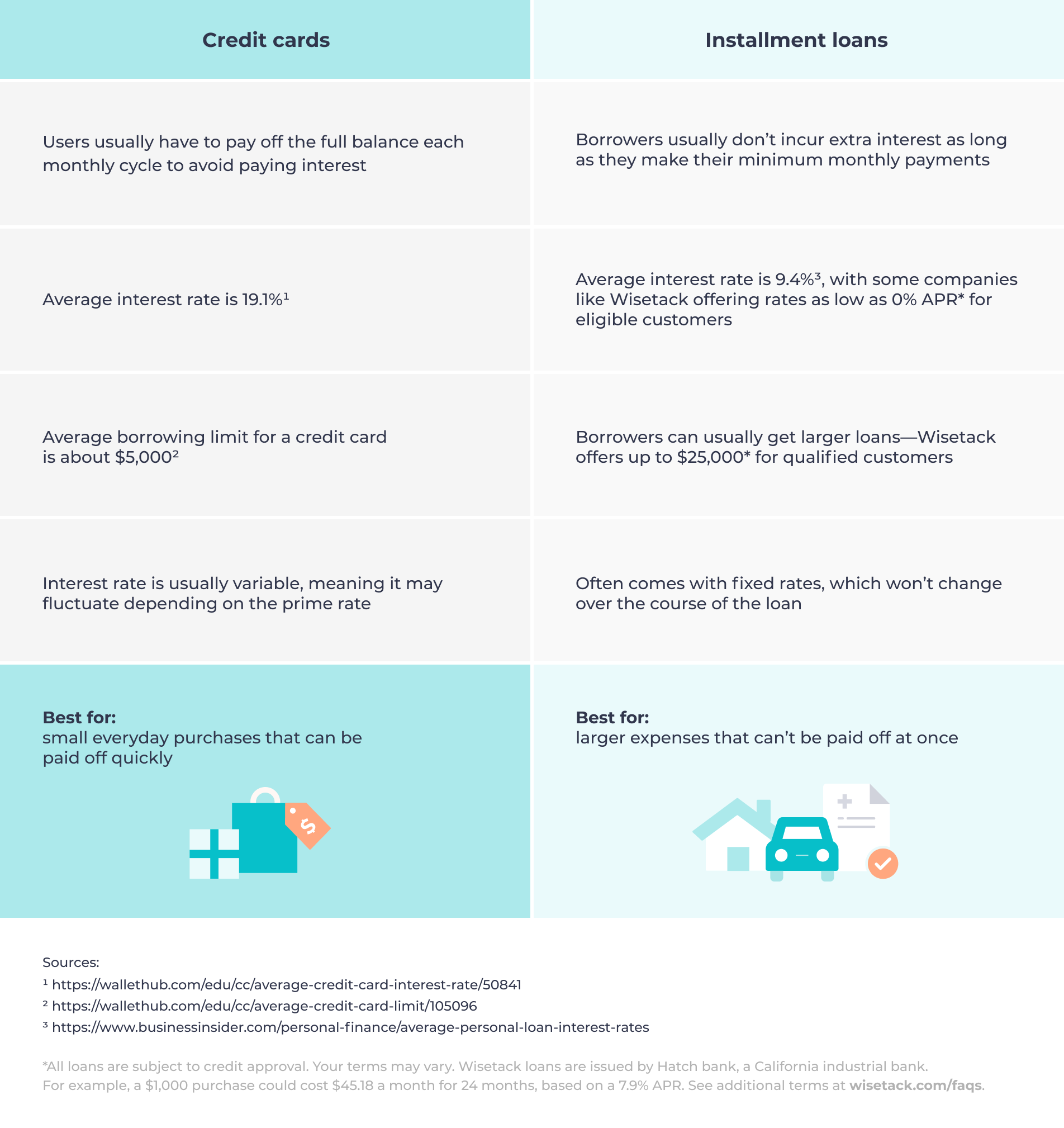
For small purchases that you can pay off within 30 days, a credit card is better because you pay zero interest. For large expenses that will take more than three months to repay, an installment loan is usually better because the interest rate is lower and the fixed payment structure ensures the debt is actually cleared.
What happens if I can't make a payment?
In Canada, missing a payment on an installment loan will result in a "non-sufficient funds" (NSF) fee from your bank and a late fee from the lender. More importantly, it will be reported to the credit bureaus as a missed payment, which can damage your credit score for up to six years. If you struggle, contact the lender immediately; many offer "hardship programs" to temporarily adjust your payment schedule.
Are online lenders safe?
Most online lenders in Canada are legitimate and highly regulated. However, you must perform due diligence. Ensure the website uses "https," check for a Canadian physical address, and look for reviews on independent platforms like the Better Business Bureau (BBB) or Trustpilot.
Final Recommendation
An installment loan in Canada is worth it when it serves as a bridge to a better financial position—whether that is by consolidating high-interest debt, repairing an essential asset, or building a credit profile. It is not worth it for discretionary spending, luxury purchases, or when the interest rate exceeds 35% APR. Before signing any contract in 2026, compare the total cost of borrowing across at least three different lenders and ensure the monthly payment fits comfortably within your existing budget without relying on future windfalls.