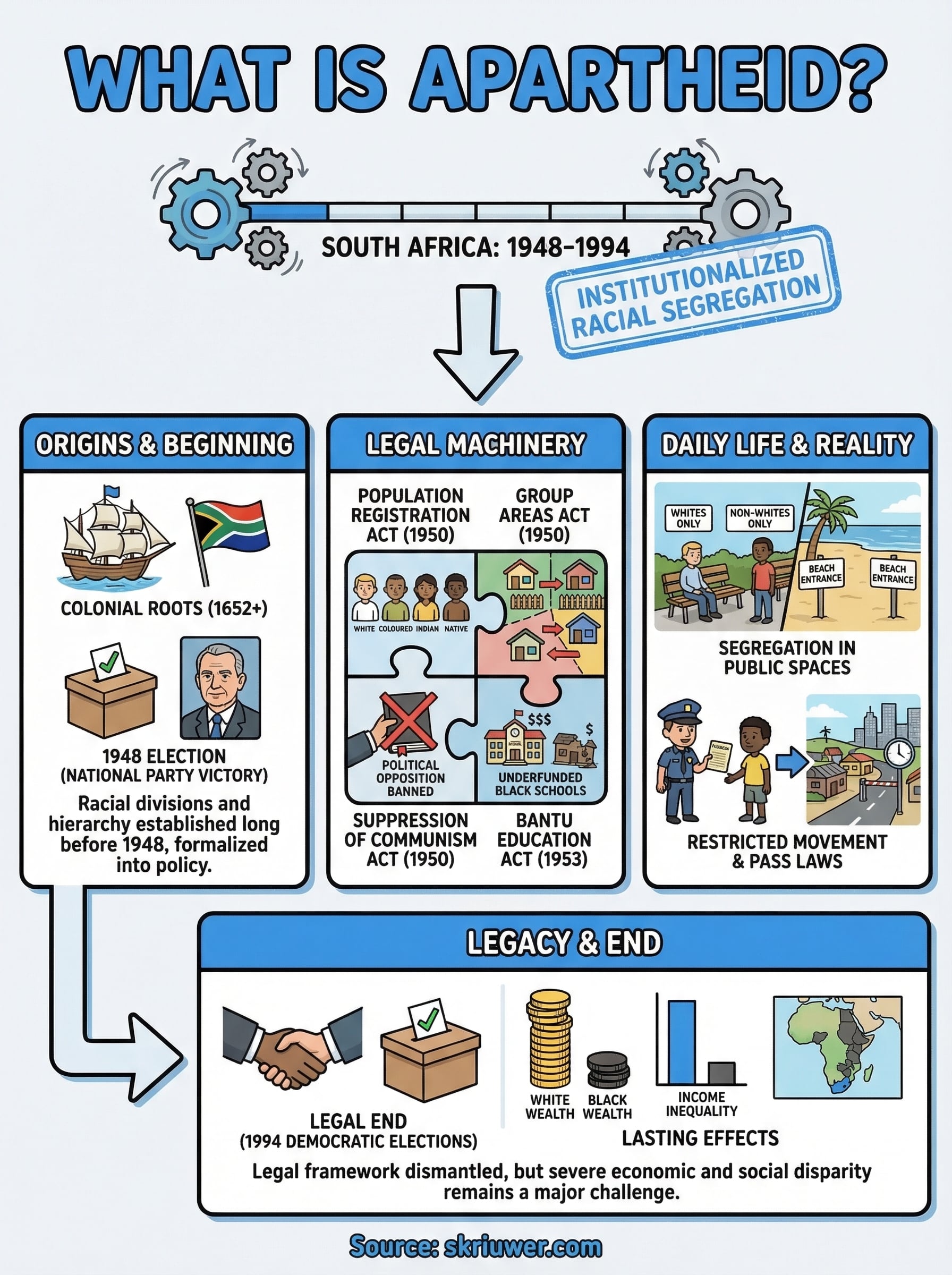
Apartheid was a legally institutionalized system of racial segregation and white supremacy enforced by the South African government from 1948 to 1994. Its systemic impact involved the deliberate restructuring of the economy, geography, and education to ensure white dominance, resulting in enduring structural inequalities that continue to shape South African society in 2026.
The Foundations of Systemic Exclusion
To understand the systemic impact of Apartheid, one must first recognize that it was not merely a collection of prejudiced social customs, but a comprehensive state project. While racial discrimination existed in South Africa long before the mid-20th century—notably through the 1913 Land Act, which reserved over 90% of the land for the white minority—the victory of the National Party (NP) in 1948 codified these practices into a rigid legal framework.
The architects of Apartheid, such as Hendrik Verwoerd, designed the system to be all-encompassing. It was divided into "Grand Apartheid," which focused on the large-scale territorial stripping of citizenship from Black South Africans, and "Petty Apartheid," which regulated the minutiae of daily interactions, such as separate entrances, transportation, and public facilities.
The Population Registration Act of 1950 served as the bedrock of this system. It required every citizen to be registered as White, Colored, Indian, or Black. This classification determined a person’s political rights, where they could live, what jobs they could hold, and the quality of education they received. By legally defining identity, the state created a hierarchy that distributed resources and opportunities based entirely on racial categorization.
The Legislative Pillars and Their Structural Consequences
The systemic nature of Apartheid was maintained through a series of interlocking laws that reinforced each other. When analyzing the long-term impact, four specific pieces of legislation stand out for their role in creating the structural bottlenecks that remain relevant in 2026.
The Group Areas Act (1950)
This law mandated the physical separation of racial groups into distinct residential areas. It led to the forced removal of hundreds of thousands of people from "black spots" or mixed-race neighborhoods like District Six in Cape Town or Sophiatown in Johannesburg.
The systemic impact here was twofold: first, it destroyed the intergenerational wealth accumulated through property ownership by Black, Indian, and Colored families. Second, it created "spatial apartheid," where Black South Africans were relegated to peripheral townships far from economic hubs. In 2026, this legacy persists as high transportation costs for the working class, who must travel long distances to reach job centers, effectively acting as a "poverty trap."
The Bantu Education Act (1953)
This act removed the education of Black South Africans from the control of missions and placed it under government control. The curriculum was intentionally designed to prepare Black students for unskilled manual labor. Verwoerd famously remarked that there was no place for the "Bantu" in European society above the level of certain forms of labor.
The systemic consequence of this was the mass production of a "skills deficit." By underfunding Black schools and emphasizing rote manual training over critical thinking or technical skills, the state ensured that the majority of the population would remain economically marginalized for generations. The current challenges in the South African labor market, characterized by high unemployment among unskilled youth, are a direct echo of this 1953 policy.
The Reservation of Separate Amenities Act (1953)
While often viewed through the lens of "petty" segregation, this act had a profound systemic impact on public health and social capital. By ensuring that the best hospitals, parks, libraries, and recreational facilities were reserved for the white minority, the state created a public health disparity that was measurable in life expectancy and infant mortality rates for decades.
The Promotion of Bantu Self-Government Act (1959)
This law created ten "homelands" or Bantustans, which were intended to become independent nations for different ethnic groups. By assigning Black South Africans to these impoverished territories, the state stripped them of their South African citizenship. This was a systemic attempt to turn the majority of the population into "foreigners" in their own country, thereby justifying their lack of political representation and the denial of social services.
Economic Marginalization and the Labor Market
The systemic impact of Apartheid on the South African economy was designed to create a "dual economy." On one side was a modern, industrialized sector catering to the white minority; on the other was a subsistence-based or labor-supplying sector for the Black majority.
The migrant labor system was a key component of this economic structure. Black men were forced to leave their families in the homelands to work in the mines or factories of the "white" cities. This system was enforced by the Pass Laws, which required Black individuals to carry a "dompas" (passbook) at all times. Failure to produce a valid pass resulted in immediate arrest and deportation to the homelands.
This system had devastating social and economic consequences:
- Family Fragmentation: The forced absence of fathers and husbands weakened the social fabric of Black communities, leading to long-term social challenges that are still being addressed today.
- Wage Suppression: Because Black workers were denied the right to form or join recognized trade unions for much of the Apartheid era (until the post-1973 labor unrest led to changes), wages were kept artificially low, ensuring high profit margins for industries like mining and agriculture.
- Property Rights: By preventing Black South Africans from owning land in urban areas, the system prevented the development of a Black middle class that could use property as collateral for business loans or investment.
Spatial Apartheid and Modern Infrastructure Challenges
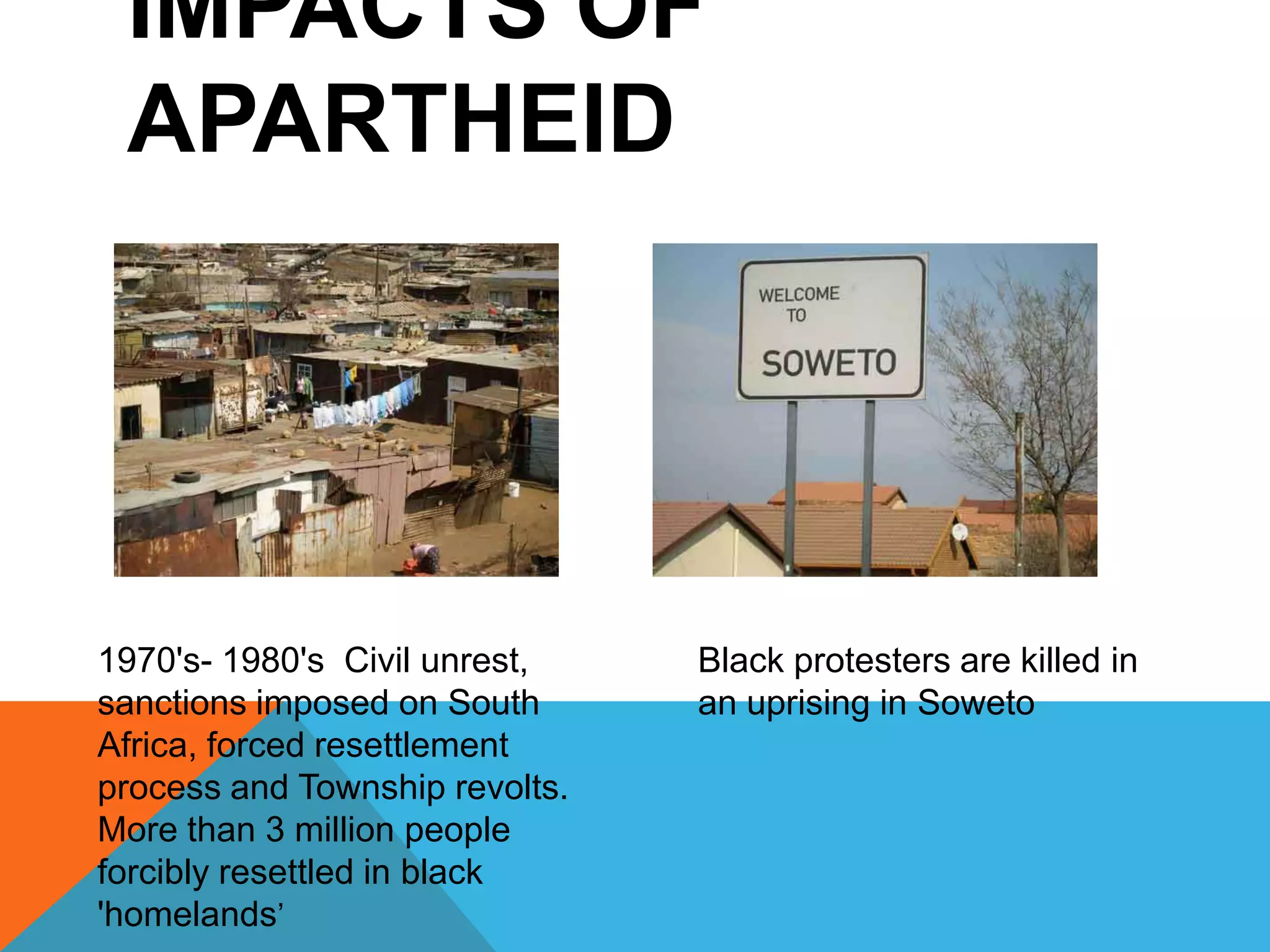
Even in 2026, the physical layout of South African cities remains one of the most visible systemic impacts of Apartheid. Townships like Soweto, Mdantsane, and Khayelitsha were designed as "dormitory towns." They were built with limited access points (to facilitate military control during uprisings) and minimal commercial infrastructure.
The systemic result of this urban planning is a phenomenon known as "spatial mismatch." Jobs are located in the north or the city center, while the workforce is concentrated in the south or the outskirts. This creates an enormous logistical burden. In modern-day South Africa, low-income earners often spend up to 40% of their income on transport alone. This geographical isolation also limits access to high-quality healthcare, specialized schools, and networking opportunities, reinforcing the cycle of poverty.
| Systemic Pillar | Apartheid Era Mechanism | 2026 Socio-Economic Legacy |
|---|---|---|
| Land Ownership | 1913 Land Act and Group Areas Act | Highly skewed land distribution; ongoing land reform debates. |
| Education | Bantu Education Act (1953) | Two-tier education system; high youth unemployment due to skills gap. |
| Labor | Job Reservation and Pass Laws | Extreme wealth inequality; high Gini coefficient. |
| Urban Planning | Forced Removals and Townships | High transport costs; spatial segregation; infrastructure backlogs. |
| Citizenship | Homeland System (Bantustans) | Underdeveloped rural provinces (e.g., Eastern Cape, Limpopo). |
Psychological and Intergenerational Trauma
The systemic impact of Apartheid was not merely physical and economic; it was also psychological. The state utilized a sophisticated propaganda machine and a brutal security apparatus to enforce a sense of inferiority among the oppressed and superiority among the enforcers.
The Truth and Reconciliation Commission (TRC), established in 1996, attempted to address these wounds. While it provided a platform for victims to share their stories, critics in 2026 often point out that it focused more on political crimes than on the "structural violence" of the system itself. The daily humiliations of the Pass Laws, the lack of decent housing, and the deliberate stunting of intellectual growth through Bantu Education left deep psychological scars that have been passed down through generations.
Intergenerational trauma manifests in various ways, including high levels of domestic violence, substance abuse in marginalized communities, and a fractured sense of national identity. Addressing these systemic psychological impacts requires more than just economic policy; it requires sustained social interventions and mental health support.
Redressing the System: Progress and Persistent Hurdles
Since the first democratic elections in 1994, the South African government has implemented several systemic interventions to counteract the legacy of Apartheid. These include:
- Broad-Based Black Economic Empowerment (B-BBEE): A policy aimed at increasing the participation of Black South Africans in the management, ownership, and control of the economy.
- Social Grants: South Africa has one of the largest social safety nets in the developing world, providing essential support to millions of households affected by structural unemployment.
- Land Reform: Efforts to redistribute land to those dispossessed under Apartheid, though progress has been slower than many expected.
- National Health Insurance (NHI): In 2026, the debate continues over the implementation of a universal healthcare system intended to bridge the gap between the world-class private healthcare sector and the overburdened public sector.
Despite these efforts, South Africa remains one of the most unequal societies in the world, with a Gini coefficient that consistently ranks among the highest globally. The systemic nature of Apartheid means that removing the laws was only the first step; dismantling the economic and spatial structures those laws built is a much longer process.
Common Misconceptions About Apartheid's Impact
It is a common error to believe that the end of legal Apartheid in 1994 immediately leveled the playing field. In reality, the "path dependency" created by 46 years of institutionalized racism meant that the starting lines were vastly different for different racial groups.
Another misconception is that the impact was only felt by Black South Africans. While they bore the brunt of the oppression, the system also impacted the Colored and Indian populations through different tiers of the Group Areas Act and political exclusion. Furthermore, the white population was socially and intellectually isolated from the global community due to international sanctions and cultural boycotts, creating a specific set of social pathologies within those communities as well.
Frequently Asked Questions
What was the primary goal of the systemic impact of Apartheid?
The primary goal was the preservation of white political and economic hegemony. By controlling where people lived, what they learned, and how they worked, the state ensured that the majority of the nation's wealth remained in the hands of the white minority while maintaining a steady supply of cheap labor for the agricultural and mining sectors.
How does Apartheid still affect South Africa in 2026?
Apartheid's impact is seen in 2026 through spatial segregation (townships located far from cities), the education gap (disparities between former white schools and township schools), and extreme wealth inequality. The high unemployment rate is partly a result of the structural skills deficit created by the Bantu Education system.
Was the systemic impact purely about race?
While race was the primary marker, the systemic impact was also deeply economic. Apartheid functioned as a form of "racial capitalism," where the state used racial laws to manage the labor market and ensure that capital remained concentrated in white-owned enterprises.
What was the role of the "Homelands" in this system?
The Homelands (Bantustans) were designed to strip Black South Africans of their citizenship. By making them citizens of small, impoverished "nations," the South African government could claim that Black people were no longer the responsibility of the central state, thus denying them the right to vote in South African elections and access to national resources.
Can the systemic impacts of Apartheid be fully reversed?
Reversal is a generational project. While laws have changed, the physical infrastructure (roads, housing, schools) and the economic distribution of wealth take much longer to reform. Policies like B-BBEE and land reform are intended to address these issues, but they face significant political and economic challenges.
How did international sanctions affect the systemic impact?
International sanctions, particularly in the 1980s, put immense pressure on the Apartheid economy. This led the state to become more self-sufficient in areas like arms production and energy (SASOL), but it also caused high inflation and economic stagnation, which eventually made the system unsustainable for the ruling National Party.
Next Steps for Understanding and Redress
To truly understand the systemic impact of Apartheid, it is recommended to study both the legislative history and the current socio-economic data of South Africa. Organizations such as the Nelson Mandela Foundation and the South African Human Rights Commission provide extensive resources on the history and the ongoing efforts to achieve social justice.
For those looking to contribute to redress, supporting initiatives focused on early childhood development in rural areas and townships is one of the most effective ways to break the intergenerational cycle of the skills deficit. Furthermore, urban planning that prioritizes "infill" housing—bringing low-income housing closer to city centers—is essential for dismantling the spatial legacies of the 1950 Group Areas Act.