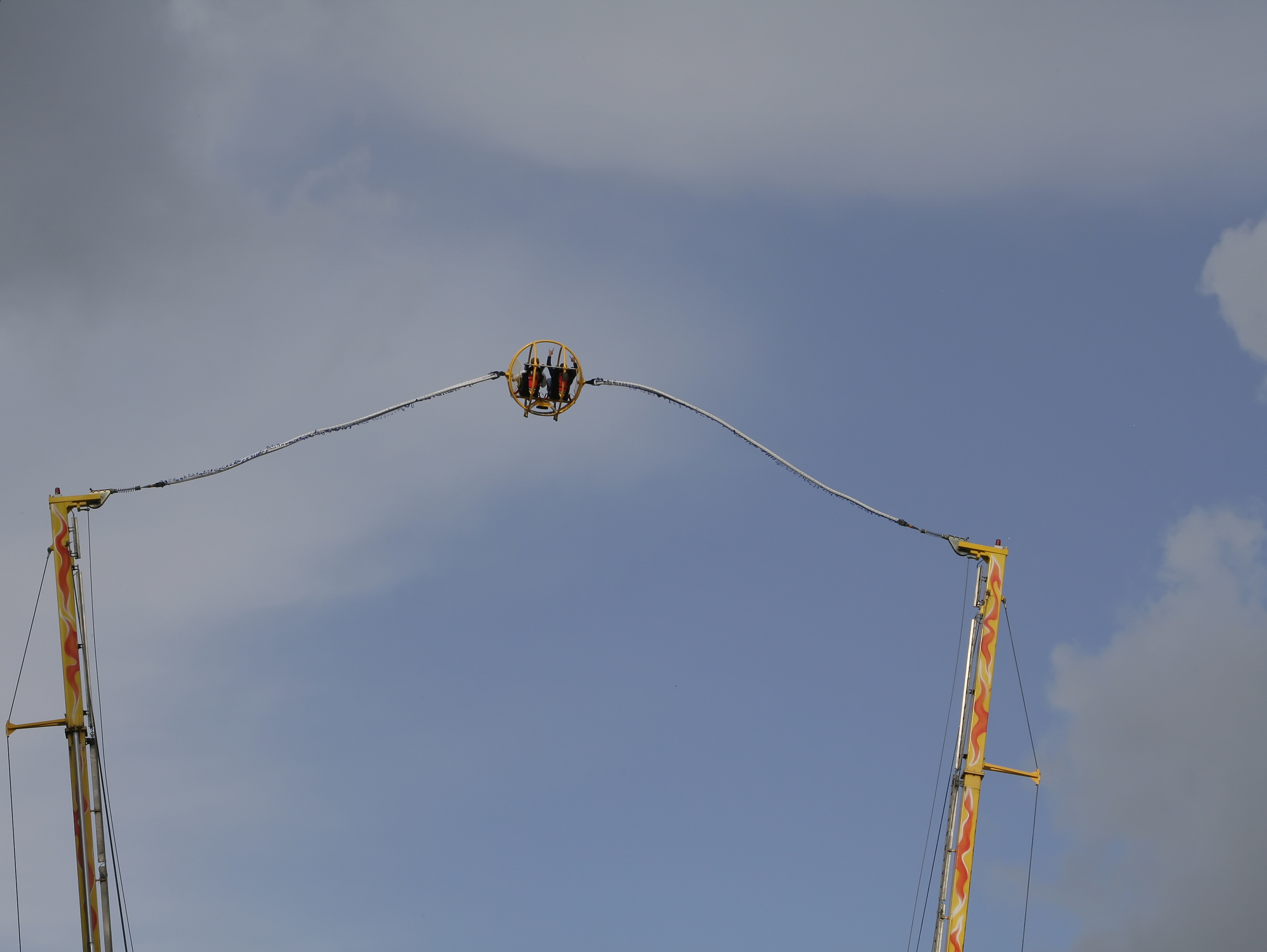
An amusement park ride slingshot—often called a reverse bungee, catapult, or ejector seat—uses high-tension elastic cords or pneumatic pistons to violently launch a two-passenger capsule straight up into the air at speeds exceeding 100 mph. Riders experience extreme acceleration forces, temporary weightlessness, and controlled rotation, relying on heavy-duty steel cables, specialized winch systems, and rigorous harness restraints for safety.
The Mechanics of Vertical Catapults
The amusement park ride slingshot represents a marvel of mechanical and structural engineering. Unlike traditional roller coasters that rely on gravity after an initial lift hill, or standard pendulum rides driven by electric motors, a slingshot ride stores massive amounts of potential energy before discharging it instantaneously. Understanding how these machines operate requires a look into the core sub-systems that make the launch possible.
Power Systems: Bungee Cord Arrays vs. Pneumatic Pistons
Historically, these attractions relied almost exclusively on heavy-duty latex bungee cord bundles. These cords consist of hundreds of individual rubber strands housed within a protective, weather-resistant fabric sheath. When the capsule is pulled down to the launch position by a motorized winch, the bungee cords stretch significantly, storing elastic potential energy.
Modern variations, however, frequently incorporate pneumatic accumulator systems. These setups use compressed air stored in high-pressure tanks. When triggered, high-speed valves release the compressed air into vertical cylinders, pushing pistons upward with tremendous force. Pneumatic systems offer consistent launch velocities regardless of ambient temperature, whereas rubber bungees can experience slight elasticity variations in extreme cold or heat.
The Launch Tower and Structural Framework
The entire assembly is supported by an inverted "V" or tripod structural steel tower. These towers typically range from 150 to over 250 feet in height. They must withstand immense dynamic loads—not just the weight of the capsule and passengers, but the explosive upward thrust and subsequent harmonic oscillations as the bungees bounce back and forth.
Guide cables or tracks are often integrated into the legs of the tower to prevent the capsule from twisting or swaying excessively during the initial vertical ascent. At the apex of the tower, heavy-duty pulleys or swivel joints accommodate the primary launch lines, ensuring that the capsule travels along a precise, predictable vertical trajectory.
Passenger Experience and Physics of G-Forces
Stepping onto an amusement park ride slingshot triggers a rapid sequence of physical sensations rooted in Newtonian physics. Riders are strapped into open-air, bucket-style seats, facing each other or outward depending on the specific manufacturer's design. Once locked in, the capsule is winched down to the launch pad, compressing the propulsion system.
The Launch Phase and Positive G-Forces
Upon release, the stored energy discharges in fractions of a second. The capsule accelerates from zero to speeds between 60 and 100 miles per hour in roughly one to two seconds. This rapid acceleration subjects riders to substantial positive G-forces—often ranging between 3Gs and 5Gs. Passengers feel heavy, as if pressed firmly into their seats, while their blood rushes downward.
Free Fall and Weightlessness
Once the upward momentum of the slingshot exhausts itself, the capsule enters a brief window of free fall. At the highest point of the trajectory—frequently reaching altitudes equivalent to a 15-story building—riders experience microgravity or weightlessness. As the capsule begins its descent, the elastic cords or secondary braking mechanisms catch the capsule, smoothly dampening the oscillation until it comes to a rest at the launch platform. Throughout this sequence, a motorized swivel mechanism often allows the capsule to spin freely on its axis, adding disorienting rolls and flips to the vertical journey.
Safety Systems, Restraints, and Operational Protocols
Because amusement park ride slingshots subject the human body to extreme and abrupt forces, redundancy is built into every layer of their operation. Safety is governed by strict engineering standards, such as those established by ASTM International (Committee F24 on Amusement Rides and Devices) in the United States, alongside local and national governmental oversight bodies.
Restraint Technologies
Unlike roller coasters that may rely solely on lap bars, slingshot rides require multi-point security to keep riders securely pinned during high-velocity vertical movement and inversion. Standard restraint configurations include:
- Over-the-Shoulder Harnesses (OTSH): Thick, molded polyurethane or padded steel harnesses that lock across the torso and shoulders.
- Lap Bars: Secondary mechanical or hydraulic lap bars that lock across the thighs.
- Between-the-Legs Safety Straps: Often referred to as "crotch straps," these prevent a rider from sliding downward under extreme negative G-forces or inverted positions.
- Interlock Sensors: Electronic sensors that verify every restraint is locked into position before the ride control system will allow the winching or launching sequence to begin.
Comparison of Propulsion Technologies
| Feature | Elastic Bungee Cord Systems | Pneumatic Piston Systems |
|---|---|---|
| Primary Energy Source | Stretched natural/synthetic rubber bundles | Compressed air accumulators |
| Launch Characteristics | Smooth initial acceleration with spring-like harmonic bounce | Immediate, linear thrust with rapid velocity peak |
| Maintenance Profile | Regular visual inspections and scheduled bundle replacements | Seal checks, valve maintenance, and pressure monitoring |
| Environmental Sensitivity | Performance can vary slightly with extreme temperature shifts | Highly consistent performance across varied weather conditions |
Rider Requirements, Health Restrictions, and Access
Not everyone can ride an amusement park ride slingshot. Due to the intense acceleration, sudden G-force transitions, and high-velocity spinning, operators enforce strict health, age, and physical criteria.
Common Passenger Restrictions
- Height Minimums and Maximums: Most parks enforce a minimum height requirement (typically around 48 to 54 inches) to ensure that restraints fit securely over the shoulders and hips. Maximum weight limits per seat or per capsule are also strictly enforced to ensure the propulsion math remains accurate.
- Cardiovascular Health: Individuals with a history of high blood pressure, aneurysms, or heart conditions are explicitly prohibited from riding, as the sudden spike in adrenaline and G-forces can trigger acute medical emergencies.
- ** musculoskeletal Conditions:** People with neck, back, or spinal injuries must avoid the ride. The violent acceleration and deceleration forces can exacerbate existing spinal disc issues.
- Pregnancy: Pregnant individuals are universally restricted from riding due to the risk of abdominal trauma from restraints and rapid pressure changes.
Maintenance, Inspection, and Engineering Oversight
The operational integrity of a slingshot ride depends on rigorous daily, weekly, and annual maintenance schedules. Technicians trained by the ride manufacturer inspect all structural welds using non-destructive testing (NDT) methods, such as magnetic particle or ultrasonic testing, to detect microscopic fatigue cracks in the steel tower.
Furthermore, elastic bungee cords have a strictly monitored lifespan measured in cycles (number of launches). Once a specific threshold is reached—regardless of how the cords appear visually—they are retired and destroyed. Pneumatic valves, backup braking cables, and electronic sensors undergo daily pre-opening test cycles without passengers to confirm all safety interlocks function properly before the public is permitted near the queue line.
Frequently Asked Questions
How fast does an amusement park ride slingshot go?
Most slingshots launch riders at speeds between 60 and 100 miles per hour, achieved in less than two seconds. The exact speed depends on the tower height, the tension of the bungee cords or pressure of the pneumatic system, and the combined weight of the passengers.
Are slingshot rides safe?
Yes, when operated in accordance with manufacturer specifications and government safety standards. They feature redundant safety systems, including multiple independent restraints, safety cables, and computerized interlocks that prevent launch if any parameter is out of spec.
What causes the capsule to spin during the ride?
The capsule is mounted on a specialized multi-axial bearing or swivel joint. As the capsule launches and descends, aerodynamic forces acting on the asymmetrical design of the vehicle—combined with the natural dynamics of the elastic or pneumatic recoil—cause the cage to tumble and spin independently.
Can I ride if I wear glasses or carry loose items?
No. Loose articles such as glasses, cell phones, keys, hats, and loose footwear are strictly prohibited on the ride platform. The extreme acceleration and wind resistance will dislodge unsecured items, creating a safety hazard for both riders and people on the ground.
How are the bungee cords inspected?
Bungee cords are inspected visually before every operating day for fraying, tears, or weather degradation. More importantly, they are tracked by total launch cycles and age. Manufacturers mandate that cords be replaced long before their material fatigue limit is reached.
Next Steps for Riders
Before visiting an amusement park featuring a slingshot ride, check the specific park’s website for individual ride height restrictions, weather-related operating policies (as high winds or lightning will temporarily shut down tall towers), and whether the attraction requires a separate, premium ticket purchase outside of regular park admission. Ensure you review the health advisory signage posted at the ride entrance to confirm you meet all physical requirements before waiting in line.