Group term life insurance is a type of life insurance coverage offered by an employer or organization to a specific group of people, typically employees or members. It provides a death benefit for a set period—usually the duration of employment—and is often provided as a low-cost or free employee benefit with no medical exam required for basic coverage levels.
Group term life insurance serves as the foundation of financial protection for millions of workers. In 2026, as the workforce continues to evolve with hybrid and remote models, understanding how these policies function is essential for maximizing your total compensation package. Unlike individual policies, which you buy directly from an insurance company, group policies are "master contracts" held by an entity for the benefit of its members. This guide breaks down the mechanics, costs, tax implications, and limitations of these plans to help you determine if your workplace coverage is sufficient for your family’s needs.
How Group Term Life Insurance Functions
The core mechanism of group term life insurance is the "risk pool." When an insurance company issues a group policy, it evaluates the risk of the group as a whole rather than assessing each individual’s health or lifestyle. This collective underwriting allows the insurer to offer coverage to individuals who might otherwise be uninsurable or face high premiums due to pre-existing conditions.
The Master Policy and Certificates of Insurance
In a group arrangement, the employer (the policyholder) signs a contract with the insurance provider. This document is known as the Master Policy. Individuals covered under this plan do not receive an individual policy; instead, they are issued a Certificate of Insurance. This certificate outlines the benefits, the name of the beneficiary, and the specific terms that apply to the individual’s coverage.
Eligibility and Enrollment Periods
Participation in a group life plan is usually contingent on employment status. Most companies require employees to be "full-time" as defined by their internal policies. There is often a waiting period—ranging from 30 to 90 days—before coverage becomes active.
Enrollment typically occurs during three specific windows:
- Initial Eligibility: When a new employee joins the company.
- Annual Open Enrollment: A yearly period where employees can sign up for or change their benefit selections.
- Qualifying Life Events: Changes such as marriage, divorce, or the birth of a child that allow for mid-year adjustments.
Types of Coverage Within Group Plans
Not all group term life insurance is identical. Most employers offer a tiered structure that allows employees to customize their protection levels.
Basic Group Term Life
This is the most common form of the benefit. The employer typically pays the full premium for a base amount of coverage. This amount is often a flat sum (e.g., $50,000) or a multiple of the employee's annual salary (e.g., 1x or 2x annual earnings). In 2026, basic group term life remains one of the most highly valued "passive" benefits because it requires no out-of-pocket cost from the employee.
Supplemental (Voluntary) Group Term Life
If the basic coverage is insufficient, many plans allow employees to purchase additional coverage, known as supplemental or voluntary life insurance. The employee pays the premiums for this additional amount through payroll deduction. While the rates are still generally "group rates," they are typically age-banded, meaning the cost increases as the employee enters new five-year age brackets (e.g., moving from the 35–39 bracket to the 40–44 bracket).
Dependent Group Life
Some employers extend the group policy to include spouses and children. These policies usually offer smaller death benefits—often capped at $10,000 to $25,000 for children and up to 50% of the employee's coverage for spouses. Premiums for dependent coverage are almost always the responsibility of the employee.
Tax Implications and IRS Section 79
Understanding the tax treatment of group term life insurance is critical for high earners. Under IRS Section 79, the first $50,000 of employer-paid group term life insurance is considered a tax-free benefit.
Imputed Income
If your employer provides more than $50,000 in coverage, the "value" of the coverage above that limit is considered a taxable benefit. This is known as imputed income. The IRS uses a specific table, called Table I, to determine the monthly cost of $1,000 of protection based on your age.
For example, if you have $150,000 in employer-paid coverage, the first $50,000 is tax-exempt. You are taxed on the "value" of the remaining $100,000. Your employer calculates this value using the IRS Table I rates, adds it to your W-2 as taxable wages, and withholds Social Security and Medicare taxes accordingly.
Key Table I Considerations
The rates in Table I are generally lower than what a private individual policy would cost, but for older employees in high-income brackets, the imputed income can become a noticeable addition to their taxable gross pay. It is important to review your pay stubs to see how much imputed income is being recorded if your coverage exceeds the $50,000 threshold.
Comparing Group Term vs. Individual Term Life Insurance
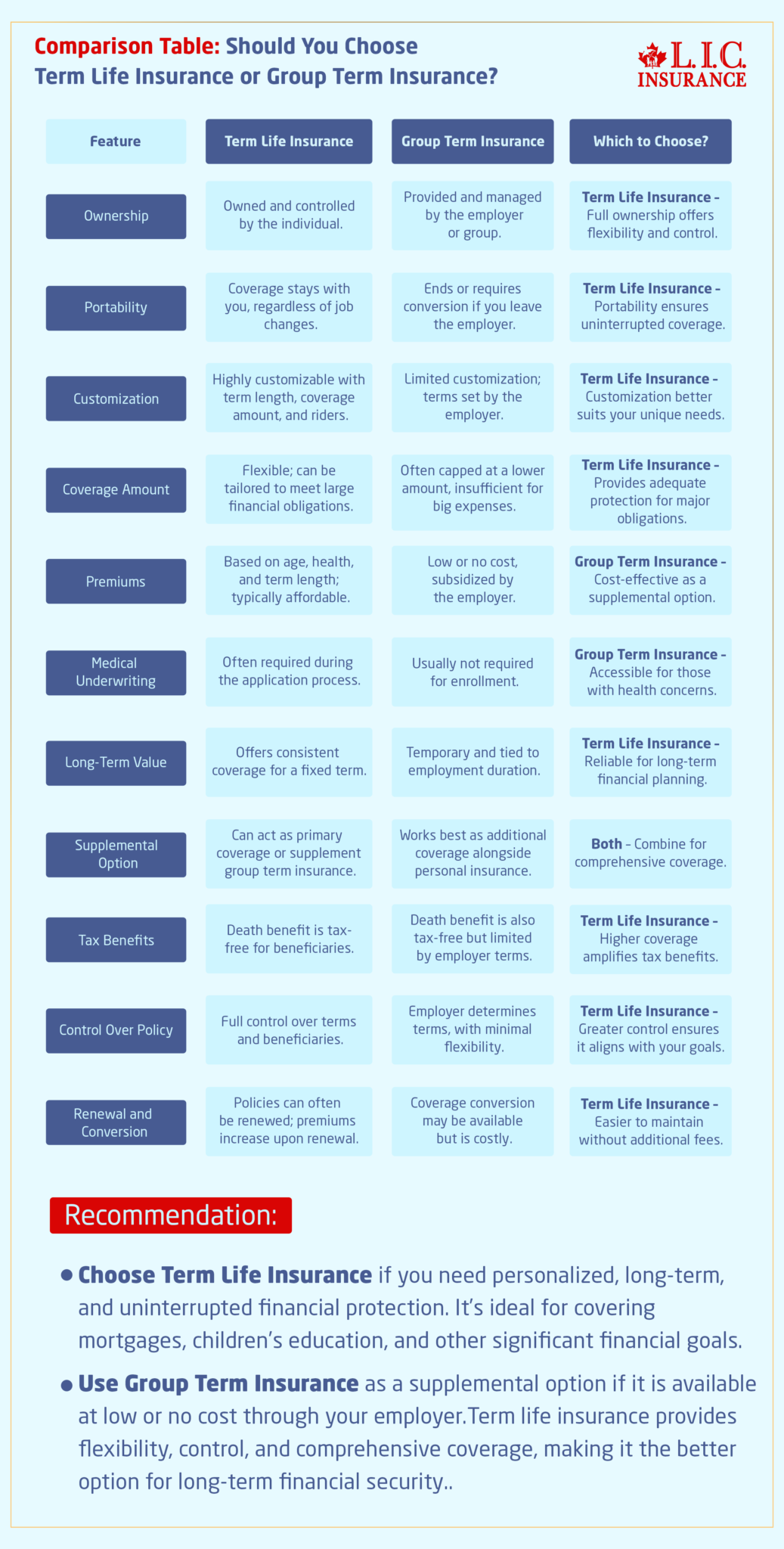
While group coverage is convenient, it is rarely the only life insurance a person should carry. The following table highlights the material differences between the two types of coverage.
| Feature | Group Term Life Insurance | Individual Term Life Insurance |
|---|---|---|
| Medical Exam | Usually not required for basic limits. | Usually required (except for "no-exam" policies). |
| Ownership | Employer owns the master policy. | You own the policy. |
| Portability | Often lost when you leave the job. | Stays with you regardless of employment. |
| Cost | Free or low-cost (group rates). | Based on individual health and age. |
| Customization | Limited to plan options. | Highly customizable riders and terms. |
| Control | Employer can cancel or change the plan. | Only you can cancel the policy. |
| Coverage Limits | Often capped at 3x–5x salary. | Limited only by your income/needs. |
Portability and Conversion Rights
One of the greatest risks of relying solely on group term life insurance is the loss of coverage upon termination of employment. However, most group policies include two provisions to mitigate this risk: Portability and Conversion.
Portability
Portability allows you to "take the policy with you" when you leave your employer. You continue to pay the premiums directly to the insurance company at group rates. However, ported policies often have "step-up" rates that can make them more expensive over time, and they may still terminate at a certain age (usually 65 or 70).
Conversion
Conversion is a legal right (often mandated by state law) that allows you to turn your group term coverage into an individual permanent (whole life) policy without proving insurability. This is a vital option for employees who have developed serious health conditions while employed.
- The Pro: You cannot be denied coverage due to health.
- The Con: Permanent life insurance is significantly more expensive than term insurance, and conversion premiums are based on your age at the time of the switch.
Most policies require you to exercise your conversion or portability rights within 31 days of leaving your job.
Limitations and Common Exclusions
Group term life insurance is designed for the "average" member of a workforce, which means it contains certain standardized limitations that might not suit everyone.
Age Reduction Schedules
A common feature in group policies is the Age Reduction Schedule. To keep premiums manageable for the employer, the death benefit often decreases as an employee gets older. For example, a policy might reduce the benefit to 65% of its original value at age 65, and further reduce it to 50% at age 70. This can leave older employees significantly underinsured at a time when they may still have financial obligations.
The "Actively at Work" Clause
To be eligible for coverage, you must generally be "actively at work" on the day the policy or an increase in coverage takes effect. If you are on disability leave or an extended medical leave when a new benefit year starts, your increased coverage may not kick in until you return to full-time status.
Standard Exclusions
While group policies are lenient on health, they still contain exclusions. The most common is the Suicide Clause, which typically states that the death benefit will not be paid if the insured person dies by suicide within the first two years of the policy’s effective date. Some policies also exclude deaths resulting from war, illegal acts, or high-risk activities like professional racing.
Frequently Asked Questions
Can I name anyone as my beneficiary?
Yes, in most cases, you can name any person, trust, or organization as your beneficiary. However, some states have community property laws that may require a spouse to sign a waiver if you name someone else. It is crucial to keep your beneficiary designations updated after life changes, as the insurance company is legally bound to pay the person listed on the form, regardless of your current marital status or will.
What is Evidence of Insurability (EOI)?
Evidence of Insurability (EOI) is a medical questionnaire or physical exam used to prove you are in good health. While basic group life usually waives EOI, you may be required to provide it if you:
- Apply for supplemental coverage above a certain "guaranteed issue" amount.
- Apply for coverage after initially declining it during your first eligibility window.
- Attempt to increase your coverage significantly during open enrollment.
Is group life insurance enough for my family?
For many, the answer is no. Financial experts generally recommend having coverage equal to 10x to 15x your annual income. Most group plans cap coverage at 3x to 5x salary. Additionally, because group insurance is tied to your job, relying on it entirely leaves you vulnerable if you become too sick to work and lose your employment-based benefits.
What happens if the insurance company goes bankrupt?
Insurance companies are regulated at the state level. If an insurer becomes insolvent, the State Insurance Guaranty Association in your state usually steps in to cover claims, up to certain limits (often $300,000 for life insurance death benefits). You can check the status of your insurer through the National Association of Insurance Commissioners (NAIC).
Can I have multiple group life insurance policies?
Yes. If you work two jobs that both offer benefits, or if you belong to a professional association that offers a group plan, you can be covered by multiple policies. Unlike indemnity insurance, life insurance will generally pay out from all valid policies upon the death of the insured, provided the total coverage amount was legally obtained and premiums were paid.
Expert Recommendation: Balancing Your Portfolio
In 2026, group term life insurance remains a foundational piece of financial security, but it should rarely be the only piece. The most effective strategy is to treat your employer-provided policy as a "bonus" layer of protection.
Next Step: Calculate your total debt (mortgage, student loans, car notes) and future obligations (children's education, spouse’s retirement). If this sum exceeds your group death benefit, seek a private, individual term life insurance policy to bridge the gap. By securing an individual policy while you are young and healthy, you lock in a low rate and ensure that your family remains protected even if you change careers or leave the workforce. Always review your group benefit summary annually to stay aware of age reductions or changes in carrier terms.