As of early 2026, Aldi operates approximately 2,850 stores across 39 states in the United States. This robust footprint is the direct result of a massive five-year expansion strategy launched in 2024, which aimed to add 800 new locations by 2028 through a combination of new construction and the strategic acquisition of Southeastern Grocers.
The State of Aldi’s US Presence in 2026
The landscape of American grocery retail has shifted significantly over the last few years, with Aldi emerging as a dominant force in the discount sector. By 2026, the company has successfully integrated hundreds of new locations, pushing its total store count toward the 3,000-unit milestone. This growth is not merely about numbers; it represents a fundamental change in how American consumers approach food shopping, prioritizing efficiency and private-label value over traditional "big box" supermarket experiences.
The expansion was catalyzed by a $9 billion capital investment announced in early 2024. This investment focused heavily on the Northeast and Midwest, while simultaneously breaking new ground in the Gulf Coast and Southern California. The acquisition of Southeastern Grocers, which included the Winn-Dixie and Harveys Supermarket banners, provided Aldi with a "plug-and-play" infrastructure in the Southeast. While many of these locations were converted to the Aldi format by 2025, some continue to operate under their original names to maintain local market loyalty, though the total "Aldi-managed" footprint remains the primary metric for the company's scale.
The 2026 store count reflects a steady cadence of roughly 150 to 200 new openings per year. This pace has allowed Aldi to maintain its supply chain integrity, ensuring that each new store is supported by a regional distribution center (RDC). Without these RDCs, the Aldi model—which relies on rapid inventory turnover and limited stock-keeping units (SKUs)—would struggle to maintain the low prices that define its brand.
The 2024-2028 Expansion Roadmap: Analyzing the $9 Billion Investment
In 2024, Aldi CEO Jason Hart announced one of the most ambitious growth phases in the company's history. The goal was to reach a total of approximately 3,200 stores by the end of 2028. As we move through 2026, the company is roughly 60% of the way through this specific growth cycle. This roadmap was designed to address "food deserts" and high-cost urban areas where consumers were increasingly seeking relief from grocery inflation.
A significant portion of the $9 billion investment was dedicated to sustainable growth. New stores built in 2025 and 2026 feature environmentally friendly building materials, rooftop solar panels, and electronic shelf labels to reduce paper waste. Furthermore, the expansion included the opening of several new regional headquarters and distribution hubs, such as the major facility in Loxley, Alabama, which serves as the nerve center for the Gulf Coast expansion.
The strategy also prioritized the "re-modeling" of older stores. By 2026, nearly the entire Aldi fleet has been updated to the "modern" format, which features expanded fresh produce sections, improved lighting, and a larger "Aldi Finds" middle aisle. This modernization ensures that the 2,850+ stores offer a consistent experience, whether the customer is in a 30-year-old location in Illinois or a brand-new storefront in Florida.
Regional Distribution: Where Aldi Stores Are Most Concentrated
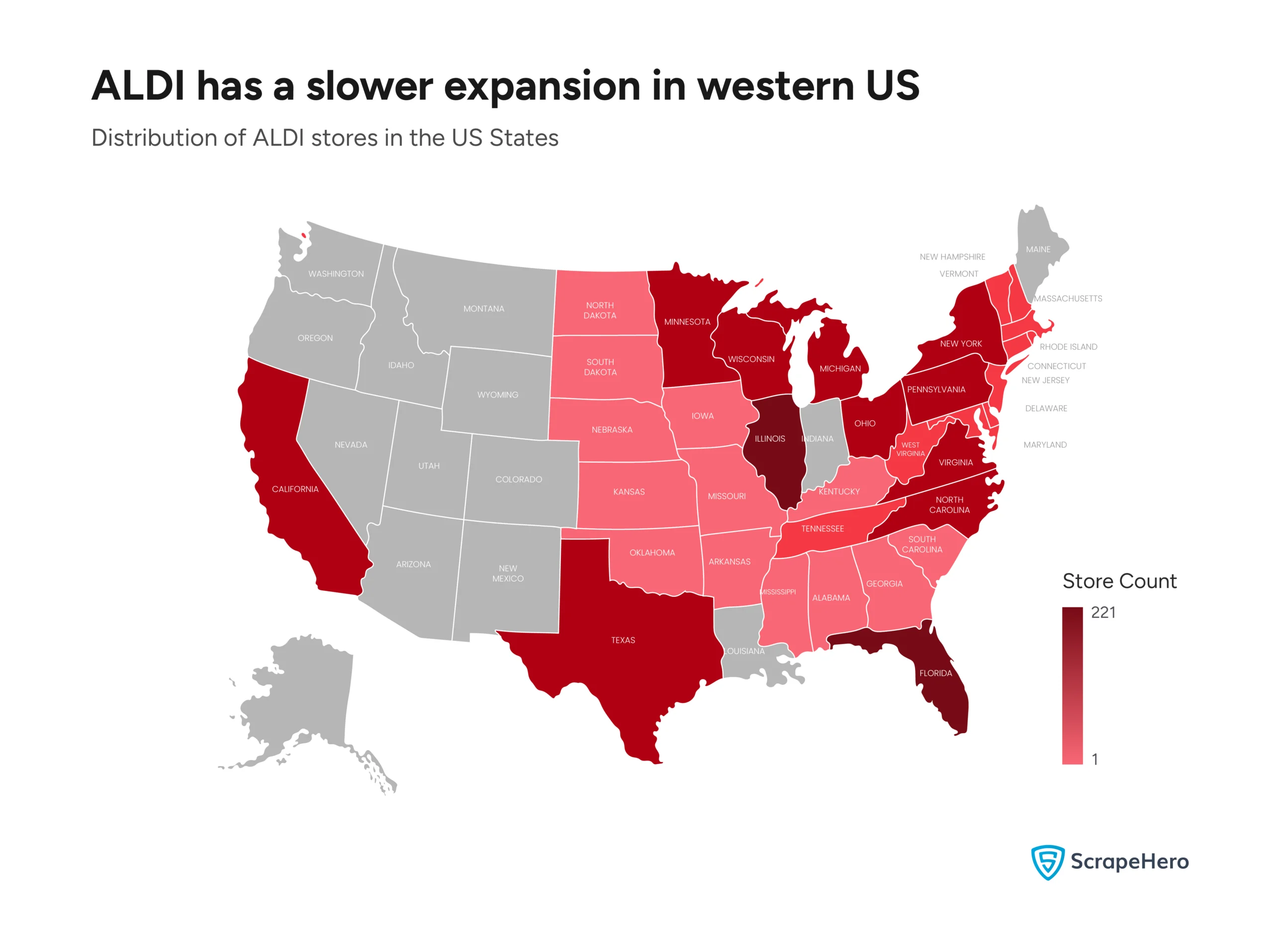
Aldi’s geographical strategy has historically favored the Midwest, where the company first established its US roots in 1976. However, the 2026 data shows a significant tilt toward the Eastern Seaboard and the Sun Belt. Illinois remains a core hub for the company, but Florida has seen the most rapid growth over the last 24 months due to the Southeastern Grocers acquisition.
| State | Estimated Store Count (2026) | Growth Trend (2024-2026) | Primary Hub City |
|---|---|---|---|
| Florida | 315 | High (Acquisitions/New Builds) | Jacksonville / Orlando |
| Illinois | 225 | Steady (Market Saturation) | Batavia (HQ) |
| Ohio | 165 | Moderate | Columbus |
| Pennsylvania | 160 | Moderate | Philadelphia / Pittsburgh |
| Texas | 155 | High | Dallas / Houston |
| New York | 135 | Moderate | Albany / Buffalo |
| North Carolina | 110 | High | Charlotte |
While Aldi has a presence in 39 states, it remains notably absent or limited in the Pacific Northwest and parts of the Mountain West. The logistics of refrigerated shipping across these sparsely populated or geographically isolated regions present a challenge to the Aldi low-cost model. However, industry analysts expect that once the 3,200-store goal is reached in 2028, the company may look toward a West Coast distribution hub to bridge the gap between its California locations and the rest of the country.
The Impact of the Southeastern Grocers Acquisition
One of the most pivotal moments in Aldi's recent history was the 2024 finalization of the acquisition of Southeastern Grocers. This deal brought approximately 400 Winn-Dixie and Harveys Supermarket locations under the Aldi umbrella. For the store count in 2026, this acquisition acted as a massive accelerant.
The conversion process was methodical. Aldi did not convert all 400 stores overnight. Instead, they evaluated each location based on local demographics. In many cases, a Winn-Dixie store was closed for several months and completely gutted to fit the high-efficiency Aldi layout. In other neighborhoods, where the Winn-Dixie brand had deep generational ties, Aldi chose to continue operating under the original banner while integrating Aldi-exclusive private-label products onto the shelves.
By 2026, this "hybrid" strategy has allowed Aldi to capture a wider demographic. The traditional Aldi shopper looks for speed and low prices, while the legacy Winn-Dixie shopper might prioritize a full-service deli or meat counter—features traditionally absent from the Aldi model. Managing this dual-brand ecosystem has been a primary focus for Aldi’s leadership throughout 2025 and 2026.
Why the Aldi Business Model Supports Rapid Expansion
Aldi’s ability to maintain over 2,850 stores while keeping prices lower than traditional competitors like Kroger or Publix is rooted in extreme operational efficiency. As the store count grows, these efficiencies scale, allowing the company to negotiate even better rates with suppliers.
- Private Label Dominance: Approximately 90% of the products in an Aldi store are exclusive brands. This eliminates the "middleman" costs associated with national brand marketing and distribution.
- Small Footprint: A typical Aldi store is about 12,000 to 18,000 square feet, compared to a traditional supermarket which can exceed 50,000 square feet. This reduces real estate costs, property taxes, and utility bills.
- Labor Efficiency: Because products are displayed in their original shipping boxes and customers bag their own groceries, Aldi stores require significantly fewer staff members per shift. This lean staffing model is a cornerstone of their ability to expand quickly into new markets.
- The Quarter Cart System: By requiring a 25-cent deposit for a shopping cart, Aldi ensures that customers return carts to the corral. This seemingly small detail saves thousands of man-hours in labor across 2,850 stores, as employees do not need to spend time patrolling the parking lot for stray carts.
Sustainability and Innovation in the 2026 Store Fleet
As Aldi expands its US footprint, it has faced increasing pressure to lead in retail sustainability. The 2026 store fleet is the "greenest" in the company’s history. In 2024, Aldi committed to transitioning all its stores to natural refrigerants. By early 2026, over 70% of the 2,850 locations have completed this transition, significantly reducing the company’s carbon footprint.
Furthermore, Aldi has eliminated plastic shopping bags entirely across all US locations as of 2025. This move, while initially met with some consumer adjustment, has become a hallmark of the Aldi brand. The company also utilizes "smart" logistics software to optimize delivery routes from distribution centers to stores, ensuring that diesel consumption is minimized. These innovations are not just for the environment; they are cost-saving measures that allow Aldi to keep its prices low even as its physical presence grows.
Frequently Asked Questions
Which state has the most Aldi stores in 2026?
As of 2026, Florida has surpassed Illinois as the state with the highest number of Aldi-operated locations. This shift occurred due to the aggressive conversion of Winn-Dixie stores following the 2024 acquisition, combined with new "organic" store openings in the Tampa and Miami metropolitan areas. Florida now hosts over 300 stores, serving as a primary growth engine for the company.
Are there any states without an Aldi store?
Yes, there are currently 11 states without an Aldi presence in 2026. These are primarily located in the Pacific Northwest, the Mountain West, and include Alaska and Hawaii. The states include Washington, Oregon, Idaho, Montana, Wyoming, Utah, Nevada, Colorado, and New Mexico. The absence is largely due to the distance from existing distribution centers and the logistical costs of establishing a new supply chain in those regions.
How many stores does Aldi open per year?
On average, Aldi has been opening between 150 and 200 new stores annually between 2024 and 2026. This includes both brand-new constructions and the conversion of acquired properties. This cadence is part of their broader goal to reach 3,200 stores by the end of 2028, representing one of the fastest expansion rates in the history of the US grocery industry.
Does Aldi plan to expand to the West Coast further?
While Aldi has a strong presence in California (specifically Southern California and the Central Valley), expansion into Northern California and the Pacific Northwest has been slower. By 2026, the company has focused on densifying its existing markets rather than a "land grab" in the Northwest. However, rumors of a new distribution center in the Sacramento area suggest that a Northern California expansion may be on the horizon for 2027.
What happened to the Winn-Dixie stores Aldi bought?
By 2026, a significant majority of the acquired Winn-Dixie locations have been converted into the standard Aldi format. However, Aldi leadership confirmed that a segment of these stores would remain under the Winn-Dixie banner. These "legacy" stores often serve communities where a full-service supermarket model is preferred, though they now carry many of Aldi’s private-label brands to improve profit margins.
Practical Recommendations for Shoppers and Analysts
For consumers looking to take advantage of Aldi’s 2,850+ locations, the best tool remains the Aldi Mobile App, which provides real-time updates on "Aldi Finds" and the nearest store locations. Given the rapid pace of expansion in 2026, new stores are frequently opening in suburban "growth rings" where traditional grocery options may be limited.
For retail analysts and real estate professionals, tracking Aldi’s Regional Distribution Center (RDC) permits is the most accurate way to predict future store clusters. Aldi rarely opens a single store in isolation; they build in clusters of 20 to 30 units surrounding a central hub. Monitoring the Southeast and the mid-Atlantic regions will likely provide the best insights into where the company will hit its next 500-store milestone.