Agile development is an iterative approach to software development and project management that prioritizes the continuous delivery of high-quality software through collaborative effort and customer feedback. Instead of delivering a finished product all at once, Agile breaks projects into small, manageable increments to ensure flexibility, speed, and alignment with user needs.
Understanding the Foundations of Agile Development
To understand Agile, one must first recognize that it is not a specific set of rules or a single software tool, but rather a philosophy or a "mindset." This mindset was formalized in 2001 when a group of seventeen software developers met in Oregon to discuss the frustrations of traditional, heavyweight development processes. They produced the Manifesto for Agile Software Development, which remains the foundational document for the industry today.
The core of the Agile philosophy is built upon four central values. These values do not suggest that the items on the right are useless, but rather that the items on the left are more critical for success in a fast-paced, unpredictable environment:
- Individuals and interactions over processes and tools: While tools are necessary, the most successful projects are driven by talented people communicating effectively.
- Working software over comprehensive documentation: Documentation is helpful for history and compliance, but the primary measure of progress is a functional product.
- Customer collaboration over contract negotiation: Instead of fighting over original contract terms, Agile teams work with customers to adapt to changing needs.
- Responding to change over following a plan: In the modern market, sticking to a rigid plan can lead to building the wrong product. Agile encourages pivoting when new information arises.
By 2026, these values have permeated nearly every industry, from marketing to human resources, though they remain most prominent in the technology sector where rapid innovation is the baseline for survival.
The 12 Principles of Agile
The Manifesto is supported by twelve principles that provide a roadmap for how teams should operate. For a beginner, these principles explain the "how" behind the "why":
- Customer Satisfaction: The highest priority is satisfying the customer through early and continuous delivery of valuable software.
- Welcome Change: Changing requirements are seen as a competitive advantage for the customer, even late in the development cycle.
- Frequent Delivery: Delivering working software frequently, ranging from a couple of weeks to a couple of months, with a preference for the shorter timescale.
- Daily Cooperation: Business people and developers must work together daily throughout the project.
- Motivated Individuals: Projects should be built around motivated individuals who are given the environment and support they need.
- Face-to-Face Conversation: This is considered the most efficient and effective method of conveying information.
- Working Software: This is the primary measure of progress.
- Sustainable Development: Agile processes promote sustainable development, where the sponsors, developers, and users can maintain a constant pace indefinitely.
- Technical Excellence: Continuous attention to technical excellence and good design enhances agility.
- Simplicity: The art of maximizing the amount of work not done is essential.
- Self-Organizing Teams: The best architectures, requirements, and designs emerge from self-organizing teams.
- Regular Reflection: At regular intervals, the team reflects on how to become more effective, then tunes and adjusts its behavior accordingly.
Agile vs. Waterfall: The Fundamental Shift
Before Agile became the standard, most software was developed using the Waterfall model. In Waterfall, a project moves through linear phases: Requirements, Design, Implementation, Verification, and Maintenance. Each phase must be completed before the next one begins.
The problem with Waterfall in software development is that it assumes you know exactly what the user wants at the start of a project that might take two years to finish. By the time the software is delivered, the market has often changed, or the original requirements turn out to be misunderstood.
| Feature | Waterfall Methodology | Agile Methodology |
|---|---|---|
| Structure | Linear, sequential phases. | Iterative, cyclical cycles (Sprints). |
| Flexibility | Rigid; changes are costly and slow. | Highly flexible; changes are expected. |
| Delivery | Single, final product at the end. | Continuous delivery of small increments. |
| Customer Involvement | High at start/end; low in middle. | High and continuous throughout. |
| Risk Management | High risk; failure often found late. | Low risk; errors caught early in iterations. |
| Success Metric | Adherence to the original plan. | Customer satisfaction and working software. |
Popular Agile Frameworks: Scrum and Kanban
While Agile is the philosophy, frameworks are the specific sets of "rules" teams use to implement that philosophy. The two most popular frameworks are Scrum and Kanban.
1. Scrum: The Time-Boxed Approach
Scrum is the most widely used Agile framework. it organizes work into fixed-length iterations called Sprints, which typically last between one and four weeks.
- The Scrum Team: Consists of a Product Owner (who represents the customer), a Scrum Master (who facilitates the process), and the Development Team (the people doing the work).
- Artifacts: These include the Product Backlog (a prioritized list of everything needed in the product) and the Sprint Backlog (the tasks chosen for the current iteration).
- Ceremonies: These are the specific meetings that define Scrum, such as the Daily Stand-up, Sprint Planning, Sprint Review, and Sprint Retrospective.
2. Kanban: The Visual Flow Approach
Kanban is less about time-boxed iterations and more about continuous flow. It is centered around a visual board (the Kanban Board) that tracks work as it moves through various stages, such as "To Do," "In Progress," and "Done."
The primary goal of Kanban is to limit Work in Progress (WIP). By restricting how many tasks can be in the "In Progress" column at once, teams can identify bottlenecks and ensure that work is actually being completed rather than just being started. Kanban is excellent for teams that deal with a constant stream of incoming requests with varying priorities, such as IT support or maintenance teams.
Key Terminology for Beginners
As you start your journey into Agile, you will encounter specific jargon. Understanding these terms will help you navigate professional discussions and tools like Jira or Trello.
- User Story: A short, simple description of a feature told from the perspective of the person who desires the new capability, usually a user or customer. Format: "As a [user type], I want [action] so that [benefit]."
- Epic: A large body of work that can be broken down into a number of smaller user stories.
- Velocity: A metric used in Scrum to measure the amount of work a team can tackle during a single Sprint.
- Burndown Chart: A graphical representation of work left to do versus time. It helps the team see if they are on track to complete the Sprint goal.
- Definition of Done (DoD): A shared understanding within the team of what it means for a piece of work to be considered complete (e.g., code written, tested, reviewed, and documented).
- Refinement (or Grooming): The process of reviewing the Product Backlog to ensure it contains the right items, that they are prioritized, and that the top items are ready for delivery.
The Lifecycle of an Agile Project
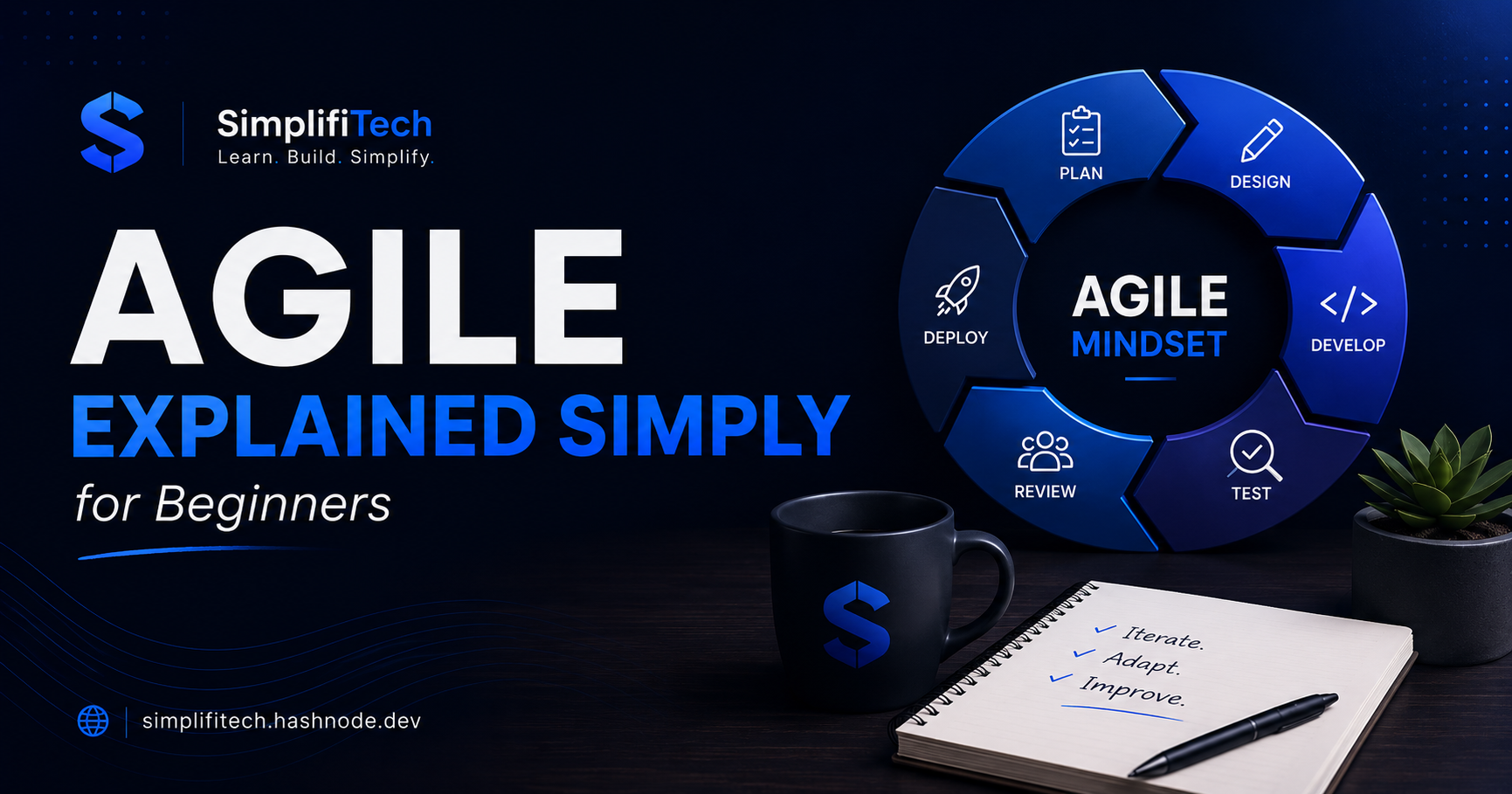
An Agile project doesn't have a definitive "end" in the same way a construction project does; it evolves. However, the typical cycle within an iteration looks like this:
- Planning: The team meets to decide what they can realistically achieve in the upcoming iteration based on the priorities in the Product Backlog.
- Development: The team writes the code, designs the interface, or builds the product features agreed upon during planning.
- Testing: Quality assurance happens continuously. Features are tested as soon as they are "finished" to ensure they meet the Definition of Done.
- Review: At the end of the iteration, the team demonstrates the working increment to stakeholders to get immediate feedback.
- Retrospective: The team meets privately to discuss what went well, what didn't, and how they can improve their process for the next iteration.
Common Challenges for Agile Beginners
Transitioning to Agile is often harder than it looks because it requires a shift in organizational culture, not just a change in schedule.
- The "Scrum-but" Trap: Many teams say, "We do Scrum, but we don't do retrospectives," or "We do Scrum, but our manager still assigns all the tasks." This prevents the team from seeing the true benefits of the framework.
- Resistance to Change: Team members used to Waterfall may feel uncomfortable with the lack of a detailed two-year plan. They may feel like Agile is "making it up as we go," when in reality, Agile is about rigorous discipline and constant adjustment.
- Underestimating Communication: Agile relies heavily on high-bandwidth communication. In a remote or hybrid 2026 work environment, teams must be intentional about using tools (like Slack, Zoom, or digital whiteboards) to maintain the "face-to-face" principle.
- Scope Creep: Because Agile welcomes change, it can be easy for the project scope to grow out of control. The Product Owner must be diligent in prioritizing the backlog to ensure the most valuable features are built first.
Why Agile is Still the Standard in 2026
In 2026, the landscape of development has been further shaped by Artificial Intelligence and automated DevOps pipelines. Agile has adapted to these changes. AI tools now assist in writing user stories and predicting team velocity with higher accuracy. However, the core need for Agile—human collaboration and customer-centricity—remains unchanged.
The speed of the market in 2026 means that "perfection" is often the enemy of "progress." Agile allows companies to release a Minimum Viable Product (MVP), gather real-world data, and then refine that product based on what users actually do, rather than what they say they want in a survey. This reduces the financial risk of building features that nobody uses.
For more information on professional standards, you can visit the Agile Alliance, a global nonprofit organization dedicated to promoting the concepts of Agile software development.
Frequently Asked Questions
Does Agile mean there is no documentation?
No. Agile prioritizes "working software over comprehensive documentation," but it does not eliminate it. The goal is to create documentation that provides value—such as API guides, setup instructions, and key architectural decisions—rather than writing hundreds of pages of requirements that will be obsolete by the time the project is finished.
Is Agile only for software developers?
While Agile originated in software development, it is now used in marketing, education, product design, and even personal productivity. Any project that involves uncertainty, requires feedback, and can be broken into smaller pieces can benefit from Agile principles.
How big should an Agile team be?
The traditional "two-pizza rule" (coined by Jeff Bezos) suggests that a team should be small enough to be fed by two large pizzas. In Scrum, the ideal team size is typically between 3 and 9 members. Larger projects use frameworks like SAFe (Scaled Agile Framework) to coordinate multiple Agile teams working on the same product.
What is the role of a manager in Agile?
In traditional settings, managers assign tasks and track hours. In Agile, the team is self-organizing. The manager's role shifts to that of a "servant leader" who removes obstacles, provides resources, and focuses on the professional growth of team members rather than micro-managing their daily tasks.
What happens if the team doesn't finish the work in a Sprint?
Unfinished work returns to the Product Backlog. It is then re-evaluated by the Product Owner to see if it is still a priority for the next Sprint. Agile encourages honesty about what can be achieved; the team should use the Retrospective to discuss why the work wasn't finished and adjust their future planning accordingly.
Next Steps for Your Agile Journey
If you are a beginner looking to move forward, your next action should be to familiarize yourself with a digital tool. Most companies use platforms like Jira, Azure DevOps, or Linear to manage their Agile workflows. You can often sign up for a free tier to practice creating a backlog and moving "cards" through a Kanban board.
Furthermore, consider looking into a foundational certification like the Certified ScrumMaster (CSM) or Professional Scrum Master (PSM I). These courses provide deep dives into the mechanics of the framework and are highly regarded by employers in 2026. For a formal educational perspective on the history and theory, Scrum.org offers extensive resources and guides that are considered the industry standard for Scrum practitioners.