Accountancy in Spanish, or contabilidad, encompasses the standardized systems of recording, classifying, and summarizing financial transactions across the Spanish-speaking world. While primarily governed by International Financial Reporting Standards (IFRS)—known in Spanish as NIIF—it also incorporates specific local regulations, such as Spain's Plan General de Contabilidad (PGC) and various Latin American adaptations, to ensure legal and fiscal compliance in diverse jurisdictions.
The Foundations of Spanish Accounting Terminology
Understanding accountancy in Spanish requires more than a simple translation of terms; it necessitates an appreciation of the conceptual framework used by practitioners in Spain and Latin America. The core of any accounting system is the classification of elements within the financial statements. In Spanish, these are broadly categorized into activos (assets), pasivos (liabilities), and patrimonio neto (equity).
Activos (Assets) are divided into activo corriente (current assets) and activo no corriente (non-current assets). For a professional operating in a Spanish-speaking environment, it is vital to distinguish between existencias (inventory), deudores comerciales (accounts receivable), and inmovilizado material (property, plant, and equipment). In 2026, the valuation of these assets often follows fair value principles (valor razonable) as dictated by modern standards, though historical cost remains a primary metric for many small and medium-sized enterprises (SMEs).
Pasivos (Liabilities) similarly split into pasivo corriente and pasivo no corriente. Common terms include acreedores comerciales (accounts payable) and préstamos a largo plazo (long-term loans). A critical aspect of Spanish accountancy is the strict distinction between provisiones (provisions) and contingencias (contingencies), as the former are recognized on the balance sheet while the latter are typically disclosed in the notes (memoria).
Patrimonio Neto (Equity) includes the capital social (share capital), reservas (reserves), and resultados acumulados (retained earnings). Understanding the nuances of "reservas legales" is particularly important in jurisdictions like Spain and Mexico, where a percentage of annual profits must, by law, be set aside until a certain threshold is reached.
Regulatory Frameworks: NIIF vs. Local GAAPs
The landscape of accountancy in Spanish is largely defined by the adoption of NIIF (Normas Internacionales de Información Financiera). However, the application of these standards varies significantly between Spain and Latin American nations.
The Spanish Model (PGC)
In Spain, the Instituto de Contabilidad y Auditoría de Cuentas (ICAC) oversees the Plan General de Contabilidad (PGC). Although the PGC was substantially overhauled to align with IFRS, it remains a distinct set of national rules. As of 2026, Spanish companies must adhere to either the "PGC Normal" for large entities or the "PGC Pymes" for smaller businesses. The Spanish system is characterized by its "Plan de Cuentas" (Chart of Accounts), which uses a standardized numbering system (e.g., Group 1 for Basic Financing, Group 2 for Non-current Assets) that is more rigid than the flexible structures often found in the United States or the United Kingdom.
The Latin American Context
In Latin America, the transition to NIIF has been widespread but is managed by different national bodies. For example:
- Mexico: Uses Normas de Información Financiera (NIF), issued by the Consejo Mexicano de Normas de Información Financiera (CINIF). While heavily converged with IFRS, Mexican NIFs maintain certain local specificities regarding inflationary accounting.
- Colombia: Has adopted a three-group system where Group 1 (large entities) follows full IFRS, Group 2 (SMEs) follows IFRS for SMEs, and Group 3 uses a simplified accounting framework.
- Chile and Peru: Both countries have moved toward full IFRS adoption for public interest entities, with localized interpretations provided by their respective colleges of accountants.
Essential Financial Statements in Spanish
A proficient accountant must be able to prepare and interpret the five primary financial statements (estados financieros) required by international standards.
- Estado de Situación Financiera (Balance Sheet): This report provides a snapshot of the entity's financial health at a specific date. It lists activos, pasivos, and patrimonio.
- Estado de Resultados (Income Statement): Also known as Cuenta de Pérdidas y Ganancias in Spain. It details ingresos (revenue) and gastos (expenses) to determine the utilidad neta or beneficio neto (net profit).
- Estado de Cambios en el Patrimonio (Statement of Changes in Equity): This tracks the movements in equity accounts, including dividends paid (dividendos pagados) and share issuances.
- Estado de Flujos de Efectivo (Cash Flow Statement): It categorizes cash movements into actividades de operación, inversión, and financiación.
- Notas a los Estados Financieros (Notes/Disclosures): In Spain, this is frequently called the Memoria. It provides the qualitative and quantitative context necessary to understand the numbers in the primary reports.
The Role of Digitalization and "Facturación Electrónica" in 2026
By 2026, the practice of accountancy in Spanish is inseparable from digital mandates. Most Spanish-speaking countries have become global leaders in facturación electrónica (electronic invoicing). This system requires businesses to issue invoices in a standardized XML format and report them to tax authorities—such as the AEAT in Spain, SAT in Mexico, or DIAN in Colombia—in real-time or near-real-time.
For accountants, this shift has moved the focus from data entry to data validation and reconciliation. Tools like the Suministro Inmediato de Información (SII) in Spain require almost instantaneous reporting of VAT (IVA) records. Consequently, software proficiency in ERPs (Enterprise Resource Planning) like SAP, Oracle, or local favorites like Contpaqi (Mexico) and Sage (Spain) is a prerequisite for any professional in the field.
Comparison of Key Accounting Terms
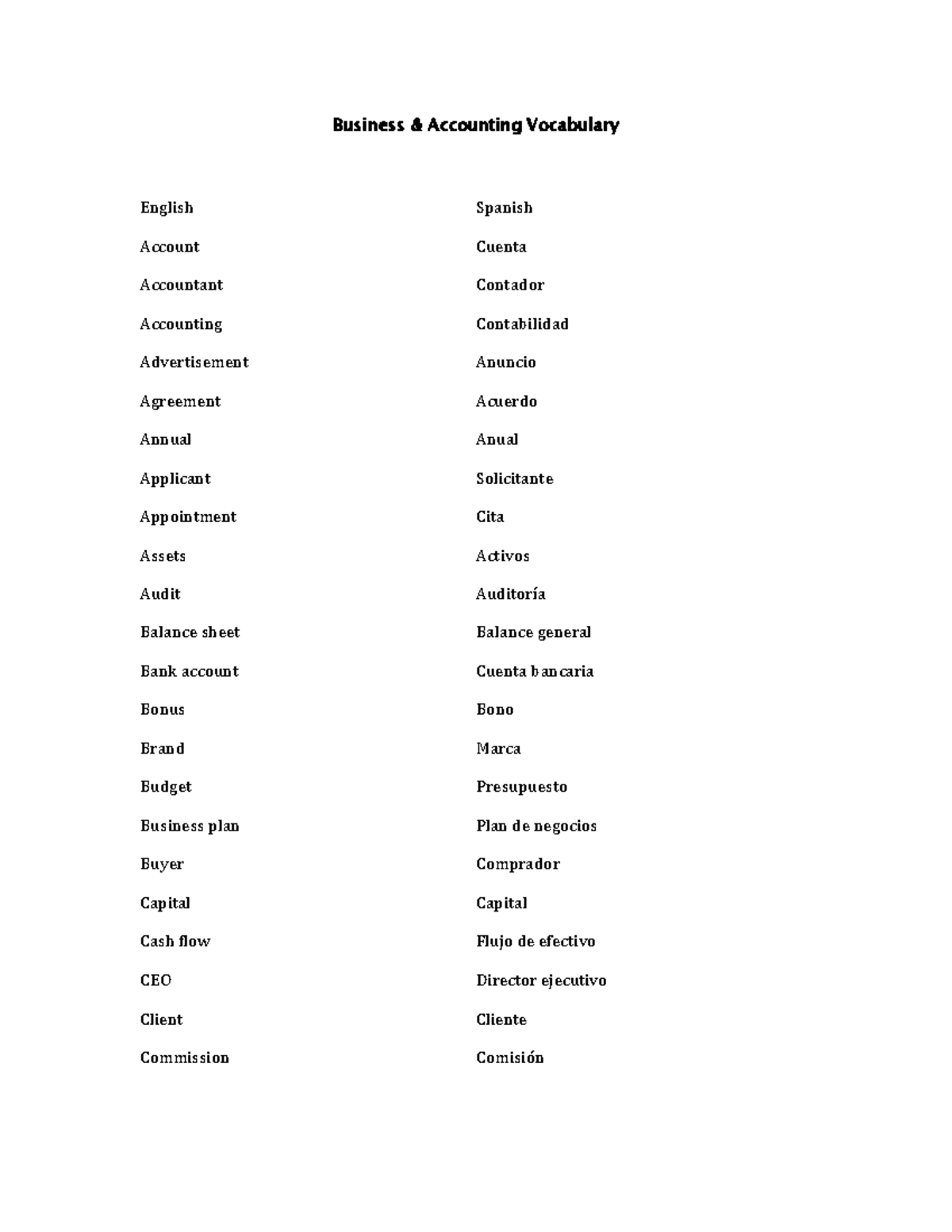
The following table provides a reference for the most frequent terms encountered in professional Spanish accountancy, comparing them to their English equivalents.
| English Term | Spanish Equivalent (LatAm/General) | Spanish Equivalent (Spain) | Definition/Context |
|---|---|---|---|
| Accounts Payable | Cuentas por Pagar | Acreedores Comerciales | Obligations to pay suppliers for goods/services. |
| Accounts Receivable | Cuentas por Cobrar | Deudores Comerciales | Amounts owed to the company by customers. |
| Fixed Assets | Activos Fijos | Inmovilizado Material | Long-term tangible assets (land, buildings, machinery). |
| Revenue | Ingresos | Ventas / Prestación de Servicios | Income arising from ordinary activities. |
| Cost of Goods Sold | Costo de Ventas | Coste de las Ventas | Direct costs attributable to the production of goods sold. |
| Retained Earnings | Utilidades Retenidas | Reservas / Resultados Acumulados | Profits not distributed as dividends. |
| Audit | Auditoría | Auditoría de Cuentas | Independent examination of financial records. |
| Ledger | Libro Mayor | Libro Mayor | The main record of all accounts in the company. |
| Journal Entry | Asiento Contable | Asiento | An individual record of a transaction. |
| Trial Balance | Balance de Comprobación | Balance de Sumas y Saldos | A list of all ledger accounts and their balances. |
Professional Certification and Ethics
To practice accountancy in a Spanish-speaking country, one must typically hold the title of Contador Público or Grado en Contabilidad y Finanzas. In many jurisdictions, such as Mexico and Colombia, professionals must be registered with a central board (e.g., the Junta Central de Contadores in Colombia) to sign off on financial statements or tax returns.
In Spain, the profession is divided between the Economista and the Censor Jurado de Cuentas. The latter is the equivalent of a Chartered Accountant or CPA specifically for auditing purposes. Ethical standards are generally aligned with the IESBA (International Ethics Standards Board for Accountants) code, translated as the Código de Ética para Profesionales de la Contabilidad. These standards emphasize integridad, objetividad, and confidencialidad.
Tax Accountancy: IVA, IRPF, and IS
Taxation is a major sub-discipline of Spanish accountancy. Accountants spend a significant portion of their time managing:
- IVA (Impuesto al Valor Agregado / Impuesto sobre el Valor Añadido): Value Added Tax. This is a consumption tax that requires complex monthly or quarterly filings (declaraciones).
- IS (Impuesto sobre Sociedades): Corporate Tax. Calculated on the accounting profit after specific tax adjustments (ajustes extracontables).
- IRPF (Impuesto sobre la Renta de las Personas Físicas): Personal Income Tax. This is particularly relevant for autónomos (freelancers) and payroll accounting.
In 2026, tax authorities have increased their use of Big Data to cross-reference these filings with bank movements, making the role of the accountant as a compliance officer more critical than ever.
Common Pitfalls in Cross-Border Spanish Accounting
When dealing with accountancy in Spanish from an English-speaking perspective, several "false friends" and conceptual differences can lead to errors:
- Gasto vs. Costo: While both can translate to "expense," costo usually refers to costs directly linked to production (COGS), while gasto refers to administrative or selling expenses.
- The Decimal Marker: Most Spanish-speaking countries use a comma (,) as a decimal separator and a period (.) for thousands, which is the inverse of the U.S. and U.K. convention. However, Mexico often follows the U.S. convention.
- Legal Reserve Requirements: Forgetting to allocate the Reserva Legal can lead to compliance issues during a statutory audit.
- The "Plan de Cuentas": Assuming you can create any account name you want. In many Spanish-speaking countries, the regulatory body expects you to follow a specific numerical hierarchy.
Frequently Asked Questions
What is the difference between NIIF and NIC?
NIC stands for Normas Internacionales de Contabilidad (IAS), which were the older standards. NIIF stands for Normas Internacionales de Información Financiera (IFRS), which include both the new standards and the older NIC that remain in effect. In a Spanish professional context, both are often referred to collectively as NIIF.
Is the "Plan General de Contabilidad" used outside of Spain?
No, the PGC is specific to Spain. However, many Latin American countries have their own "Planes Únicos de Cuentas" (PUC) or standardized charts of accounts that were historically influenced by the Spanish or French models. Today, these are increasingly being replaced or modified by IFRS-compliant frameworks.
Can a U.S. CPA practice in a Spanish-speaking country?
A U.S. CPA cannot automatically sign off on financial statements in countries like Spain or Mexico. They generally must undergo a process of homologación (recognition of their degree) and may need to pass additional exams on local tax and commercial law.
What is "Contabilidad de Doble Entrada"?
This is the Spanish term for double-entry bookkeeping. It follows the same principle that every transaction has a debe (debit) and a haber (credit), and the sum of both must always be equal.
How has AI affected accountancy in Spanish by 2026?
By 2026, Artificial Intelligence (AI) has automated the majority of asientos contables (journal entries) through OCR (Optical Character Recognition) of electronic invoices. Accountants now focus more on análisis de datos (data analysis) and asesoría estratégica (strategic advisory) rather than manual entry.
Practical Recommendation for Professionals
For those looking to master accountancy in Spanish, the first step should be to familiarize oneself with the specific Plan de Cuentas of the target country. If you are working internationally, focus on the IFRS (NIIF) framework, as this provides a common language that transcends borders. Additionally, ensure you use 2026-compliant accounting software that integrates directly with local tax authorities to handle facturación electrónica automatically. For career advancement, obtaining a local certification or a specialized Master’s in Contabilidad Internacional is highly recommended.