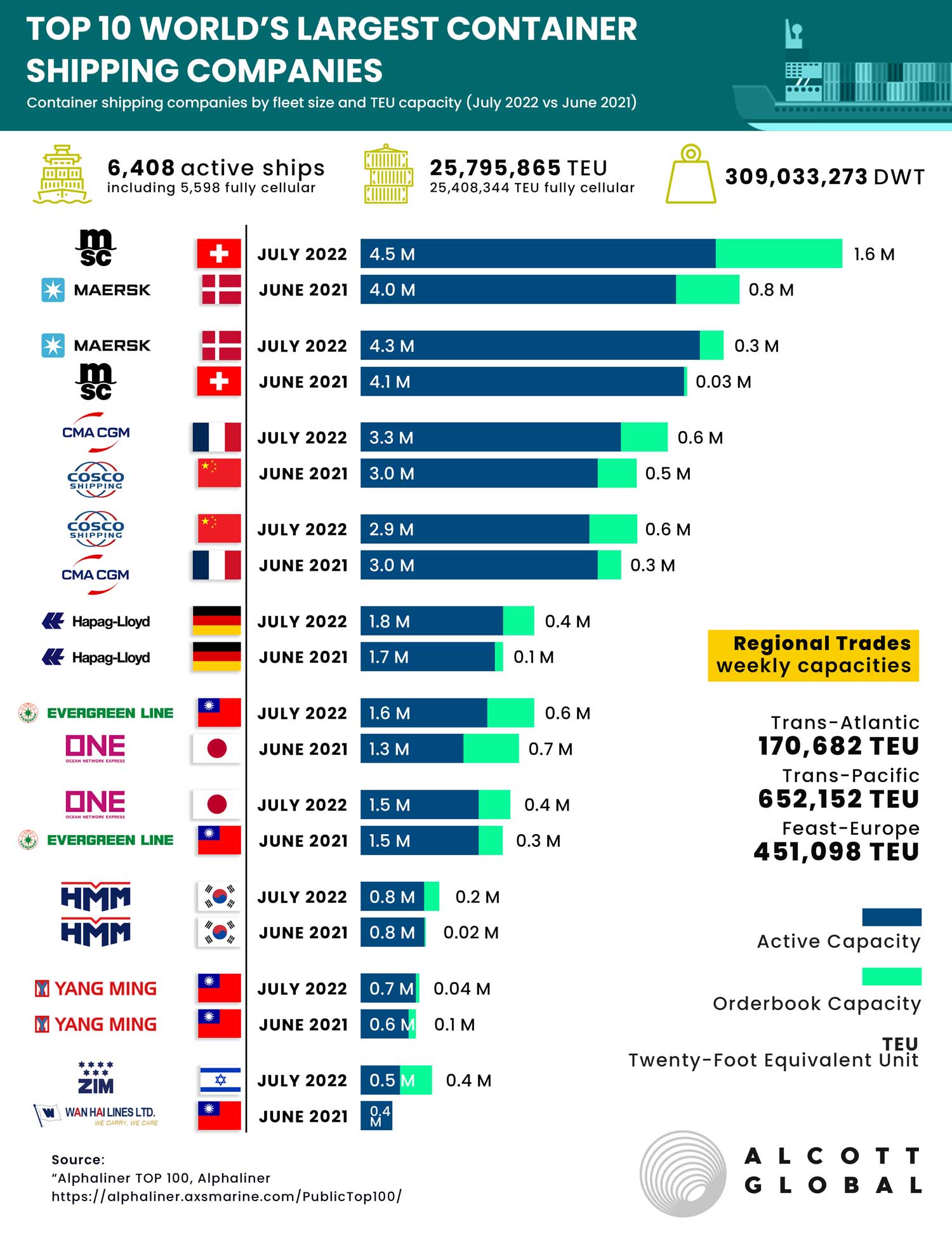
The global logistics and maritime transport sector experienced monumental financial shifts, driven by fluctuating container freight rates, post-pandemic supply chain normalization, and evolving international trade patterns. The 10 largest shipping companies by revenue generated massive turnover figures, reflecting their dominance in moving approximately 80 percent of global trade volume across international waters.
Analyzing the financial performance of global ocean carriers requires looking beyond simple vessel counts or total container capacity (TEU). While fleet size indicates physical scale, revenue figures capture charter rates, integrated logistics services, port terminal operations, and air or land freight forwarding segments. During this fiscal period, major container lines capitalized on lingering high-contract rates from previous years before experiencing a rapid normalization of freight spot markets toward the latter half of the twelve-month cycle.
Understanding Ocean Shipping Industry Metrics and Financial Scale
Evaluating ocean-going shipping lines involves understanding specialized metrics that separate containerized transport from bulk or tanker shipping. The primary unit of measurement is the Twenty-Foot Equivalent Unit (TEU), which quantifies container ship capacity. However, revenue rankings are determined through consolidated financial statements that include maritime transport, intermodal rail and trucking, supply chain management, and port infrastructure management.
Container Shipping Versus Integrated Logistics
Traditionally, ocean carriers operated strictly as port-to-port transporters. Over recent years, many industry leaders transitioned into comprehensive supply chain integrators. Companies acquired logistics firms, warehouses, and dedicated cargo aircraft fleets to offer end-to-end transport solutions. Consequently, the revenue figures for these top global players often encompass multimodal operations rather than ocean freight alone.
Market Dynamics Impacting the 2023 Fiscal Year
The 2023 business year represented a stark contrast to the historic profit peaks of 2021 and 2022. As global supply chain bottlenecks eased and consumer demand softened amid rising inflation and interest rates, global container spot rates plummeted. Despite declining freight rates, leading carriers maintained substantial financial reserves and high revenues from long-term contracts signed prior to the market correction, allowing them to secure positions among the world's most valuable logistics corporations.
The 10 Largest Shipping Companies by Revenue
The following assessment outlines the major ocean-going shipping enterprises ranked by their reported full-year revenues. These organizations manage vast networks of container vessels, roll-on/roll-off (RoRo) ships, and specialized carriers.
1. A.P. Moller - Maersk
Headquartered in Copenhagen, Denmark, Maersk remains a defining pillar of global maritime logistics. As an integrated transport and logistics company, Maersk operates an extensive fleet of container vessels and inland transport infrastructure. Despite the market correction in container shipping demand, the company retained the top revenue position through its aggressive expansion into non-ocean logistics, including air freight and contract warehousing.
2. Mediterranean Shipping Company (MSC)
Privately owned and headquartered in Geneva, Switzerland, MSC boasts the world's largest fleet by total TEU capacity. While MSC does not publicly report detailed financial breakdowns with the same regulatory transparency as publicly traded competitors, financial analyses and industry estimates position it near or at the absolute pinnacle of global shipping revenue due to its massive fleet deployment and strategic capacity management during fluctuating market cycles.
3. CMA CGM Group
Led by the Saadé family and based in Marseille, France, the CMA CGM Group is a global player in sea, land, air, and logistics solutions. The company leveraged the high-yield environment of preceding years to invest heavily in terminal operations, dedicated cargo airlines (CMA CGM Air Cargo), and digital supply chain technologies, ensuring robust top-line revenue streams throughout the period.
4. COSCO Shipping Holdings
Backed by the Chinese state, COSCO Shipping is a behemoth in container transport and port management. Headquartered in Shanghai, the group commands an immense fleet spanning major East-West and North-South trade lanes. Its integration with port operations through COSCO SHIPPING Ports provides a stable and diversified revenue foundation.
5. Hapag-Lloyd
Based in Hamburg, Germany, Hapag-Lloyd is a leading global liner shipping company. Specializing in transatlantic, Latin American, and intra-Asia trades, Hapag-Lloyd maintained solid financial performance through disciplined capacity management and high-quality customer service standards, cementing its status as a top-tier global carrier.
6. Evergreen Marine Corporation
Headquartered in Taoyuan, Taiwan, Evergreen is one of the world's largest ocean freight carriers, recognized globally for its distinctive green vessels and large ultra-large container ships (ULCS). Evergreen benefited from robust trans-Pacific trade volumes and aggressive fleet modernization programs that improved operational efficiency during a volatile economic climate.
7. ONE (Ocean Network Express)
Formed through the integration of the container shipping businesses of Japanese giants Nippon Yusen Kaisha (NYK), Mitsui O.S.K. Lines (MOL), and K Line, ONE is headquartered in Singapore. The carrier focuses on optimizing trans-Pacific and intra-Asia trade routes, utilizing standardized container assets and collaborative alliance structures to sustain competitive financial performance.
8. HMM (formerly Hyundai Merchant Marine)
Headquartered in Seoul, South Korea, HMM has undergone substantial state-backed financial restructuring and fleet expansion. The carrier operates a modern fleet of mega-container ships and has steadily increased its market share across major global trade corridors, supporting consistent revenue generation.
9. Yang Ming Marine Transport Corporation
Based in Keelung, Taiwan, Yang Ming is a prominent ocean carrier providing global container transportation services. As a core member of THE Alliance, Yang Ming leverages cooperative vessel-sharing agreements to maintain cost efficiency and secure stable freight revenues across competitive international trade routes.
10. ZIM Integrated Shipping Services
Headquartered in Haifa, Israel, ZIM operates with a differentiated business model that emphasizes digital agility, asset-light vessel chartering, and targeted deployment on niche and high-demand trades, such as the trans-Pacific express lanes. This strategic flexibility allows ZIM to capture profitable market segments despite broader industry volatility.
Comparative Overview of Top Carriers
The following table summarizes key structural indicators and operational focuses for the leading shipping enterprises.
| Company | Headquarters | Primary Operational Focus | Asset Strategy |
|---|---|---|---|
| A.P. Moller - Maersk | Copenhagen, Denmark | Integrated Container Logistics | Owned fleet & acquired logistics networks |
| MSC | Geneva, Switzerland | Global Container Transport | Large owned & chartered fleet mix |
| CMA CGM Group | Marseille, France | Multimodal & Air/Sea Logistics | Comprehensive asset diversification |
| COSCO Shipping | Shanghai, China | Container Shipping & Port Operations | State-backed scale & port integration |
| Hapag-Lloyd | Hamburg, Germany | Liner Shipping & Reefer Transport | Balanced owned & chartered vessels |
| Evergreen Marine | Taoyuan, Taiwan | Trans-Pacific & Global Trade | Ultra-large container ship deployment |
| Ocean Network Express (ONE) | Singapore | Trans-Pacific & Intra-Asia | Consolidated Japanese fleet assets |
| HMM | Seoul, South Korea | Global Mainline Container Routes | Modernized mega-ship fleet expansion |
| Yang Ming Marine | Keelung, Taiwan | Alliance-Based Global Shipping | Cooperative vessel-sharing agreements |
| ZIM Integrated Services | Haifa, Israel | Niche Trades & Express Lanes | Asset-light chartering model |
Strategic Operational Trends and Market Factors
The financial standing of these global shipping giants depends on several interdependent operational pillars. Understanding these factors explains how these corporations maintain multi-billion-dollar revenue streams even as macroeconomic pressures mount.
Fleet Modernization and Environmental Regulations
International maritime regulations enforced by the International Maritime Organization (IMO) mandate significant reductions in greenhouse gas emissions. Shipping companies invested heavily during this period in dual-fuel vessels capable of running on liquefied natural gas (LNG), green methanol, or bio-fuels. These capital expenditures impact short-term financial liquidity but are viewed as essential prerequisites for long-term operational viability and compliance with carbon-tax frameworks in regions like the European Union.
Vessel-Sharing Alliances and Capacity Management
To optimize operational costs and maintain schedule reliability, the major ocean carriers operate within formalized global alliances, such as THE Alliance and the Ocean Alliance. These cooperative agreements allow carriers to share vessel space, rationalize port calls, and manage capacity deployment dynamically in response to shifting global trade volumes. This collaborative framework acts as a vital buffer against severe freight rate fluctuations.
Digital Transformation and Supply Chain Visibility
Modern cargo owners demand real-time visibility into cargo location, customs clearance status, and predictive analytics regarding arrival times. The leading shipping companies accelerated investments in digital booking platforms, electronic bills of lading (eBL), and internet of things (IoT) container tracking sensors. These digital enhancements improve customer retention and create secondary revenue streams through value-added data services.
Frequently Asked Questions
How do shipping companies generate revenue besides ocean freight?
While port-to-port maritime transport remains the core income driver, top shipping companies generate substantial revenue through inland rail and trucking services, contract logistics and warehousing, air freight forwarding, customs brokerage, and container terminal operations. This diversification cushions companies against downturns in ocean freight spot rates.
What is TEU capacity and why is it important?
TEU stands for Twenty-Foot Equivalent Unit, a standard measure used in the container shipping industry to describe the capacity of container ships and terminals. One TEU represents the volume of a standard 20-foot long intermodal shipping container. While TEU capacity measures physical scale, it does not directly equate to revenue, as revenue depends heavily on freight rates, route profitability, and integrated logistics services.
Why did shipping revenues fluctuate significantly around this period?
Shipping revenues surged to historic highs during the post-pandemic supply chain congestion period due to extreme container shortages and soaring freight rates. As global supply chains normalized, consumer demand softened, and new vessel deliveries entered the market, spot freight rates declined sharply, causing revenues to normalize toward pre-pandemic structural baselines.
Are all major shipping companies publicly traded?
No. While industry leaders such as A.P. Moller - Maersk, Hapag-Lloyd, COSCO Shipping, and ZIM are publicly listed on stock exchanges, others like the Mediterranean Shipping Company (MSC) operate as privately held family-owned enterprises. Privately held carriers are not subject to the same public financial reporting requirements, meaning their exact revenue figures are derived from industry estimates and financial modeling.
How do global alliances affect shipping company operations?
Global alliances are operational partnerships between ocean carriers that allow them to pool vessel fleets, share slot allocations on specific trade loops, and coordinate shared port terminal usage. These agreements enable smaller or mid-tier carriers to offer comprehensive global network coverage without bearing the entire capital expenditure of maintaining independent fleets on every international route.
Conclusion and Next Actions
Navigating the global logistics landscape requires stakeholders, cargo owners, and industry analysts to monitor not just top-line revenue figures, but also fleet efficiency, decarbonization progress, and multimodal integration strategies. When evaluating carriers for long-term contract logistics partnerships, organizations should examine schedule reliability metrics, digital booking capabilities, and financial stability indices alongside published annual turnover reports.