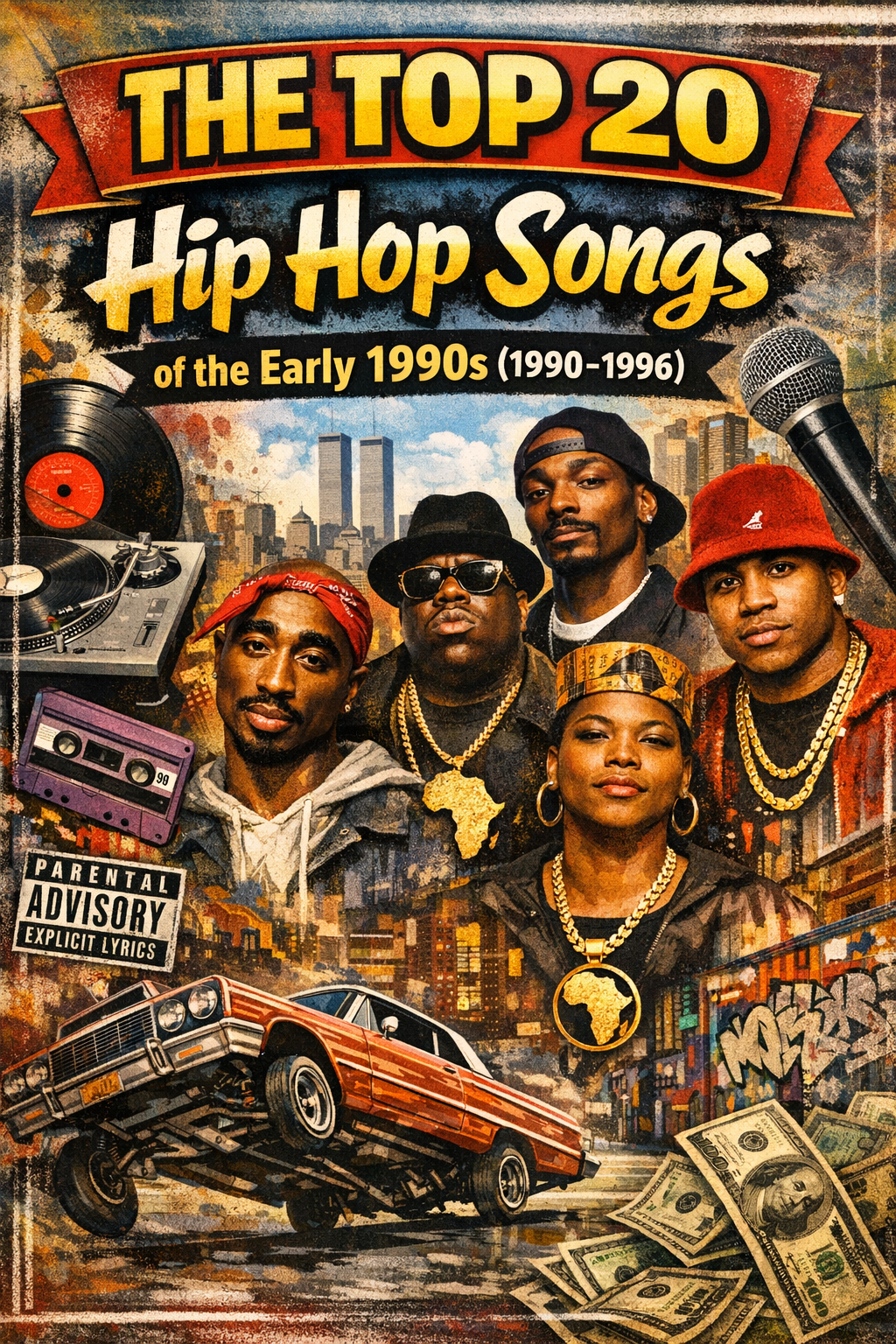
The 1990s marked the golden era of hip-hop, transitioning the genre from an urban subculture into the dominant force in global popular music. Driven by legendary lyrical rivalry, groundbreaking production techniques, and vivid storytelling, the decade produced tracks that shaped fashion, language, and youth culture. This retrospective examines ten iconic 1990s rap songs that defined a generation, analyzing their production, social impact, and enduring artistic legacy.
The Golden Era: How 1990s Hip-Hop Reshaped Global Culture
During the 1990s, rap music underwent an unprecedented artistic and commercial evolution. The decade began with regional soundscapes defining distinct identities: the West Coast popularized G-funk through laid-back synth lines and heavy funk samples, while the East Coast perfected raw, sample-heavy boom-bap centered on intricate lyricism and urban realism. By mid-decade, Southern hip-hop introduced rich live instrumentation, blues influences, and fresh rhythmic cadences that permanently altered the genre's geographic center of gravity.
Beyond musical aesthetics, 1990s rap served as a vital socio-political platform. Artists used their mics to document systemic inequality, economic hardship, police friction, and the complexities of urban life following the crack cocaine epidemic. Concurrently, hip-hop culture dictated global youth fashion—popularizing oversized streetwear, designer boot trends, and luxury athletics—while reshaping vernacular language across international lines. Understanding these ten pivotal tracks requires looking beyond chart positions to see how each song captured the distinct cultural climate of its release.
The 10 Definitive 1990s Rap Tracks
1. Dr. Dre feat. Snoop Doggy Dogg – "Nuthin' but a 'G' Thang" (1992)
Released as the lead single from Dr. Dre’s seminal 1992 album The Chronic, "Nuthin' but a 'G' Thang" established the West Coast G-funk sound that dominated mid-1990s airwaves. Built on a slowed-down sample of Leon Haywood’s 1975 funk track "I Want'a Do Something Freaky to You," the song substituted the frantic, fast-paced breaks of late-1980s hip-hop with synthesizer glides, heavy basslines, and a relaxed, melodic bounce.
The track introduced the world to Snoop Doggy Dogg, whose effortless, conversational delivery complemented Dr. Dre's command of the beat. By securing massive rotation on MTV, "Nuthin' but a 'G' Thang" proved that explicit street narratives could achieve mainstream pop radio success without compromising regional authenticity.
2. Wu-Tang Clan – "C.R.E.A.M." (1993)
"C.R.E.A.M." (Cash Rules Everything Around Me) stands as the atmospheric centerpiece of Wu-Tang Clan’s debut masterpiece, Enter the Wu-Tang (36 Chambers). Produced by RZA, the track samples the soulful piano loop from The Charmels' 1967 single "As Long As I've Got You," layered over cracking, unpolished snare drums.
Featuring poignant verses from Raekwon and Inspectah Deck alongside Method Man’s iconic hook, the track offers a somber, unvarnished look at economic desperation and survival in Staten Island. The acronym itself entered the global lexicon permanently, exemplifying how hip-hop transformed street financial realities into enduring cultural philosophies.
3. The Notorious B.I.G. – "Juicy" (1994)
The lead single from Christopher Wallace’s debut album Ready to Die, "Juicy" remains the definitive hip-hop rags-to-riches anthem. Produced by Poke of the Trackmasters and Sean "Puffy" Combs, the track relies on a direct sample of Mtume’s 1983 funk hit "Juicy Fruit."
Biggie Smalls used the breezy, uplifting instrumental to chart his trajectory from living in a Brooklyn apartment without heat to achieving international stardom. His cadence, impeccable timing, and balance of humor with hardship created a template for crossover rap tracks that appealed equally to hardcore hip-hop heads and pop audiences.
4. Nas – "N.Y. State of Mind" (1994)
Featured on Nas’s landmark debut Illmatic, "N.Y. State of Mind" is widely regarded as a masterclass in narrative lyricism and street journalism. Producer DJ Premier constructed a dark, jazz-infused beat by pairing a pitch-bent piano sample from Joe Chambers' "Mind Rain" with sharp drum patterns and cuts from Donald Byrd.
Nas recorded his famous first verse—beginning with the candid off-mic phrase "I don't know how to start this shit"—in a single legendary take. At just 20 years old, his complex rhyme schemes, cinematic imagery, and vivid depiction of New York housing projects set a new technical benchmark for lyricism in rap music.
5. 2Pac feat. Dr. Dre & Roger Troutman – "California Love" (1995)
Serving as Tupac Shakur's grand debut on Death Row Records after his release from prison in late 1995, "California Love" became an instant anthem for the Golden State. Produced by Dr. Dre, the song incorporates a reworked horn sample from Joe Cocker's "Woman to Woman" and features electro-funk pioneer Roger Troutman delivering talk-box vocals.
The track showcased 2Pac’s unmatched charismatic energy, paired with an iconic post-apocalyptic, Mad Max-inspired music video directed by Hype Williams. "California Love" topped the Billboard Hot 100, symbolizing the peak of West Coast hip-hop's commercial power during the mid-1990s.
6. Mobb Deep – "Shook Ones, Pt. II" (1995)
Few songs capture the haunting atmosphere of 1990s East Coast hardcore rap as vividly as Mobb Deep’s "Shook Ones, Pt. II." Produced by Havoc, the beat features a pitch-shifted, slowed-down sample from Herbie Hancock's "Jessica," anchored by a stark, slicing snare drum and heavy sub-bass.
Prodigy and Havoc delivered sharp, unflinching verses detailing the psychological tension and constant vigilance required to navigate street life in Queensbridge, Queens. The track's opening hi-hat and guitar line remain among the most instantly recognizable sound clips in hip-hop history.
7. 2Pac – "Dear Mama" (1995)
Published on the 1995 album Me Against the World, "Dear Mama" demonstrated hip-hop's capacity for deep emotional vulnerability. Produced by Tony Pizarro, the song samples Joe Sample’s "In All My Wildest Dreams" and The Spinners' "Sadie" to craft a warm, nostalgic musical foundation.
2Pac’s heartfelt tribute to his mother, Afeni Shakur, directly confronted her struggles with addiction while honoring her resilience raising children in poverty. In 2010, the track was inducted into the National Recording Registry by the Library of Congress, highlighting its cultural and historical significance.
8. The Notorious B.I.G. – "Hypnotize" (1997)
Released just weeks before Wallace’s tragic death in March 1997, "Hypnotize" served as the primary single for his double album Life After Death. Produced by Deric "D-Dot" Angelettie, Ron Lawrence, and Sean Combs, the beat centers on a prominent loop of Herb Alpert’s 1979 jazz-funk instrumental "Rise."
"Hypnotize" captured the luxury-focused "Shiny Suit Era" of late-1990s rap. Biggie’s fluid rhythm, effortless internal rhymes, and immense vocal charisma pushed the song to number one on the Billboard Hot 100 posthumously, affirming his status as one of the greatest lyricists in music history.
9. OutKast – "Rosa Parks" (1998)
As East Coast and West Coast rivalries dominated headlines throughout the decade, Atlanta duo OutKast (Big Boi and André 3000) carved out a distinct identity for Southern hip-hop. "Rosa Parks," from their 1998 album Aquemini, combined futuristic rap flows with traditional Southern acoustic guitar riffs and an unexpected harmonica solo.
Self-produced under their Earthtone III moniker, the track’s titular hook—"Ah ha, hush that fuss / Everybody move to the back of the bus"—used civil rights imagery as a metaphor for pushing competing rappers out of the spotlight. The song proved that Southern hip-hop possessed the technical lyricism and musical versatility to challenge coastal dominance.
10. Lauryn Hill – "Doo Wop (That Thing)" (1998)
Written, produced, and performed by Lauryn Hill for her ground-breaking album The Miseducation of Lauryn Hill, "Doo Wop (That Thing)" redefined the boundaries between rap, neo-soul, and classic R&B. The song features a brass-heavy horn section and a swinging 1960s doo-wop drum break.
Lyrically, Hill delivered two distinct verses—one addressed to women, the other to men—calling for self-respect, accountability, and maturity in relationships. The song debuted at number one on the Billboard Hot 100 and went on to win multiple Grammy Awards, solidifying female MCs at the absolute peak of the music industry.
Musical Innovations and Production Styles of 90s Rap
The musical landscape of 1990s rap was defined by distinct regional production philosophies and sampling techniques. Producers operated within hardware constraints using digital samplers like the E-mu SP-1200 and the Akai MPC2000, forcing creative ingenuity in how audio clips were chopped, looped, and filtered.
| EAST COAST BOOM-BAP | WEST COAST G-FUNK | SOUTHERN HYBRID |
|---|---|---|
| - Gritty drum breaks- Jazz/Soul chops- Minor key piano loops | - Smooth synth lines- Heavy P-Funk samples- Slowed tempo bounce | - Live guitars- Harmonica/Blues- Fast hi-hats |
- The Boom-Bap Aesthetic: Popularized in New York by producers like DJ Premier, RZA, Pete Rock, and Havoc, boom-bap emphasized hard-hitting kick drums, sharp snares, and dusty vinyl samples drawn primarily from 1960s and 1970s jazz, soul, and blues records.
- The G-Funk Revolution: Developed in Los Angeles by Dr. Dre, Cold 187um, and Daz Dillinger, G-Funk relied heavily on re-recorded or sampled Parliament-Funkadelic rhythm tracks, layered with high-pitched Portamento synthesizer leads and deep basslines.
- Southern Organic Fusion: Crafted by production teams like Organized Noize and Earthtone III, Southern production introduced live guitar instrumentation, gospel harmonies, and original horn arrangements, blending traditional American music styles with fast, double-time rap cadences.
Detailed Comparison: 90s Hip-Hop Masterpieces
The following matrix compares key technical, production, and thematic attributes of these ten landmark compositions:
| Track Title | Artist | Year | Primary Producer(s) | Signature Sample / Foundation | Core Cultural Theme |
|---|---|---|---|---|---|
| "Nuthin' but a 'G' Thang" | Dr. Dre ft. Snoop Dogg | 1992 | Dr. Dre | Leon Haywood – "I Want'a Do Something Freaky to You" | West Coast lifestyle & G-funk introduction |
| "C.R.E.A.M." | Wu-Tang Clan | 1993 | RZA | The Charmels – "As Long As I've Got You" | Inner-city economic hardship & survival |
| "Juicy" | The Notorious B.I.G. | 1994 | Poke (Trackmasters), Sean Combs | Mtume – "Juicy Fruit" | The American Dream & musical success |
| "N.Y. State of Mind" | Nas | 1994 | DJ Premier | Joe Chambers – "Mind Rain" | Realist street journalism & urban decay |
| "California Love" | 2Pac ft. Dr. Dre | 1995 | Dr. Dre | Joe Cocker – "Woman to Woman" | Regional pride & celebration |
| "Shook Ones, Pt. II" | Mobb Deep | 1995 | Havoc | Herbie Hancock – "Jessica" | Paranoia, street pressure, and defense |
| "Dear Mama" | 2Pac | 1995 | Tony Pizarro | Joe Sample – "In All My Wildest Dreams" | Maternal appreciation & emotional honesty |
| "Hypnotize" | The Notorious B.I.G. | 1997 | Deric "D-Dot" Angelettie, Ron Lawrence, Sean Combs | Herb Alpert – "Rise" | Pop crossover & luxury lifestyle |
| "Rosa Parks" | OutKast | 1998 | Earthtone III (OutKast) | Original live guitar & harmonica composition | Southern identity & artistic evolution |
| "Doo Wop (That Thing)" | Lauryn Hill | 1998 | Lauryn Hill | Original 1960s R&B/Doo-wop arrangement | Social accountability & self-respect |
The Socio-Political and Cultural Impact of 90s Hip-Hop
The cultural imprint of 1990s rap extended far beyond album sales and radio charts. The era’s lyrical narratives provided a direct commentary on contemporary historical events, including the 1992 Los Angeles uprising, the war on drugs, and national debates over artistic censorship.
Hip-hop fashion also grew into a multi-billion-dollar global industry during this decade. Artist-led and hip-hop-adjacent brands such as Karl Kani, FUBU, Cross Colours, and Sean John replaced traditional fashion houses among urban youth. These tracks also served as the primary vector for spreading African American Vernacular English (AAVE) into mainstream global discourse. Terms popularized in these songs—such as "C.R.E.A.M." for money or regional slang like "playa" and "drop it like it's hot"—became permanent fixtures in pop culture language.
Frequently Asked Questions
What made the 1990s the "Golden Era" of rap music?
The 1990s earned this title due to an unprecedented convergence of lyrical innovation, diverse regional styles, groundbreaking production techniques, and commercial expansion. During this decade, artists perfected complex rhyme schemes and poetic storytelling while hip-hop transformed from a niche regional genre into the dominant force in global popular culture.
Which 1990s rap song had the biggest commercial crossover impact?
"California Love" by 2Pac and "Hypnotize" by The Notorious B.I.G. both reached the top spot on the Billboard Hot 100, but Lauryn Hill’s "Doo Wop (That Thing)" achieved extraordinary crossover success. It debuted at number one on the Billboard Hot 100, won multiple Grammy Awards including Album of the Year for its parent record, and brought conscious rap into the pop mainstream.
How did regional rivalries shape the sound of 1990s rap?
The competitive tension between the East Coast and West Coast led producers and MCs to sharpen their distinct musical identities. East Coast artists leaned heavily into dark, jazz-sampled boom-bap and complex lyricism to defend New York's status as hip-hop's birthplace. Conversely, West Coast producers developed melodic, synth-driven G-funk to build an independent sonic movement.
What role did women play in shaping 1990s hip-hop culture?
Female MCs and producers broken down gender barriers and delivered critical commercial and artistic triumphs in the 1990s. Artists like Lauryn Hill, Queen Latifah, MC Lyte, Salt-N-Pepa, Foxy Brown, and Lil' Kim challenged male dominance in the genre, introducing fresh perspectives on female empowerment, social accountability, and stylistic versatility.
Why did hip-hop sampling change drastically in the late 1990s?
Sampling practices shifted primarily due to high-profile legal rulings, such as the 1991 lawsuit Grand Upright Music, Ltd. v. Warner Bros. Records Inc., which mandated that clearance must be obtained prior to using copyrighted sound recordings. This made clearing multi-layered samples expensive, prompting producers to rely on single prominent sample loops or re-record live instrumentation.
Recommended Next Steps for Music Historians and Listeners
To fully appreciate the musical depth and historical context of 1990s hip-hop, consider exploring the following actions:
- Listen to Full Albums: Experience these tracks within their original context by listening to full albums such as Nas's Illmatic (1994), The Notorious B.I.G.'s Ready to Die (1994), 2Pac's Me Against the World (1995), OutKast's Aquemini (1998), and Lauryn Hill's The Miseducation of Lauryn Hill (1998).
- Trace the Original Samples: Research the original 1960s and 1970s funk, soul, and jazz tracks sampled by producers like Dr. Dre, RZA, and DJ Premier using sample databases such as WhoSampled.
- Explore Regional Soundscapes: Compare the production aesthetics of early 1990s New York boom-bap directly with West Coast G-funk and emerging Southern rap to gain a deeper understanding of geographic musical trends.