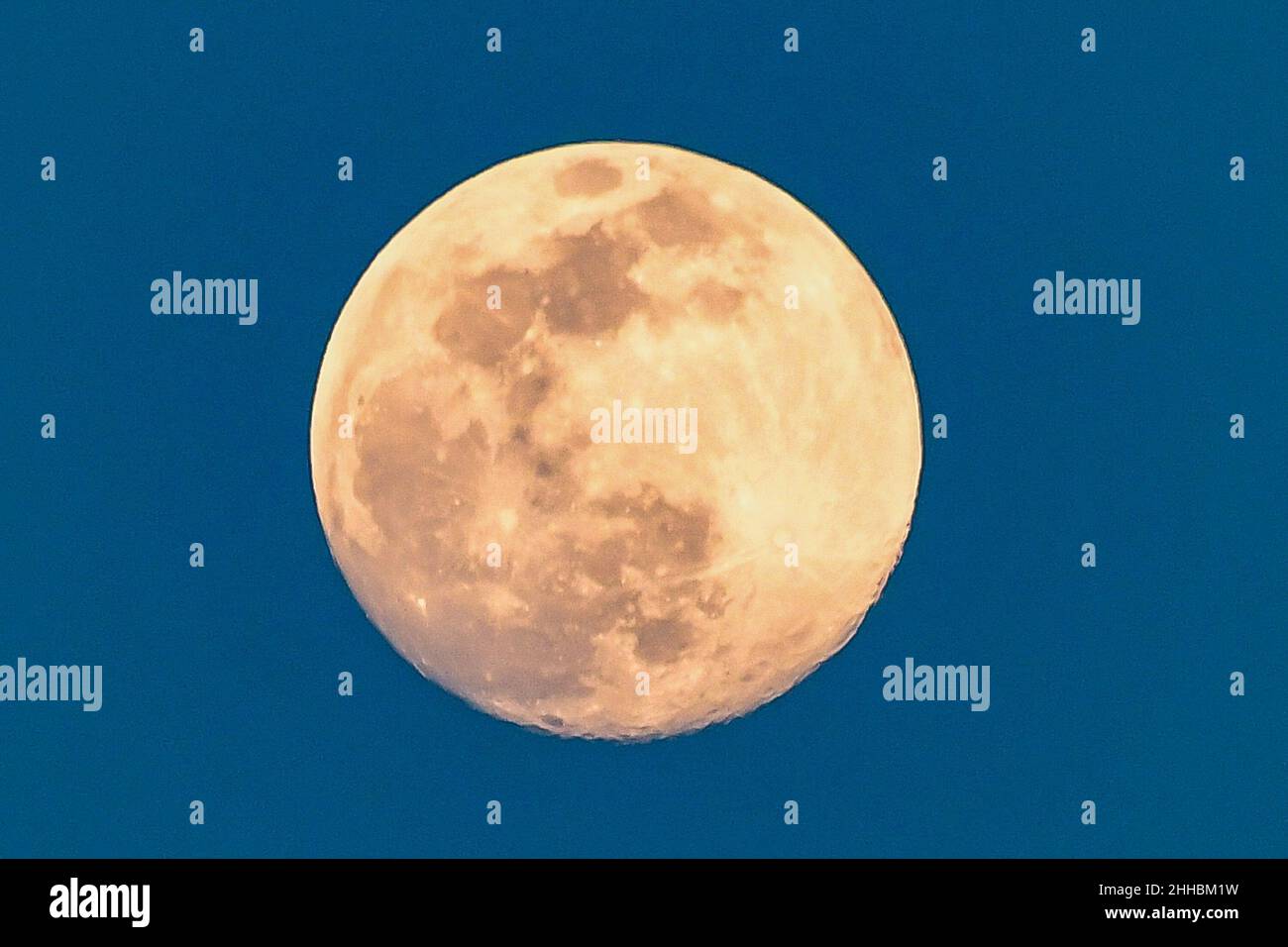
The April 2020 Pink Moon was a significant astronomical and cultural event, occurring on April 7 and 8, 2020, as the biggest and brightest full moon of that year. Despite its colorful name, the moon did not actually turn pink; instead, the moniker originates from North American folklore, denoting the blooming of wild ground phlox flowers in early spring.
Understanding the Terminology: Why Is It Called a "Pink Moon"?
To appreciate the April 2020 full moon, it helps to understand how full moon names originate. Traditional full moon names derive from a combination of Native American, Colonial American, and European folklore. These societies tracked the changing seasons by giving distinct names to each recurring full moon of the year.
The name "Pink Moon" specifically references Phlox subulata, a native North American wildflower commonly known as creeping phlox, moss phlox, or moss pink. As winter recedes and spring progresses into April, these vibrant magenta and pink flowers blanket fields and woodlands, signaling the full return of plant life and warmer weather. Other historical names for this specific lunar cycle include the Sprouting Grass Moon, the Egg Moon, and, among coastal tribes, the Fish Moon, because it coincided with shad swimming upstream to spawn.
Crucially, the Pink Moon is a cultural descriptor rather than an official scientific term. The National Aeronautics and Space Administration (NASA) and professional astronomers recognize the event simply as the April full moon. The moon reflects sunlight back to Earth, and during a full moon, the sun, Earth, and moon are aligned in an approximately straight line, with Earth in the middle. This geometry causes the face of the moon visible from Earth to be fully illuminated, appearing as a brilliant disk in the night sky.
The Supermoon Phenomenon of April 2020
The April 2020 full moon was not just notable for its traditional name; it was also classified as a supermoon. A supermoon occurs when a full moon coincides with lunar perigee—the point in the moon's elliptical orbit when it is closest to Earth.
The moon’s orbit around Earth is not a perfect circle; it is an ellipse, meaning the distance between Earth and its natural satellite varies continuously. The average distance is roughly 238,855 miles (384,400 kilometers). When a full moon occurs near perigee, the moon can approach within approximately 221,600 miles (356,500 kilometers) of Earth.
Because of this closer proximity, a supermoon appears slightly larger and significantly brighter than a typical full moon. Specifically:
- Apparent Size: A supermoon can appear up to 14% larger than a full moon at apogee (its farthest point from Earth).
- Illumination and Brightness: A supermoon can shine about 30% brighter than a full moon at its dimmest point.
The April 2020 supermoon was particularly celebrated because it was the closest supermoon of the year 2020. It edged out the March 2020 supermoon by a razor-thin margin of just over 85 miles, making it the absolute peak of the supermoon trio that spanned spring 2020.
Timeline and Global Visibility of the April 2020 Event
The exact timing of the full moon varies depending on the observer's geographic time zone, but the peak illumination occurred globally on April 7 and April 8, 2020.
For observers in North America, the peak occurred on the evening of Tuesday, April 7, 2020. Specifically, maximum illumination was reached at 10:35 PM Eastern Daylight Time (EDT), which corresponded to 7:35 PM Pacific Daylight Time (PDT). For regions further east, such as Europe, Asia, and Australia, the peak occurred during the early morning hours of Wednesday, April 8, 2020.
Despite there being an exact minute of peak fullness, the moon appeared completely full to the unaided human eye for a period spanning roughly three days, from Monday night through Thursday morning. This window provided ample opportunity for stargazers, astrophotographers, and casual observers worldwide to view the phenomenon, weather permitting.
Cultural and Global Significance During a Historical Moment
The April 2020 Pink Moon occurred during a unique historical context: the height of global lockdowns associated with the COVID-19 pandemic. For millions of people confined to their homes, looking up at the night sky became a popular, safe, and accessible form of recreation and community connection.
Astronomical events often serve as communal touchstones, encouraging people to step outside, disconnect from screens, and share a collective experience. In April 2020, social media feeds were flooded with photographs of the bright lunar disk framed by cityscapes, trees, and monuments. The moon’s brilliant display offered a brief moment of natural wonder and psychological respite for populations navigating unprecedented social restrictions.
Furthermore, the April full moon holds religious significance in several traditions. In the Christian liturgical calendar, the full moon of the vernal equinox (or the first full moon after the equinox) determines the date of Easter. The April 2020 full moon directly influenced the timing of Easter Sunday, which fell on April 12, 2020, just days after the lunar peak. In various Buddhist traditions, full moon days are observed as holy days, with practitioners engaging in meditation, chanting, and reflection.
Observational Characteristics and Moon Illusion
For those attempting to view the April 2020 supermoon, the experience was heavily influenced by atmospheric conditions and a well-documented psychological phenomenon known as the "moon illusion."
When the moon first rises above the horizon—just as the sun is setting—it often appears massive, sometimes glowing with a warm, golden, or amber hue. Many observers mistakenly attribute this giant appearance to the supermoon status. However, this is an optical illusion.
| Feature | Horizon Moon (Moon Illusion) | High Overhead Moon |
|---|---|---|
| Apparent Size | Appears unnaturally large to the human brain. | Appears smaller, standard size. |
| Coloration | Warm, golden, orange, or reddish hues due to light scattering. | Bright white or silver. |
| Cause | Psychological perception and comparison with terrestrial objects (trees, buildings). | Light passes through less atmosphere directly overhead. |
| Scientific Reality | The physical size of the moon's image on the retina is identical in both positions. | The physical size remains constant. |
The moon illusion occurs because our brains compare the low-hanging moon to familiar terrestrial objects on the horizon, such as buildings, trees, and mountains. Once the moon climbs high into the night sky, those comparative reference points disappear, and the moon appears to shrink back to its normal proportions, despite remaining at the exact same distance from Earth.
Astrophotography and Viewing Tips
Capturing or observing a supermoon like the one in April 2020 requires understanding basic viewing dynamics. While binoculars and telescopes reveal stunning crater details along the lunar terminator (the dividing line between light and shadow), the naked eye provides a striking experience of its overall brightness.
For individuals interested in maximizing their viewing or photographic experience of similar full moons, several technical practices apply:
- Timing the Rise: The best moment to view a supermoon is during moonrise, which happens roughly around sunset. This provides the dual benefit of warm twilight colors and the moon illusion.
- Finding Dark Skies: While the full moon is bright enough to cut through moderate light pollution, moving away from urban centers enhances the contrast of the surrounding stars and constellations.
- Camera Settings: Photographers attempting to capture the moon often make the mistake of using automatic settings, which overexpose the bright lunar surface. Manual settings—using a low ISO, a fast shutter speed, and a narrow aperture (high f-number)—are necessary to preserve surface details like craters and maria (dark volcanic plains).
Frequently Asked Questions
Did the April 2020 Pink Moon actually look pink?
No, the moon did not physically change color. The name "Pink Moon" is derived from Native American and colonial folklore, referencing the blooming of wild pink ground phlox flowers that appear across North America in early spring. During moonrise, a full moon can sometimes appear amber, orange, or reddish due to the thickness of Earth's atmosphere scattering blue light wavelengths, but it never turns a vibrant botanical pink.
What makes a full moon a supermoon?
A supermoon occurs when a full moon coincides with or is near lunar perigee—the point in the moon's elliptical orbit where it comes closest to Earth. Because of this proximity, the moon appears up to 14% larger and roughly 30% brighter than a micro-moon (a full moon at apogee). Not every full moon is a supermoon; they typically occur three to four times a year in consecutive sequences.
Why do full moon names vary across cultures?
Full moon names historically functioned as a calendar system for agrarian and foraging societies. Different indigenous tribes, European settlers, and Asian cultures tracked the progression of the seasons, animal migrations, and plant cycles by naming each full lunar cycle after notable ecological markers observed in their specific geographic regions.
Was the April 2020 supermoon the biggest of the decade?
No. While it was the closest and largest supermoon of the year 2020, it was not the largest of the decade. Supermoons vary slightly in their perigee distance due to gravitational interactions involving the Earth, Moon, and Sun. The closest supermoons of the 21st century occur in specific multi-year clusters, with other years featuring marginally closer perigees than 2020.
How does the moon's orbit cause it to change distance from Earth?
The moon orbits Earth in an ellipse rather than a perfect circle. This elliptical path results from gravitational forces exerted primarily by the Earth and the Sun. Because the orbit is oval-shaped, the distance between the center of Earth and the center of the moon continuously fluctuates between perigee (closest point, roughly 226,000 miles on average) and apogee (farthest point, roughly 251,000 miles on average) over a roughly 27.5-day cycle.
Next Steps for Stargazers
To deepen your understanding of lunar cycles and prepare for upcoming celestial events, consult reputable astronomical resources such as NASA's Dial-A-Moon tool, the U.S. Naval Observatory, or established astronomy software and mobile applications. Tracking lunar perigees and apogees throughout the year allows observers to anticipate future supermoons and plan viewing sessions around optimal weather and moonrise schedules.