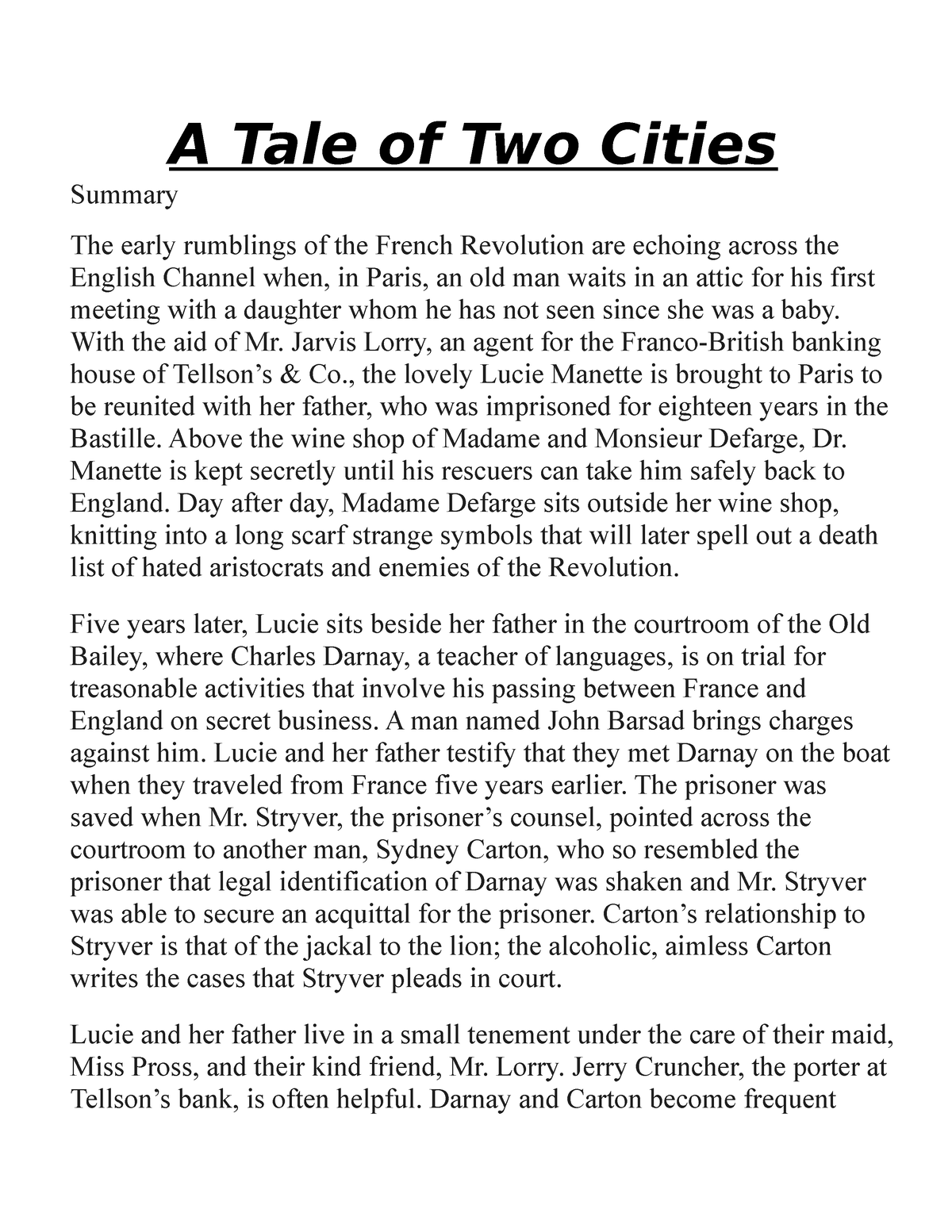
A comprehensive book report on Charles Dickens' 1859 masterpiece, A Tale of Two Cities, requires a nuanced analysis of its dual-city setting, its intricate character arcs—particularly the redemption of Sydney Carton—and its heavy focus on the themes of resurrection and social upheaval during the French Revolution.
Charles Dickens’ A Tale of Two Cities remains one of the most widely read and studied novels in the English language. Set against the turbulent backdrop of the late 18th century, it juxtaposes the relative stability of London with the blood-soaked chaos of Revolutionary Paris. For a student or academic in 2026, writing an effective report on this text involves more than a simple plot summary; it necessitates an exploration of how Dickens uses historical fiction to comment on the cyclical nature of violence and the possibility of personal transformation.
Historical Context: The Ancien Régime and the Victorian Perspective
To understand A Tale of Two Cities, one must first grasp the historical context of both the setting (1775–1793) and the time of its publication (1859). Dickens was deeply influenced by Thomas Carlyle’s The French Revolution: A History, and he sought to capture the "terrible" spirit of the era.
The novel opens in 1775, a time when social inequality in France had reached a breaking point. The "Ancien Régime" was characterized by a massive divide between the decadent aristocracy and the starving peasantry. Dickens portrays this inequality through the Monseigneur and the Marquis St. Evrémonde, whose indifference to human life serves as the catalyst for the eventual revolutionary explosion.
However, Dickens also writes from a mid-Victorian perspective. In 1859, Britain was experiencing its own social anxieties regarding class struggle and industrialization. By highlighting the horrors of the French "Reign of Terror," Dickens was offering a cautionary tale to his contemporaries: that systemic injustice inevitably leads to a violent, uncontrollable reaction. This duality—sympathy for the oppressed but horror at the resulting mob violence—is the foundation of the novel’s narrative tension.
Character Profiles: The Pillars of the Narrative
A successful book report must analyze the characters not just as individuals, but as symbols of larger social forces. Dickens’ characters in this novel are often categorized by their capacity for change or their static adherence to a cause.
Sydney Carton: The Redemption of the Dissolute
Sydney Carton is arguably Dickens' most complex protagonist. Introduced as a "jackal"—a brilliant but alcoholic and self-loathing lawyer who does the work for which others take the credit—he begins the novel as a man without hope or purpose. His physical resemblance to Charles Darnay is a crucial plot point, but their moral divergence is what drives the story. Carton’s love for Lucie Manette, which he acknowledges is unrequited in a traditional sense, becomes his path to salvation. His final act of sacrifice is the ultimate expression of the novel’s theme of "resurrection."
Charles Darnay: The Burden of Ancestry
Charles Darnay represents the possibility of breaking away from a corrupt past. Born into the cruel Evrémonde family, he renounces his title and moves to London to live as a tutor. Darnay is a "man of honor," but his character is often criticized by scholars for being somewhat flat compared to Carton. His primary role in the narrative is to serve as the catalyst for the plot's movement between the two cities and to provide the contrast against which Carton’s transformation is measured.
Madame Defarge: The Personification of Vengeance
If Sydney Carton represents the possibility of mercy, Madame Defarge represents the inevitability of retribution. She is a terrifying figure who spends her days knitting a register of those marked for death by the Revolution. Unlike her husband, Ernest Defarge, who retains some vestige of pity (particularly for his former master, Dr. Manette), Madame Defarge is fueled by a generational trauma caused by the Evrémonde family. She embodies the "broken" nature of the revolution—how the pursuit of justice can devolve into a mindless thirst for blood.
Dr. Alexandre Manette: The Psychological Victim
Dr. Manette is the bridge between the past and the present. His eighteen-year imprisonment in the Bastille has left him psychologically shattered, a condition symbolized by his compulsive shoemaking. His recovery, or "recalling to life," is the first major thematic movement of the book. However, his past remains a "buried" secret that eventually threatens the safety of his family, demonstrating that the scars of the past are never truly gone.
Detailed Plot Structure: A Three-Part Journey
Dickens originally published the novel in weekly installments in his journal All the Year Round. The structure reflects this, with high-stakes cliffhangers and a division into three distinct "Books."
- Book the First: Recalled to Life. This section focuses on the year 1775. Jarvis Lorry, an agent for Tellson’s Bank, informs Lucie Manette that her father, whom she thought dead, is alive in Paris. They travel to the wine shop of the Defarges to retrieve him. The "spilled wine" in the streets of Saint Antoine serves as a dark omen of the blood that will eventually flow during the Revolution.
- Book the Second: The Golden Thread. Spanning several years, this book establishes the lives of the characters in London. Charles Darnay is tried for treason but acquitted thanks to the intervention of Carton. Lucie becomes the "golden thread" that binds her father back to his sanity and holds her family together. The narrative tension builds as the revolution begins in France, culminating in the storming of the Bastille in 1789.
- Book the Third: The Track of a Storm. The action shifts entirely to Paris during the Reign of Terror. Darnay returns to France to save a former servant, Gabelle, but is arrested as an aristocrat. The novel reaches its climax through a series of trials where Dr. Manette’s past is used against his own son-in-law. The resolution involves Carton’s famous switch with Darnay, leading to the novel's iconic ending at the guillotine.
Key Themes and Symbolism
To elevate a book report, one must discuss the literary devices Dickens employs to reinforce his message.
Resurrection and "Recalled to Life"
The concept of being "recalled to life" is the central motif. It applies literally to Dr. Manette’s release from prison, but also metaphorically to Sydney Carton’s spiritual rebirth. Dickens suggests that while the state may kill, the human spirit has the capacity to be reborn through love and sacrifice.
The Duality of the Two Cities
London and Paris are not just locations; they are opposing states of being. London is depicted as a place of business, law, and domesticity (though not without its own flaws, like the harshness of Newgate Prison). Paris is a place of passion, chaos, and radical change. By oscillating between the two, Dickens explores the tension between private life and public history.
Symbols to Include in Your Report
- The Knitting: Madame Defarge’s knitting is a "shroud" for the aristocracy. It represents the cold, methodical planning of the revolutionaries.
- The Grindstone: A symbol of the sharpening of the revolution’s violence, where the mob prepares their weapons for the massacres.
- The Sea: Dickens frequently uses the metaphor of a rising sea or a storm to describe the revolutionary mob, emphasizing its unstoppable, elemental power.
- The Shadow: Used throughout the book to represent the looming threat of the past and the literal shadows of the prison cells.
Comparative Overview: London vs. Paris
The following table summarizes the primary differences in how Dickens portrays the two settings during the height of the narrative.
| Feature | London (The "Stable" City) | Paris (The "Volatile" City) |
|---|---|---|
| Social Climate | Orderly, albeit conservative and occasionally stagnant. | Chaotic, revolutionary, and violently transformative. |
| Main Locations | Soho (Manette home), Tellson’s Bank, Old Bailey. | Saint Antoine (Wine shop), The Bastille, La Force Prison. |
| Atmosphere | Foggy, domestic, focused on private industry. | Blood-stained, public, focused on "Liberty, Equality, Fraternity." |
| Representation of Law | Strict and often absurd (Darnay’s first trial). | Arbitrary and lethal (The Revolutionary Tribunal). |
| Key Symbols | The "Golden Thread" of Lucie’s hair. | The "Guillotine" and the spilled red wine. |
Practical Guide: How to Structure Your Report
When compiling your report for a 2026 academic or professional audience, follow this logical progression:
- Introduction: State the title, author, and year of publication. Provide a brief "hook" regarding the novel’s enduring relevance.
- Thesis Statement: Summarize the main point of your analysis (e.g., "Dickens uses the character of Sydney Carton to argue that individual redemption is possible even in the midst of societal collapse").
- Setting and Context: Briefly explain the French Revolution’s role in the story.
- Plot Summary: Do not recount every detail. Focus on the major "inciting incidents" and the climax.
- Character Analysis: Dedicate paragraphs to at least three main characters (Carton, Darnay, and Madame Defarge are the standard choices).
- Thematic Discussion: Choose two major themes (e.g., Sacrifice and Social Justice) and provide examples of how they are manifested in the text.
- Critical Evaluation: Offer your own perspective on Dickens' writing style. Is the prose too melodramatic? Is the ending satisfying?
- Works Cited: If you are using external sources like The British Library's Dickens collection or Project Gutenberg, ensure they are properly cited.
Frequently Asked Questions
Why is the book called "A Tale of Two Cities"?
The title refers to London and Paris. The novel explores how the events of the French Revolution in Paris directly impact a group of people living in London, demonstrating that the two cities are inextricably linked by the characters' secrets and histories.
Is Charles Darnay the hero of the story?
While Darnay is the "traditional" hero (noble, handsome, and virtuous), most critics consider Sydney Carton to be the true protagonist or "anti-hero." Carton undergoes a much more significant character arc and performs the novel’s most defining action.
What does the opening line "It was the best of times, it was the worst of times" mean?
This famous paradox highlights the extreme contradictions of the era. It suggests that every period of history contains both great progress and great suffering, and that one’s experience of "the times" depends entirely on their social standing and perspective.
What is the significance of the "Golden Thread"?
The "Golden Thread" is a metaphor for Lucie Manette. Dickens uses this image to describe how her love and devotion bind her father back to reality after his imprisonment and keep her family united through the various crises they face.
Does Dickens support the French Revolution?
Dickens is ambivalent. He clearly shows that the French aristocracy was cruel and deserved to lose its power, but he is equally horrified by the "inhuman" violence of the revolutionary mob. He supports the cause of the oppressed but rejects the methods of the revolutionaries.
Final Recommendation for Students
When writing your report, avoid the temptation to use generic summaries found online. Instead, focus on the emotional journey of Sydney Carton. His transition from a man who says "I care for no man on earth, and no man on earth cares for me" to a man who gives his life for others is the heartbeat of the novel. Highlighting this transformation will provide your report with the depth and insight required for a high-level academic submission in 2026.