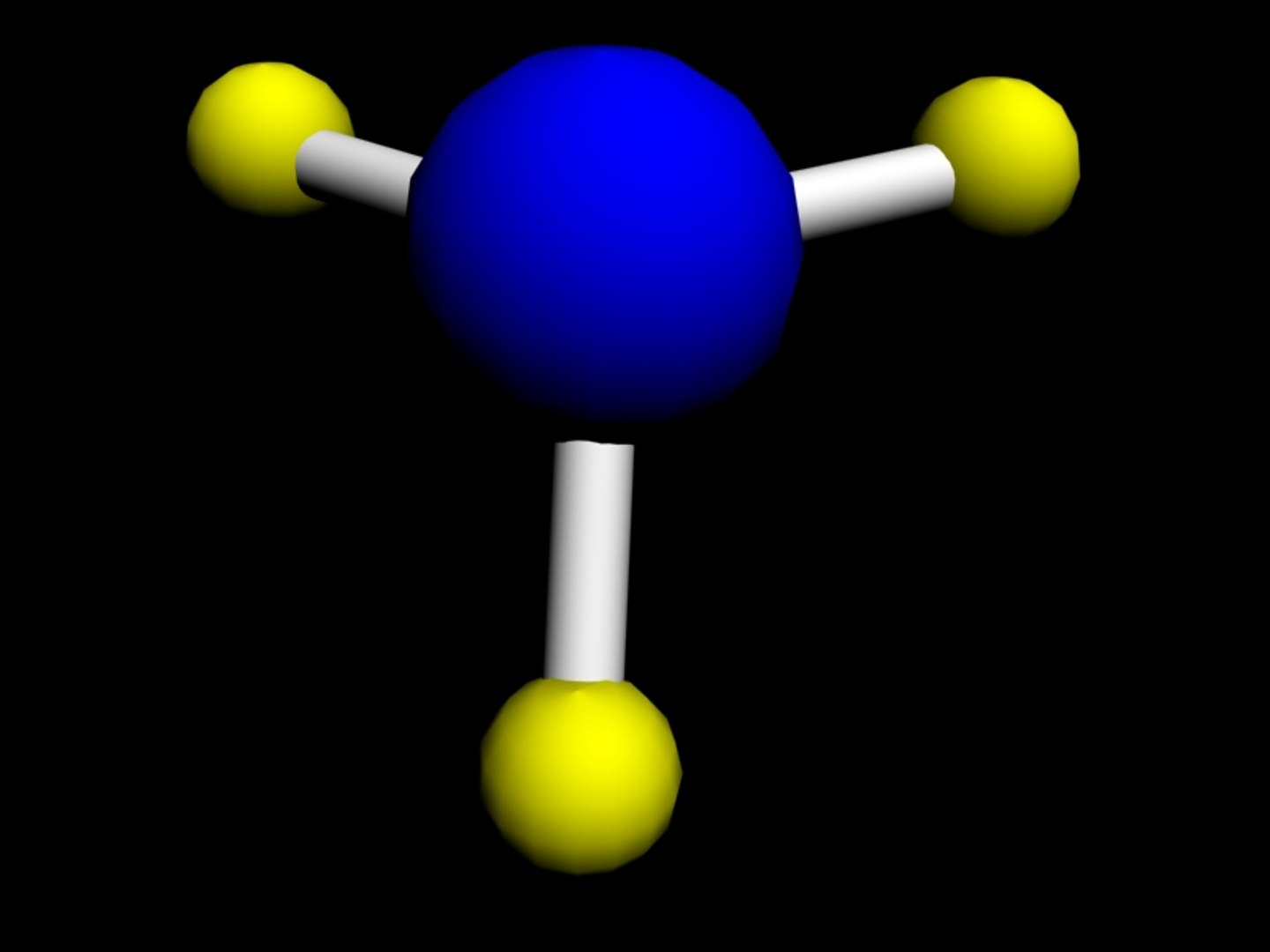
Ammonia is a discrete chemical molecule represented by the molecular formula $\text{NH}_3$. It consists of one nitrogen atom covalently bonded to three hydrogen atoms in a distinct trigonal pyramidal arrangement. Held together by polar covalent bonds, ammonia possesses a lone pair of valence electrons, making it a reactive base, polar solvent, and critical industrial precursor.
Understanding the Molecular Definition: Why Ammonia Is a Molecule
To understand why ammonia is a molecule, it is necessary to examine how individual chemical elements interact to achieve stability. In chemistry, a molecule is defined as an electrically neutral group of two or more atoms held together by chemical bonds. When atoms share pairs of valence electrons rather than transferring them completely, they form covalent bonds, resulting in discrete molecular entities.
Ammonia fits this definition precisely. It is not an element, nor is it a giant ionic lattice or a metallic network. Instead, ammonia ($\text{NH}_3$) is a covalent compound formed when one nitrogen atom ($N$) shares electrons with three individual hydrogen atoms ($H$).
.. : N : / | \ H H H
Each hydrogen atom contributes one electron to achieve a stable duet configuration (similar to helium), while the central nitrogen atom contributes five valence electrons. Three of nitrogen's electrons participate in single covalent bonds with the three hydrogen atoms, while the remaining two electrons form a non-bonding lone pair. This electron-sharing configuration fills nitrogen’s valence shell with eight electrons, satisfying the octet rule.
Because ammonia exists as independent, neutral chemical units with a fixed molar mass of $17.031\text{ g/mol}$, it exhibits physical and chemical properties typical of molecular substances—such as low boiling and melting points relative to ionic compounds, high vapor pressure, and distinct molecular geometry.
Chemical Structure and Electronic Configuration of $\text{NH}_3$
The physical state, reactivity, and electronic behavior of the ammonia molecule stem directly from its orbital structure and valence electron distribution.
Lone Pair (..) N <-- Central sp3 Nitrogen /|\ / | \ H H H (Trigonal Pyramidal, ~107.8°)
1. Valence Shell Analysis and Lewis Structure
Nitrogen belongs to Group 15 of the periodic table and has five valence electrons ($2s^2 2p^3$). Hydrogen belongs to Group 1 and has a single $1s^1$ electron. In the Lewis structure of ammonia:
- Total valence electrons = $5 + (3 \times 1) = 8\text{ electrons}$ ($4\text{ electron pairs}$).
- Three pairs are bonding pairs (forming three $\text{N-H}$ single $\sigma$-bonds).
- One pair is a non-bonding lone pair localized on the nitrogen atom.
2. Orbital Hybridization: $sp^3$ Configuration
To accommodate four electron domains (three bonding pairs and one lone pair), the central nitrogen atom undergoes $sp^3$ orbital hybridization. The single $2s$ orbital and three $2p$ orbitals mix to create four equivalent $sp^3$ hybrid orbitals. Three of these orbitals overlap with the $1s$ orbitals of the hydrogen atoms to form strong $\sigma$ (sigma) bonds, while the fourth $sp^3$ orbital contains the non-bonding electron pair.
3. VSEPR Theory and Trigonal Pyramidal Geometry
According to Valence Shell Electron Pair Repulsion (VSEPR) theory, electron pairs around a central atom orient themselves as far apart as possible to minimize electrostatic repulsion. Four electron domains adopt a basic tetrahedral arrangement.
However, VSEPR theory also dictates that lone pairs exert a stronger repulsive force than bonding pairs because a lone pair is held close to a single atomic nucleus rather than being shared between two nuclei.
- Ideal tetrahedral bond angle: $109.5^\circ$
- Actual $\text{H-N-H}$ bond angle in ammonia: approximately $107.8^\circ$
The lone pair pushes the three $\text{N-H}$ bonding pairs closer together, compressing the $\text{H-N-H}$ angles from $109.5^\circ$ down to approximately $107.8^\circ$. As a result, the molecular geometry (the position of the atoms alone) is classified as trigonal pyramidal, belonging to the $C_{3v}$ point group in molecular symmetry. Detailed spectral datasets for these structural parameters can be cross-referenced via the NIST Chemistry WebBook.
4. Nitrogen Inversion (The Umbrella Effect)
A fascinating feature of the ammonia molecule is its rapid structural inversion, often referred to as nitrogen inversion or the "umbrella effect." The nitrogen atom continuously oscillates through the plane formed by the three hydrogen atoms, turning the pyramid inside out.
At room temperature, this quantum mechanical tunneling and thermal inversion occurs at a frequency of approximately $2.4 \times 10^{10}\text{ Hz}$ ($24\text{ GHz}$). This phenomenon was historically leveraged in 1954 to create the first maser (Microwave Amplification by Stimulated Emission of Radiation), demonstrating how fundamental molecular properties directly enable modern quantum electronics.
Polarity and Intermolecular Forces
The spatial geometry and electronegativity differences within the ammonia molecule give rise to notable macro-scale physical properties.
(δ-) N <-- High Electronegativity (3.04) /|\ / | \ (δ+) H (δ+) H (δ+)
Electronegativity Difference and Dipole Moment
Electronegativity measures an atom's ability to attract shared electrons in a chemical bond. On the Pauling scale, nitrogen has an electronegativity of $3.04$, while hydrogen has an electronegativity of $2.20$. The electronegativity difference ($\Delta \text{EN} = 0.84$) creates polar covalent $\text{N-H}$ bonds, where the shared electrons are pulled closer to the nitrogen atom.
Because ammonia’s trigonal pyramidal structure is asymmetric, the three bond dipole moments do not cancel out (unlike in symmetric molecules such as methane, $\text{CH}_4$). Instead, they add vectorially toward the nitrogen atom, aligning in the same direction as the dipoles generated by the lone pair. This gives ammonia a significant net molecular dipole moment of approximately $1.47\text{ Debye}$ ($\text{D}$).
Hydrogen Bonding in Ammonia
Because the nitrogen atom is small, highly electronegative, and possesses a localized lone pair, ammonia molecules participate in strong hydrogen bonding. The partially negative ($\delta^-$) nitrogen atom of one $\text{NH}_3$ molecule attracts the partially positive ($\delta^+$) hydrogen atom of an adjacent $\text{NH}_3$ molecule.
H H | | H-N: ··········· H-N: | Hydrogen | H Bond H
Although hydrogen bonds in ammonia are weaker than those in water ($\text{H}_2\text{O}$)—because oxygen is more electronegative than nitrogen ($3.44$ vs $3.04$) and water offers two lone pairs and two hydrogens per molecule—hydrogen bonding dramatically alters ammonia's physical parameters compared to nonpolar hydrides:
- Boiling Point: Ammonia boils at $-33.34^\circ\text{C}$ ($239.81\text{ K}$) at $1\text{ atm}$, which is substantially higher than the boiling point of phosphine ($\text{PH}_3$, $-87.7^\circ\text{C}$), even though $\text{PH}_3$ has a higher molecular weight.
- Water Solubility: Ammonia is exceptionally soluble in liquid water. At $20^\circ\text{C}$, one liter of water can dissolve roughly $700\text{ liters}$ of gaseous ammonia. This high solubility is driven by extensive inter-molecular hydrogen bonding between $\text{NH}_3$ and $\text{H}_2\text{O}$ molecules.
Comprehensive chemical safety, thermodynamic, and toxicological properties of the molecule are maintained on the PubChem Ammonia Page.
Comparative Analysis: Ammonia vs. Related Hydrides
To illustrate how electron geometry, lone pair count, and atom size affect molecular structure, consider the following comparison between period 2 hydrides ($\text{CH}_4$, $\text{NH}_3$, $\text{H}_2\text{O}$) and period 3 hydride ($\text{PH}_3$):
| Property | Methane ($\text{CH}_4$) | Ammonia ($\text{NH}_3$) | Water ($\text{H}_2\text{O}$) | Phosphine ($\text{PH}_3$) |
|---|---|---|---|---|
| Central Atom | Carbon ($C$) | Nitrogen ($N$) | Oxygen ($O$) | Phosphorus ($P$) |
| Valence Electron Pairs | 4 Bonding, 0 Lone | 3 Bonding, 1 Lone | 2 Bonding, 2 Lone | 3 Bonding, 1 Lone |
| Hybridization | $sp^3$ | $sp^3$ | $sp^3$ | $sp^3$ (unhybridized character) |
| Molecular Geometry | Tetrahedral | Trigonal Pyramidal | Bent | Trigonal Pyramidal |
| Bond Angle | $109.5^\circ$ | $107.8^\circ$ | $104.5^\circ$ | $93.5^\circ$ |
| Dipole Moment (D) | $0\text{ D}$ (Nonpolar) | $1.47\text{ D}$ (Polar) | $1.85\text{ D}$ (Highly Polar) | $0.58\text{ D}$ (Weakly Polar) |
| Boiling Point (1 atm) | $-161.5^\circ\text{C}$ | $-33.3^\circ\text{C}$ | $100.0^\circ\text{C}$ | $-87.7^\circ\text{C}$ |
| Dominant Force | London Dispersion | Hydrogen Bonding | Hydrogen Bonding | Dipole-Dipole |
Key Takeaways from the Comparison
- Bond Angle Compression: Moving from $\text{CH}_4$ to $\text{NH}_3$ to $\text{H}_2\text{O}$, each additional lone pair consumes more angular space around the central atom, steadily compressing the adjacent bond angles ($109.5^\circ \rightarrow 107.8^\circ \rightarrow 104.5^\circ$).
- Phosphine vs. Ammonia Contrast: Although phosphorus sits directly below nitrogen in Group 15, the $\text{H-P-H}$ bond angle in $\text{PH}_3$ is $93.5^\circ$. Phosphorus utilizes mostly unhybridized $p$-orbitals for bonding, and its larger covalent radius reduces electron density, preventing effective hydrogen bonding. This accounts for phosphine's much lower boiling point compared to ammonia.
Chemical Reactivity: How Structure Dictates Behavior
The lone pair of electrons on the nitrogen atom acts as the primary reaction center for the ammonia molecule.
H H + | | H — N : + H+ ---> H — N — H (Ammonium Ion, NH4+) | | H H
1. Brønsted-Lowry and Lewis Base Characteristics
- Brønsted-Lowry Base: Ammonia acts as a proton recipient. In aqueous solution, ammonia accepts a proton ($\text{H}^+$) from water to form the polyatomic ammonium ion ($\text{NH}_4^+$) and a hydroxide ion ($\text{OH}^-$):
$$\text{NH}_3(aq) + \text{H}_2\text{O}(l) \rightleftharpoons \text{NH}_4^+(aq) + \text{OH}^-(aq)$$
This equilibrium yields a weakly basic solution with a base dissociation constant ($K_b$) of approximately $1.8 \times 10^{-5}$ ($pK_b = 4.75$) at $25^\circ\text{C}$.
- Lewis Base: Ammonia acts as an electron pair donor. Because its lone pair is unshared and accessible, ammonia donates electrons to Lewis acids (electron pair acceptors) like boron trifluoride ($\text{BF}_3$) to yield Lewis adducts ($\text{H}_3\text{N}\rightarrow\text{BF}_3$).
2. Ligand Formation in Coordination Chemistry
In inorganic chemistry, ammonia functions as a neutral monodentate ligand (termed ammine in coordination nomenclature). The nitrogen lone pair forms dative covalent (coordinate) bonds with transition metal cations. For instance, adding excess ammonia to solutions containing copper(II) ions forms the deep-blue tetraamminecopper(II) complex:
$$\text{Cu}^{2+}(aq) + 4\text{NH}_3(aq) \rightarrow [\text{Cu}(\text{NH}_3)_4]^{2+}(aq)$$
3. Amphoteric Potential (Extreme Conditions)
Although predominantly recognized as a base, ammonia can display amphoteric behavior in liquid media. In pure liquid ammonia, self-ionization occurs:
$$2\text{NH}_3(l) \rightleftharpoons \text{NH}_4^+ + \text{NH}_2^-$$
Under extremely strong basic conditions (e.g., in the presence of alkali metals like sodium), ammonia can lose a proton to form the amide ion ($\text{NH}_2^-$), demonstrating its ability to serve as an exceedingly weak acid ($pK_a \approx 38$).
Industrial Synthesis and Global Applications
The ability to manipulate the ammonia molecule on a mega-ton scale underpins modern agriculture and industrial chemical production.
[ High Pressure: 150-250 atm ] N2 (g) + 3 H2 (g) -----------------------------------> 2 NH3 (g) [ High Temp: 400-450°C, Fe ]
The Haber-Bosch Process
Developed in the early 20th century by Fritz Haber and Carl Bosch, the Haber-Bosch process synthesizes molecular ammonia directly from atmospheric nitrogen gas ($\text{N}_2$) and hydrogen gas ($\text{H}_2$):
$$\text{N}_2(g) + 3\text{H}_2(g) \rightleftharpoons 2\text{NH}_3(g) \quad \Delta H = -92.4\text{ kJ/mol}$$
Because the strong triple bond in atmospheric nitrogen ($\text{N}\equiv\text{N}$) has a high dissociation energy ($945\text{ kJ/mol}$), the reaction requires:
- Moderate-to-high temperatures ($400^\circ\text{C} - 450^\circ\text{C}$)
- High pressures ($150\text{ atm} - 250\text{ atm}$)
- An iron-based catalyst promoted with $\text{K}_2\text{O}$, $\text{Al}_2\text{O}_3$, and $\text{CaO}$
Primary Industrial Uses
- Synthetic Fertilizers: Over $80%$ of industrially produced ammonia is used to manufacture fertilizers such as ammonium nitrate ($\text{NH}_4\text{NO}_3$), urea ($\text{CO}(\text{NH}_2)_2$), and ammonium phosphate. Synthetic nitrogen fertilizers support global crop yields that sustain roughly half of the global population.
- Chemical Intermediates: Ammonia is oxidized via the Ostwald process to yield nitric acid ($\text{HNO}_3$), a foundational chemical in pharmaceuticals, polymers (such as nylon), and explosives.
- Refrigeration: Due to its high latent heat of vaporization ($1371\text{ kJ/kg}$ at $-33.34^\circ\text{C}$), anhydrous ammonia is widely employed as a industrial refrigerant (R-717) in large-scale cold storage and processing plants.
- Hydrogen Energy Vector: As decarbonization efforts scale, liquid ammonia ($\text{NH}_3$) is increasingly utilized as an energy-dense, carbon-free hydrogen carrier. Liquid ammonia contains nearly double the energy density by volume compared to liquid hydrogen, making it easier to transport and store using existing infrastructure.
Safety, Toxicity, and Handling Guidelines
Despite its essential utility, anhydrous ammonia and concentrated aqueous solutions present significant health risks.
- Corrosive Nature: When molecular ammonia gas contacts moisture on skin, eyes, or mucous membranes, it forms corrosive hydroxide ions ($\text{OH}^-$), causing caustic chemical burns and severe tissue necrosis.
- Inhalation Hazards: Inhaling high concentrations of ammonia causes coughing, bronchospasm, pulmonary edema, and respiratory failure. The Occupational Safety and Health Administration (OSHA) sets a Permissible Exposure Limit (PEL) of $50\text{ ppm}$ ($35\text{ mg/m}^3$) over an 8-hour time-weighted average.
- Environmental Impact: Ammonia runoff into aquatic systems can cause severe environmental damage. In water, un-ionized ammonia ($\text{NH}_3$) is highly toxic to fish and aquatic life, while excessive nitrate levels from agricultural runoff contribute to eutrophication in waterways.
Disclaimer: Work involving compressed anhydrous ammonia or concentrated solutions requires appropriate personal protective equipment (PPE), engineered ventilation, and adherence to local regulatory standards (such as OSHA or EPA risk management protocols).
Frequently Asked Questions
Is ammonia an element, compound, or mixture?
Ammonia is a compound made of two distinct elements: nitrogen and hydrogen. Because its individual constituent atoms are held together by polar covalent bonds in a fixed $1:3$ ratio, it is classified as a discrete covalent compound.
Why is ammonia polar while methane is nonpolar?
Both ammonia ($\text{NH}_3$) and methane ($\text{CH}_4$) have central atoms undergoing $sp^3$ hybridization. However, methane has four identical $\text{C-H}$ bonds arranged in a symmetric tetrahedral geometry, causing individual bond dipoles to cancel completely. Ammonia has only three bonding pairs and one unshared lone pair, creating an asymmetric trigonal pyramidal structure with a net dipole moment of $1.47\text{ D}$.
What is the structural difference between ammonia ($\text{NH}_3$) and ammonium ($\text{NH}_4^+$)?
Ammonia ($\text{NH}_3$) is a neutral molecule with three covalent bonds and one non-bonding lone pair on the central nitrogen atom, featuring a trigonal pyramidal shape. Ammonium ($\text{NH}_4^+$) is a positively charged polyatomic ion created when ammonia's lone pair forms a coordinate covalent bond with a proton ($\text{H}^+$). The resulting $\text{NH}_4^+$ ion has a symmetric tetrahedral geometry and no lone pairs.
Why is the bond angle in ammonia smaller than in methane?
In methane ($\text{CH}_4$), four bonding electron pairs push apart equally, producing an ideal tetrahedral angle of $109.5^\circ$. In ammonia ($\text{NH}_3$), the nitrogen atom holds three bonding pairs and one non-bonding lone pair. Because the lone pair is anchored by only one nucleus, its electron cloud expands and exerts greater repulsion, compressing the adjacent $\text{H-N-H}$ bond angles to approximately $107.8^\circ$.
Can ammonia act as an acid?
Yes, but only under extreme conditions. While ammonia functions primarily as a weak base in water, it is amphoteric in principle. When reacted with exceptionally strong bases (such as alkali metal hydrides) or in pure liquid ammonia systems, it can donate a proton to form the amide ion ($\text{NH}_2^-$). Its acid dissociation constant ($pK_a \approx 38$) confirms that it acts as an extremely weak acid.
Summary and Key Takeaways
Understanding that ammonia is a molecule provides fundamental insights into its physical properties, chemical reactivity, and industrial applications:
- Formula & Bonding: $\text{NH}_3$ consists of one central nitrogen atom covalently bonded to three hydrogen atoms, leaving one non-bonding lone pair.
- Geometry: Ammonia exhibits a trigonal pyramidal shape ($C_{3v}$ symmetry) with an $sp^3$-hybridized nitrogen atom and an $\text{H-N-H}$ bond angle of approximately $107.8^\circ$.
- Polarity: The asymmetrical geometry and electronegativity difference ($\Delta \text{EN} = 0.84$) generate a net dipole moment ($1.47\text{ D}$), enabling strong hydrogen bonding, high water solubility, and an elevated boiling point compared to nonpolar hydrides.
- Reactivity: Ammonia acts as a versatile Lewis base, Brønsted-Lowry base, and ligand in coordination chemistry due to the localized lone pair on the nitrogen atom.
- Practical Impact: Ammonia synthesis via the Haber-Bosch process remains a cornerstone of global agriculture, chemical manufacturing, and emerging zero-carbon energy systems.
For further analytical studies, refer to spectroscopic standards published by NIST or formal nomenclature guidelines established by IUPAC.