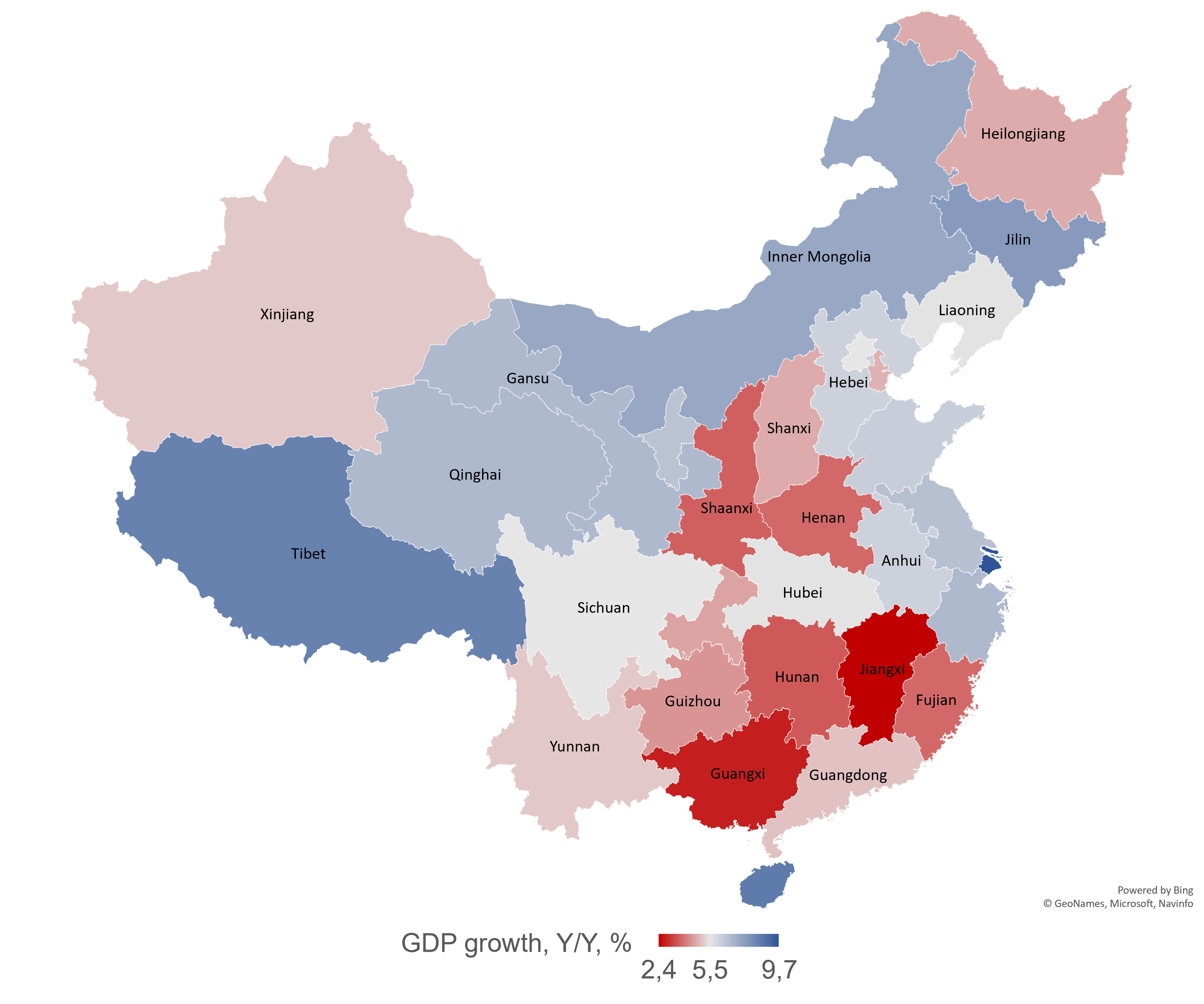
In 2026, China’s economy is defined by a sophisticated division of labor across its 34 provincial-level administrative units. From the high-tech manufacturing hubs of the Greater Bay Area to the critical energy corridors of the western frontiers, each province plays a specialized role in the nation’s "Dual Circulation" strategy, balancing domestic consumption with international trade.
The Foundations of China’s Economic Landscape
The Chinese economic model has transitioned from a centralized manufacturing base into a decentralized network of specialized regional economies. As of 2026, this evolution is guided by the 14th and 15th Five-Year Plans, emphasizing "high-quality growth" over raw GDP expansion. To understand China's market today, one must look past the national figures and analyze the unique economic contributions of its provinces, autonomous regions, municipalities, and special administrative regions.
The geography of Chinese wealth remains tiered, but the gap between the prosperous coastal east and the developing west is narrowing due to massive infrastructure investments and the relocation of heavy industries. The following analysis categorizes these regions by their primary economic functions, industrial strengths, and strategic importance to the global supply chain.
The Industrial and Technological Powerhouses: The Coastal Giants
The eastern seaboard remains the engine of the Chinese economy, contributing the largest share of GDP and serving as the primary interface for global trade.
Guangdong: The Global Manufacturing and Innovation Hub
Guangdong remains the wealthiest province in 2026, with a GDP that rivals many G20 nations. Its economic role is centered on the Greater Bay Area (GBA) initiative, which integrates Shenzhen, Guangzhou, and several other cities with Hong Kong and Macau. Guangdong is the world’s leading hub for electronics, telecommunications, and advanced robotics. Shenzhen, often called the "Silicon Valley of Hardware," is the headquarters for giants like Huawei and Tencent, focusing heavily on AI integration and semiconductor design in the current year.
Jiangsu and Zhejiang: The Centers of Private Enterprise and High-Tech
Jiangsu and Zhejiang represent the core of the Yangtze River Delta. Jiangsu is a leader in heavy machinery, chemicals, and increasingly, solar energy components. Its "Suzhou Industrial Park" remains a gold standard for international joint ventures. Zhejiang, conversely, is the heart of China’s private sector and e-commerce. With Hangzhou as its capital, the province dominates digital payments, fintech, and small-commodity manufacturing, maintaining a robust network of agile, private-owned enterprises (POEs) that drive domestic consumption.
Shandong: The Heavy Industry and Agricultural Anchor
Shandong serves a dual role. It is a massive producer of industrial commodities—steel, petroleum refining, and chemicals—while simultaneously acting as a primary agricultural exporter to Japan and South Korea. In 2026, Shandong is also a pioneer in China’s "Blue Economy," focusing on marine science and deep-sea aquaculture from the port city of Qingdao.
The Strategic Municipalities: Command and Control
China’s four direct-controlled municipalities act as specialized economic nodes with administrative powers equivalent to provinces.
- Beijing: The "Headquarters Economy." Beijing serves as the political center and the hub for State-Owned Enterprises (SOEs). Its economic role is focused on high-end services, research and development, and the burgeoning aerospace sector.
- Shanghai: The "Financial Gateway." Shanghai remains China’s primary financial center. In 2026, the Pudong New Area continues to lead in semiconductor fabrication (SMIC) and international shipping via the world’s busiest container port.
- Tianjin: The "Northern Logistics Hub." Tianjin acts as the maritime gateway for the Jing-Jin-Ji (Beijing-Tianjin-Hebei) cluster, specializing in aviation manufacturing (Airbus assembly) and petrochemicals.
- Chongqing: The "Inland Manufacturing Base." As the only inland municipality, Chongqing is a critical link in the "New International Land-Sea Trade Corridor," specializing in automotive manufacturing and being the world’s largest producer of laptops.
The Heartland: Agriculture, Mining, and Industrial Transition
The central provinces are the traditional "breadbasket" and mineral reserves of China, currently undergoing a digital transformation.
Henan and Anhui: The Rising Central Hubs
Henan has successfully pivoted from a purely agricultural province to a manufacturing giant, notably hosting the world's largest iPhone assembly plants in Zhengzhou. Anhui has emerged as a surprise leader in the "New Three" industries: electric vehicles (EVs), lithium batteries, and solar cells. Hefei, the capital, is now recognized globally for its "Hefei Model" of state-led venture capital in high-tech startups.
Hubei and Hunan: Logistics and Heavy Machinery
Hubei, centered on Wuhan, is a vital transportation and logistics nexus for the Yangtze River. It is a major hub for automotive parts and optoelectronics (FiberHome). Hunan is the domestic leader in heavy machinery and construction equipment (Sany Heavy Industry), playing a significant role in the Belt and Road Initiative’s infrastructure projects.
The "Rust Belt" Transition: Liaoning, Jilin, and Heilongjiang
The Northeast (Dongbei) continues its difficult transition from legacy heavy industry (coal and steel) to modern high-end manufacturing. Liaoning focuses on shipbuilding and aircraft engines, while Jilin remains the heart of the traditional internal combustion engine (ICE) and EV automotive industry (FAW Group). Heilongjiang serves as the primary northern agricultural reserve and a strategic energy corridor for Russian oil and gas.
The Western Frontier: Energy, Resources, and the Digital Silk Road
The western provinces and autonomous regions are critical for China’s energy security and its "Go West" development strategy.
Sichuan and Shaanxi: Tech and Defense
Sichuan (Chengdu) has become a primary destination for companies fleeing high costs on the coast. It is a major center for defense technology, aerospace, and electronics assembly. Shaanxi (Xi'an) leverages its deep history and academic institutions to lead in semiconductor packaging, satellite navigation, and renewable energy research.
Xinjiang, Inner Mongolia, and Shanxi: The Energy Powerhouses
- Xinjiang: In 2026, Xinjiang is central to China’s green energy transition, hosting massive wind and solar farms. It is also the primary gateway for the Silk Road Economic Belt, linking China to Central Asia and Europe.
- Inner Mongolia and Shanxi: These regions remain the backbone of China’s energy grid. While coal remains significant, both provinces have diversified into "Green Hydrogen" production and rare earth element mining, which are essential for modern electronics.
Yunnan, Guizhou, and Guangxi: Gateway to ASEAN
Yunnan and Guangxi serve as the land and sea bridges to Southeast Asia (ASEAN). Yunnan focuses on hydropower and flowers, while Guangxi’s Beibu Gulf Port is the primary exit point for goods moving from Western China to Singapore and Vietnam. Guizhou has specialized as China's "Big Data Valley," housing the massive server farms for Apple, Alibaba, and Huawei due to its cool climate and cheap hydroelectric power.
Comparative Economic Roles of Chinese Provinces (2026 Data)
| Region | Primary Economic Role | Key Industries (2026) | Strategic Importance |
|---|---|---|---|
| Guangdong | Global Export Hub | Electronics, EVs, Robotics | Greater Bay Area Integration |
| Shanghai | Finance & Logistics | Fintech, SMIC Chips, Shipping | International Trade Gateway |
| Jiangsu | Advanced Manufacturing | Solar Cells, Chemicals, Textiles | High-tech Supply Chain |
| Sichuan | Western Tech Center | Defense, IT Services, Hydropower | Inland Development Hub |
| Anhui | EV Innovation | Lithium Batteries, AI, Quantum | Industrial Transformation |
| Hainan | Free Trade Port | Tourism, Duty-free, Seed Tech | Tropical Trade Experiment |
| Xinjiang | Energy & Logistics | Solar, Wind, Petrochemicals | Belt and Road Gateway |
| Shanxi | Resource Security | Coal, Hydrogen Energy, Steel | National Energy Grid |
| Hubei | Transit & Optics | Fiber Optics, Auto Parts | Yangtze River Logistics |
Special Jurisdictions and Islands
Hainan has undergone a massive transformation into a comprehensive Free Trade Port by 2026, aiming to rival Hong Kong in duty-free trade and maritime services. It is the only province with a "closed-customs" operation, making it a unique laboratory for economic liberalization.
Hong Kong continues its role as a premier offshore Renminbi (RMB) clearing center and a legal/professional services hub for international firms entering the Chinese market. Macau has successfully diversified its economy from pure gaming into healthcare, conventions, and financial services connecting China to Lusophone (Portuguese-speaking) countries.
Fujian plays a specialized role in cross-strait economic cooperation. It is a leader in the "Blue Economy" and serves as a major manufacturing base for apparel and footwear (Anta, Xtep), as well as battery technology (CATL).
Regional Economic Synergies in 2026
The Chinese economy is no longer a collection of isolated provinces but a series of interconnected "clusters." In 2026, the most significant of these is the Jing-Jin-Ji cluster, which aims to relieve Beijing of non-capital functions by moving industries to Hebei. This has turned Hebei from a polluted steel province into a hub for medical services, green energy, and logistics.
Similarly, the Yangtze River Delta (YRD) integration has reached a stage where high-value R&D happens in Shanghai, while specialized component manufacturing is distributed across satellite cities in Anhui and Jiangsu. This ecosystem creates a resilient supply chain that is difficult for international competitors to replicate.
FAQ: Understanding Provincial Economies
Which Chinese province has the highest GDP?
As of 2026, Guangdong maintains the highest GDP in China. Its economy is larger than that of most medium-sized countries, driven by the massive manufacturing output of the Pearl River Delta and the tech dominance of Shenzhen.
Why is Anhui considered a new economic leader?
Anhui has transitioned from a poor agricultural province to a high-tech hub through the "Hefei Model." By 2026, it has become the national leader in electric vehicle (EV) supply chains and quantum computing research, attracting massive domestic investment.
What is the economic role of the "Western Development" provinces?
Provinces like Sichuan, Shaanxi, and Guizhou are tasked with providing strategic depth. They serve as "data centers" (Guizhou), "defense hubs" (Sichuan), and "energy corridors" (Xinjiang), reducing the country's reliance on vulnerable coastal trade routes.
How does the 2026 Hainan Free Trade Port affect trade?
The Hainan Free Trade Port offers zero tariffs on many goods and simplified visa requirements. In 2026, it serves as a primary entry point for luxury goods and a hub for the "Seed Silicon Valley," focusing on agricultural technology and genetic research.
What happened to the "Rust Belt" provinces in the Northeast?
Liaoning, Jilin, and Heilongjiang have shifted toward specialized niches. While they no longer lead in raw output, they are critical for food security (Heilongjiang) and heavy industrial equipment (Liaoning) used in mining and aerospace.
Strategic Recommendation for Stakeholders
For businesses and analysts looking at the Chinese market in 2026, a "one-size-fits-all" approach is no longer viable. Investors should align their strategies with provincial specializations:
- For High-Tech & AI: Focus on the Shenzhen-Hong Kong axis or the Hefei innovation cluster.
- For Green Energy & EVs: Look to Anhui, Jiangsu, and Fujian for the most mature supply chains.
- For Low-Cost Manufacturing with Export Access: Consider the emerging industrial parks in Guangxi or Yunnan, which offer lower labor costs and direct access to ASEAN markets.
- For Digital Infrastructure: Guizhou and Shaanxi offer the best combination of government support and established data infrastructure.
Understanding the granular economic roles of these provinces is essential for navigating the complexities of the world's second-largest economy as it moves toward its mid-century development goals.