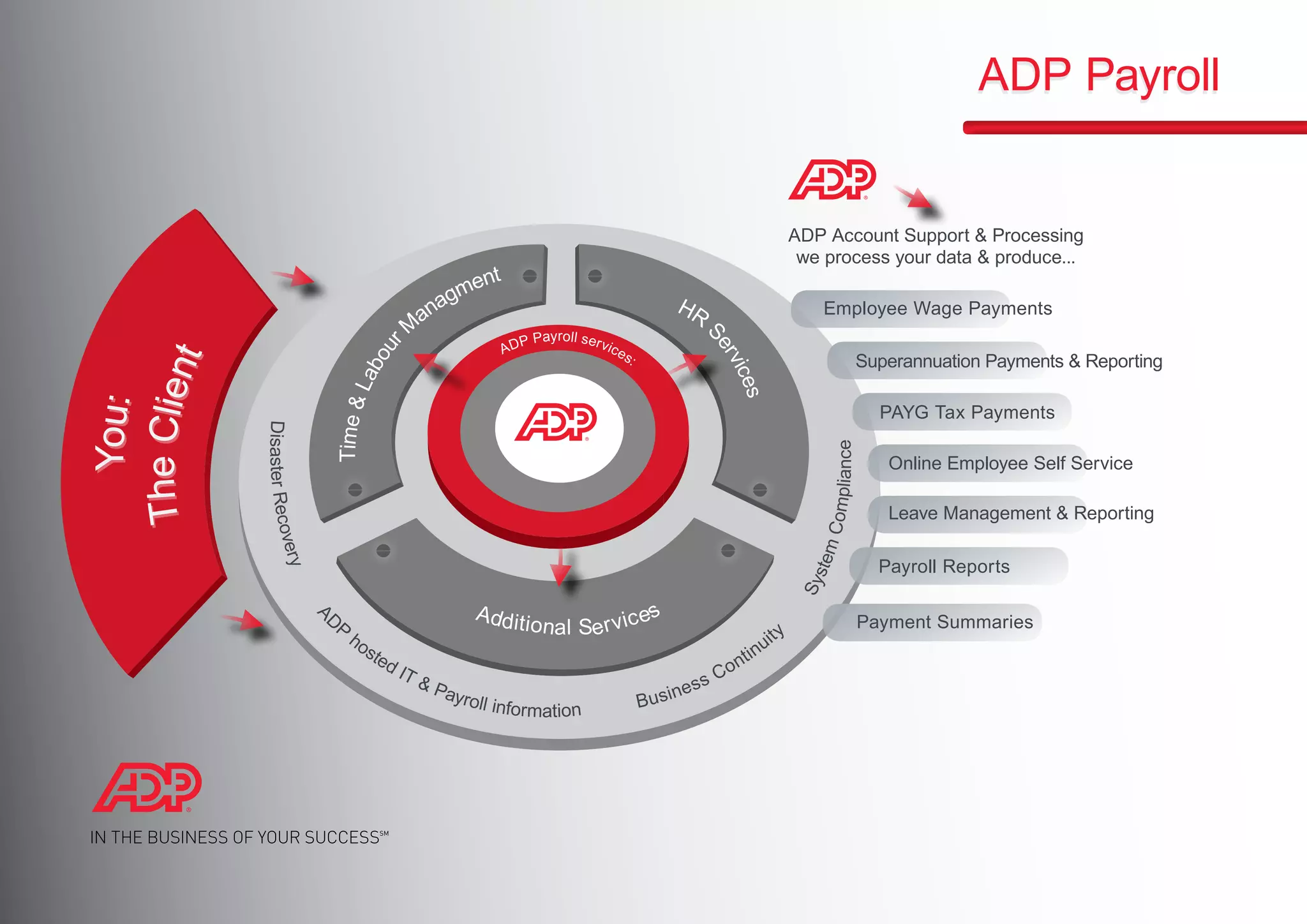
ADP Canada is a leading payroll provider and human capital management (HCM) firm that offers automated payroll processing, tax filing, and integrated HR software to businesses of all sizes. By streamlining compliance with Canadian provincial and federal regulations, ADP helps organizations manage their workforce efficiently through data-driven insights and cloud-based technology.
As of 2026, the Canadian business landscape is characterized by complex remote-work tax regulations, evolving labor standards, and a heightened need for data security. ADP Canada remains a dominant player in this space, providing a bridge between administrative tasks and strategic human resources management. Whether you are a small business owner looking to automate your first pay cycle or a multinational corporation seeking an integrated HCM suite, understanding the depth of ADP’s offerings is essential for operational success.
The Strategic Importance of Professional Payroll Management in 2026
Payroll management has evolved far beyond the simple distribution of funds. In 2026, it is the intersection of financial health, legal compliance, and employee satisfaction. With the Canada Revenue Agency (CRA) and Revenu Québec implementing more rigorous digital reporting requirements, the margin for error in source deductions and year-end filing has narrowed significantly.
Choosing a provider like ADP Canada allows businesses to mitigate the risks associated with manual data entry. The complexity of the Canadian payroll system—including Canada Pension Plan (CPP) enhancements, Employment Insurance (EI) fluctuations, and varying provincial health taxes (like Ontario’s EHT or Quebec’s HSF)—demands a system that updates in real-time. ADP’s infrastructure is designed to absorb these legislative changes automatically, ensuring that employers remain compliant without having to manually track every statutory update.
Core Solutions and Product Tiers
ADP Canada categorizes its services based on company size and specific organizational needs. This tiered approach ensures that a startup with three employees isn't overwhelmed by enterprise-level features, while ensuring a large corporation has the robust analytics it requires.
Small Business Solutions (1–49 Employees)
For small businesses, the primary goal is often time-saving and simplicity. ADP’s small business platforms, such as TeamPay by ADP, focus on:
- Automated Tax Remittances: Calculating and sending source deductions to the CRA and Revenu Québec.
- Employee Self-Service: Providing workers with digital access to their pay stubs and T4s/RL-1s via the ADP Mobile Solutions app.
- Direct Deposit: Eliminating paper checks and ensuring timely payments.
Midsize to Large Business Solutions (50–999+ Employees)
As organizations scale, their needs shift toward "Human Capital Management." ADP Workforce Now is the flagship platform for this segment. It integrates payroll with:
- Talent Acquisition: Streamlining the hiring process from job posting to onboarding.
- Time and Attendance: Tracking hours worked, vacation balances, and sick leave in a way that feeds directly into the payroll engine.
- Benefits Administration: Managing group insurance plans and retirement savings contributions (RRSPs/DPSP) with automated carrier connections.
Enterprise and Global Solutions
For the largest employers, ADP offers ADP Decidium and global payroll services that handle multi-jurisdictional compliance. These platforms are built to manage complex union environments, high-volume processing, and deep integration with third-party Enterprise Resource Planning (ERP) systems like SAP or Oracle.
Navigating Canadian Compliance with ADP
One of the primary reasons ADP Canada is considered a leading payroll provider is its deep localization for the Canadian market. Compliance is not a "one-size-fits-all" feature; it varies significantly by province.
Federal and Provincial Tax Filing
ADP manages the entire lifecycle of tax filing. This includes the calculation of federal income tax, provincial income tax, and the remittance of these funds to the appropriate authorities. In 2026, this also includes handling the specific requirements of the Canada Revenue Agency (CRA) for electronic filing and the T4/T4A summary reports.
Quebec-Specific Requirements
Quebec has its own distinct payroll environment. ADP Canada provides dedicated support for Revenu Québec requirements, including the calculation of the Québec Pension Plan (QPP), Québec Parental Insurance Plan (QPIP), and the generation of RL-1 slips. Their systems are natively bilingual to support the language requirements of the province.
Workers' Compensation and Health Levies
Managing Workers' Compensation Board (WCB/WSIB/CNESST) premiums is a common pain point for Canadian employers. ADP simplifies this by calculating premiums based on gross insurable earnings and, in some service tiers, managing the reporting and payment process entirely.
Technological Integration and AI in 2026
By 2026, ADP has fully integrated its generative AI assistant, ADP Assist, into the Canadian user experience. This technology changes how payroll administrators interact with their data. Instead of generating manual reports to find labor costs, an administrator can simply ask the system, "What was our total overtime spend in British Columbia last quarter compared to our budget?"
The ADP Marketplace
ADP operates an open ecosystem called the ADP Marketplace. This allows businesses to connect their payroll data with other business software, such as:
- Accounting Software: Automatic syncing with QuickBooks Online, Xero, or Sage to ensure the general ledger is always accurate.
- Point of Sale (POS): Importing hours from systems like Lightspeed or Shopify.
- Wealth Management: Exporting data to group RRSP providers to ensure contributions are invested immediately after pay day.
Implementation: The Path to Going Live
Transitioning to a professional payroll provider requires a structured implementation process to ensure data integrity. ADP typically follows a four-stage onboarding model:
- Discovery and Scoping: ADP consultants analyze your current payroll structure, benefits, and GL requirements to configure the system.
- Data Migration: Historical year-to-date (YTD) data is moved into the ADP platform. This is critical for ensuring that T4s at the end of the year are accurate.
- Parallel Running: The business runs its old payroll system alongside ADP for one or two cycles to verify that the net pay and tax calculations match perfectly.
- Go-Live and Optimization: Once the parallel runs are successful, the business moves fully to ADP, often accompanied by training sessions for HR staff and employees.
Comparing ADP Canada Service Tiers
| Feature | Small Business (TeamPay) | Mid-Market (Workforce Now) | Enterprise (Decidium) |
|---|---|---|---|
| Ideal Headcount | 1–49 | 50–999 | 1,000+ |
| Payroll Frequency | Weekly, Bi-weekly, Semi-monthly | Fully Customizable | Multi-entity / Global |
| HR Features | Basic Employee Records | Full HCM (Talent, Perf, Ben) | Advanced Workforce Analytics |
| Compliance Support | Standard CRA/RQ Remittances | Dedicated Account Manager | Global Compliance Monitoring |
| AI Integration | Basic Reporting | Full ADP Assist Capabilities | Custom AI Data Modeling |
| Onboarding | Template-based | Guided Implementation | Dedicated Project Team |
Managed Services: The Outsourcing Option
For many Canadian organizations, the goal is to get out of the payroll business entirely. ADP Canada offers Comprehensive Services, a managed payroll model where ADP acts as your internal payroll department. In this arrangement, ADP staff handle the data entry, validation, and inquiry management, while the client retains oversight.
This model is particularly beneficial for businesses experiencing high turnover in their administrative departments or those that lack a dedicated payroll specialist. It ensures continuity of service even if an internal HR manager leaves the company, as the institutional knowledge of the payroll process resides with the provider.
Security, Privacy, and Data Residency
Data security is a paramount concern for any organization handling sensitive employee information, such as Social Insurance Numbers (SINs) and banking details. ADP Canada adheres to high standards of data protection, including SOC 1 and SOC 2 compliance.
For Canadian businesses, data residency is often a legal or policy requirement. ADP maintains data centers that satisfy the requirements of the Personal Information Protection and Electronic Documents Act (PIPEDA) and provincial equivalents like Quebec’s Law 25. This ensures that sensitive employee data is handled according to Canadian privacy standards.
Common Pitfalls to Avoid When Choosing a Provider
While ADP is a market leader, businesses should be aware of common challenges when implementing any third-party payroll solution:
- Underestimating Implementation Time: Moving payroll is a major project. Businesses should allow at least 60 to 90 days for a smooth transition, especially if they have complex union rules.
- Data Quality Issues: If the data coming out of your old system is messy (e.g., incorrect addresses or outdated tax codes), it will be messy in the new system. Prioritize data cleansing before the migration.
- Over-Buying Features: It is tempting to purchase every module available. Start with core payroll and add modules like Performance Management or Learning as the organization’s maturity grows.
Frequently Asked Questions
Does ADP Canada handle year-end T4 and RL-1 filing?
Yes, ADP Canada automates the generation and distribution of T4, T4A, and RL-1 slips. They also handle the electronic filing of the T4 Summary and RL-1 Summary with the federal and provincial governments, respectively. This service is typically included in their standard payroll packages, reducing the administrative burden on HR teams during the "tax season" of January and February.
Can ADP integrate with my existing accounting software?
ADP Canada provides robust integration capabilities with most major accounting platforms, including QuickBooks, Xero, Sage, and various enterprise-level ERPs. These integrations allow for the automatic mapping of payroll expenses to the general ledger, ensuring that financial statements accurately reflect labor costs without the need for manual journal entries.
What happens if there is a legislative change mid-year?
One of the core advantages of using a cloud-based provider like ADP is that legislative updates are managed by the provider. If the federal government announces a change to EI rates or a new statutory holiday, ADP updates its tax engines globally. Clients are usually notified of these changes through the ADP portal or newsletters, but no manual software updates are required by the user.
Is the ADP Mobile Solutions app available for Canadian employees?
Yes, the ADP Mobile Solutions app is fully supported in Canada and is available in both English and French. Employees can use the app to view their current and historical pay statements, check vacation balances, and view their year-end tax forms. In 2026, the app also includes features for clocking in/out and viewing team schedules if the employer has enabled the Time and Attendance module.
How does ADP Canada support businesses in Quebec?
ADP Canada has a significant presence in Quebec, offering fully bilingual software and customer support. Their systems are specifically configured to handle the unique requirements of Revenu Québec, including QPP, QPIP, and the Health Services Fund (HSF). They also assist businesses in complying with the French Language Charter requirements for workplace software.
What are the typical costs associated with ADP Canada?
ADP generally uses a "Per Employee Per Pay" (PEPP) pricing model, often combined with a base processing fee. There are also one-time implementation fees that cover the cost of data migration and training. While small business packages are more standardized, mid-market and enterprise pricing is highly customized based on the number of modules (HR, Benefits, Time) being utilized.
Practical Recommendation
For businesses seeking to modernize their payroll, the first step is to conduct a payroll audit. Document your current manual steps, the number of errors encountered in the last six months, and the time spent on compliance tasks. If your internal team spends more than two days per month on payroll-related administration, moving to an automated provider like ADP Canada is likely to provide a significant return on investment.
Start by requesting a demonstration specifically for the ADP Workforce Now platform if you have more than 50 employees, as this offers the best balance of scalability and ease of use. For smaller teams, ensure you compare the "all-in" costs of TeamPay against the time-savings of automated tax remittances to justify the shift from manual or spreadsheet-based tracking.